The land of the Buddha and Mahavira — two of the greatest dietary reformers in world history, both born here. Litti chokha over an open fire, sattu as the working poor's protein, and a deep Brahminical vegetarian tradition from the Gangetic plain's most ancient agricultural zone.
⏱ 12 min read🗓 Updated June 2026★ State Food Guide
State Food Guide
Bihar — The Ancient Gangetic Kitchen
Bihar is the Gangetic plain at its most ancient — Patna (ancient Pataliputra) was the capital of the Maurya Empire; Bodh Gaya is where the Buddha attained enlightenment; Vaishali is where Mahavira preached Jainism. This deep civilisational history produced a food culture shaped by two of the world's greatest vegetarian philosophies.
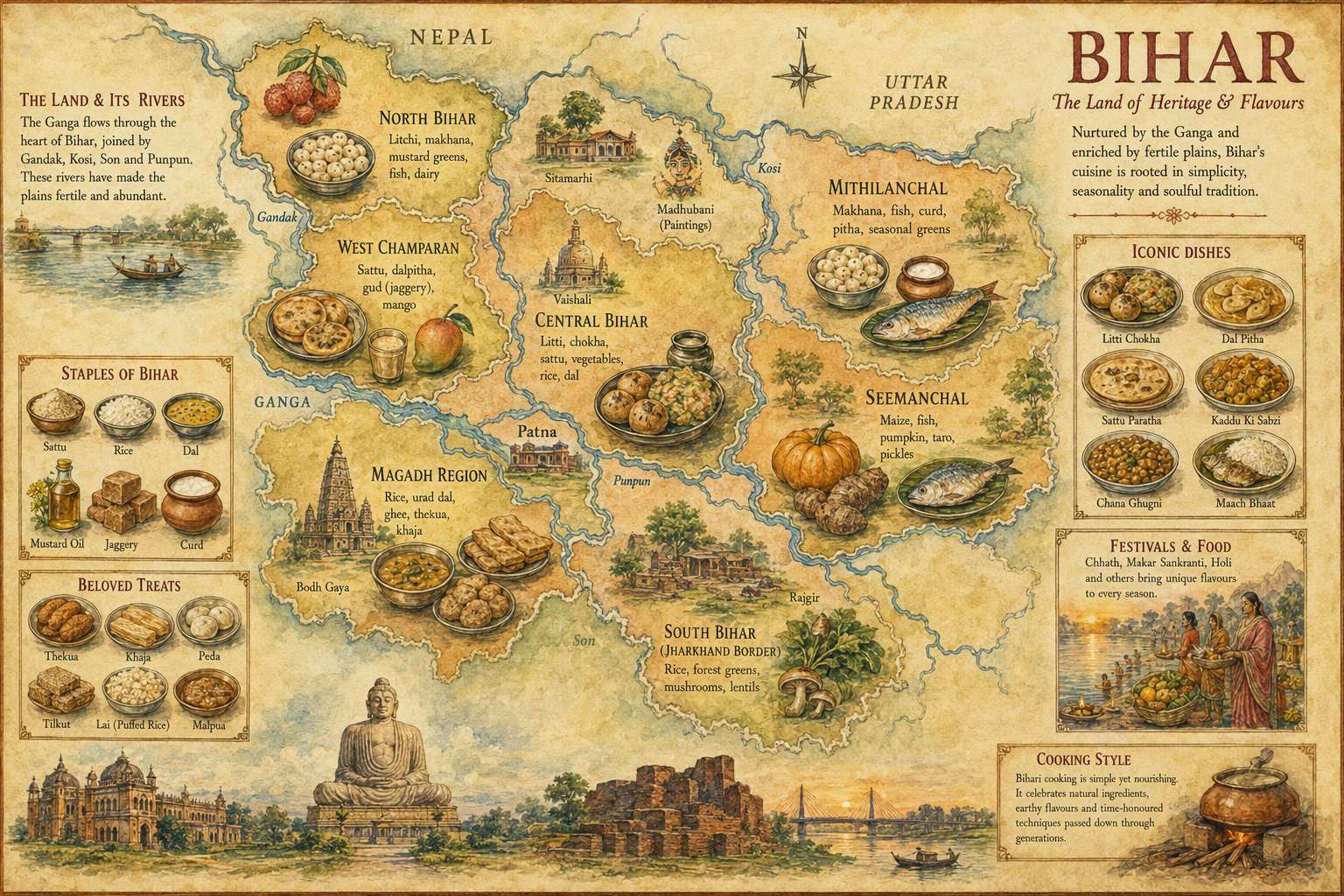
The geographic regions and food zones of Bihar Food Guide.
🗺
Geography & Climate
The land that made this food inevitable
The Ganges flows through Bihar from northwest to southeast, with its major tributaries (Son, Gandak, Kosi) creating an extraordinarily fertile alluvial plain. This fertility has supported continuous civilisation for 2,500+ years — and the food culture reflects that continuity. The preparation methods of Bihari cooking (open-fire baking, sattu as the primary travel food, the specific lentil traditions of the plain) are among the most ancient still in daily practice in India.
Sattu — roasted gram flour — is Bihar's defining ingredient. Chickpeas, barley, or mixed grains are dry-roasted then ground to a fine flour. Sattu is consumed as a sherbet (mixed with water, salt, lemon, and spices), as a stuffing for litti, as a flatbread, and as a complete meal mixed with raw mustard oil, onion, green chilli, and pickle. It requires no cooking. It stores indefinitely. It provides complete protein. It was the marching ration of the Maurya Empire's armies and is the daily food of Bihar's working poor today.
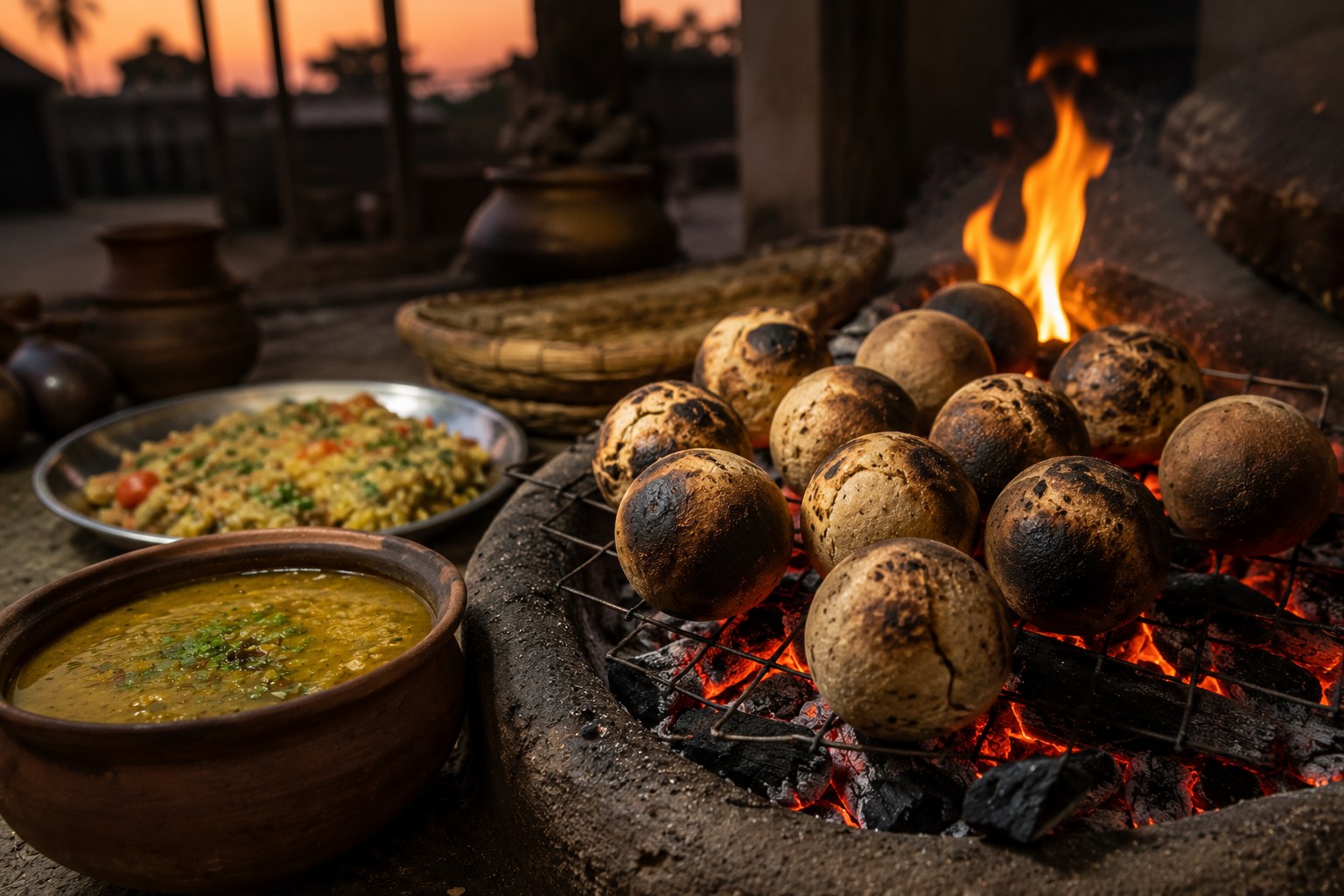
Litti chokha is Bihar's most celebrated preparation — wheat flour balls stuffed with spiced sattu filling, baked directly in the embers of a cooking fire (the same ember-baking method as Rajasthani baati, but with a specific sattu filling and specific flavour profile). The chokha is roasted and mashed vegetables (brinjal, tomato, potato) — the accompaniment that completes the preparation. Litti chokha has become Bihar's national food ambassador.
Why Bihar's Food Is Ancient
Bihar contains three of the most significant sites in world religious history: Bodh Gaya (where the Buddha attained enlightenment), Sarnath (where he delivered his first sermon), and Vaishali (associated with Mahavira and early Buddhism). Both the Buddha and Mahavira were born in what is now Bihar or the adjacent Terai, and both preached non-violence — which translated into the vegetarian dietary philosophy that spread from this region across Asia. The vegetarian food culture of Bihar is not merely a tradition — it is the direct descendant of the two most influential dietary reformations in world history, both beginning here 2,500 years ago.
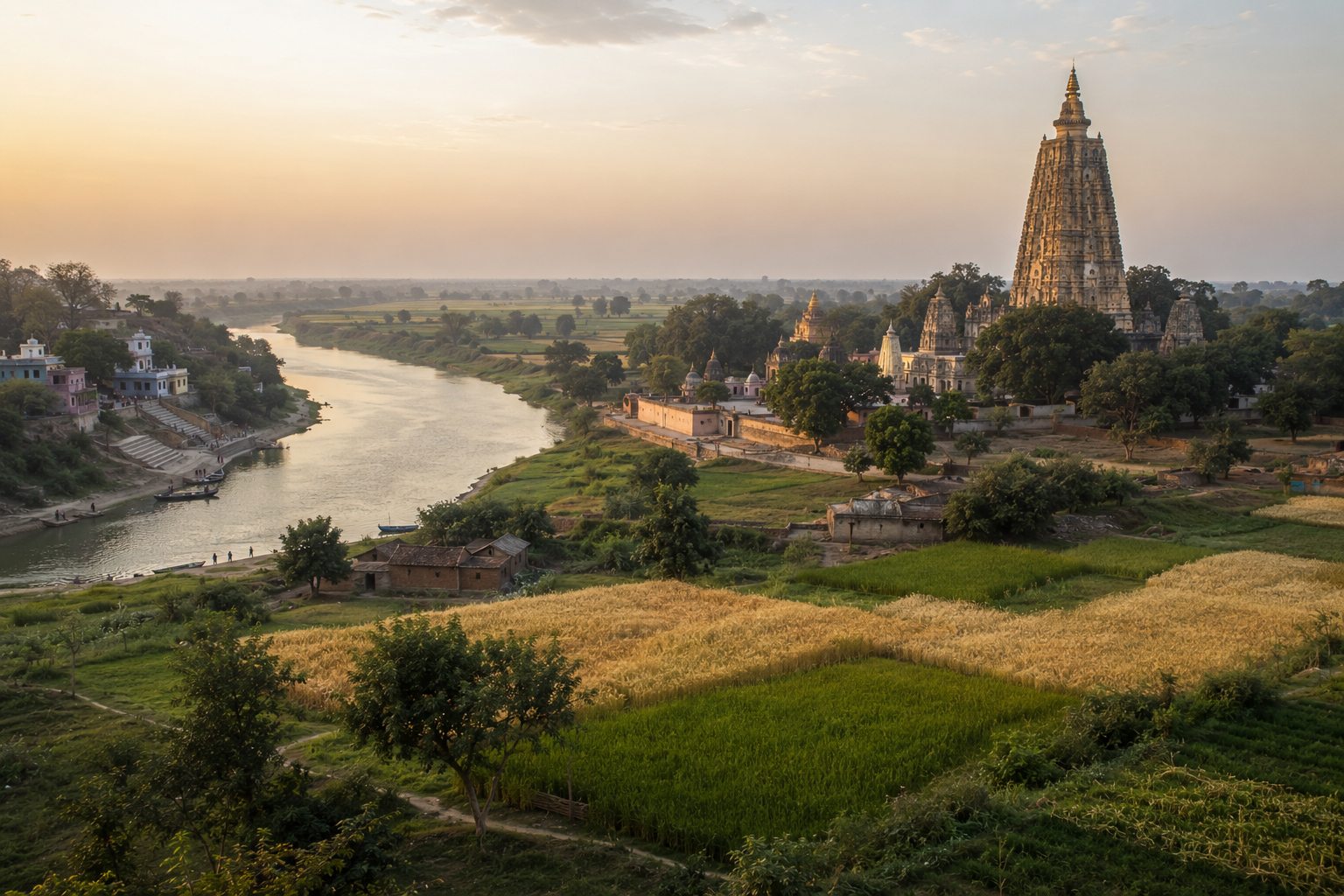
The terrain and agricultural landscape that produces the defining ingredients.
🧬
Food DNA
The flavour architecture
Grains and Bread
Litti — wheat ball with sattu filling, baked in embers — the Bihar identity food
Sattu — roasted gram flour — the ancient protein staple
Makhana (fox nuts) — from the Mithila region's ponds — Bihar's most distinctive produce
Legumes
Chana dal — chickpea lentil — the most-consumed lentil in Bihar
Toor dal — split pigeon pea — the daily meal standard
Chawal-dal — rice and lentil combination — the simple complete meal
Vegetables
Chokha — roasted and mashed vegetables — the litti accompaniment
Aloo (potato) — central to chokha and multiple preparations
Bitter gourd — specific Bihar preparations with mustard
Bihar-specific
Makhana (lotus seeds) — the Mithila delicacy — used in kheer and dry-roasted as snack
Thekua — wheat and jaggery deep-fried biscuit — the Chhath Puja offering
Tilkut — sesame and jaggery sweet — specific to Gaya and Patna
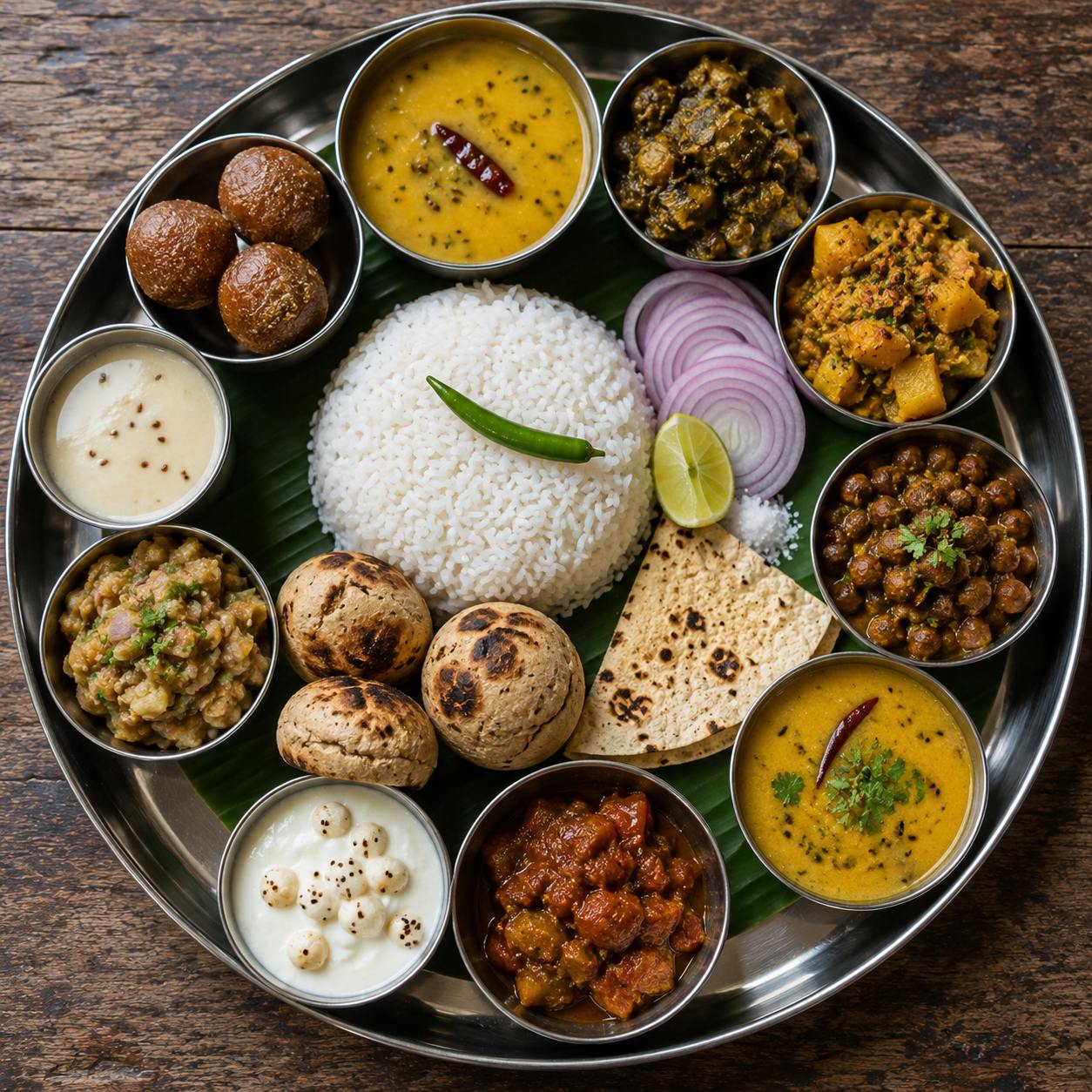
A complete thali representing the full flavour range.
🎉
Festival Foods
When the calendar drives the kitchen
Chhath Puja
The most important Bihar festival — Chhath prasadam (thekua, rice kheer, fruits) offered to the setting and rising sun. The most water-intensive festival food ritual in India.
Makar Sankranti
Tilkut and til-gur preparations — sesame and jaggery as the harvest festival sweet.
Ram Navami
Sattu preparations and specific Ram Navami bhog — the Hindu festival food tradition.
Sarhul
The tribal Jharkhand-Bihar spring festival — fermented rice drink (handia) and specific tribal food traditions.
Diwali
Kheel (puffed rice) and makhana kheer — Bihar's specific Diwali food tradition.
🌍
Diaspora & Reach
How this cuisine spread beyond its borders
The Bihari diaspora — significant in Mauritius (where Bihari indentured labourers went from the 1830s), Fiji, Trinidad, and Suriname — maintained their food traditions over 150+ years. Mauritius Hindi and Bhojpuri communities maintain Bihari food traditions that are more conservative than what is practised in Bihar today.
Within India, the Bhojpuri-speaking diaspora (a significant portion of Bihar and eastern UP) has made litti chokha and sattu nationally known through migration to Delhi, Mumbai, and the Gulf states.
Litti chokha is Bihar's defining preparation — wheat dough balls stuffed with spiced sattu (roasted gram flour) filling, baked directly in the embers of a fire. The chokha is roasted and mashed vegetables (brinjal, tomato, potato) as the accompaniment. Eaten together with ghee and pickle.
What is sattu?
Sattu is roasted gram flour — chickpeas, barley, or mixed grains dry-roasted then ground to flour. Consumed as a sherbet, as the litti filling, mixed raw with oil and pickle as a complete meal. No cooking required. Stores indefinitely. The ancient high-protein staple of the Gangetic plain and the marching ration of the Maurya Empire.