★★★★★ Mughlai biryani tradition
★★★☆☆ North India
What Does Shahi Jeera Taste Like?
Shahi Jeera in Every Indian Language
| Language | Name | Pronunciation |
|---|---|---|
| English | Black Cumin / Royal Cumin | BLAK KYOO-min |
| Hindi | शाही जीरा — Shahi Jeera | SHA-hee JEE-rah |
| Bengali | কালো জিরা — Kalo Jira | KAH-lo JEE-rah |
| Tamil | கருஞ்சீரகம் — Karunjeeragam (same as nigella) | KAH-run JEE-rah-gum |
| Telugu | నల్ల జీలకర్ర — Nalla Jeelakarra | NAH-lah JEE-lah-kah-rah |
| Malayalam | കരിന്ജീരകം — Karinjeerakam | KAH-rin JEE-rah-kum |
| Kannada | ಕರಿಜೀರಿಗೆ — Karijeerige | KAH-ree JEE-ree-geh |
| Gujarati | શાહ જીરૂ — Shah Jeeru | SHAH JEE-roo |
| Marathi | शहा जिरे — Shaha Jire | SHA-hah JEE-reh |
| Punjabi | ਕਾਲਾ ਜੀਰਾ — Kala Zeera | KAH-lah ZEE-rah |
| Urdu | شاہ زیرہ — Shah Zeera | SHAH ZEE-rah |
| Sanskrit | कृष्णजीरक — Krishnajiraka | KRISH-nah JEE-rah-kah |
What Is Shahi Jeera?
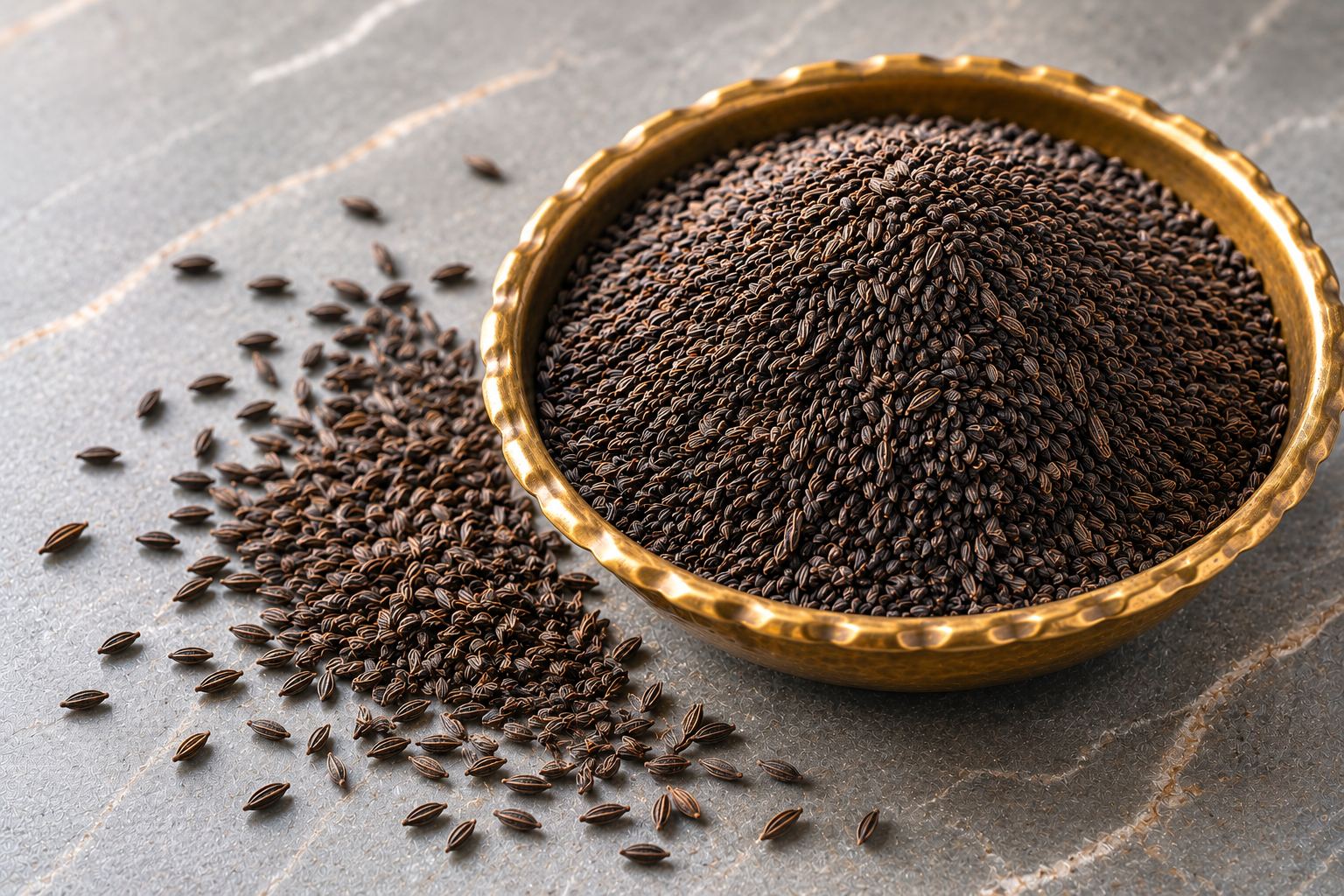
Shahi jeera — black cumin — is the seed of Bunium persicum, a plant native to the Himalayan foothills and Central Asia. It is critically different from both regular cumin (Cuminum cyminum) and nigella seeds (Kalonji) — three completely different plants that share confusingly similar common names. Shahi jeera seeds are thinner, darker, and more curved than regular cumin, with a dramatically more intense, smoky-earthy flavour at roughly 2–3x the aromatic strength of regular cumin.
Shahi jeera's primary culinary home is Mughlai biryani and Kashmiri cooking — the 'royal' (shahi) in its name reflects its historical association with Mughal court cuisine. In regular everyday Indian cooking across most of the country, regular cumin replaces it — shahi jeera is a premium, specific-use spice rather than a pantry staple.
- Mughlai biryani's distinctive, intensely earthy depth comes from shahi jeera added to the cooking ghee alongside other whole spices — regular cumin does not produce the same result
- Kashmiri yakhni (yogurt-based lamb curry) uses shahi jeera as one of its defining spices — the smoky-earthiness is characteristic
- The 'royal' character of Mughlai cooking — the sense of concentrated, layered flavour — depends significantly on shahi jeera's intensity
- Without shahi jeera, Kashmiri cooking loses a specific aromatic layer that regular cumin cannot replicate
- The naming confusion between shahi jeera, regular jeera, and kalonji is one of Indian cooking's most persistent identification problems — getting it right matters for authentic recipes
Shahi Jeera Through History
Shahi jeera has been cultivated in the Himalayan regions — particularly Kashmir and Himachal Pradesh — for centuries. The 'shahi' (royal) designation comes from its Mughal court association: the imperial kitchen used black cumin for specific preparations where regular cumin's milder profile was insufficient. The name reflects the spice hierarchy of Mughal cuisine, where more intensely flavoured, less commonly available spices were associated with royal cooking.
In Kashmir, shahi jeera grows wild and cultivated in the high-altitude regions, where it is known as kash zeera or shah zeera. Its presence in Kashmiri yakhni, roghan josh, and other traditional preparations dates back centuries, predating Mughal influence in the region.
The Science of Shahi Jeera
How to Store Shahi Jeera
How to Buy Good Shahi Jeera
How to Use Shahi Jeera Correctly
- Biryani: add 1/2 tsp to hot ghee at the very start alongside cardamom, cloves, and cinnamon
- Use half the quantity of regular cumin — it is significantly more intense
- For Kashmiri yakhni: add whole seeds to hot ghee at the start
- For special garam masala: dry-roast and grind as one component
- Quantity: 1/4 to 1/2 tsp per dish for 4 — not a direct 1:1 replacement for regular cumin
- Can be combined with regular cumin for a biryani that benefits from both
What Shahi Jeera Pairs Well With
Dishes That Use Shahi Jeera
Where Shahi Jeera Matters Most
| Kashmiri Cuisine | Essential |
| Mughlai Cuisine | Essential |
| North Indian Cuisine | Common |
| Biryani Tradition | Essential |
| South Indian Cuisine | Rare |
| Jain Cooking | Occasional |
Shahi Jeera vs Regular Cumin vs Nigella Seeds
| Feature | Shahi Jeera (Black Cumin) | Regular Cumin (Jeera) | Nigella Seeds (Kalonji) |
|---|---|---|---|
| Botanical name | Bunium persicum | Cuminum cyminum | Nigella sativa |
| Family | Apiaceae | Apiaceae | Ranunculaceae |
| Colour | Dark brown-black | Pale brown | Jet black |
| Shape | Thin, curved | Ridged, straight | Teardrop, rough |
| Flavour | Intense earthy, smoky | Earthy, warm | Onion-oregano, bitter |
| Culinary use | Biryani, Kashmiri cooking | Universal tadka | Panch phoron, naan |
| Intensity | Very high — use less | Medium | High |
| Interchangeable? | Partially with cumin | Partially with shahi jeera | Not with either |