Series 1 · The Chronological Story · Chapter 7 of 17
Birth of
Vegetarian Traditions
How Philosophy, Agriculture and Society
Shaped India's Plant-Based Food Culture
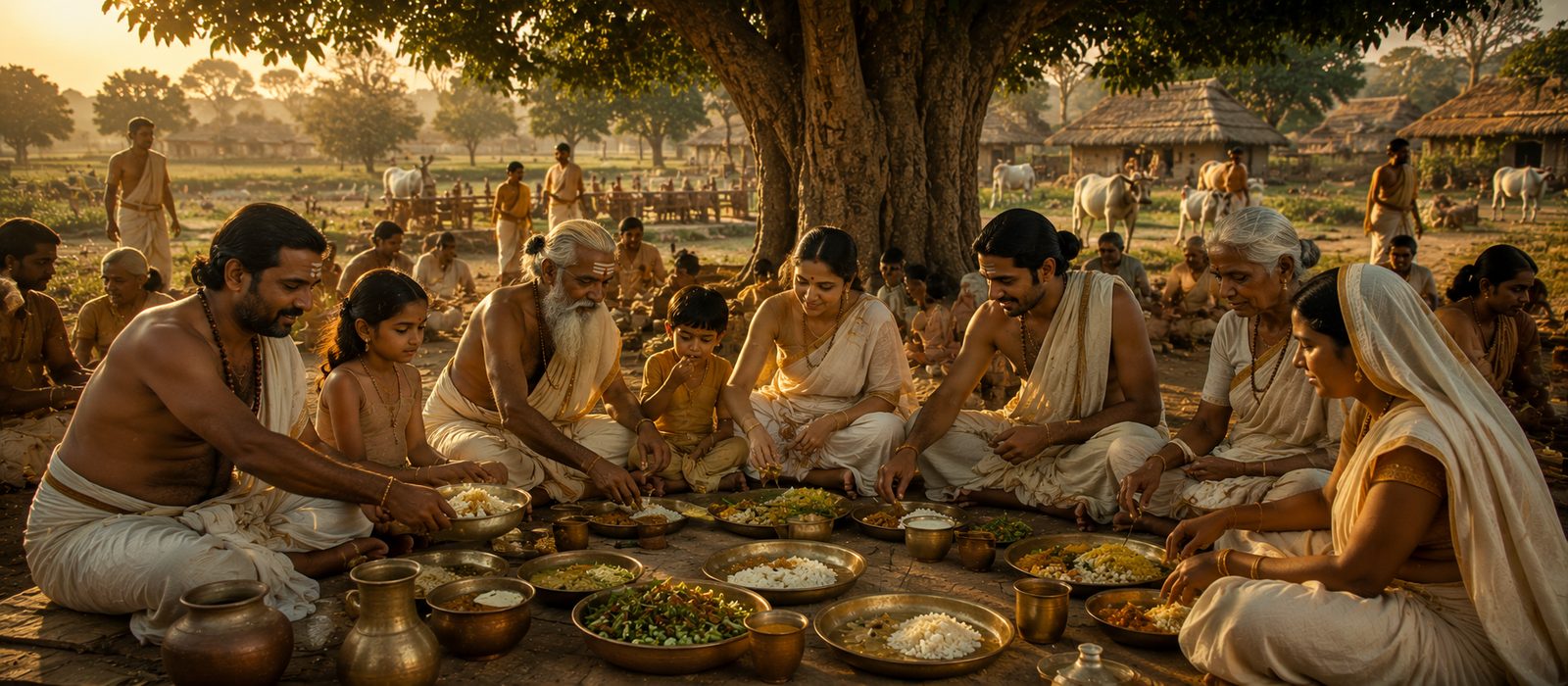
Artist's reconstruction based on historical evidence
How Philosophy, Agriculture and Society
Shaped India's Plant-Based Food Culture
Artist's reconstruction based on historical evidence
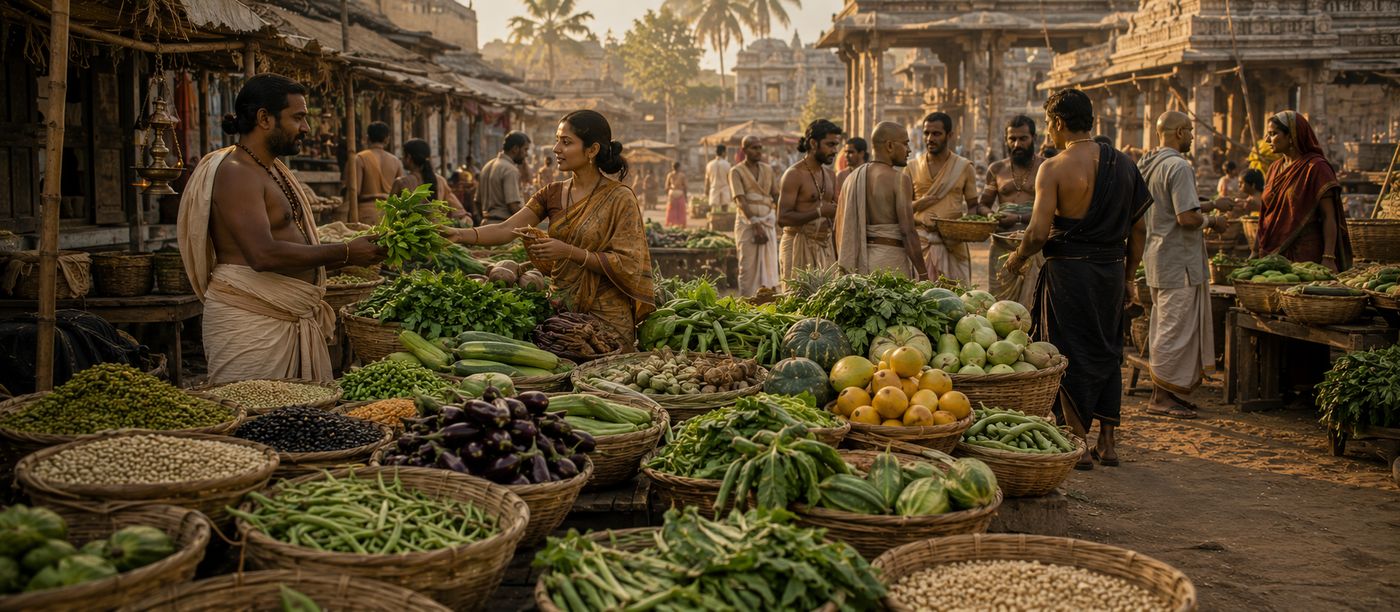
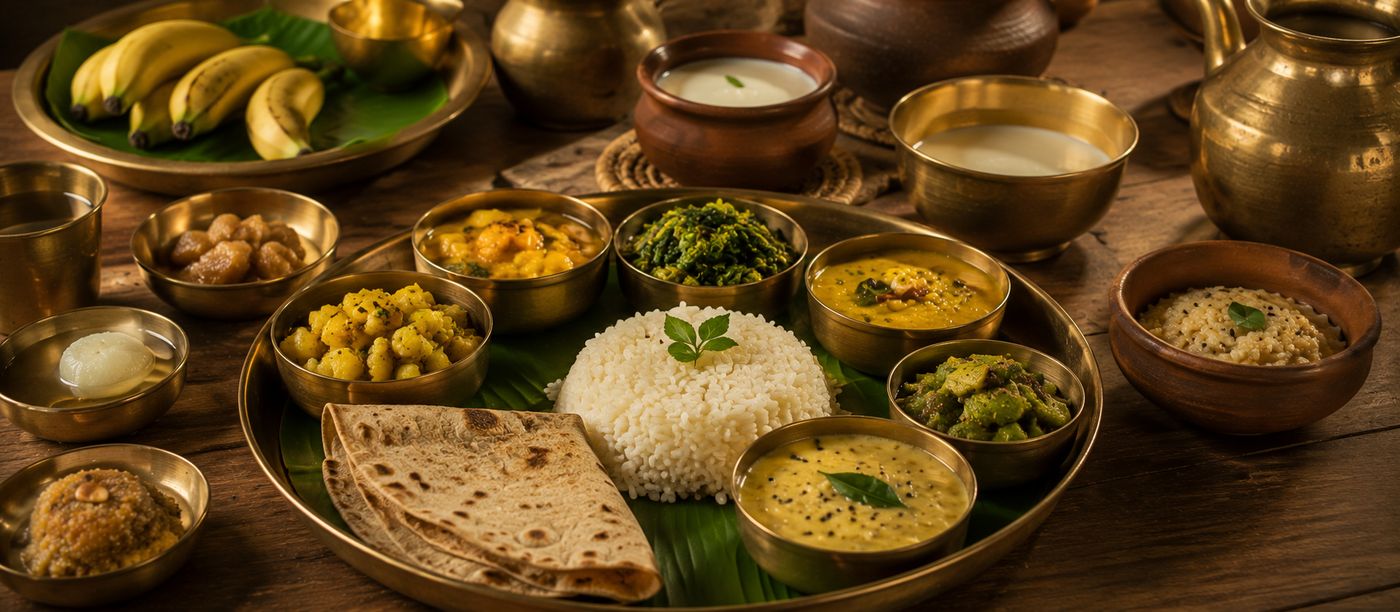
Walk through an Indian city today and vegetarian food seems to be everywhere. Temples serve vegetarian meals. Families follow vegetarian traditions passed down for generations. Entire regional cuisines — Rajasthani, Gujarati, much of South Indian cooking — are built almost entirely around plants. But this food culture did not appear overnight. It emerged through centuries of philosophical debate, religious reform, agricultural development, and culinary adaptation. The story of Indian vegetarianism is far more complex, contested, and interesting than the assumption that India was always this way.
 🔍 Click to enlarge
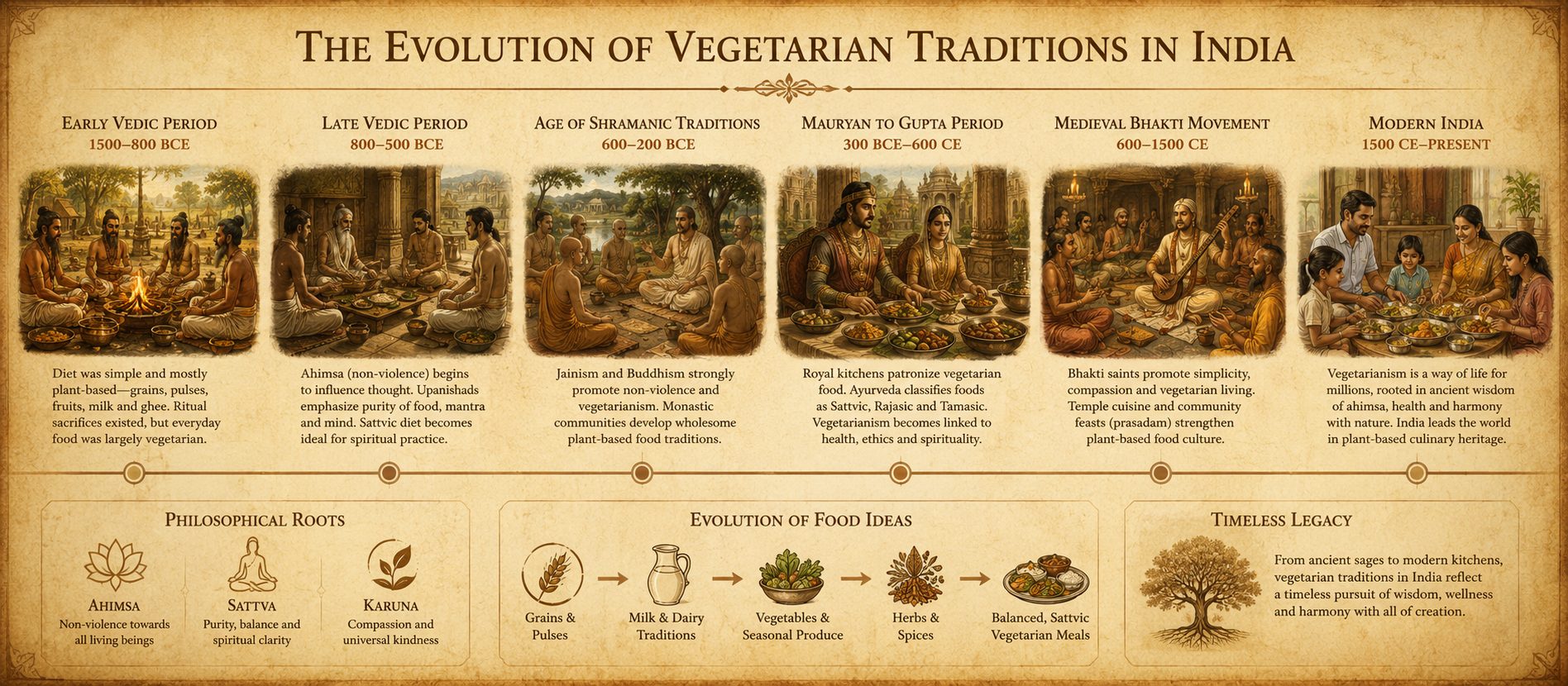
The single most important thing to understand about Indian vegetarianism is that it was not the default. The Vedic texts — the earliest documents of Indian food culture — describe a society where cattle, sheep, goats, and horses were slaughtered for ritual purposes and almost certainly consumed. The Rigveda describes the preparation of meat at specific ceremonies. The Mahabharata contains detailed descriptions of meat eating at feasts. Early Buddhist texts describe the meals offered to monks, which sometimes included meat.
This is not a minor qualification. It is a fundamental corrective to the popular narrative that vegetarianism is the primordial Indian food tradition, merely maintained against outside pressure. The historical evidence suggests the opposite: vegetarianism was a developed philosophical position that spread gradually, through specific religious and social mechanisms, over several centuries. Understanding this history makes both the achievement of Indian vegetarian cooking and its current status more remarkable, not less.
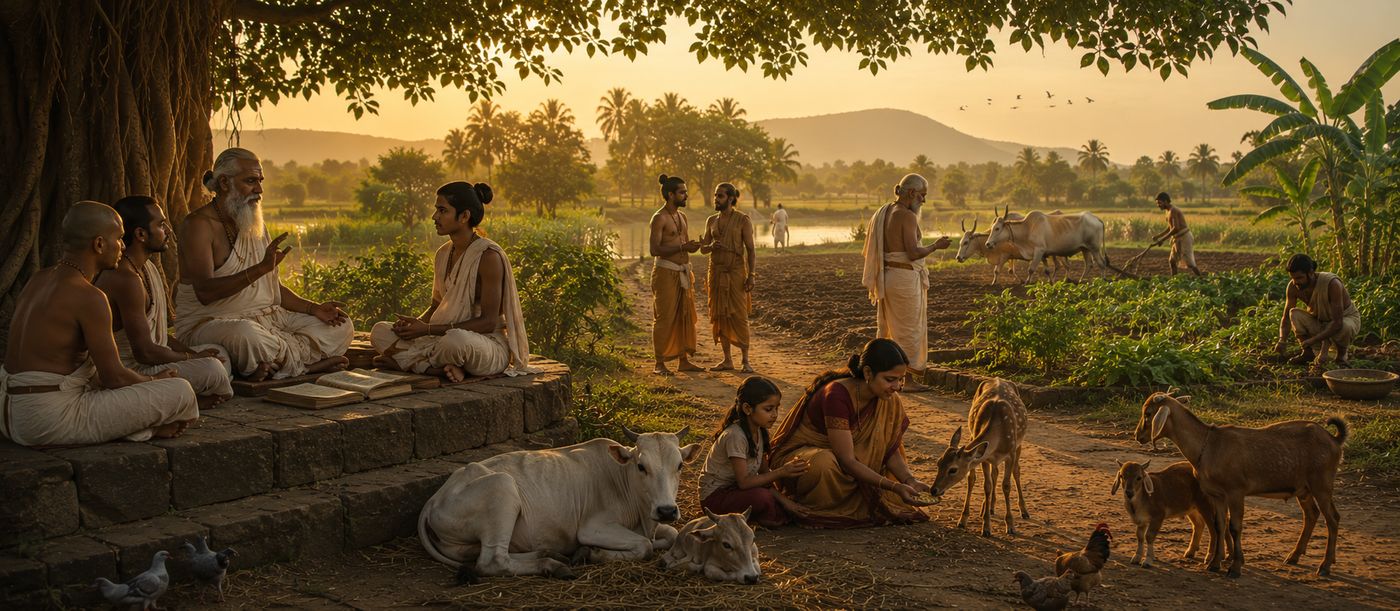
The philosophical concept that drove the spread of vegetarianism in India is ahimsa — non-violence, or more precisely, the principle of not causing harm to living beings. Ahimsa is older than either Buddhism or Jainism; it appears in early Upanishadic thought and is likely rooted in even older traditions. But it is in the Jain and Buddhist movements of the 6th century BCE that ahimsa becomes a systematic food ethic with practical consequences.
The critical move is the extension of moral concern from humans to animals. If causing suffering to a sentient being is ethically problematic — and this is what ahimsa claims — then killing animals for food becomes an ethical problem, not merely a ritual one. This is a genuinely radical philosophical position in its historical context, and it required a revolution in thinking about what counts as morally relevant suffering.
Jainism, Buddhism, and the reforming Brahmanical traditions all provided philosophical frameworks that made vegetarianism not just permissible but morally superior. In a society where religious authority had enormous social weight, religious endorsement of vegetarianism was a powerful driver of adoption across social classes. The competitive dynamic between these traditions — each seeking to demonstrate superior purity and ethics — also drove escalating vegetarian commitments.
The intensification of settled agriculture created a new economic calculus for cattle. A plough ox that is kept alive can cultivate twenty acres a year. A dairy cow that is kept alive produces milk, curds, and ghee worth far more annually than her slaughter value. As agricultural productivity became the primary basis of wealth, the living animal became more economically valuable than the slaughtered one. Religious prohibition and economic calculation aligned.
Urban populations depend on food markets rather than direct production. In a market system, plant-based foods are generally cheaper and more reliably available than meat. The urbanisation that the Mauryan and Gupta periods accelerated created large populations for whom vegetarianism was not only philosophically appealing but practically convenient and economically rational.
The Gangetic plain — the agricultural heartland of India — supported intensive grain and pulse cultivation. Its ecology was not suited to extensive pastoral meat production at the scale that its population required. A predominantly plant-based diet was not a sacrifice on the Gangetic plain: it was a rational response to what the land could reliably produce.
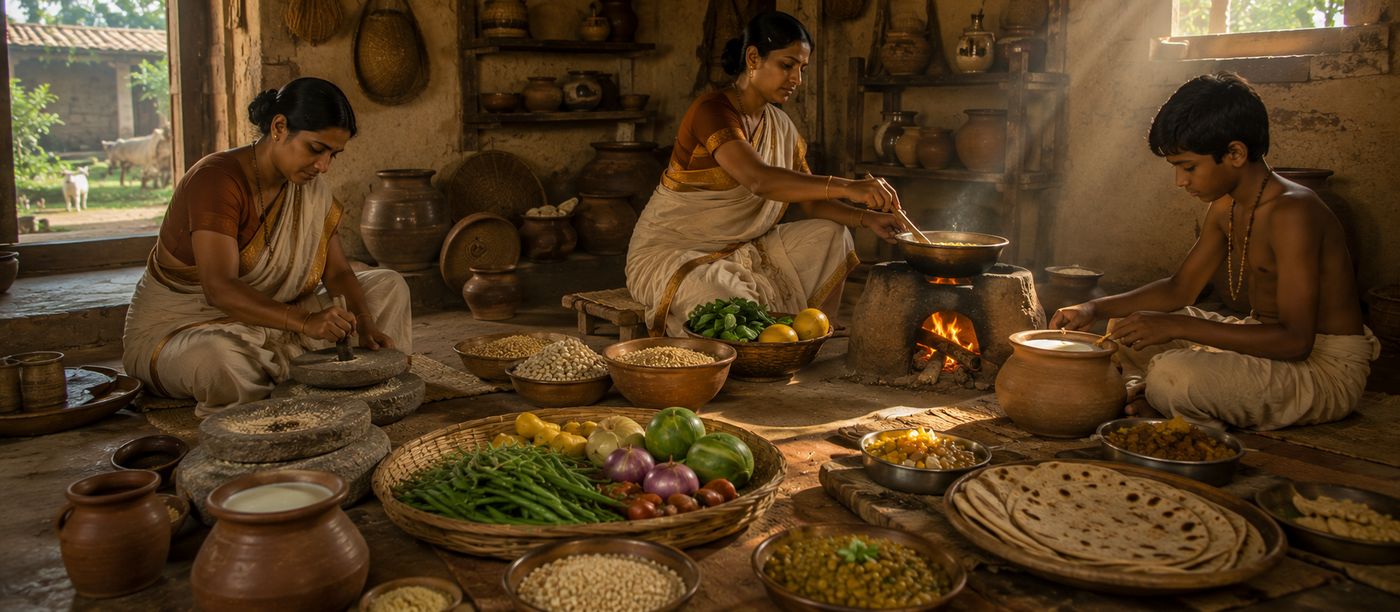
The most underappreciated achievement in Indian food history is not a single dish or a single tradition. It is the systematic, centuries-long development of a culinary system that could produce nutritionally complete, gastronomically satisfying, culturally rich food entirely from plant sources — at a time when no other food culture had attempted this at population scale.
The challenge was real. Meat is a complete protein, a rich source of fat, and a concentrated source of flavour. Removing it from a food system that has relied on it creates nutritional gaps (complete protein, specific amino acids, vitamin B12, iron, zinc) and flavour gaps (the Maillard reaction products of meat browning, the fat-soluble aromatic compounds of animal fat). The Indian vegetarian culinary tradition solved both problems — through specific food combinations, specific cooking techniques, and a level of spice sophistication that no other tradition has matched.
The protein solution was grain-plus-pulse. Rice or wheat with dal provides all essential amino acids in sufficient quantities. This is the same nutritional logic the Indus Valley established four thousand years earlier, now deployed as the conscious foundation of a vegetarian dietary system. The fat solution was ghee, sesame oil, and coconut oil — providing the richness and fat-soluble flavour compounds that animal fat had supplied. The flavour solution was spice — the most complex, diverse, and systematically developed spice tradition in the world, which provided the aromatic intensity that meat cooking provides through other means.
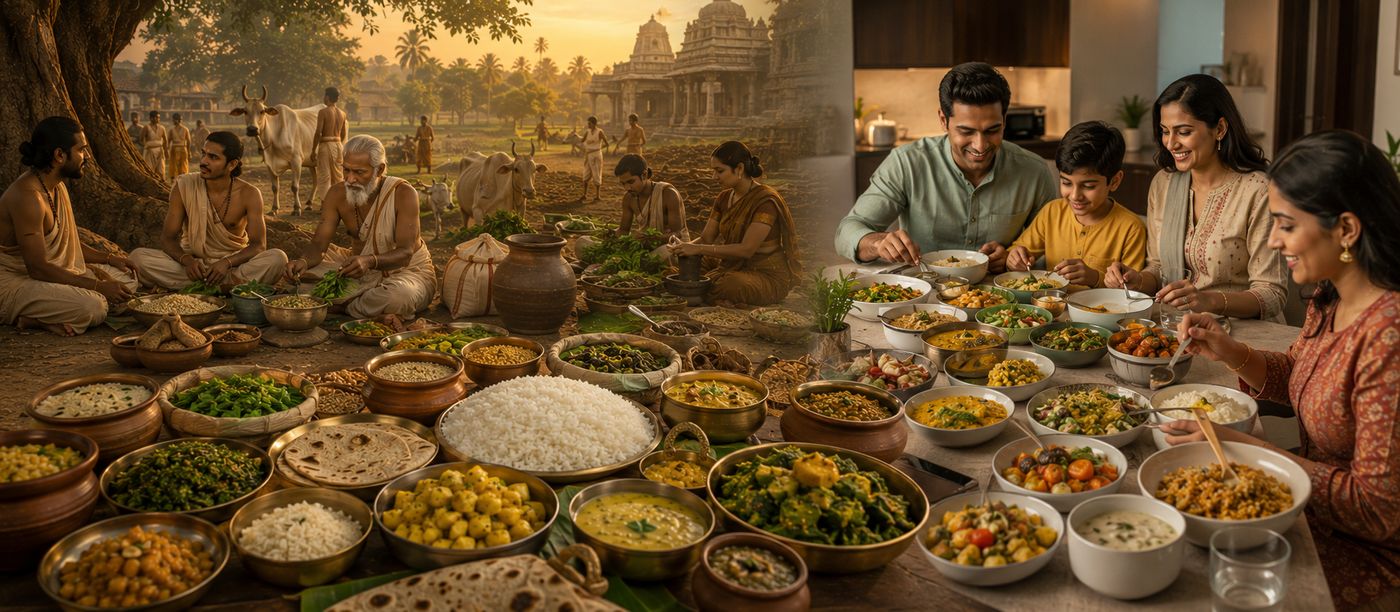
The grain-and-pulse combination that forms the foundation of Indian vegetarian eating is a scientifically elegant solution to the protein completeness problem. Proteins are made of amino acids, nine of which are "essential" — meaning the human body cannot synthesise them and must obtain them from food. Animal proteins contain all nine in sufficient quantities; most plant proteins are deficient in at least one.
Wheat and rice are low in lysine but adequate in methionine. Lentils and chickpeas are high in lysine but low in methionine. Combined in a meal, they provide all nine essential amino acids at adequate levels — a "complete" protein equivalent in nutritional quality to animal protein. This is the science behind dal-roti and dal-chawal: two plant foods whose amino acid profiles complement each other precisely.
The timing question: Modern nutritional science establishes that the complementary proteins in a grain-pulse combination do not need to be eaten at exactly the same meal — the body maintains an amino acid pool that can compensate for a few hours' offset. But the traditional practice of eating grain and dal together at every meal provides a margin of safety that more than covers this flexibility. The ancient solution was correct even if the mechanism was empirically rather than scientifically derived.
Vitamin B12 — essential for neurological function and blood formation — is not reliably present in plant foods. This is the most significant nutritional challenge for strict vegetarians. The traditional Indian solution was not a conscious one: it was a side effect of food fermentation and traditional food preparation methods. Fermented foods produced in traditional clay vessels and traditional kitchen environments can contain B12-producing bacteria. The residual use of unsterilised vessels, the consumption of small amounts of insects in traditionally stored foods, and the use of fermented preparations together appear to have provided adequate B12 in traditional vegetarian Indian diets in ways that modern strictly hygienic plant-based diets do not replicate.
Because India has the world's largest vegetarian population — approximately 300-400 million people — and the world's most sophisticated vegetarian culinary tradition. Neither of these facts was inevitable. They are the result of specific historical processes, philosophical arguments, economic conditions, and culinary innovations that unfolded over a period of more than a thousand years.
Understanding this history changes how you see Indian vegetarian cooking. Every technique developed to make plant-based food satisfying, every spice combination designed to provide aromatic depth without meat, every dal preparation engineered to provide complete protein alongside grain — these are not arbitrary cultural practices. They are solutions to specific problems, developed through centuries of practical and philosophical work. The Indian vegetarian tradition is one of humanity's great culinary achievements — and it was earned, not inherited.
| c. 500 BCE – 500 CE | Modern India |
|---|---|
| Vegetarianism as philosophical position, spreading gradually | ~30% of Indians vegetarian — world's largest vegetarian population, the result of 2,500 years of philosophical and cultural development |
| Dal-rice as vegetarian protein solution | Dal-chawal still the most eaten meal in India — the same nutritional logic, now understood scientifically |
| Jain, Buddhist, Brahmin traditions as distinct food ethics | Each tradition still active with distinct food practices — Jain communities, Buddhist monasteries, Brahmin households all maintaining specific traditions |
| Spice development to compensate for absent meat flavour | India's spice tradition — the world's most complex — is partly the legacy of this period's requirement to make plant-based food as satisfying as meat-based food |