Series 1 · The Chronological Story · Chapter 9 of 17
Buddhist Food
Traditions
Moderation, Travel and the Spread
of Culinary Ideas Across Asia
Artist's reconstruction based on historical evidence
Moderation, Travel and the Spread
of Culinary Ideas Across Asia
Artist's reconstruction based on historical evidence
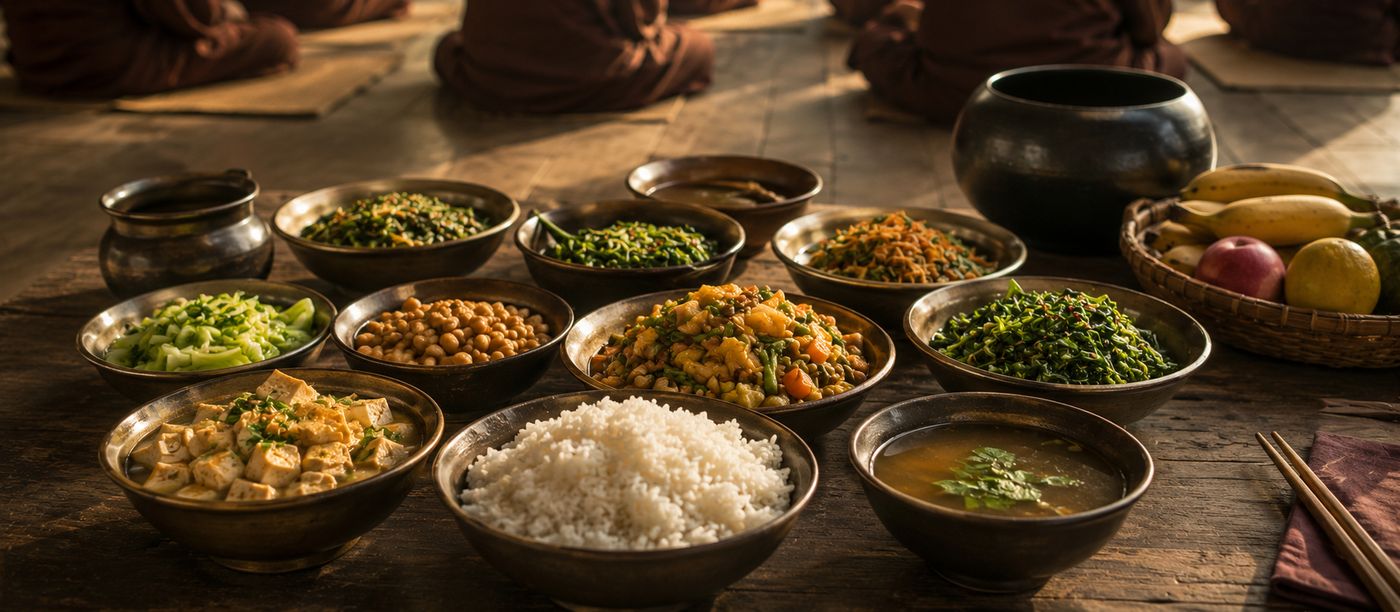
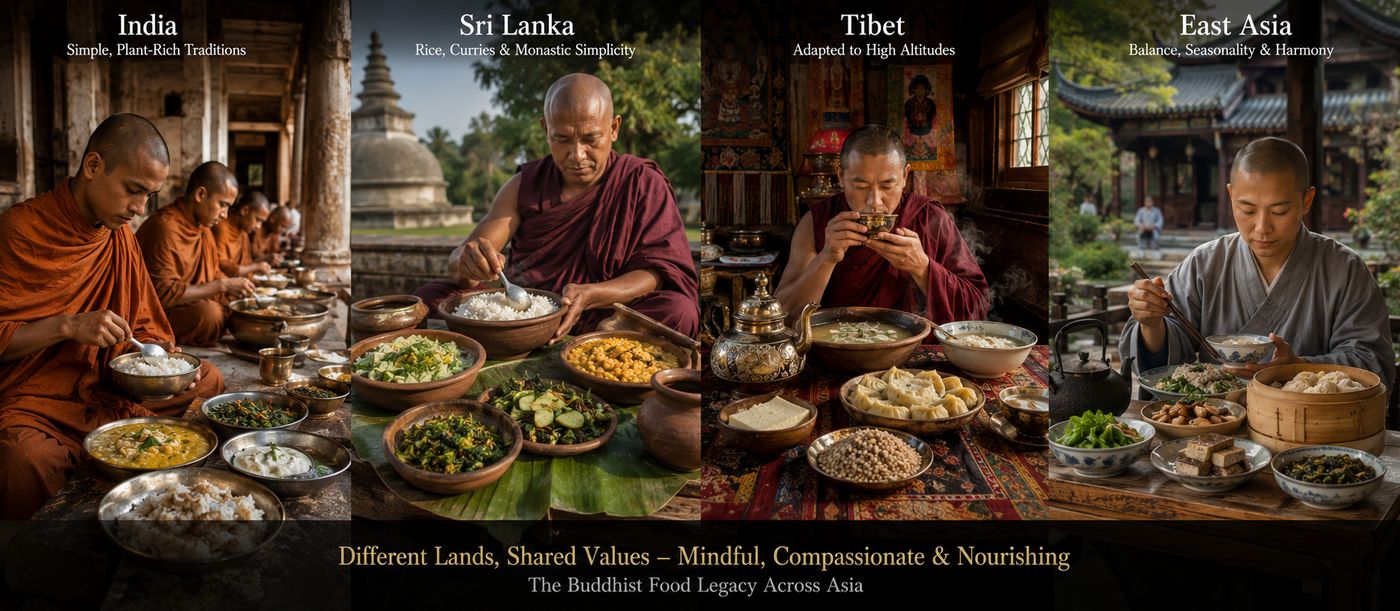
Food travelled with monks. As Buddhism spread from its origins in the Gangetic plain of northern India across the length and breadth of Asia — into Sri Lanka and Southeast Asia to the south, through Central Asia and China to the north, into Korea, Japan, and Tibet — cooking traditions, specific ingredients, and food philosophies travelled with it. The result, over a period of more than two thousand years, was one of history's greatest culinary exchanges. The vegetable-forward cuisine of Japanese Buddhist temples, the specific use of tofu in Chinese monastic cooking, the rice-and-vegetable traditions of Southeast Asian Buddhist communities — all have roots in Indian food ideas that Buddhist missionaries carried with them.
The Buddha's approach to food was shaped by his own experience. Before his enlightenment, Siddhartha Gautama practiced severe asceticism — including extreme food restriction — and found it spiritually unhelpful. The near-starvation that he endured did not produce enlightenment; it produced weakness and distraction. After his enlightenment, he formulated the Middle Way: neither the indulgence of sensual pleasure nor the self-mortification of extreme asceticism, but a balanced, moderate path that supported both physical and mental wellbeing.
Applied to food, the Middle Way produced a distinctive food philosophy. Food was not to be pursued for pleasure — eating for the mere enjoyment of taste was a form of attachment. But food was also not to be denied beyond what the body needed for health and meditation — self-starvation was a form of ego-attachment to an idea of purity. The purpose of eating was simply to sustain the body in a condition that supported the practice of meditation and the pursuit of enlightenment. No more and no less.
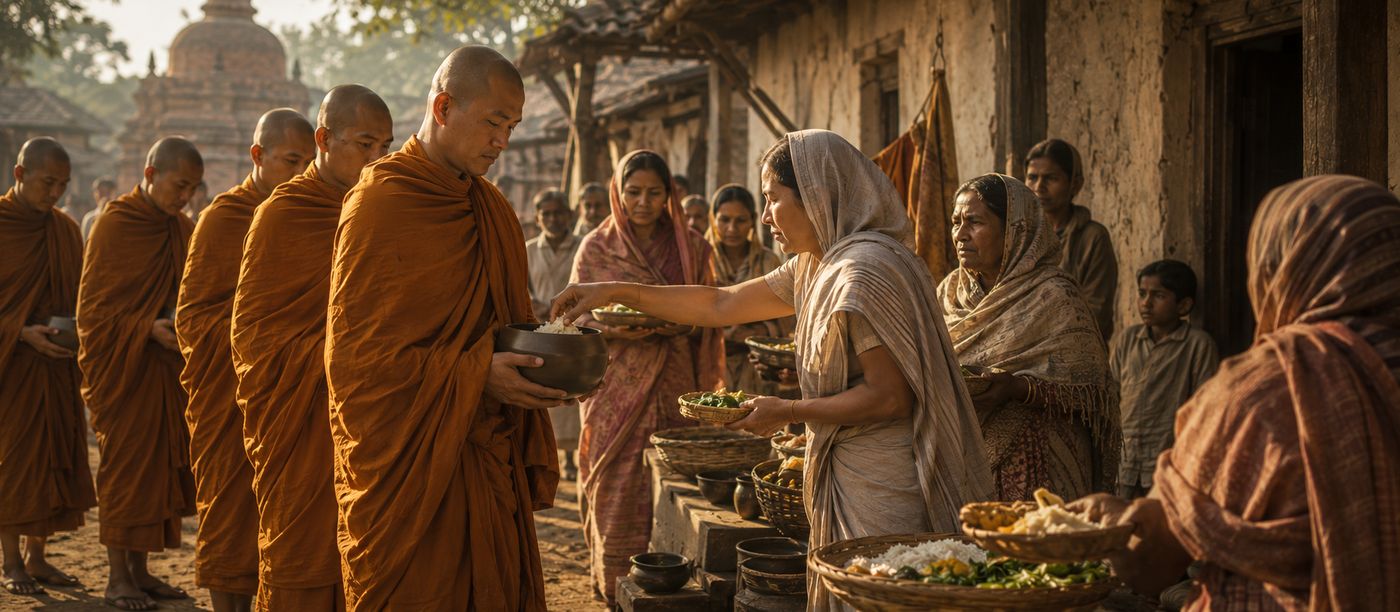
This philosophy has specific practical consequences that distinguish Buddhist food culture from both the Jain tradition (which emphasises restriction) and the Brahmanical tradition (which emphasises purity). For Buddhists, food received as alms is appropriate regardless of its content — rejecting offered food is a form of pride. Eating mindfully, without attachment to taste, is the practice. The content of the food matters less than the state of mind with which it is received and consumed.
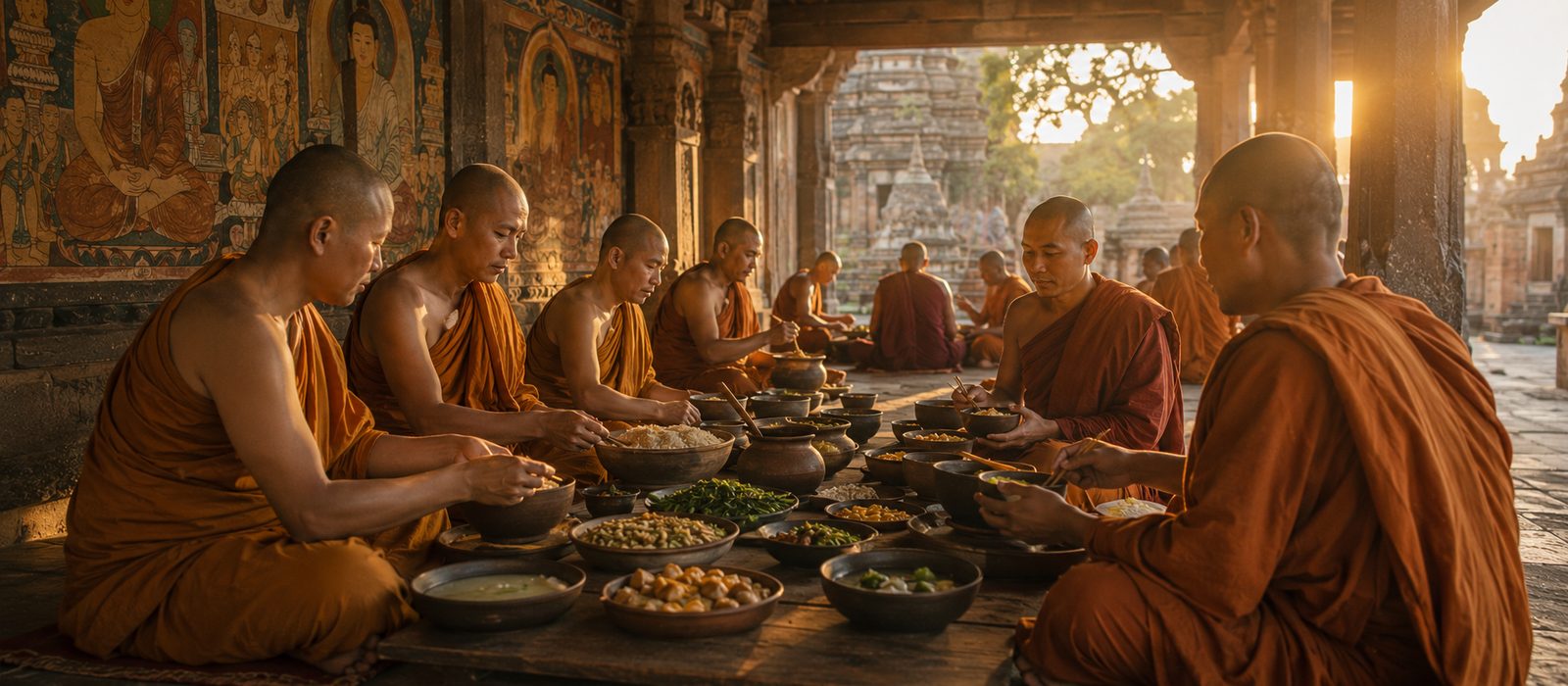
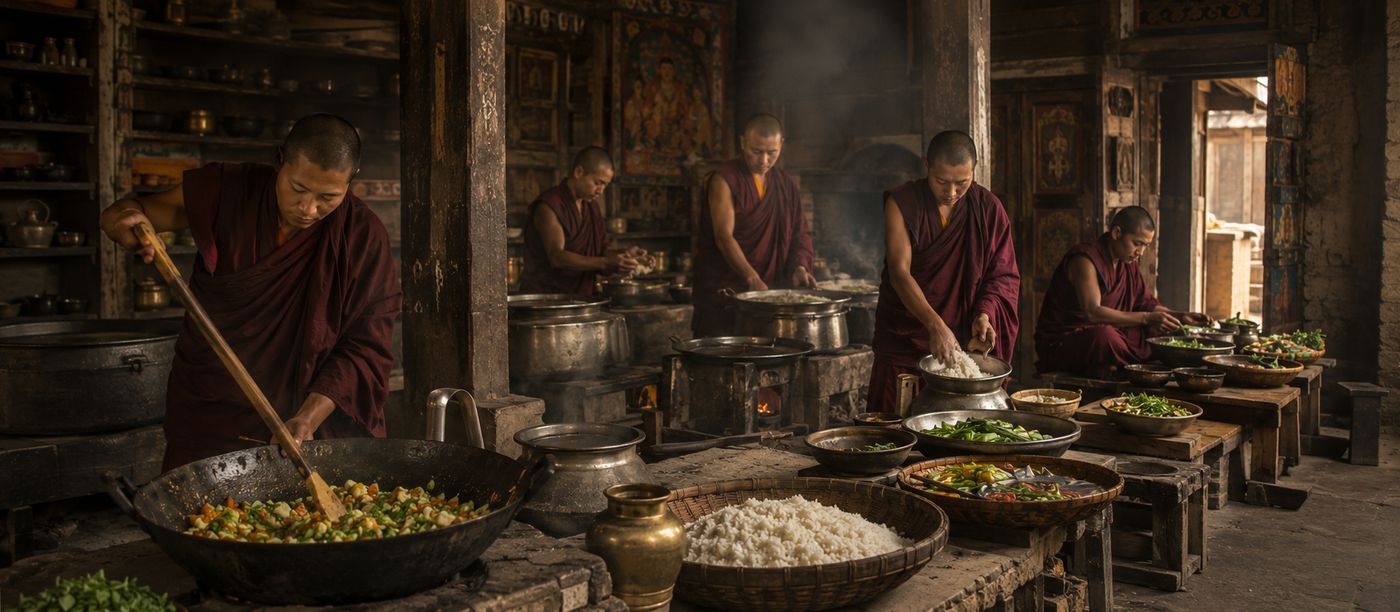
The Vinaya Pitaka — the section of the Pali Canon governing monastic discipline — contains detailed provisions about food. These rules shaped the eating practices of hundreds of thousands of Buddhist monks across Asia for more than two thousand years. They are extraordinarily specific, and they created a distinctive food culture that left traces in every country where Buddhism established itself.
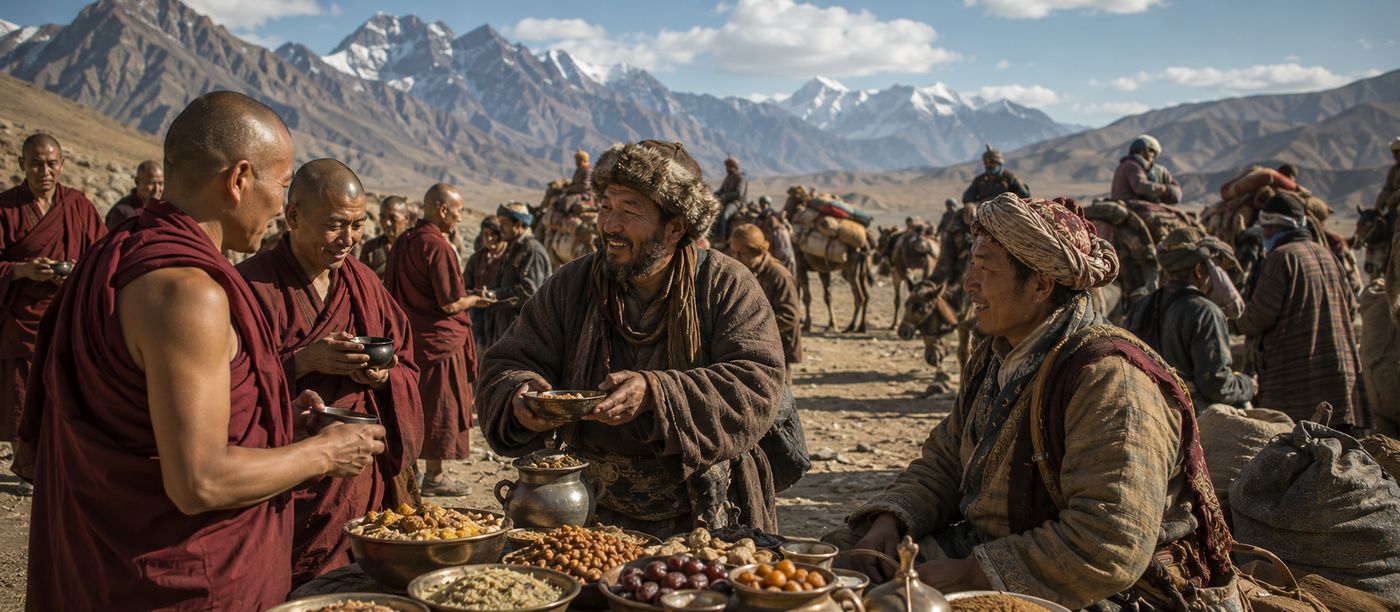
The Silk Road was not primarily a road. It was a network of trade routes connecting the Mediterranean world to China, passing through Central Asia, with India connected at multiple points through maritime and overland branches. Along these routes moved silk, spices, precious stones, horses, ideas, religions — and food. Buddhist monasteries were nodes in this network: rest stops for travellers, repositories of knowledge, and points of cultural exchange.
Monks who made the arduous journey from India to Central Asia and China did not travel empty-handed. They carried texts, obviously. But they also carried seeds, dried spices, medicinal herbs, food knowledge, and cooking techniques. Chinese Buddhist monk-pilgrims like Xuanzang (7th century CE) and Yijing (7th-8th century CE) who travelled to India and back left detailed accounts not only of Buddhist sites but of Indian food culture — the specific preparations, the ingredients, the eating customs they encountered. These accounts are among the most valuable food history documents of the ancient world.
Indian spices — pepper, cardamom, ginger, turmeric — moved westward and northward along the Silk Road in significant quantities. Buddhist monasteries in Central Asia and China received Indian spice donations and incorporated them into monastic cooking. The specific spice palate of some East Asian Buddhist vegetarian cuisines still shows the influence of Indian spice knowledge transmitted through this route.
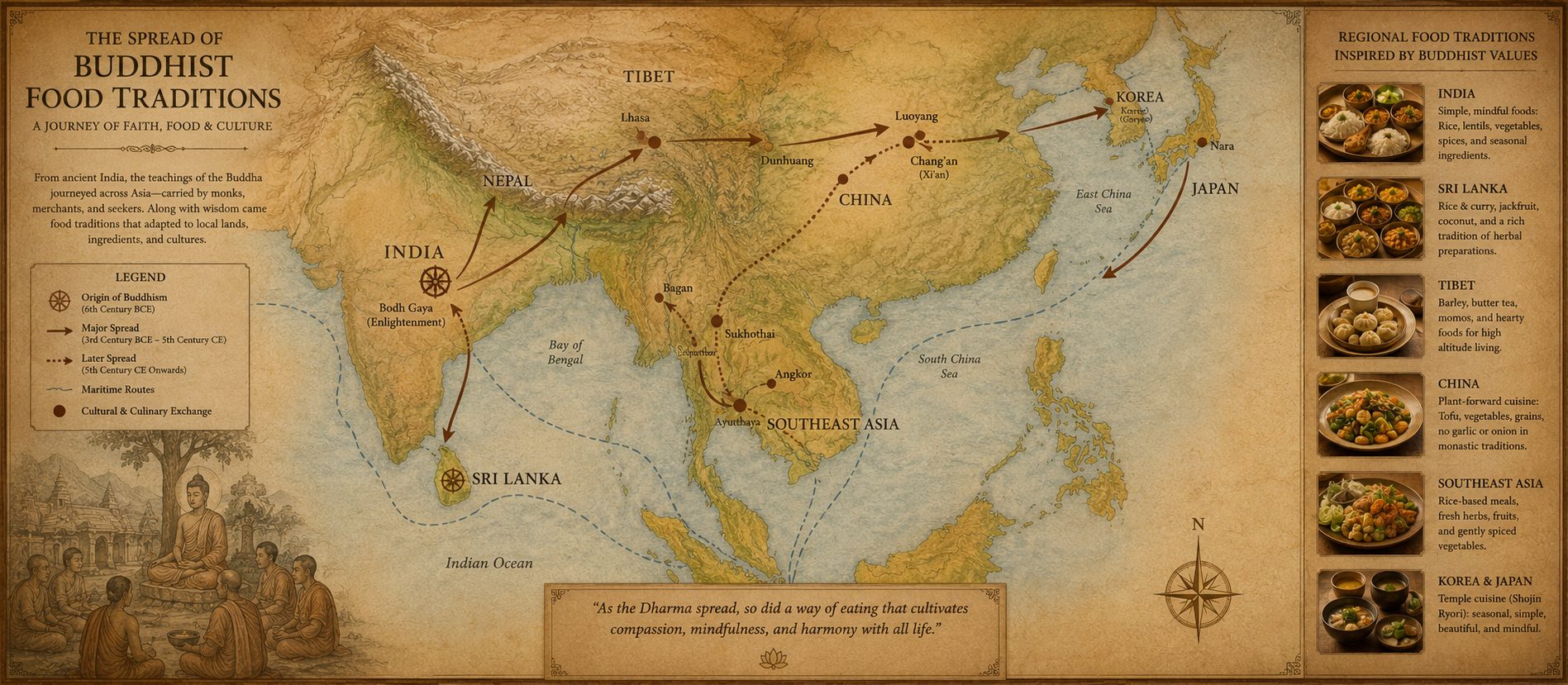 🔍 Click to enlarge
Buddhist monks who undertook the long journeys of the Silk Road — journeys that could take months or years — needed food that was portable, shelf-stable, and nutritionally adequate. The food preservation techniques they developed and carried were a significant technological contribution.
Drying was the primary method. Dried pulses, dried spices, dried mushrooms, and dried vegetables could survive months of travel without spoiling. The specific drying techniques developed in Indian monastic contexts — including the use of salt, sunlight, and specific temperature conditions — were practical responses to the physics of water activity: removing water below a certain level (typically below 0.6 water activity) prevents the microbial growth that causes spoilage.
The fermentation connection: Buddhist monasteries also developed fermented food traditions as preservation strategies. Chinese Buddhist fermented bean paste, Korean Buddhist kimchi (in later periods), and Japanese Buddhist miso all represent the application of fermentation technology — the same technology that Indian food had developed millennia earlier — to the specific ingredients and climate conditions of each region. The Buddhist food tradition is partly a global history of fermentation technology transfer.
The Buddhist practice of eating mindfully — paying full attention to the sensory experience of food without distraction — has documented physiological consequences that modern nutrition science has confirmed. Eating more slowly allows more time for the hormonal signals of satiety (primarily leptin and ghrelin) to reach the brain, reducing the tendency to overeat. Paying attention to flavour and texture increases subjective satisfaction from smaller quantities of food. The practice of stopping before complete fullness — eating to 80% capacity — is a specific Buddhist food recommendation that modern research confirms as beneficial for metabolic health.
Because Buddhist food ideas are actively shaping global eating culture right now. The concept of mindful eating — paying attention to what you eat, why you eat, and how you eat — is the single most widely adopted element of Buddhist practice in secular Western culture. The global growth of plant-based eating draws on Buddhist ethical frameworks about harm and compassion. The Japanese shojin ryori aesthetic — seasonal ingredients, minimal processing, attention to texture and colour — is influencing the world's best restaurants.
The Buddhist food tradition also demonstrates something important about how food cultures spread. Food does not travel through conquest or commerce alone: it travels with ideas. Buddhist monks carried Indian spice knowledge, Indian grain combinations, and Indian food ethics to every country they reached — not through trade but through the practice of cooking and eating together. The spread of Indian food ideas through Buddhism is one of the clearest examples in history of food culture as intellectual and ethical transmission.
| Early Buddhist Food Culture | Today |
|---|---|
| Eat before noon, nothing after | Intermittent fasting as global health practice — structurally similar to the Buddhist before-noon rule, now supported by metabolic science |
| Mindful eating as spiritual practice | Mindful eating as mainstream health intervention — the Buddhist principle secularised and adopted globally |
| Chinese Buddhist vegetarian protein innovation (tofu) | Tofu is now a global ingredient, found in supermarkets worldwide — the direct product of Chinese Buddhist vegetarian necessity |
| Alms round connecting monks and community | Still practiced daily in Thailand, Myanmar, Sri Lanka, Cambodia — the oldest surviving food ritual in continuous practice in Asia |
| Food as means, not end | The global conversation about food ethics — sustainability, harm reduction, mindful consumption — draws heavily on Buddhist frameworks developed 2,500 years ago |