Series 1 · The Chronological Story · Chapter 6 of 17
Temple Kitchens
of India
Feeding Faith, Community
and Pilgrims for Two Thousand Years
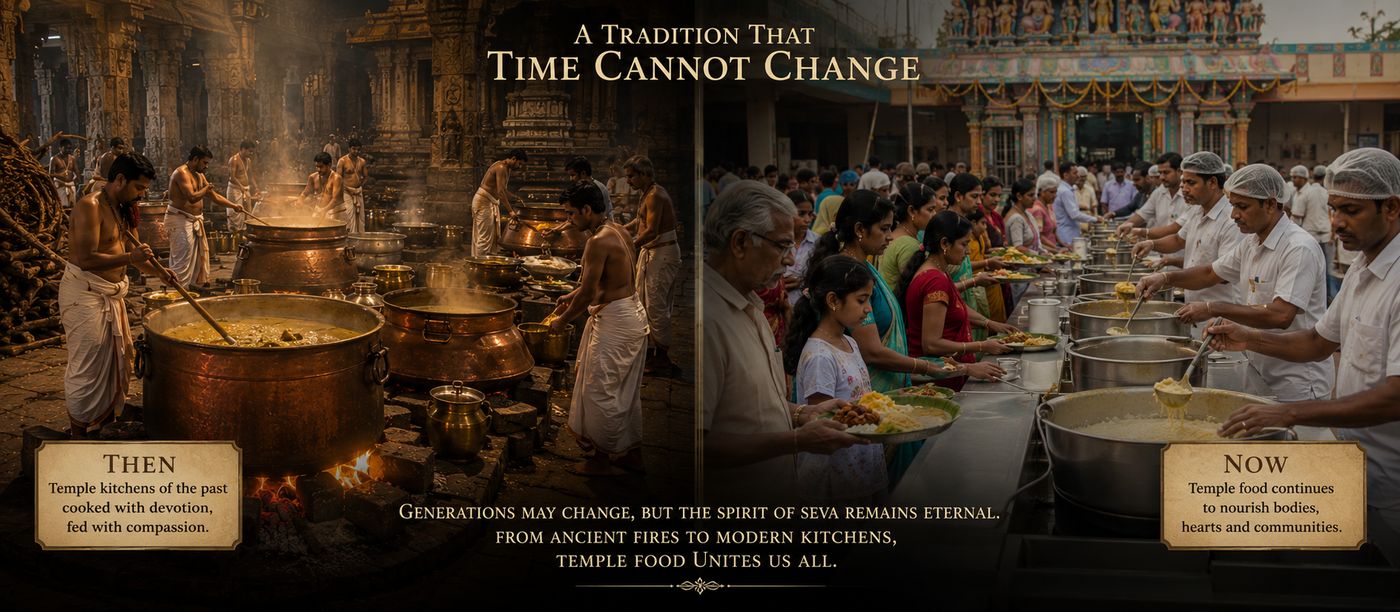
Artist's reconstruction based on historical evidence
Feeding Faith, Community
and Pilgrims for Two Thousand Years
Artist's reconstruction based on historical evidence
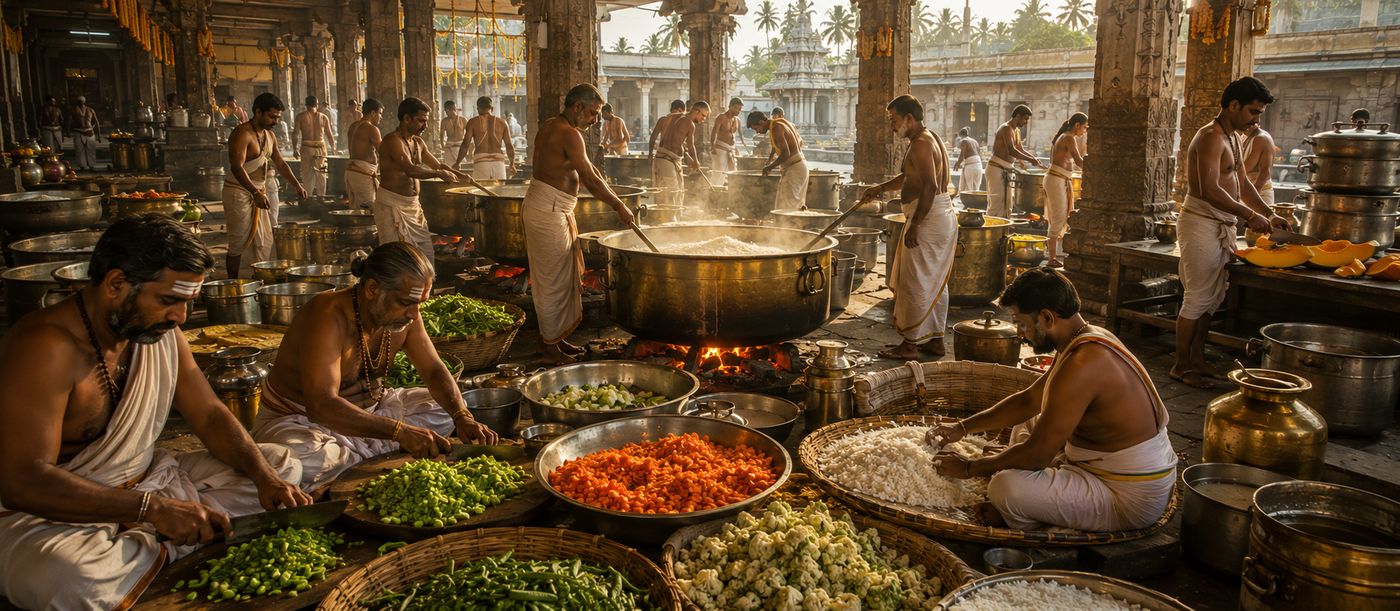
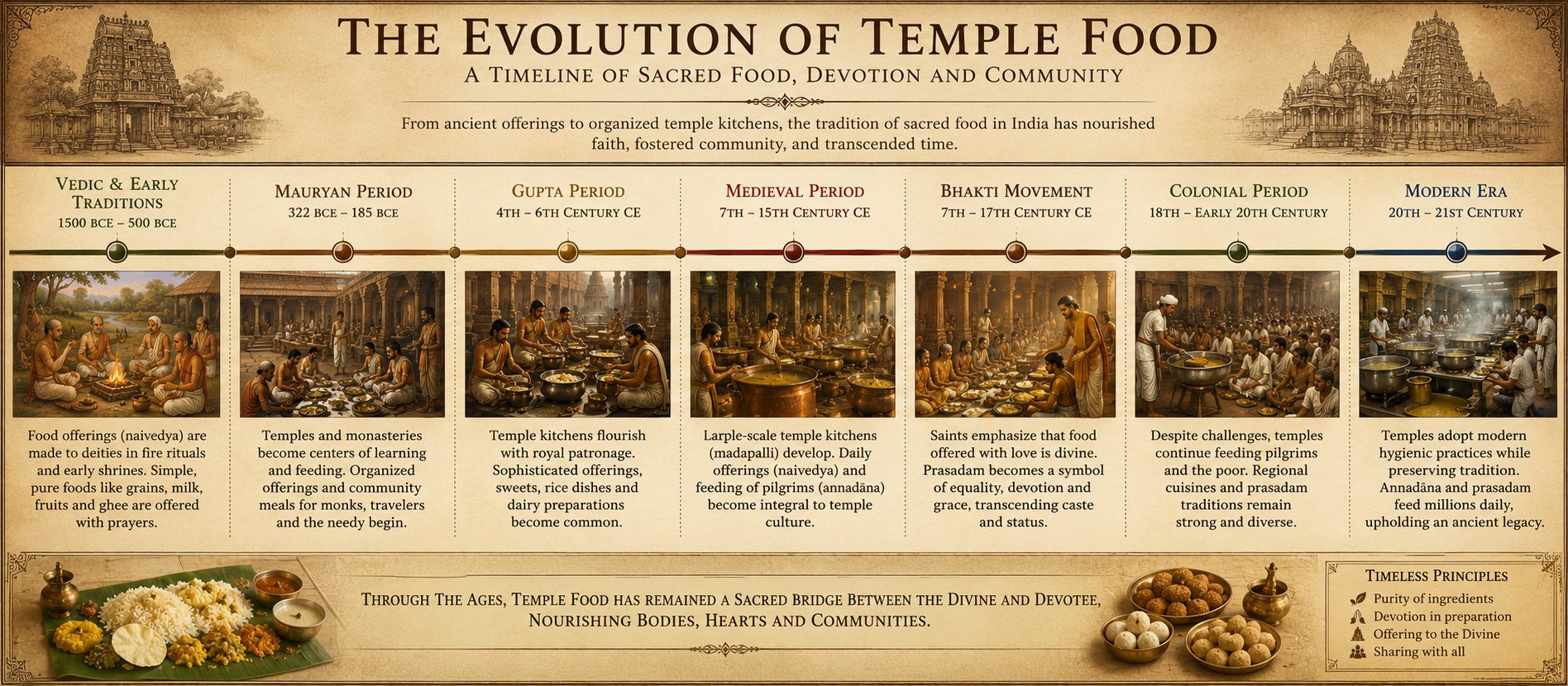
Before sunrise in Puri, the fires are already burning. The Jagannath Temple kitchen — one of the largest in the world — operates on a scale that would challenge a modern restaurant: hundreds of cooks, dozens of simultaneous preparations, quantities of food measured in tonnes rather than kilograms, and a tradition of continuous operation that stretches back more than a thousand years. This is not a catering operation. It is a sacred institution — and it has been feeding pilgrims every single day for longer than most nations have existed.
 🔍 Click to enlarge
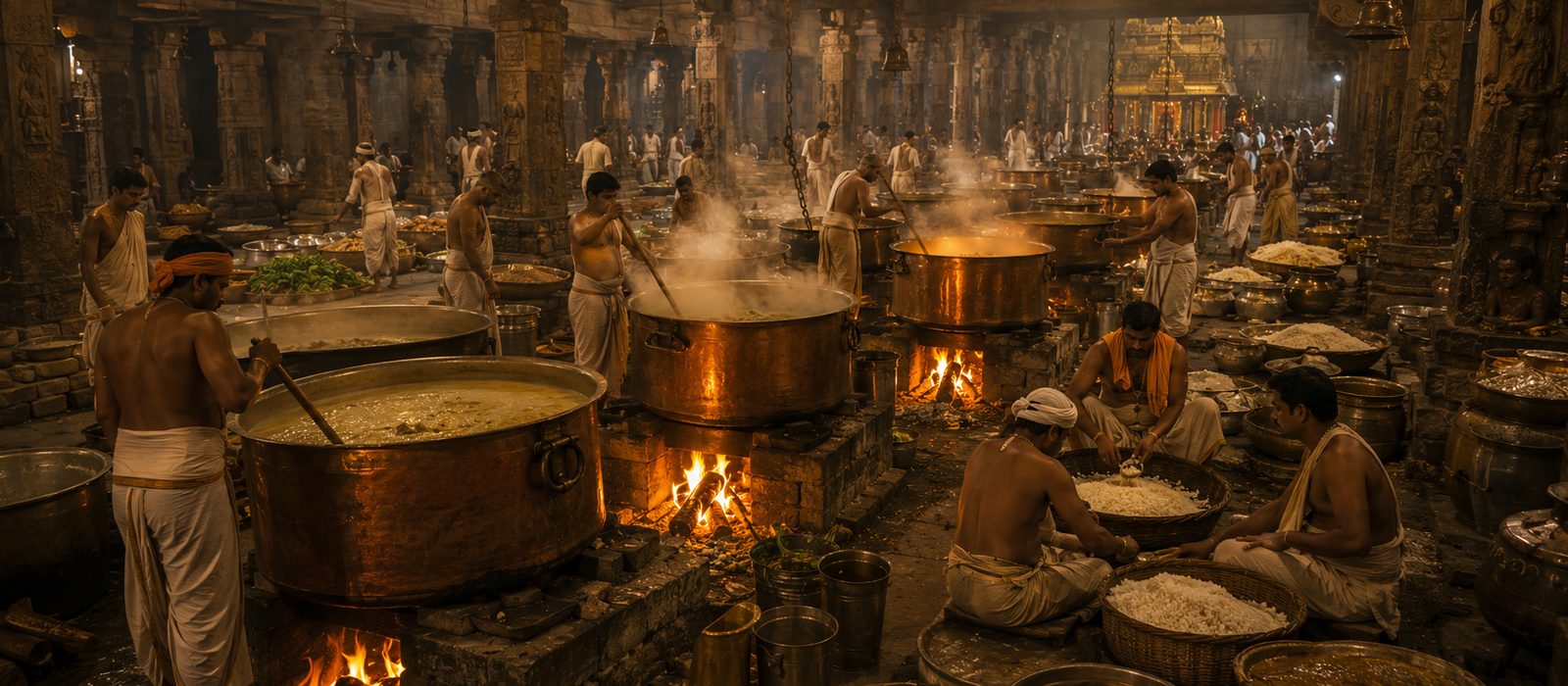
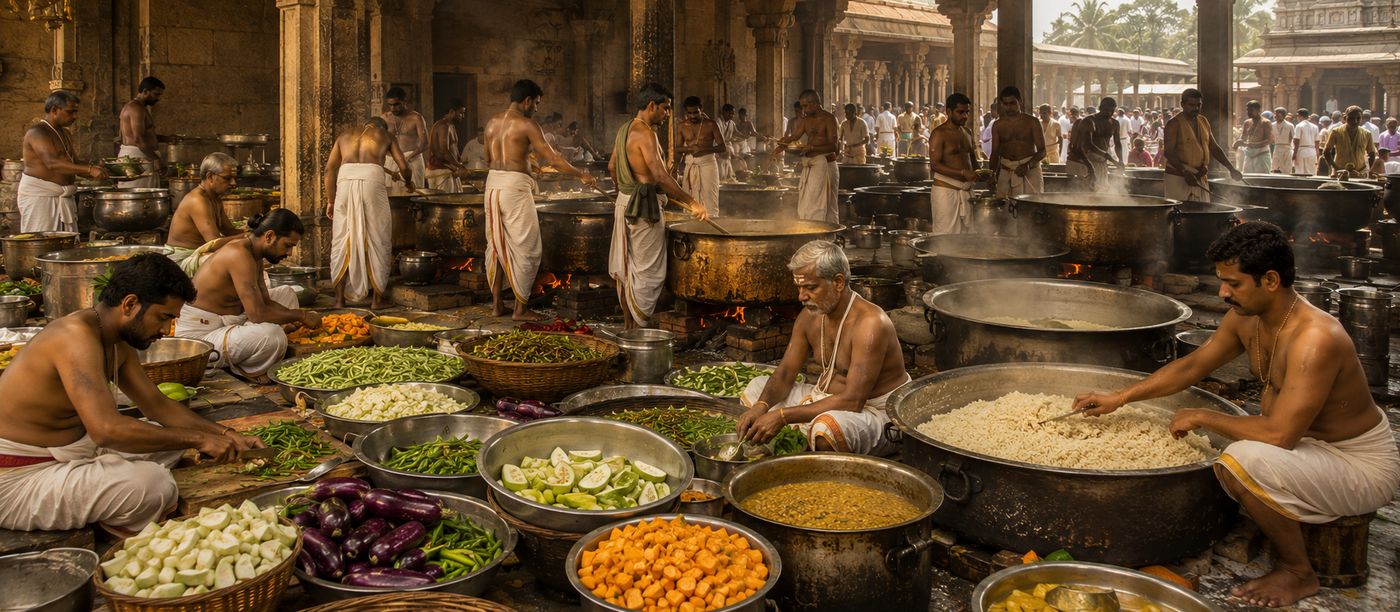
The Jagannath Temple kitchen in Puri is the most extraordinary food institution in the world. On ordinary days it feeds between 10,000 and 15,000 people. On the Rath Yatra festival day, it feeds up to 100,000. It operates with approximately 400 permanent cooks (suaras), who are divided into specialist teams for different preparations. The kitchen has operated continuously, without a single day's interruption, for more than a thousand years.
The physical engineering of this kitchen is remarkable. The cooking area contains up to 752 clay pots arranged in 32 series of stacked fires. The stacking method — pots placed directly on top of each other above a single fire source — is unique to this kitchen and allows simultaneous cooking of multiple preparations at different temperatures. The lowest pot receives the most intense heat; each successive pot receives progressively less, its contents cooked by the heat that passes through from below. This is not primitive — it is a specific solution to the problem of cooking nine courses simultaneously with minimal fuel.
The food is cooked exclusively in clay pots. Gas, induction, and steel vessels are prohibited. The clay is changed daily for specific preparations. This is not conservatism: the clay pot's thermal properties — slow, even heating, natural convection, mineral interaction — are functional specifications, not aesthetic preferences. The food produced in this kitchen genuinely cannot be replicated in steel or aluminium at the same scale.
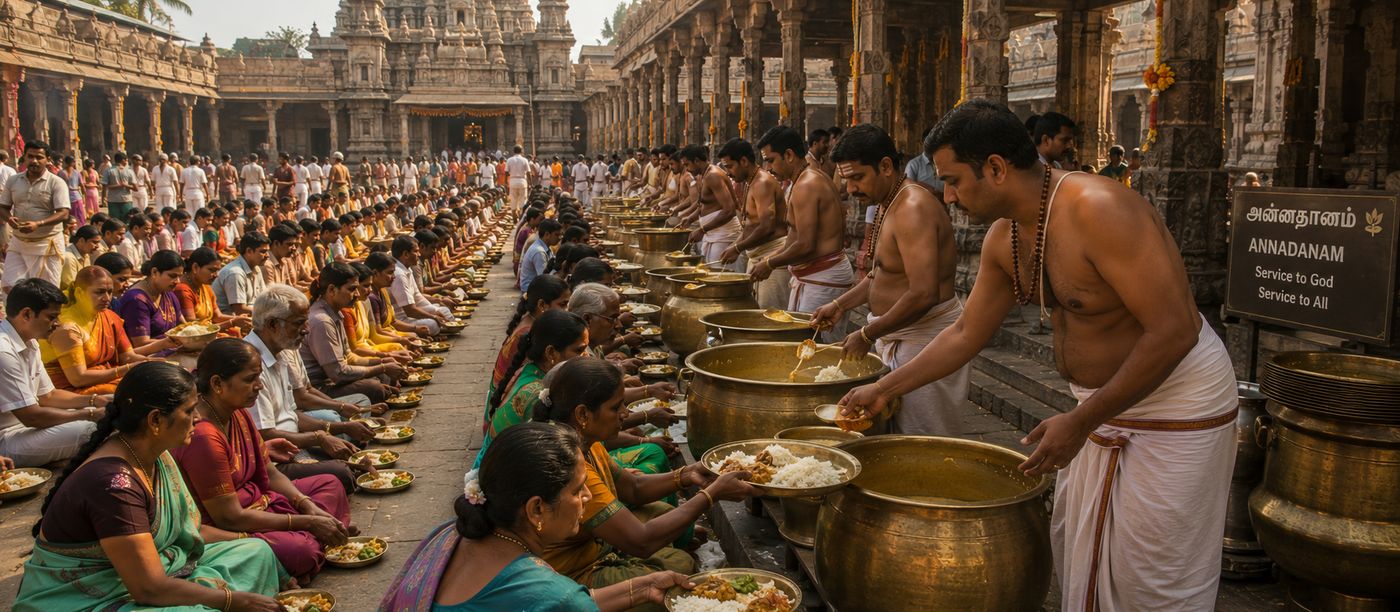
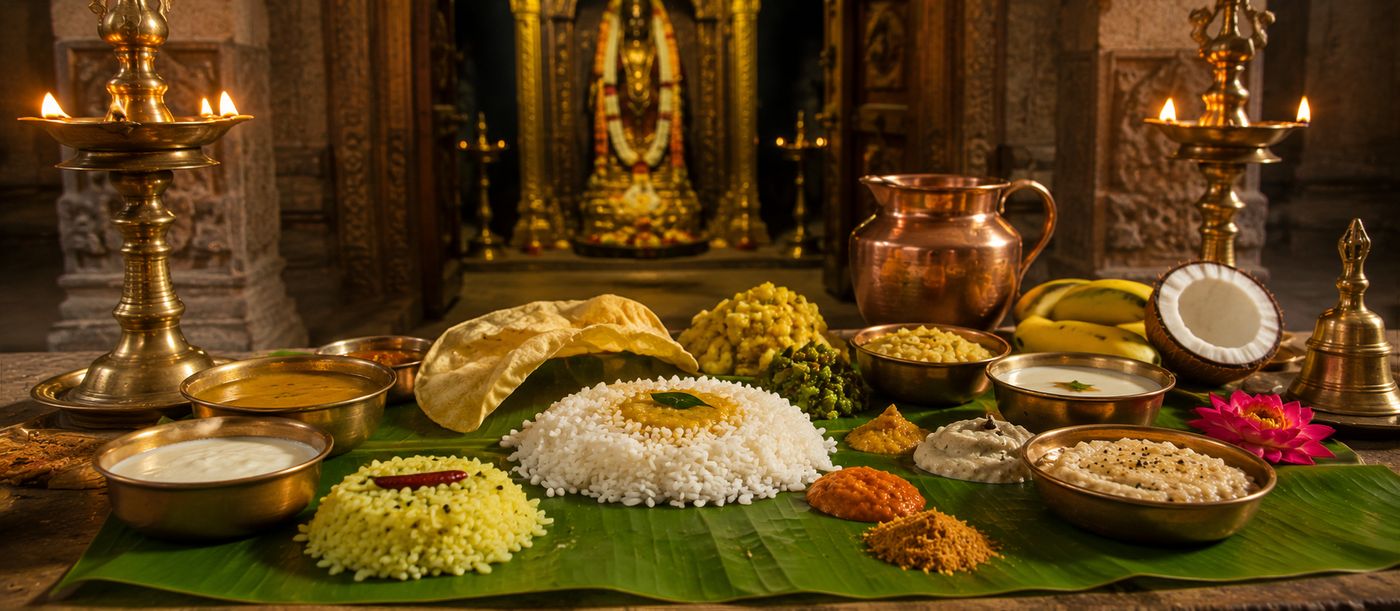
The concept of prasadam — food that has been offered to the deity and returned to worshippers — is one of the most theologically and practically significant ideas in Indian food culture. It is not simply blessed food: in Hindu theology, prasadam is food that has been transformed by the divine encounter. The deity has consumed the essence of the offering; what is returned to the worshipper carries divine grace and cannot cause harm.
The practical consequences of this theology are significant. Prasadam cannot be wasted — to throw away prasadam is a serious transgression. Prasadam must be shared — hoarding divine grace is philosophically incoherent. Prasadam must be offered to the poorest — the theological imperative to feed all who come is not charity but obligation. These three principles make temple kitchens structurally committed to large-scale, egalitarian food distribution in a way that no secular institution can quite replicate.
The food quality consequences are also significant. Prasadam is typically prepared without onion, garlic, or other "tamasic" ingredients that are believed to stimulate the lower passions. This restriction — which applies across most Hindu temple traditions — is the foundation of a specific vegetarian cooking style that developed differently from the lay vegetarian tradition. Temple cooking had to produce satisfying, complete meals without two of the most flavour-generating ingredients in Indian cooking. The solutions developed — specific spice combinations, specific frying and tempering methods, specific grain-and-pulse balances — are among the most sophisticated in the entire Indian culinary tradition.
The Jagannath kitchen's stacked-pot method is not merely traditional — it reflects a genuine understanding of heat transfer physics, even if that understanding was empirically rather than theoretically derived.
When clay pots are stacked directly on top of each other above a single fire, heat is transferred from pot to pot primarily by conduction through the clay walls at the contact points, and by convection through the steam and hot air rising between the pots. The result is a temperature gradient: the bottom pot is hottest, the top pot is coolest. This gradient allows different preparations to cook at different temperatures simultaneously — a preparation that needs sustained high heat (like a grain dish) goes in the bottom pot; a preparation that needs gentle heat (like a milk-based sweet) goes higher up.
The efficiency advantage: Nine preparations cooking simultaneously over one fire source is dramatically more fuel-efficient than nine separate fires. In a kitchen that has been operating continuously for a thousand years, this efficiency represents an enormous resource saving. The traditional method is not inefficient compared to modern alternatives — it is more fuel-efficient for high-volume, simultaneous multi-preparation cooking than any modern equivalent.
The restriction on onion and garlic in temple cooking is theologically motivated, but it has created a cooking tradition with genuinely distinct flavour chemistry. Onion and garlic both contain sulphur-containing compounds (allicin in garlic, propanethial S-oxide in onion) that are among the most potent flavour generators in Indian cooking — they form the aromatic base of the vast majority of Indian dishes.
Temple cooks working without these ingredients had to build their flavour base from other sources: asafoetida (hing) for the sulphurous depth of garlic without the garlic plant; specific spice combinations (cumin, coriander, pepper, ginger) layered to achieve aromatic complexity; tamarind, kokum, and amchur for sourness and depth; and more intensive use of tempering in ghee to extract maximum flavour from the spices that were permitted. The result is a flavour profile that is recognisably Indian but distinctly different from the onion-garlic-based cooking of non-temple kitchens — lighter, more spice-forward, less pungent, more aromatic.
Because they are still operating. The Jagannath kitchen has not stopped for a single day in over a thousand years. The tradition of feeding all who come — pilgrim, priest, pauper, and prince — without distinction and without charge continues daily in temples across India. The Golden Temple in Amritsar has fed 100,000 people every day for centuries. These are not heritage sites. They are active food institutions of extraordinary scale and continuity.
Temple cooking also preserves culinary techniques and food traditions that would otherwise have been lost. Specific preparations, specific vessel types, specific spice combinations used in temple kitchens have been maintained with remarkable consistency over centuries, while lay cooking has changed dramatically. The Mahaprasad of Jagannath today is prepared using largely the same methods and ingredients as it was five hundred years ago. This makes temple kitchens living museums of Indian food history — not reconstructions, but continuous practice.
| Ancient Temple Kitchen | Today |
|---|---|
| Clay pots stacked over wood fire | Jagannath kitchen still uses this exact method — unchanged in a thousand years |
| No onion, garlic in offerings | All major temple kitchens still observe this restriction — Udupi cuisine, temple prasadam, ISKCON cooking globally |
| Food free to all pilgrims | Golden Temple langar feeds 100,000 daily free; Jagannath Mahaprasad nominally priced to all; the egalitarian tradition continues |
| 56 preparations daily at Jagannath | Still 56 items in the Mahaprasad — the menu has not changed significantly in centuries |
| Prasadam as divine grace | ISKCON prasadam distributed globally; temple food distributed to millions daily — the theology unchanged |