Series 1 · The Chronological Story · Chapter 8 of 17
Jain Food
Through History
Discipline, Adaptation and One of the
World's Most Unique Food Systems
Artist's reconstruction based on historical evidence
Discipline, Adaptation and One of the
World's Most Unique Food Systems
Artist's reconstruction based on historical evidence
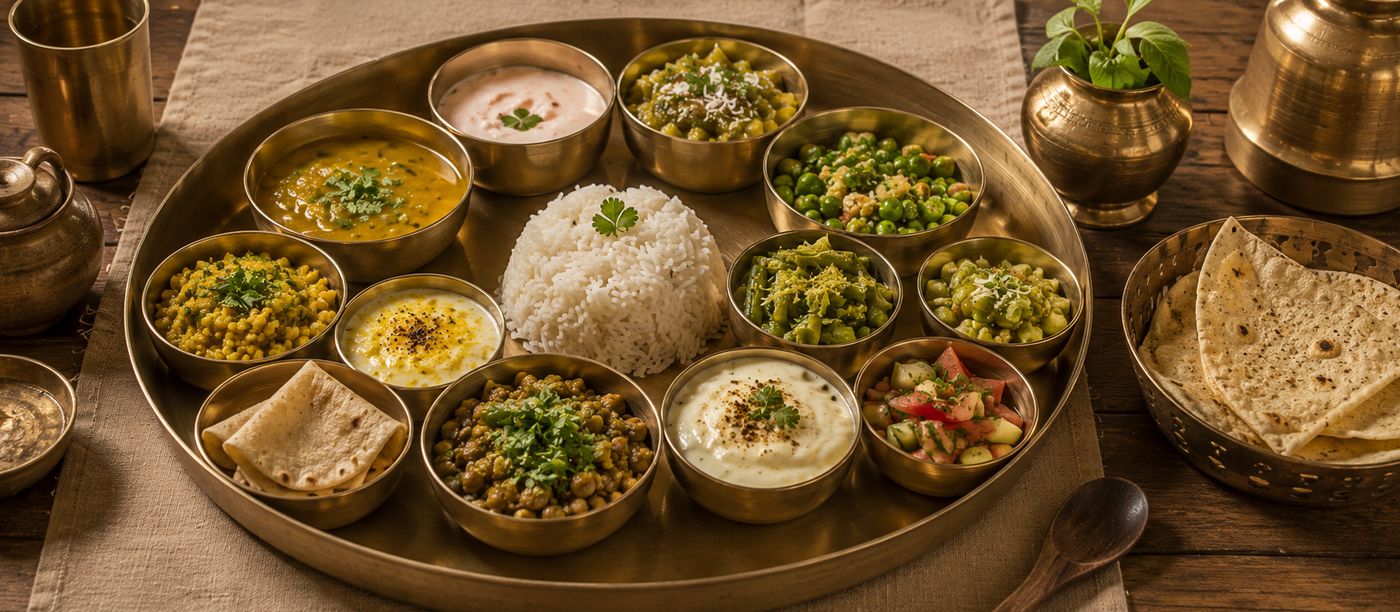
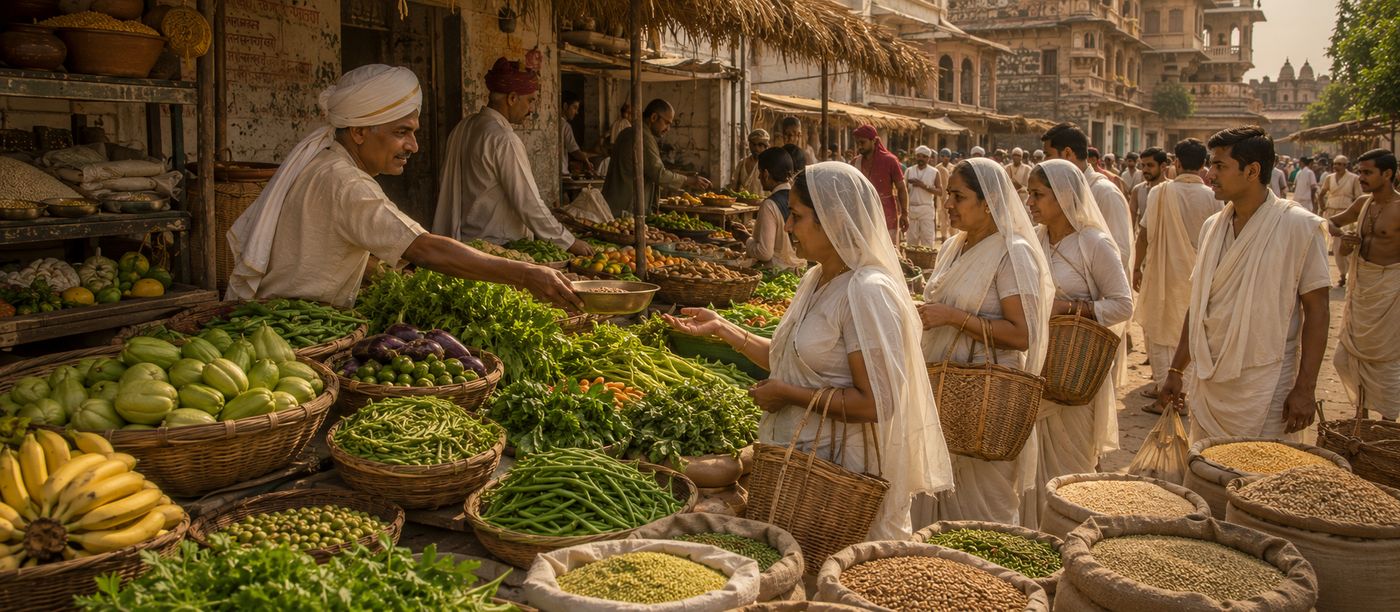
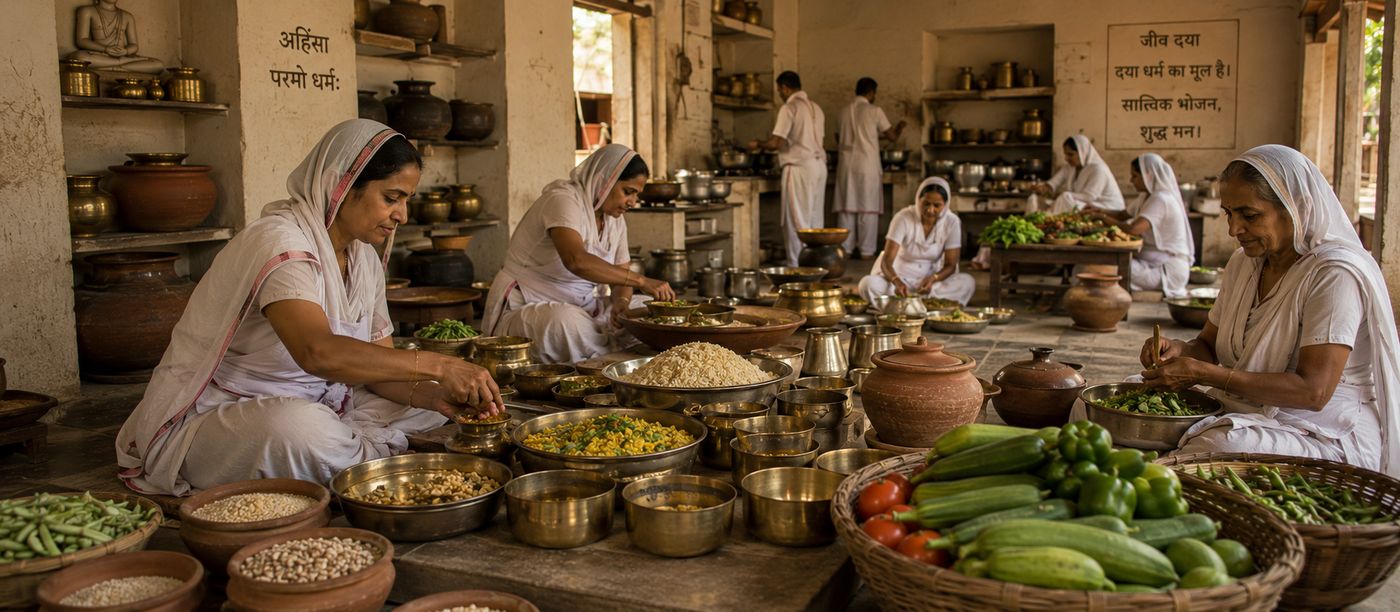
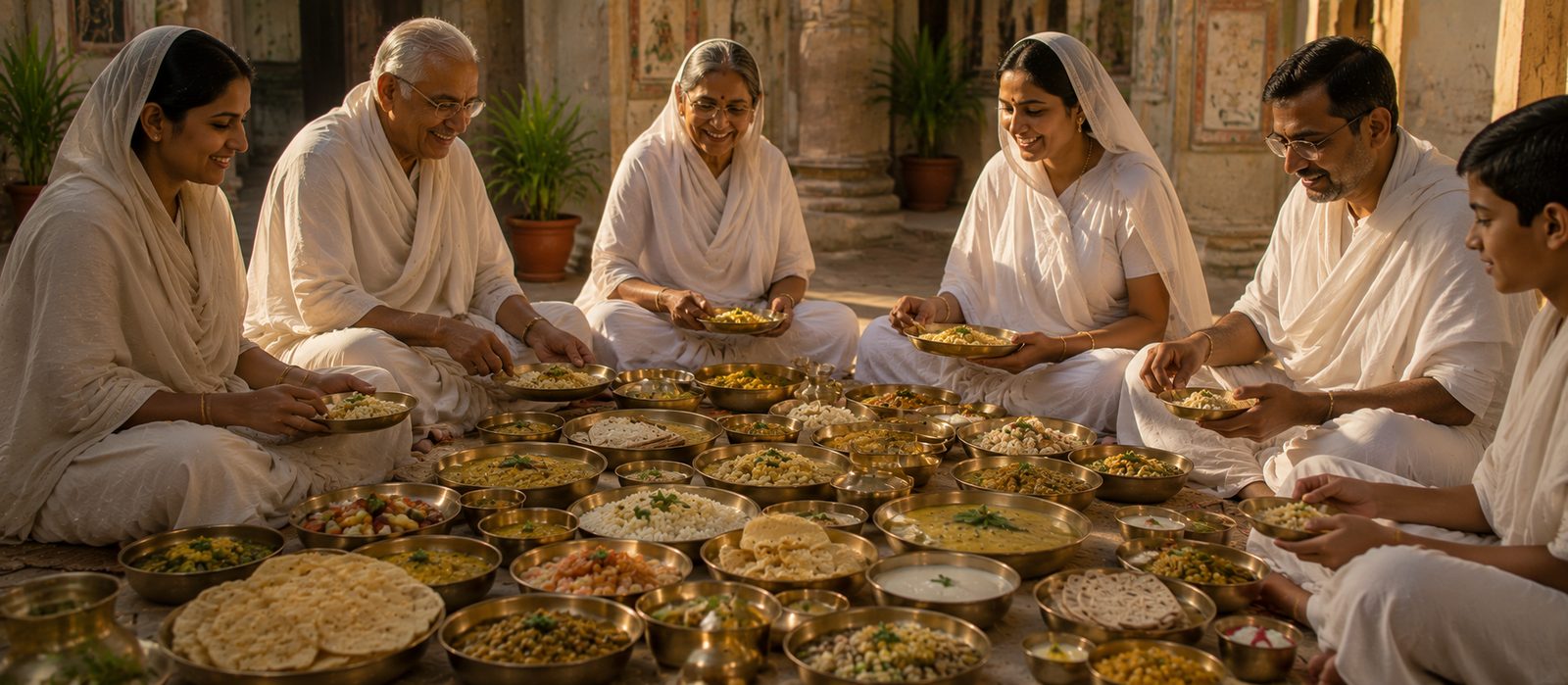
Imagine cooking an Indian feast without onions, garlic, potatoes, carrots, beetroot, radishes, or any underground vegetable. For most cooks, this would seem not just difficult but nearly impossible — these ingredients form the aromatic and nutritional foundation of the vast majority of Indian dishes. Yet for Jain communities, this restriction has been observed for more than two and a half thousand years. And rather than producing a diminished cuisine, it inspired one of the most creative and sophisticated culinary traditions in the world.
 🔍 Click to enlarge
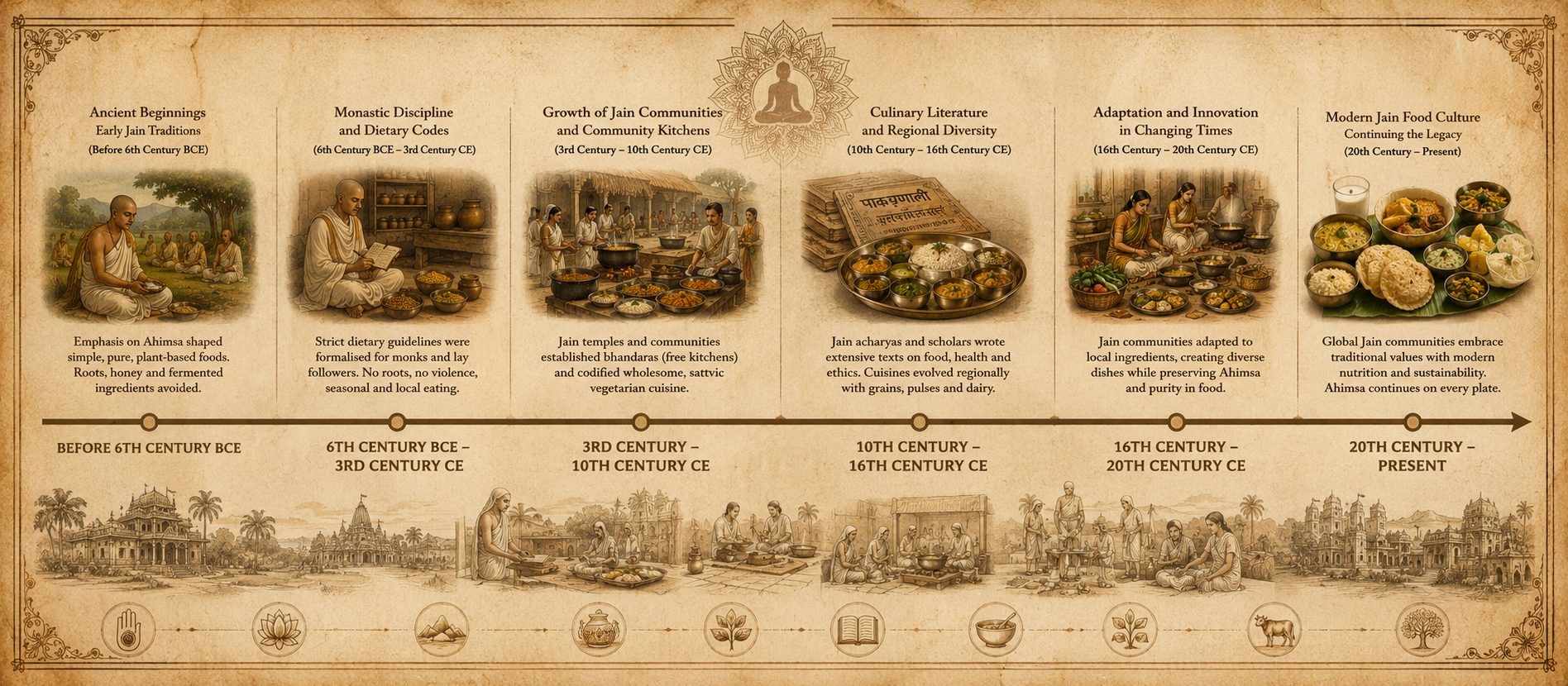
Jainism was founded — or, in Jain cosmology, revived — by Vardhamana Mahavira in the 6th century BCE, a contemporary of the Buddha and of Confucius. Its core principle is ahimsa: non-violence toward all living beings. Unlike the Buddhist formulation, which focuses on intentional harm and permits some contextual flexibility, the Jain application of ahimsa is comprehensive and systematic. The question "does this cause harm?" is applied to every aspect of food production, preparation, and consumption with a rigour that no other food tradition has matched.
The logical structure of Jain food restrictions is entirely coherent once the premise is accepted. All living organisms have souls (jivas) that deserve moral consideration. Different categories of organism have different numbers of senses: a five-sensed animal (with hearing, sight, smell, taste, and touch) is more morally significant than a one-sensed organism (which has only touch — including plants, microorganisms, and earth, water, fire, and air elementals). But even one-sensed organisms deserve consideration. Causing unnecessary harm to any of them violates ahimsa.
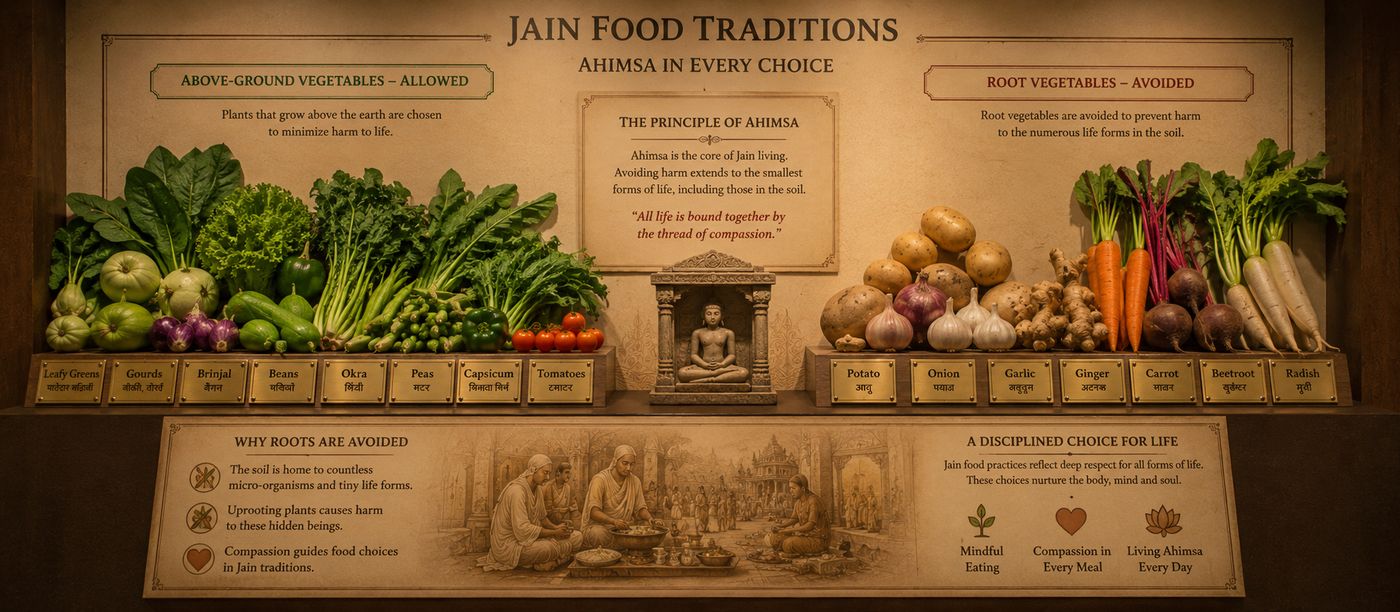
The restriction on root vegetables — the most practically consequential of all Jain food rules — follows directly from ahimsa logic. When you extract a root vegetable from the soil, you kill the entire plant. Unlike harvesting fruit (which the plant produces and can survive the loss of) or cutting leaves (which the plant can regenerate), uprooting destroys the whole organism. This violates ahimsa.
Additionally, the soil around roots contains enormous numbers of micro-organisms — the one-sensed jivas of earth, water, and air. Digging disturbs and potentially harms these organisms at scale. The more severe Jain food traditions therefore avoid not only root vegetables but any food that requires significant soil disturbance in its production.
The practical consequence is striking. No potatoes. No carrots. No onions or garlic (also root-adjacent, and additionally avoided for being multi-germ — each clove is a separate organism). No radishes, beetroot, turnips, parsnips, or yams. No ginger root in its fresh form in stricter traditions. The pantry of a strict Jain cook excludes ingredients that form the aromatic base of the majority of Indian regional cuisines.
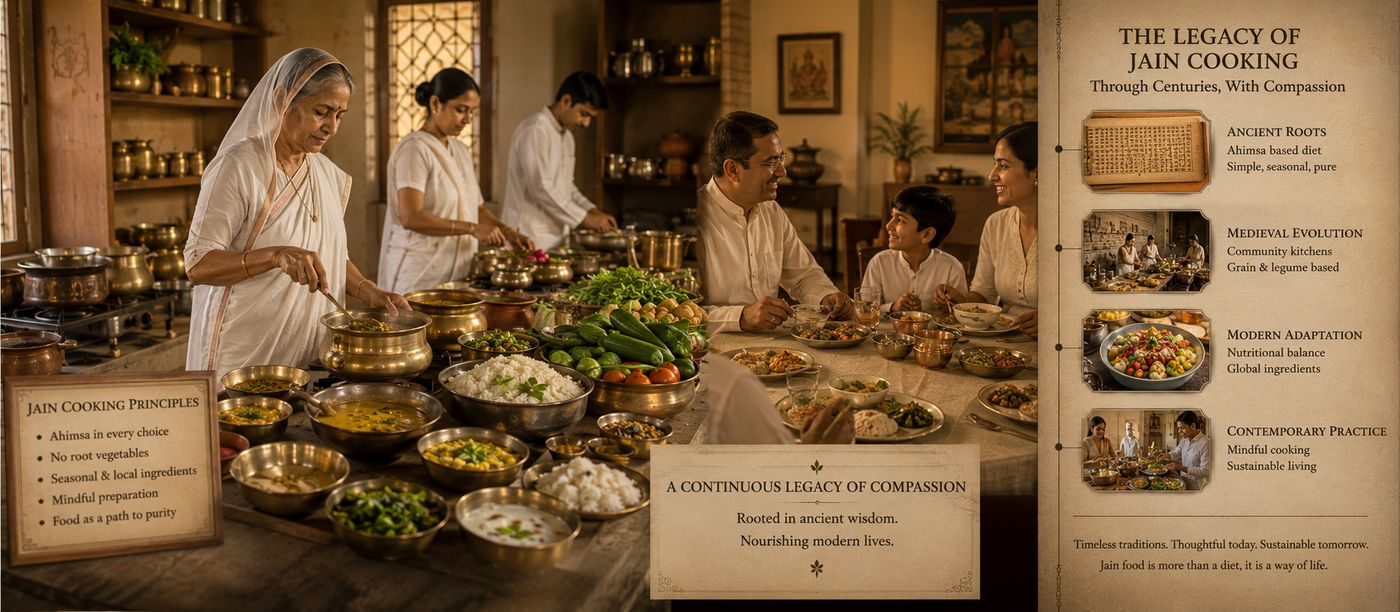
The most extraordinary achievement of Jain food culture is not its restrictions — it is what those restrictions produced. Faced with the loss of ingredients that form the aromatic foundation of most Indian cooking, Jain cooks developed substitute techniques, substitute ingredients, and entirely new preparations that are in many cases superior to the originals they replaced.
The genius move was asafoetida. Hing — the dried resin of Ferula asafoetida — provides a sulphurous, garlic-onion-adjacent depth of flavour that can, when used correctly, substitute for the aromatic base that onion and garlic provide. In hot oil, hing becomes remarkably garlic-like in aroma. It requires skill: too much makes food smell like old socks; the right amount creates a depth that is indistinguishable from garlic to many palates. Jain cooking developed the use of hing to its highest level of sophistication — and this Jain-developed technique then spread into mainstream Indian cooking, where hing is now a standard ingredient in dal and vegetable preparations across many regions.
The commercial success of Jain trading communities — the Oswal, Porwal, Shrimali, and other merchant castes who dominated banking, textiles, and long-distance trade across medieval and early modern India — gave their food traditions an influence disproportionate to their numbers. Wherever Jain merchants established trading posts, the demand for Jain-compliant food created local food systems that adapted to their requirements.
In Gujarat, Rajasthan, and parts of Maharashtra — the regions of heaviest Jain commercial influence — vegetarian food culture developed with particular sophistication and depth. The elaborate Gujarati thali, with its extraordinary variety of preparations, its balance of tastes, and its commitment to seasonal cooking, is partly a Jain legacy. The Marwari vegetarian tradition of Rajasthan — one of the most celebrated vegetarian cuisines in India — developed in communities with strong Jain influence. The Sindhi trading community, the Bohra community, and many others show Jain food ethics absorbed through commercial and social contact.
Asafoetida (hing) and garlic both produce powerful sulphurous aromas, but through different chemical pathways. Garlic's pungent aroma comes primarily from allicin — a sulphur-containing compound produced when garlic cells are cut or crushed, triggering the enzymatic reaction between alliin and alliinase. Allicin is volatile and degrades relatively quickly during cooking, producing a sequence of secondary aroma compounds.
Asafoetida contains ferulic acid esters and a range of organosulphur compounds including sec-butyl propenyl disulfide. Raw hing has a famously unpleasant, acrid smell — quite different from garlic. But when added to hot oil, the heat triggers molecular rearrangements that convert these compounds into aroma molecules much closer to those produced by cooked garlic. The result in hot ghee is genuinely garlic-adjacent — not identical, but close enough that Jain cooks developed it to its current sophistication over centuries of practical experience.
The practical application: The key is the quantity and timing. A pinch of hing (literally 1/8 of a teaspoon) in hot oil, cooked for 10-15 seconds before other ingredients are added, produces a flavour base comparable to 2-3 cloves of garlic. More hing produces an acrid, over-sulphurous result. This precision — developed by Jain cooks over centuries of practical experience — is why hing use in Jain cooking is considered a skilled technique requiring training to master.
Because Jain food innovations are now in everyone's kitchen. Asafoetida — developed to its highest culinary form in Jain cooking — is now standard in dal across India and increasingly in international vegetarian cooking. The principle of building flavour depth without onion or garlic, developed out of necessity by Jain cooks, is the foundation of no-onion-no-garlic cooking that is practiced in temples worldwide, by Brahmin communities on auspicious days, and by anyone following temple food traditions.
Jain food culture also offers the global vegetarian movement something it lacks: a 2,500-year-old laboratory of techniques for making plant-based food deeply satisfying without meat, onion, or garlic. The solutions Jain cooks developed — hing as aromatic base, raw banana as potato substitute, dried ginger as ginger substitute, the sophisticated use of spice to replace the aromatic work that onion and garlic perform — are directly applicable to modern plant-based cooking challenges.