Series 1 · The Chronological Story · Chapter 4 of 17
Mauryan Food Culture
Empire, Agriculture and
Feeding Ancient India — 322 to 185 BCE
Artist's reconstruction based on archaeological and textual evidence
Empire, Agriculture and
Feeding Ancient India — 322 to 185 BCE
Artist's reconstruction based on archaeological and textual evidence
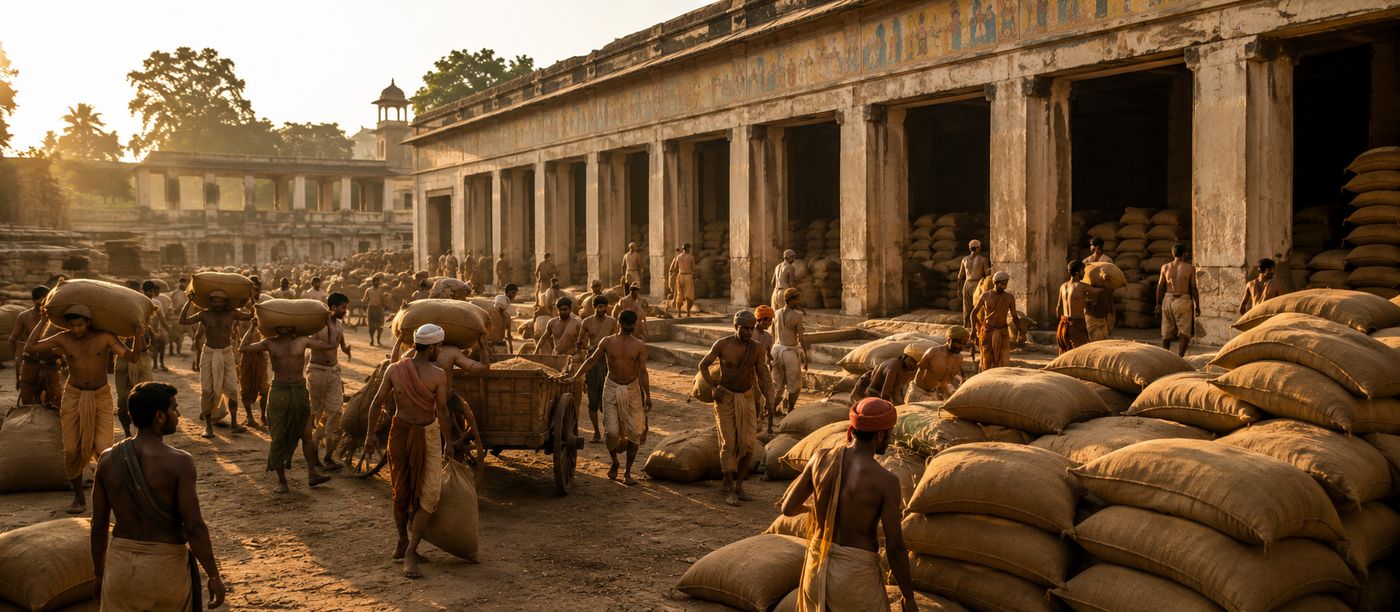
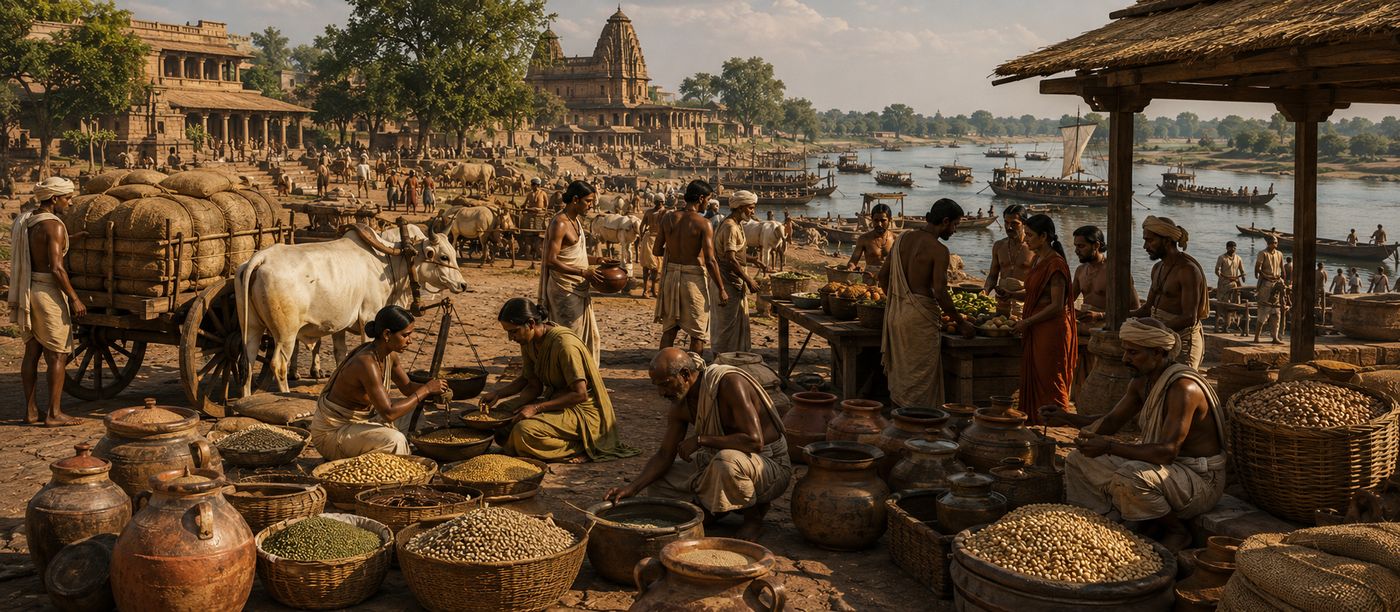
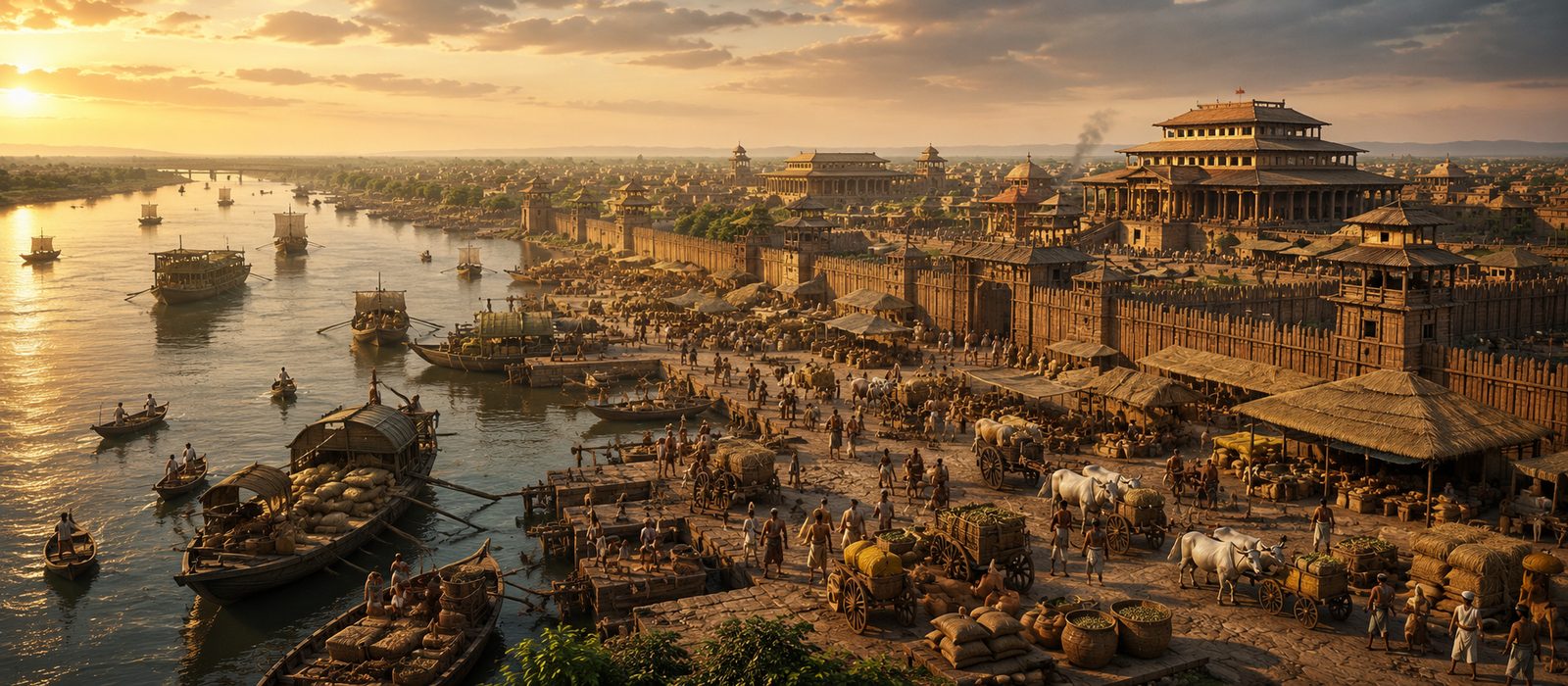
Imagine standing in Pataliputra around 250 BCE. Boats loaded with grain arrive daily along the Ganges. Merchants unload sacks of rice and barley. Government officials monitor supplies with the attention of modern logistics managers. Market streets overflow with spices, vegetables, and dairy products. For the first time in Indian history, feeding millions had become a state responsibility — and the consequences of failure were political, not merely personal.
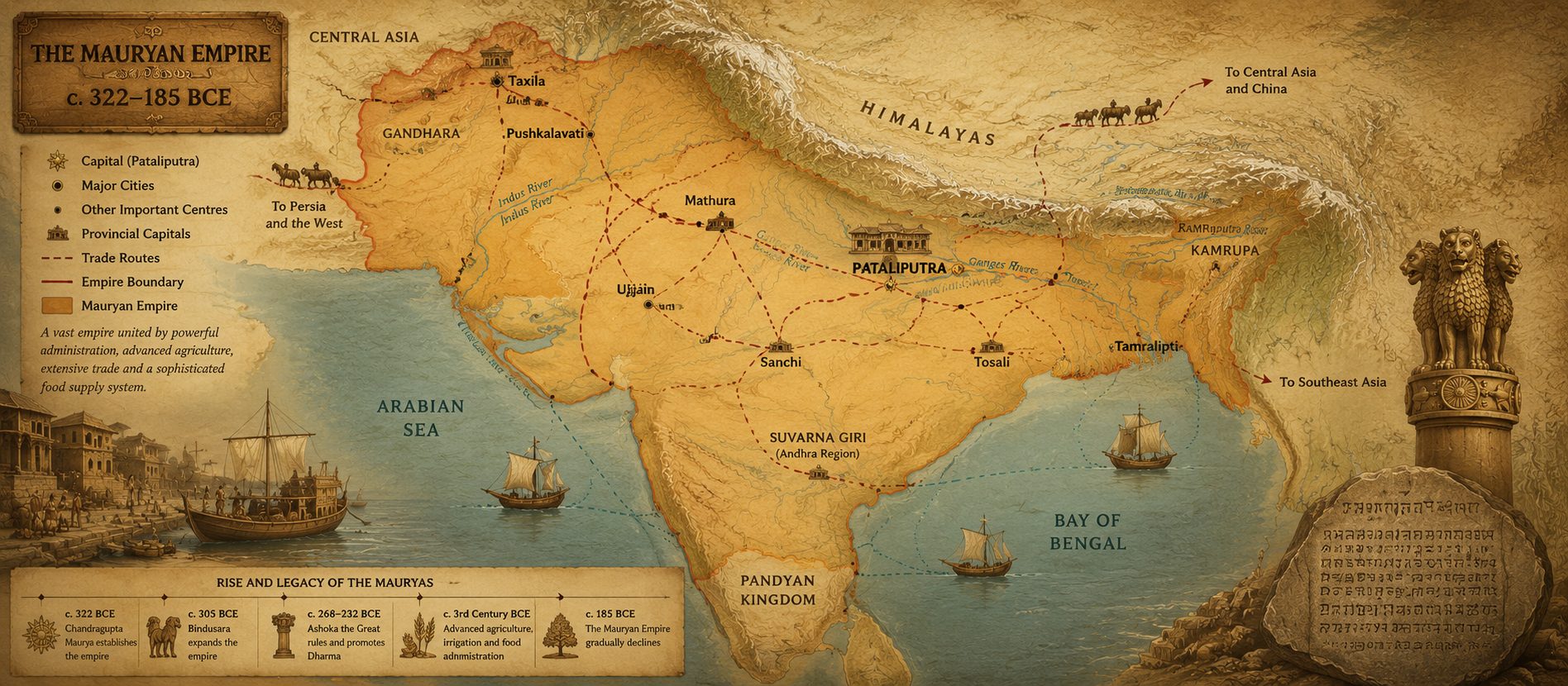 🔍 Click to enlarge
To understand Mauryan food culture, you have to understand Pataliputra. The Greek ambassador Megasthenes, who visited the city around 300 BCE, describes it as 9 miles long and 1.75 miles wide, surrounded by a timber palisade with 570 towers and 64 gates, situated at the confluence of the Ganges and Son rivers. Whatever the accuracy of these specific dimensions, every source agrees that Pataliputra was extraordinary — a city of a scale that India had not seen since the Indus Valley Civilisation, and arguably larger than anything that had existed in the subcontinent before.
Feeding a city of this size was not simply a matter of farmers growing more food. It required supply chains — networks of producers, transporters, merchants, and administrators connecting agricultural hinterlands to urban consumers. It required storage — granaries capable of holding enough grain to buffer seasonal variation and protect against harvest failure. It required markets — organised spaces where food could be bought and sold at regulated prices. And it required oversight — officials monitoring supply, quality, and price to prevent the hoarding and adulteration that threaten any large urban food system.
"Food is the basis of everything. From food all beings are born, by food they live, toward food they move and into it they return. Therefore food should be treated as the most important thing."
Kautilya, Arthashastra, c. 300 BCE
The Arthashastra describes a food governance system of remarkable sophistication. It specifies how grain should be stored (elevated, ventilated, monitored for pests), how markets should be regulated (standardised weights and measures, quality inspectors, penalties for adulteration), how prices should be managed (maximum and minimum price provisions, government intervention when market prices became destabilising), and how food emergencies should be handled (strategic grain reserves, redistribution from surplus to deficit regions).
This is not ancient primitive administration. This is systematic food policy thinking that addresses the same problems — supply chain management, price stability, food security — that modern governments grapple with today, using analytical frameworks that are structurally similar to modern food policy. The difference is scale and technology, not conceptual sophistication.
The Ganges was the infrastructure that made all of this possible. A boat can carry in one trip what would require dozens of carts and hundreds of draft animals to transport overland. The Gangetic river system — connecting the agricultural plains of Bihar, Bengal, and Uttar Pradesh — gave the Mauryan Empire a bulk food transport network that no overland road system could match. Grain moved from the fields of eastern India to the markets of Pataliputra by river, arriving continuously through the harvest and post-harvest season.
No figure in Indian food history has a more interesting relationship with food than Ashoka. Before the Kalinga War — a battle of extraordinary brutality that Ashoka himself later described with horror — he was a conventional Mauryan emperor who ate meat, hunted, and maintained the imperial food culture of the court. After his conversion to Buddhism and his adoption of the principle of ahimsa (non-harm), he attempted to transform the food ethics of an empire.
The Rock Edicts that Ashoka had inscribed on stone across his empire — some of which still stand — document specific food-related provisions. He restricted the slaughter of animals, initially limiting and then progressively eliminating the royal kitchen's consumption of meat. He established veterinary hospitals — the first documented state veterinary care — and provided for the welfare of animals across the empire. He had medicinal herbs, fruit trees, and shade trees planted along roads, providing food and medicine for travellers. He dug wells and rest houses.
These are not the actions of a ruler managing food supply for efficiency. These are the actions of a ruler who had developed a food philosophy — that the way an empire treats the living things it consumes reflects its moral character — and attempted to institutionalise that philosophy at scale. Whether his subjects agreed, whether the provisions were enforced, and what lasting effect they had on actual food practice are all debated. But the edicts themselves represent the first documented attempt in Indian history to make food ethics a matter of state policy.
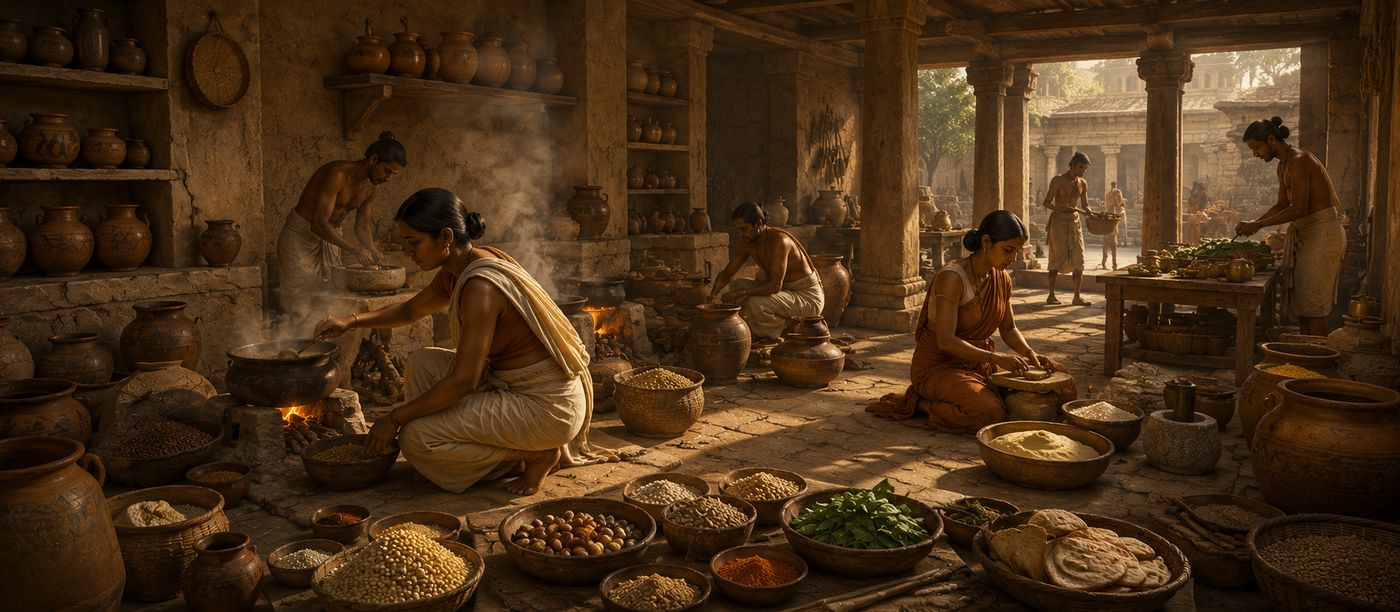
The Arthashastra and Greek accounts focus on the imperial level — state granaries, royal kitchens, military provisioning. What ordinary people in Mauryan India actually ate is reconstructed from a combination of these sources, Buddhist texts (which were being written in this period and contain many incidental food references), and the archaeological record.
Rice had become the dominant grain of the Gangetic heartland by the Mauryan period — the intensive wet rice agriculture of the floodplains provided the primary caloric base for the empire's core population. Barley and wheat continued in drier regions to the west and north. Pulses — lentils, chickpeas, mung beans — remained the primary protein source alongside dairy. The dal-and-rice meal that was already ancient by the Indus Valley period was, in the Mauryan period, the everyday food of tens of millions of people.
The markets of Pataliputra and other Mauryan cities offered considerably more variety than the rural diet. Megasthenes describes Indian markets selling extraordinary quantities of produce — fish, meat, vegetables, fruits, spices, and prepared foods. The urban food culture of Mauryan India was complex and diverse: a large city supports occupational specialisation, which includes culinary specialisation, and the markets of Pataliputra almost certainly included prepared food vendors, sweet makers, and specialised spice merchants.
| Food | Category | Evidence | Notes |
|---|---|---|---|
| Rice | Grain | Strong | Dominant in Gangetic heartland; wet rice agriculture at large scale |
| Barley | Grain | Strong | Continued in drier regions; also used in ritual contexts |
| Wheat | Grain | Strong | Northwestern regions; flatbread tradition continues |
| Lentils / Dal | Pulse | Strong | Primary protein; dal-rice as everyday meal confirmed in Buddhist texts |
| Ghee | Dairy Fat | Strong | Continues from Vedic period; high status; ritual use documented |
| Milk & Curds | Dairy | Strong | Daily consumption documented in multiple sources |
| Sugarcane Products | Sweetener | Moderate | Jaggery production expanding; crystalline sugar emerging |
| Fish | Protein | Moderate | Extensively documented; Ganges provided substantial fish supply |
| Seasonal Vegetables | Produce | Moderate | Market vegetables documented by Megasthenes; varieties unclear |
| Meat (various) | Protein | Moderate | Available but restricted by Ashoka's edicts for part of the period |
| Black Pepper | Spice | Moderate | Trade routes from southern India expanding; pepper increasingly available |
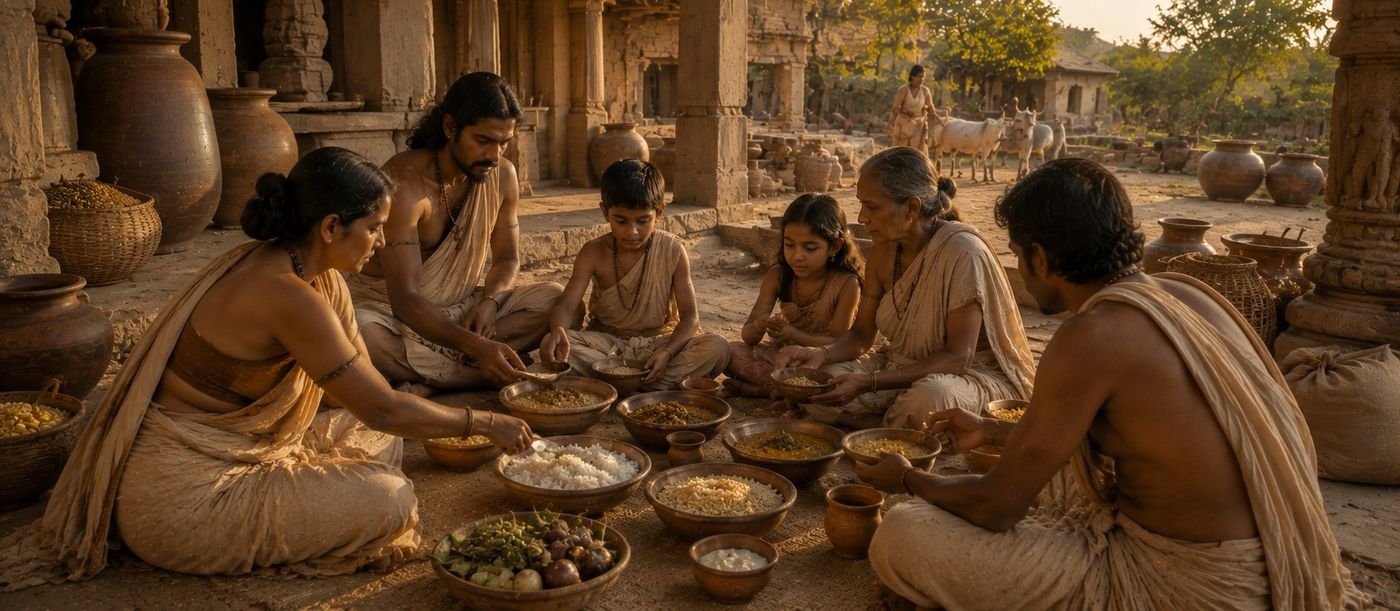
What meals actually looked like in Mauryan India — from the urban commoner to the imperial court.
By the Mauryan period, the combination of rice, dal, and dairy that defines the core of Indian food culture was fully established in the Gangetic heartland. Buddhist texts of this period describe monks receiving alms of cooked rice and dal as standard daily food — reflecting what ordinary urban people ate. The addition of ghee or sesame oil, curds on the side, and whatever seasonal vegetables the market provided completes the picture. This is, structurally, the thali — the complete Indian meal — in its earliest documented form.
The Arthashastra describes the royal kitchen in enough detail to reconstruct a court meal. Multiple grain preparations — rice in various forms, wheat flatbreads, barley preparations — alongside elaborate pulse dishes, dairy preparations, fish from the Ganges, spiced meat preparations (before Ashoka's restrictions), and sweet preparations made from milk, ghee, and jaggery. The court meal was an exercise in variety and abundance — a deliberate demonstration of imperial wealth through food.
Buddhist monastic texts from the Mauryan and post-Mauryan period describe the meal structure of monasteries in considerable detail. Rice was the foundation. Dal provided protein. Seasonal vegetables — whatever was available and could be prepared without harm — completed the meal. Dairy was generally permitted. Meat was restricted or eliminated. This is, essentially, the sattvic vegetarian meal framework that still structures temple food, Jain cooking, and much of Indian vegetarian tradition today. Its systematic, documented development dates to this period.
The Arthashastra's instructions for grain storage are remarkably consistent with modern food science understanding. It specifies that grain should be stored elevated from the ground (to prevent moisture absorption from the soil), ventilated (to allow the respiration of the grain to dissipate without creating moisture), and monitored for pests. These are not ritual prescriptions — they are empirically derived solutions to specific physical problems.
Grain is a living biological material. After harvest, it continues to respire — consuming oxygen and releasing carbon dioxide and water vapour. In a sealed, unventilated space, this respiration elevates humidity, promoting mould growth and insect activity. The water vapour released also enables the germination of remaining weed seeds and the development of mycotoxins — fungal poisons that can make grain dangerous to eat.
The Arthashastra's solution: Elevated storage (away from ground moisture), ventilation (dissipating respiratory water vapour), and monitoring (early detection of infestation before it spreads). These three principles — elevation, ventilation, monitoring — are still the foundation of modern bulk grain storage design. The 2,300-year-old text and the modern grain storage engineer are working from the same thermodynamic and biological constraints.
The Mauryan period saw the expansion of jaggery (gur) production — unrefined sugarcane sugar — from a local agricultural product to a traded commodity. Jaggery production is a relatively simple process: sugarcane juice is boiled in large vessels until it thickens and crystallises into blocks. But scaling this process to produce jaggery in quantities sufficient for urban markets and long-distance trade requires systematic agricultural production, consistent processing, and reliable storage — all of which the Mauryan economy enabled.
Jaggery is nutritionally superior to refined white sugar: it retains iron, calcium, potassium, and other minerals that the refining process removes. It also has a more complex flavour profile — the Maillard reaction and caramelisation that occur during boiling produce hundreds of flavour compounds absent from refined sugar. The jaggery in a modern Bengali payesh or a Tamil pongal is the same product, made by the same process, that Mauryan-era sweet makers were producing 2,300 years ago.
Because the Mauryan period established two things that have never left Indian food culture. The first is the institutional framework: that food is a matter of governance, that the state has a responsibility for food security, that markets need regulation, and that quality standards matter. Every Indian government since has operated with these assumptions, even when the specific mechanisms have changed dramatically.
The second is Ashoka's food ethics. The idea that how we treat the animals we eat reflects our moral character — that food choices have ethical dimensions — enters Indian public discourse in this period and never leaves it. The vegetarian traditions of Buddhism and Jainism, the sattvic food philosophy of Ayurveda, the prasadam system of temple kitchens, and the modern Indian vegetarian tradition all have roots in the food ethics movement that Ashoka made visible and imperial.
When you see a "pure vegetarian" restaurant sign in India today, or when a Hindu household observes specific days of vegetarian eating, or when a Jain entrepreneur structures their entire business around non-harm — you are seeing the long shadow of a decision made by an Indian emperor 2,300 years ago. Food ethics is not a modern concept in India. It is among the oldest documented features of Indian public life.
The Mauryan kitchen was sophisticated and diverse — but still missing the ingredients that now define Indian cooking to the outside world.
The Mauryan state granary system was the logistical backbone of the empire. Tax was collected in kind — a proportion of every harvest flowed into state stores. The Arthashastra specifies that grain stores should be maintained as a strategic reserve, sufficient to support the army for a campaign season and the civilian population through at least one failed harvest. The infrastructure required to implement this — collection, transport, storage, distribution — was the most sophisticated food logistics operation the ancient world had produced outside China.
Food taxation under the Mauryas was also a tool of social policy. The Arthashastra describes differential tax rates for different crops and land qualities, relief provisions for farmers in drought years, and the state's explicit obligation to redistribute stored grain to the poor during famine. The Mauryan state was not merely extractive — it assumed direct responsibility for food security in ways that most modern states only formalised in the 20th century. The great granaries at Pataliputra were not just storage facilities. They were the physical expression of a theory of government in which feeding the population was a core imperial duty.
| Mauryan India, c. 250 BCE | Modern India |
|---|---|
| State granaries as food security infrastructure | Food Corporation of India managing 70+ million tonnes of grain reserves — same principle, vastly larger scale |
| Market regulation by government officials | FSSAI (Food Safety and Standards Authority) — regulating food quality and adulteration, as Kautilya recommended |
| Rice dominant in Gangetic heartland | Rice still dominant in eastern and southern India — the agricultural geography unchanged in 2,300 years |
| Dal-rice as everyday meal | Dal chawal remains the most widely eaten meal in India — directly continuous from this period |
| Ashoka's vegetarianism as imperial policy | India has the world's largest vegetarian population — the ethical tradition Ashoka codified is still structuring food choices |
| Jaggery as primary sweetener | Jaggery still used in regional cooking, festivals, and traditional sweet-making — the same product, the same process |
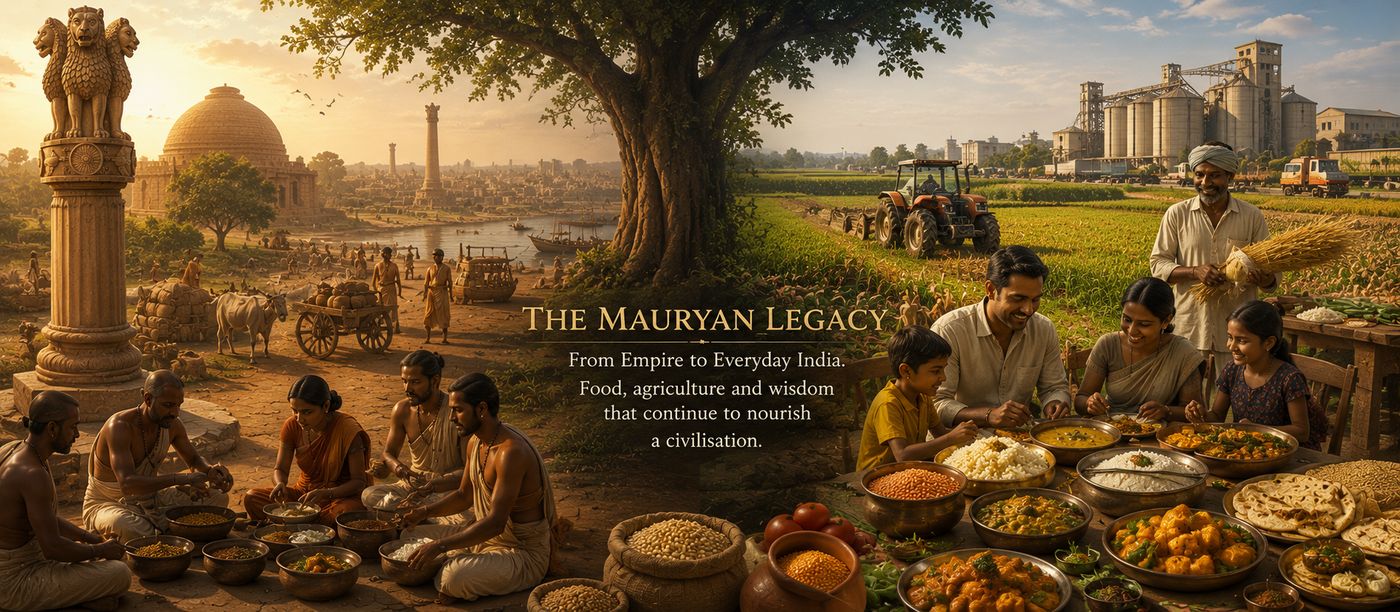
The Mauryan period left two legacies in Indian food culture that are still active today — one institutional, one ethical.