Series 1 · The Chronological Story · Chapter 5 of 17
Gupta Golden Age
Food
Refinement, Taste and
the Birth of Classical Indian Cuisine
Artist's reconstruction based on archaeological and textual evidence
Refinement, Taste and
the Birth of Classical Indian Cuisine
Artist's reconstruction based on archaeological and textual evidence
If the Mauryan period was about feeding an empire, the Gupta period was about refining what was fed. In the kitchens of Gupta India — from royal courts to Sanskrit poets' households — cooks began to think differently about food. Not merely what sustained the body, but what delighted it. Not merely what was available, but what was balanced. Not merely recipes, but philosophy.
The Gupta period was the great age of Ayurvedic codification. The Charaka Samhita and Sushruta Samhita — the foundational texts of Indian medicine — reached their compiled form in this period, and both are substantially food documents as much as medical ones. For the Ayurvedic physicians of Gupta India, food was not separate from medicine. It was medicine — the primary tool for maintaining health, correcting imbalance, and supporting mental and spiritual wellbeing.
The Ayurvedic understanding of food was built on the concept of ahara (nourishment) as a direct influence on dosha balance — the three constitutional principles (vata, pitta, kapha) whose equilibrium determined health. Every food had properties that either supported or disturbed this balance. Ghee was the supreme food — balancing all three doshas when used correctly, nourishing the brain, lubricating the joints, and supporting digestion. Warm, freshly cooked food was always preferable to cold or reheated preparations. Eating in the right season, at the right time of day, with the right mental state — all of this was medicine. This framework is not historical curiosity. It is the foundation of how hundreds of millions of Indians still think about food today.
The Gupta period represents the pivotal moment when two Indian food traditions — the ancient dairy heritage and the emerging sugar technology — combined to create the foundations of Indian mithai. India is almost certainly the first civilisation to produce crystallised sugar from sugarcane juice, and the Gupta period is the era when this technology developed to the point where sugar became a distinct culinary ingredient rather than simply a preserved cane product.
The combination of khoa (concentrated milk solids), jaggery, and emerging crystallised sugar with the existing tradition of dairy-based festival foods produced the first recognisable ancestors of modern Indian sweets. Kheer — rice or grain cooked in sweetened milk — is documented in this period as both a ritual offering and a festival food. The modak, associated with Ganesh worship which consolidates in the Gupta period, appears in texts as a steamed sweet preparation. The intellectual culture of the Gupta court, which valued aesthetic refinement in all things, elevated sweet-making from a domestic skill to a culinary art — the same elevation that happened to music, poetry, and sculpture in the same period.
 🔍 Click to enlarge
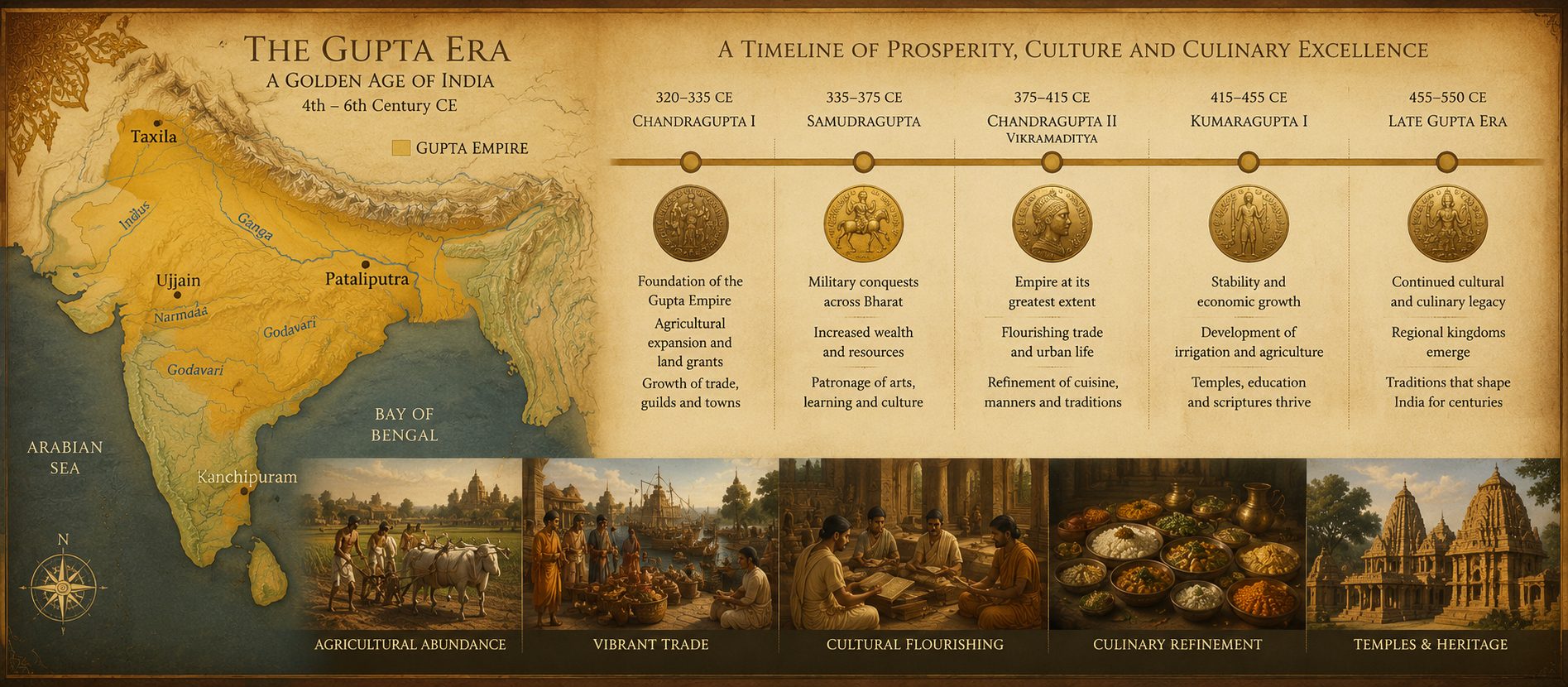
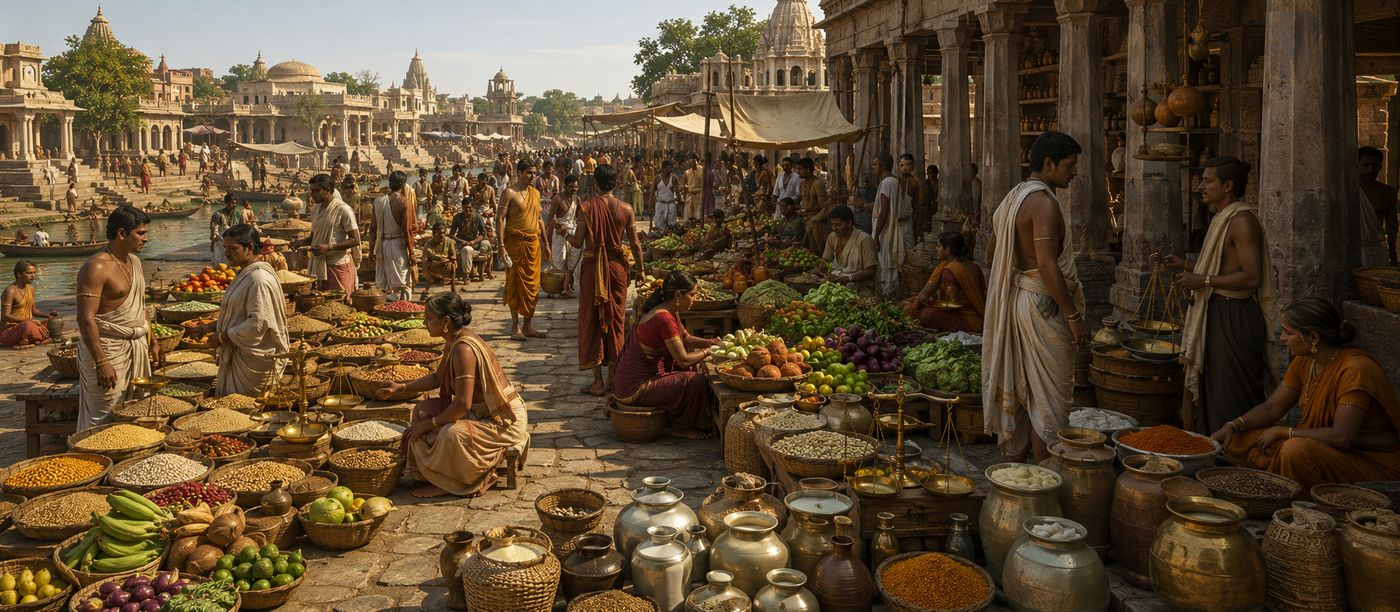
The Chinese monk Fa Hien, who travelled through Gupta India around 400 CE, describes a country of exceptional prosperity. Markets are abundant. Cities are well-organised. The population is fed. What he observes is a society that has moved beyond the basic problem of food security — the constant preoccupation of the Mauryan period — and is now free to think about food differently.
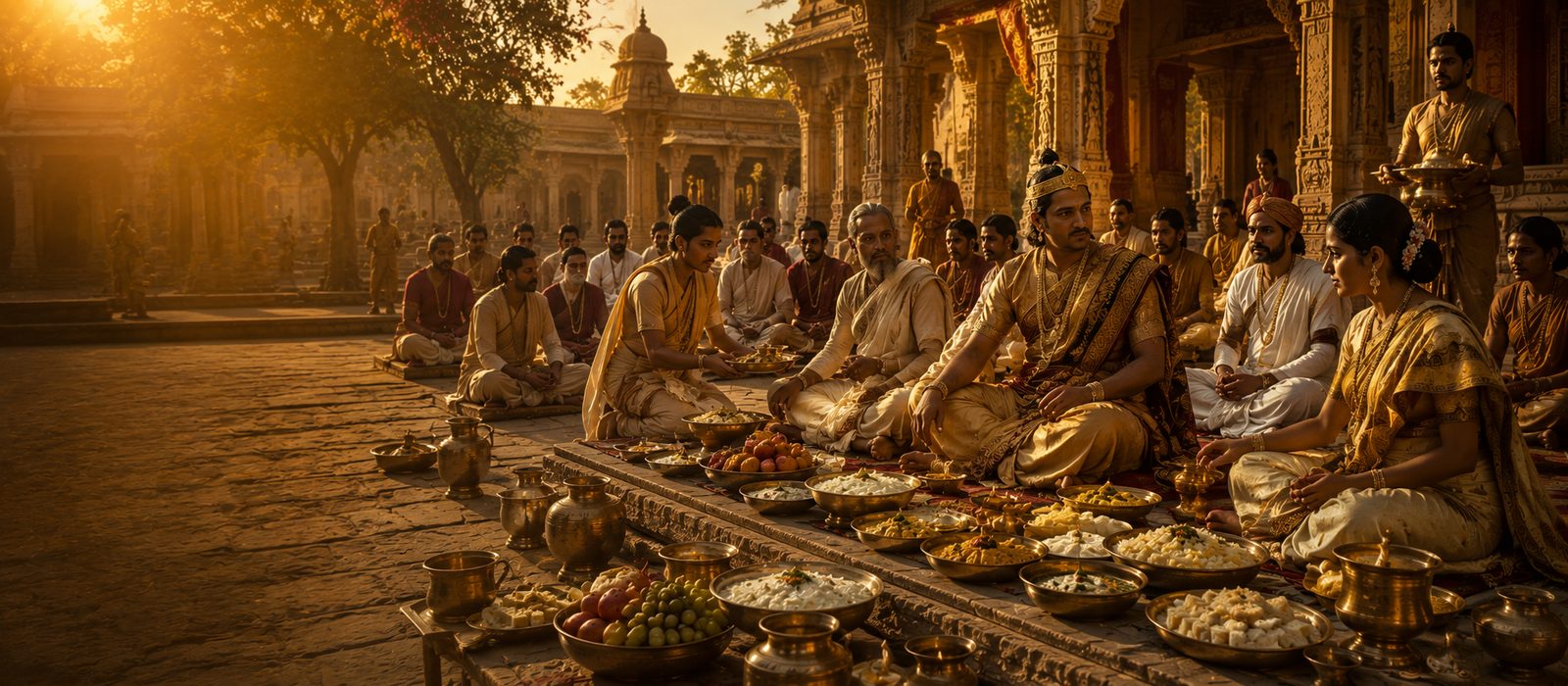
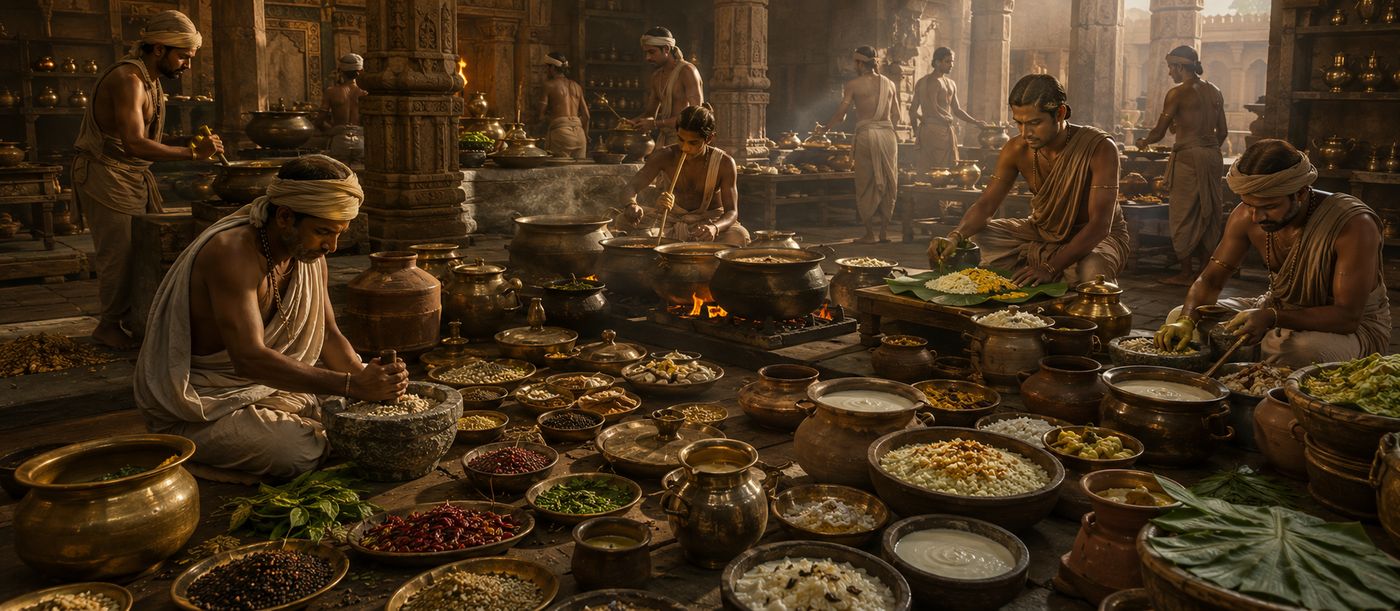
In the courts of Gupta India, food became a performance of culture. The preparation and service of food at royal banquets was governed by aesthetic principles as much as practical ones. Specific vessels for specific preparations, specific sequences of service, specific combinations of flavours — all of this is documented in the literature and Ayurvedic texts of the period. The cook in a Gupta court was not merely a craftsperson. The best were artists, and they were recognised as such.
This shift — from food as survival, to food as ritual (the Vedic period), to food as governance (the Mauryan period), to food as art (the Gupta period) — is one of the most important trajectories in the entire history of Indian cuisine. The Gupta period is where Indian cooking acquires the aesthetic ambition that distinguishes its greatest traditions today.
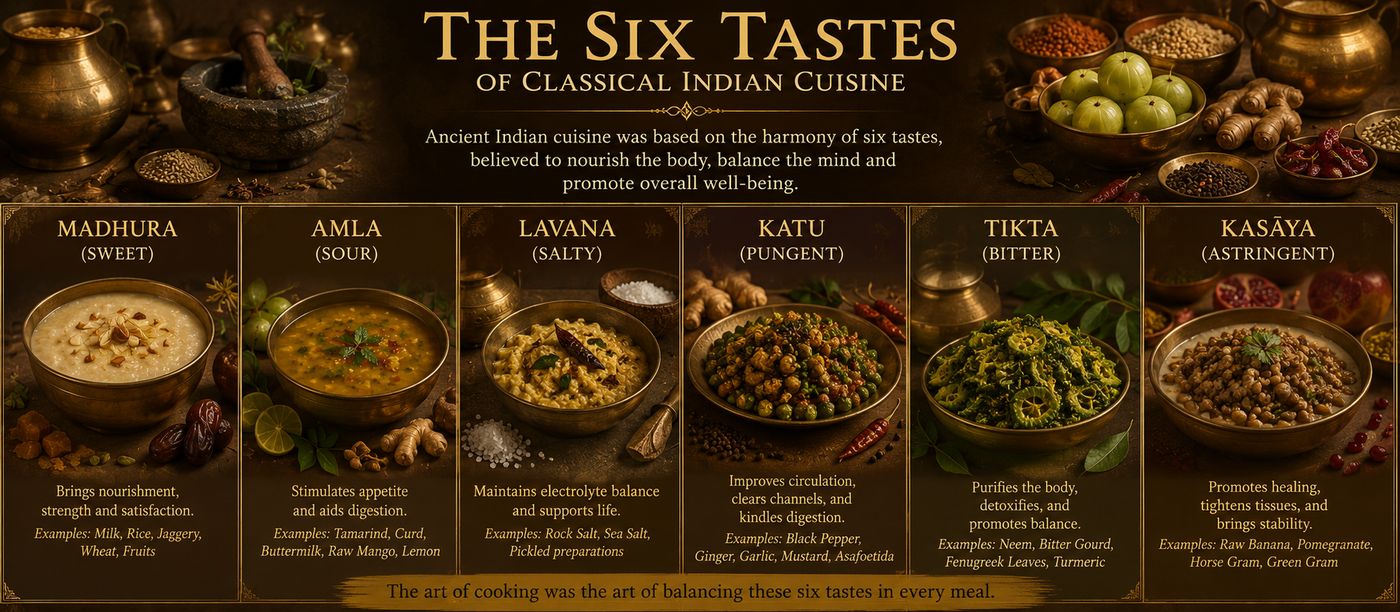
The six-taste framework is one of the most extraordinary contributions of Gupta-era food philosophy to world culinary thought. It is older than any European concept of flavour balance, more systematic than anything produced in the contemporary Byzantine or Tang Chinese culinary traditions, and it remains the foundation of Ayurvedic nutritional guidance today.
The system holds that every food has a primary taste from these six, and that a complete, balanced meal should include all six in appropriate quantities and sequence. Too much of any one taste is physically and mentally destabilising; the right balance produces health, satisfaction, and mental clarity. This is simultaneously a nutritional theory, a flavour philosophy, and a cooking framework — and it influenced every sophisticated Indian culinary tradition that followed.
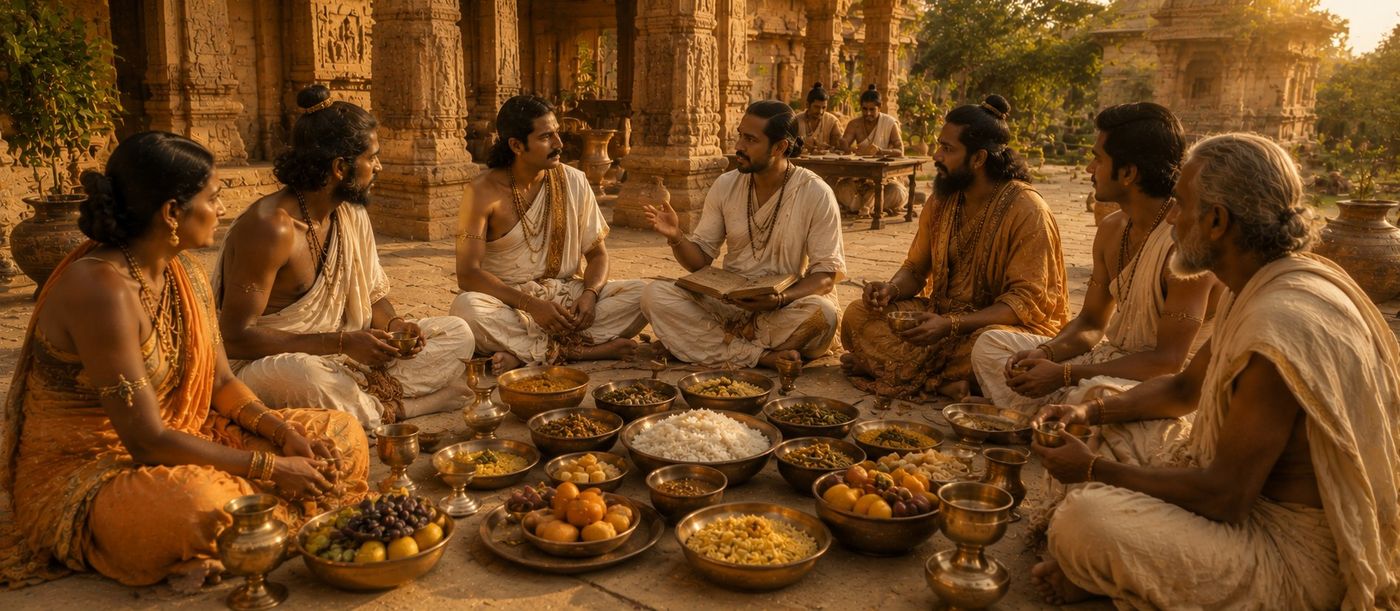
India's mithai tradition — the extraordinary world of milk-solid-based sweets that distinguishes Indian confectionery from every other culinary tradition — has its deepest roots in the Gupta period. The combination of ingredients and techniques that makes Indian sweets unique came together in this era: the availability of fresh milk and paneer, the development of jaggery and early crystallised sugar, the skill of working khoa (concentrated milk solids), and the Ayurvedic understanding that sweet foods are nourishing, grounding, and appropriate for celebrations.
The chemistry of Indian milk sweet making is distinctive. Heating milk while stirring continuously drives off water and concentrates the milk solids (proteins, fat, and lactose). At moderate temperatures, the result is khoa or mawa — a dense, slightly grainy mass that can be shaped, flavoured, and further cooked into dozens of preparations. At higher temperatures with acid addition, the proteins precipitate as paneer or chenna — the fresh curd cheese that is the basis of Bengal's famous sweets. The Maillard reaction and caramelisation that occur during heating create the complex caramel and nutty flavours that distinguish Indian milk sweets from the simpler sugar confectionery of other traditions.
The sweets that now define Indian festivals, weddings, and daily celebration have their earliest systematic development in the Gupta period. Each category represents a specific technique — a specific way of transforming milk, sugar, and ghee into something extraordinary.
The science of Indian milk sweet making is more complex than it first appears. The key transformation is the concentration of milk through sustained heating — a process that drives off water, concentrates proteins and fat, and triggers a series of chemical reactions that create flavour, colour, and texture.
As milk is heated above 70°C for extended periods, the Maillard reaction begins: the amino acids in milk proteins react with the lactose (milk sugar) to produce hundreds of new flavour compounds — the nutty, caramel, cooked-milk notes that characterise khoa. Simultaneously, some lactose caramelises, adding additional colour and sweetness depth. The proteins denature and aggregate, changing the texture from liquid to plastic to solid depending on how far the reduction is taken.
Why this matters for flavour: The specific flavour compounds produced by Maillard reaction in milk are different from those produced in other foods. The combination of milk proteins (casein and whey), milk fat, and lactose creates a specific flavour profile — rich, creamy, caramel, slightly nutty — that cannot be replicated by any other ingredient combination. This is why Indian milk sweets taste like nothing else in world confectionery.
The six-taste framework is not arbitrary — each taste corresponds to a distinct set of chemical compounds that have documented physiological effects. Sweet taste responds to simple sugars and some amino acids; sour to organic acids (citric, lactic, malic, tartaric); salty to sodium and other mineral ions; pungent to volatile organic compounds including piperine (pepper), gingerols (ginger), and allicin (garlic); bitter to alkaloids and other complex organics; astringent to tannins and polyphenols. The Ayurvedic claim that each taste has distinct health effects is not pharmacological nonsense: the chemical classes that produce each taste do have distinct metabolic and physiological activities, even if the specific Ayurvedic attributions are sometimes imprecise.
Because the six-taste framework is still active. Every time an Indian cook adds a pinch of jaggery to a dal to balance the sourness of tamarind, they are applying the shadrasa principle — consciously or not. Every time a temple kitchen prepares prasadam with sweet, salt, and a touch of spice, they are working within a flavour philosophy that was systematised in the Gupta period. Every time an Ayurvedic practitioner recommends specific foods for specific conditions, they are drawing on the nutritional framework that Gupta-era physicians codified.
The Gupta period also gave Indian food its ambition. Before this era, food in India was sacred, practical, and important — but the idea that cooking was an art form, that specific flavour combinations were aesthetically superior to others, that a meal could be designed as well as prepared — this is a Gupta-period idea. It is the idea that eventually produces the elaborate court cuisines of the Mughal period, the extraordinary temple kitchen traditions of South India, and the complex regional food cultures that make Indian cooking the most diverse culinary tradition in the world.
| Gupta India, c. 400 CE | Modern India |
|---|---|
| Shadrasa — six taste balance as cooking philosophy | Ayurvedic cooking and nutrition still structured around the six tastes; taught in food science and traditional cooking |
| Kheer as festival and ritual food | Kheer and payasam still on every Indian festival table — the preparation is identical, the cultural role unchanged |
| Early crystallised sugar emerging | India still one of the world's largest sugar producers — the same Gangetic and Deccan agricultural systems |
| Jaggery as primary everyday sweetener | Jaggery retained in regional cooking, festival food, and traditional medicine — the same product, same process |
| Food as aesthetic as well as practical | Indian food culture's extraordinary diversity and sophistication — the direct inheritance of the Gupta period's elevation of cooking to art |
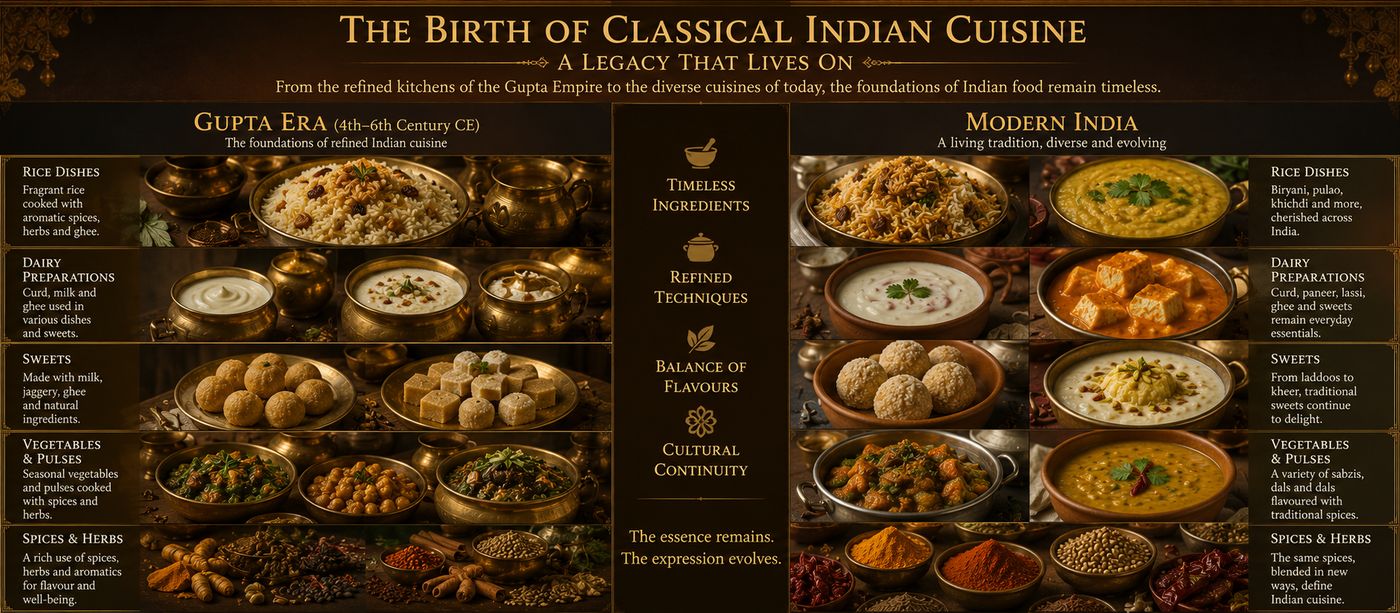
The Gupta period's legacy in Indian food is invisible precisely because it is so thoroughly absorbed — it is not a visible layer added to Indian cooking, but the philosophical foundation beneath it.