★★★★★ Delhi
★★★★★ North India street food
★★★★☆ All India
What Does Kabuli Chana Taste Like?
Kabuli Chana in Every Indian Language
| Language | Name | Pronunciation |
|---|---|---|
| English | White Chickpea / Garbanzo Bean | kah-BOO-lee CHAH-nah |
| Hindi | काबुली चना — Kabuli Chana | kah-BOO-lee CHAH-nah |
| Bengali | কাবুলি ছোলা — Kabuli Chola | kah-BOO-lee CHO-lah |
| Tamil | கொண்டைக்கடலை — Kondakadalai | kon-dah-KAH-dah-lye |
| Telugu | సెనగలు — Senagalu | seh-NAH-gah-loo |
| Malayalam | കടല — Kadala | KAH-dah-lah |
| Kannada | ಕಡಲೆ — Kadale | KAH-dah-leh |
| Gujarati | કાબુલી ચણા — Kabuli Chana | kah-BOO-lee CHAH-nah |
| Marathi | काबुली चणे — Kabuli Chane | kah-BOO-lee CHAH-neh |
| Punjabi | ਕਾਬਲੀ ਛੋਲੇ — Kabli Chole | KAHB-lee CHO-leh |
| Urdu | کابلی چنا — Kabuli Chana | kah-BOO-lee CHAH-nah |
| Sanskrit | श्वेत चणक — Shweta Chanaka | SHWEH-tah CHAH-nah-kah |
What Is Kabuli Chana?
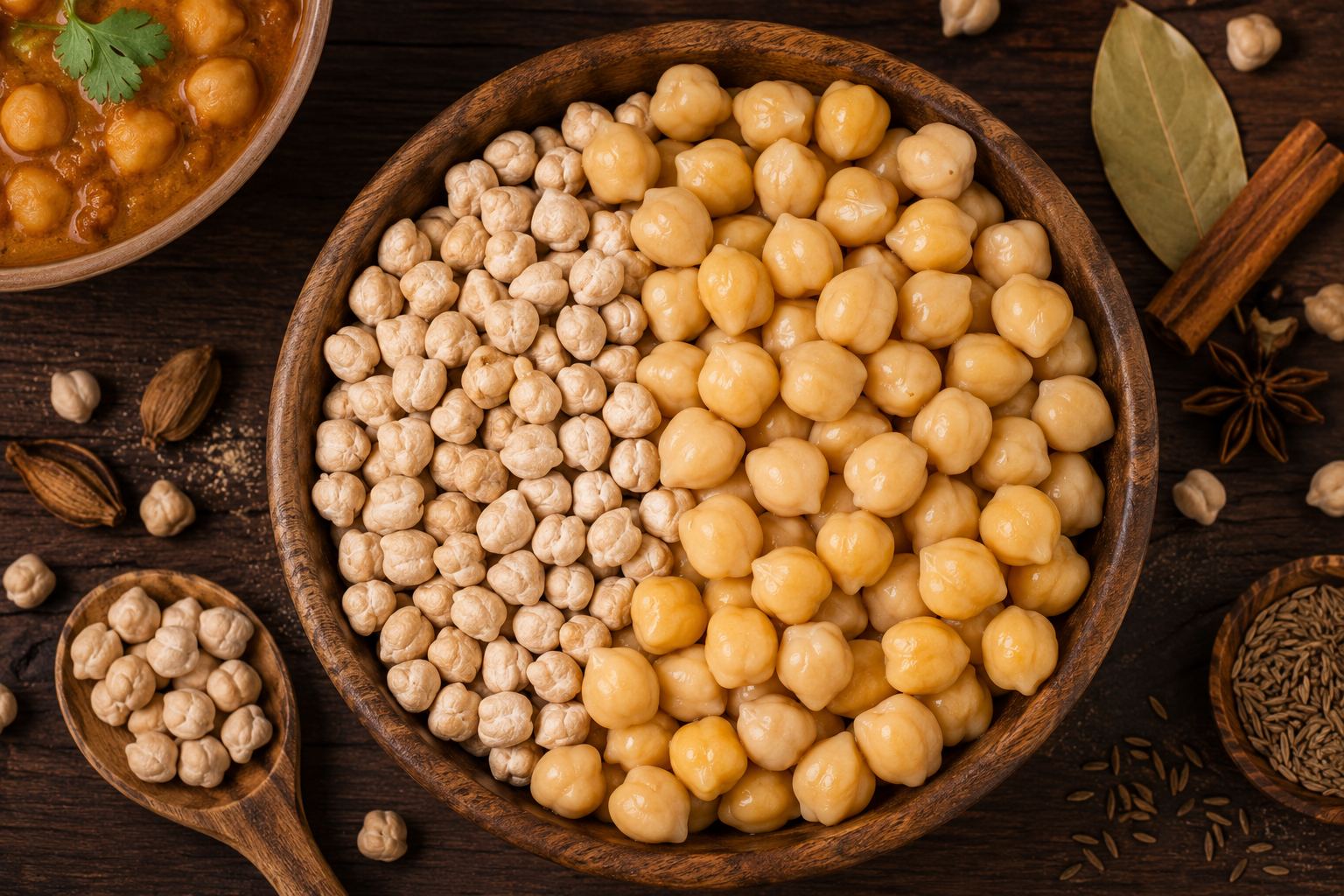
Kabuli chana — the white or 'Kabuli' chickpea — is the large, smooth, cream-coloured variety of Cicer arietinum that dominates Western and Middle Eastern chickpea cooking (it is the chickpea of hummus and falafel) and has become equally central to North Indian cuisine through chole. It is distinct from kala chana (desi chickpea) — smaller, darker, wrinkled, and more ancient to the subcontinent.
The name 'kabuli' references Kabul, reflecting the medieval trade route through which this larger-seeded variety reached India from Central Asia and the Mediterranean. Once introduced, it was rapidly adopted and became the foundation of one of North India's most beloved dishes: chole, the spiced chickpea curry that defines Punjabi and Delhi street food culture, eaten with bhature, poori, or rice.
- Chole Bhature — the quintessential Punjabi-Delhi breakfast and street food — is built entirely on kabuli chana; no other legume produces the right texture or flavour absorption
- Samosa chaat and aloo tikki chaat across North India use boiled kabuli chana as a base layer beneath the chutneys and yogurt
- Chana masala, served in restaurants worldwide as one of India's most recognisable vegetarian curries, depends on kabuli chana's ability to hold its shape while becoming tender
- The chickpea's versatility — equally at home in North Indian curry, Middle Eastern hummus, and Mediterranean salads — makes it one of the most globally connective Indian pantry staples
- Without kabuli chana, North India's most iconic street food and breakfast culture loses its centrepiece ingredient
Kabuli Chana Through History
Kabuli chana's name reflects its documented arrival path: traders moving through Kabul brought this larger, paler chickpea variety into North India during the medieval period, likely accelerating in the Mughal era when trade and culinary exchange between Central Asia, Persia, and the subcontinent intensified. This is distinct from kala chana (desi chickpea), which has been cultivated in South Asia since the Indus Valley Civilisation — kabuli chana is the comparative newcomer.
Despite its later arrival, kabuli chana was adopted with extraordinary speed and thoroughness. Chole — the spiced curry built around it — became so identified with Punjabi and Delhi food culture that it is now considered quintessentially North Indian, even though the chickpea itself originated far outside the subcontinent. This mirrors the pattern of other 'foreign' ingredients (potato, tomato, chilli) that became definitionally Indian after introduction. Delhi's chole bhature stalls and Punjabi dhaba culture cemented kabuli chana's status by the mid-20th century as a daily, beloved, and unmistakably Indian food.
The Science of Kabuli Chana
How to Store Kabuli Chana
How to Buy Good Kabuli Chana
How to Use Kabuli Chana Correctly
- Soak overnight (8–12 hours) — essential for even cooking and digestibility
- Pressure cook: 30–40 minutes (soaked) until very tender, not just soft
- For chole: add a tea bag or 2 dried amla to the soaking/cooking water for the traditional dark colour
- Cook until chickpeas are tender enough to mash easily between fingers, but still hold shape
- For salads or chaat: cook until just tender, do not overcook
- 1/2 cup dry per 2 servings
What Kabuli Chana Pairs Well With
Dishes That Use Kabuli Chana
Where Kabuli Chana Matters Most
| North Indian Cuisine | Essential |
| Punjabi Cuisine | Essential |
| Street Food | Essential |
| Restaurant Indian (all India) | Essential |
| Jain Cooking | Common |
| Sattvic Cooking | Common |
Kabuli Chana vs Kala Chana vs Rajma
| Feature | Kabuli Chana | Kala Chana | Rajma |
|---|---|---|---|
| Size | Large, smooth | Small, wrinkled | Medium, kidney-shaped |
| Colour | Cream-white | Dark brown-black | Deep red |
| Origin | Mediterranean/Central Asia | Ancient South Asian | Americas |
| Glycemic index | Higher — ~33–47 | Lower — ~28–35 | Moderate |
| Primary dish | Chole, hummus | Festival prasad, curry | Rajma chawal |
| Texture cooked | Firm exterior, creamy centre | Firm, nutty | Soft, meaty |