Series 1 · The Chronological Story · Chapter 10 of 17
The Spice Trade
How Pepper, Cardamom and Cinnamon
Connected India to the World
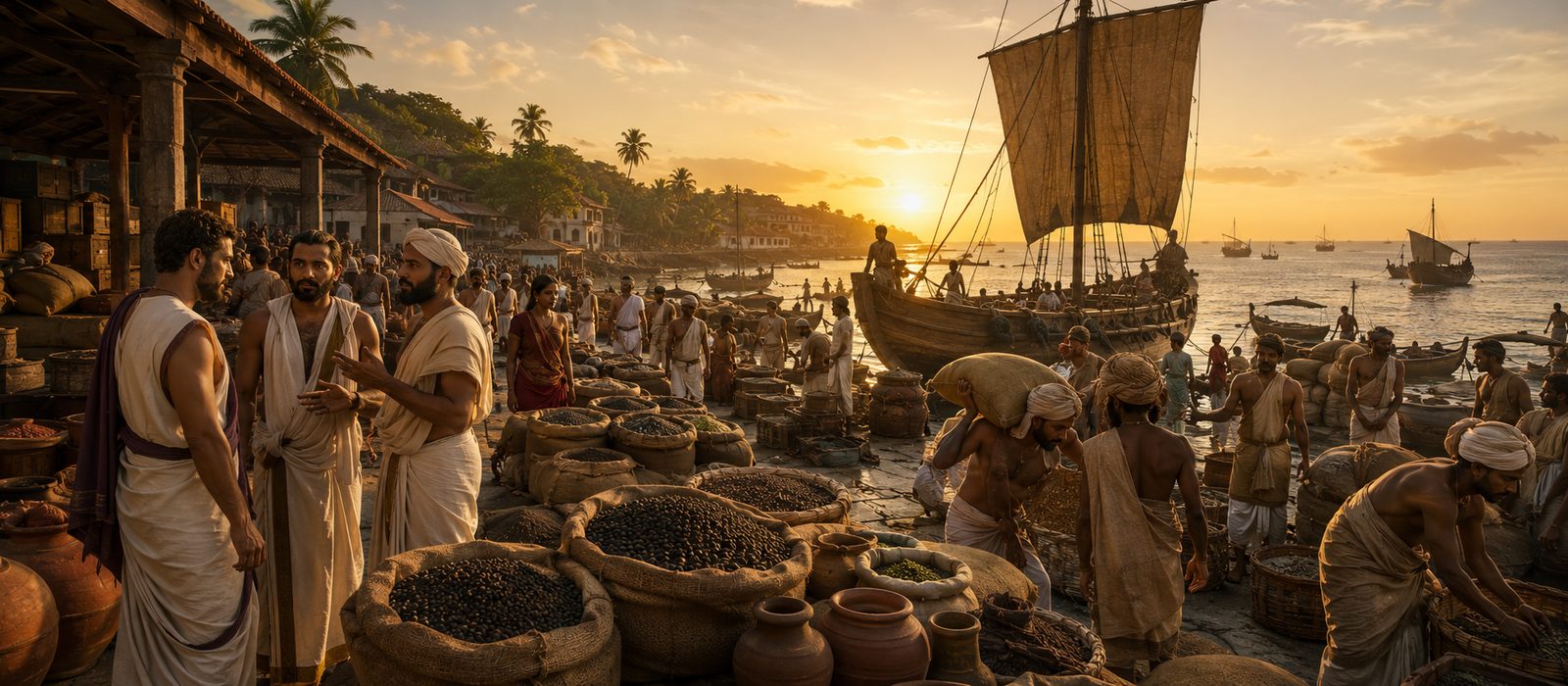
Artist's reconstruction based on historical evidence
How Pepper, Cardamom and Cinnamon
Connected India to the World
Artist's reconstruction based on historical evidence
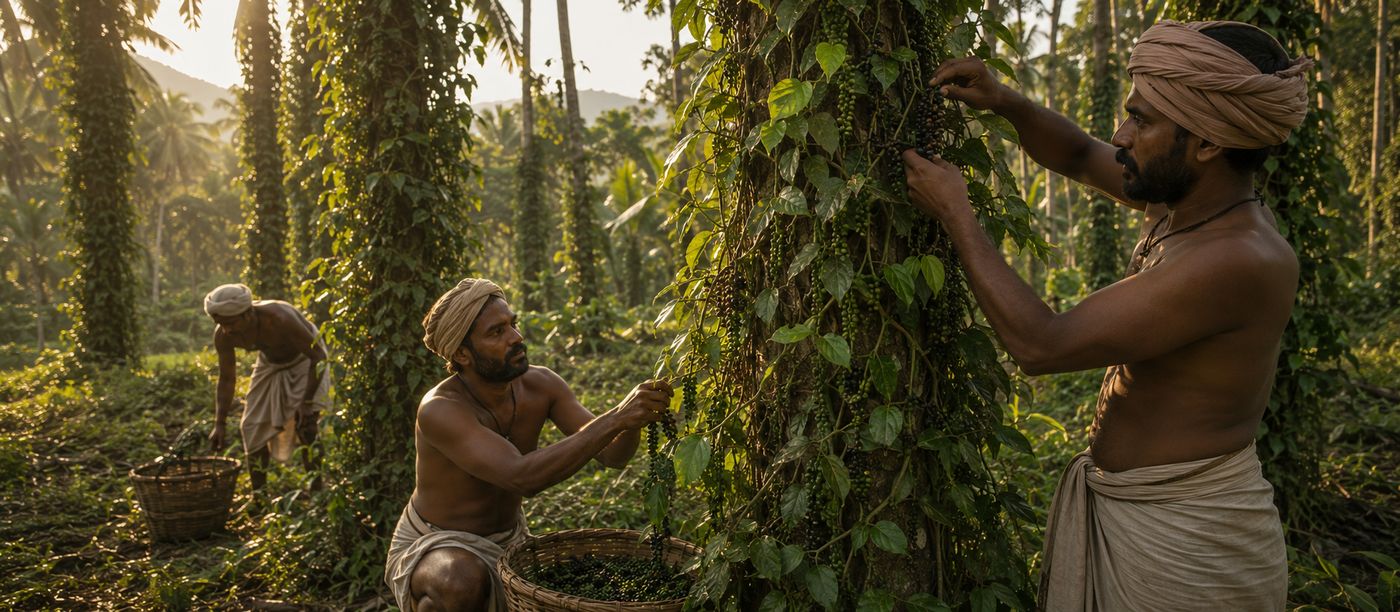
Two thousand years before container ships crossed the oceans, merchants were already sailing toward India in search of a cargo so valuable it could rival gold. The cargo was not silk. It was not precious stones. It was the dried berry of a climbing vine that grew on the humid hillsides of Kerala's Malabar Coast — black pepper. The story of how this small, hot, aromatic fruit connected the ancient world is not simply a story of food. It is a story of trade, exploration, wealth, diplomacy, and empire. It is, in a very real sense, the story of how the modern world began.
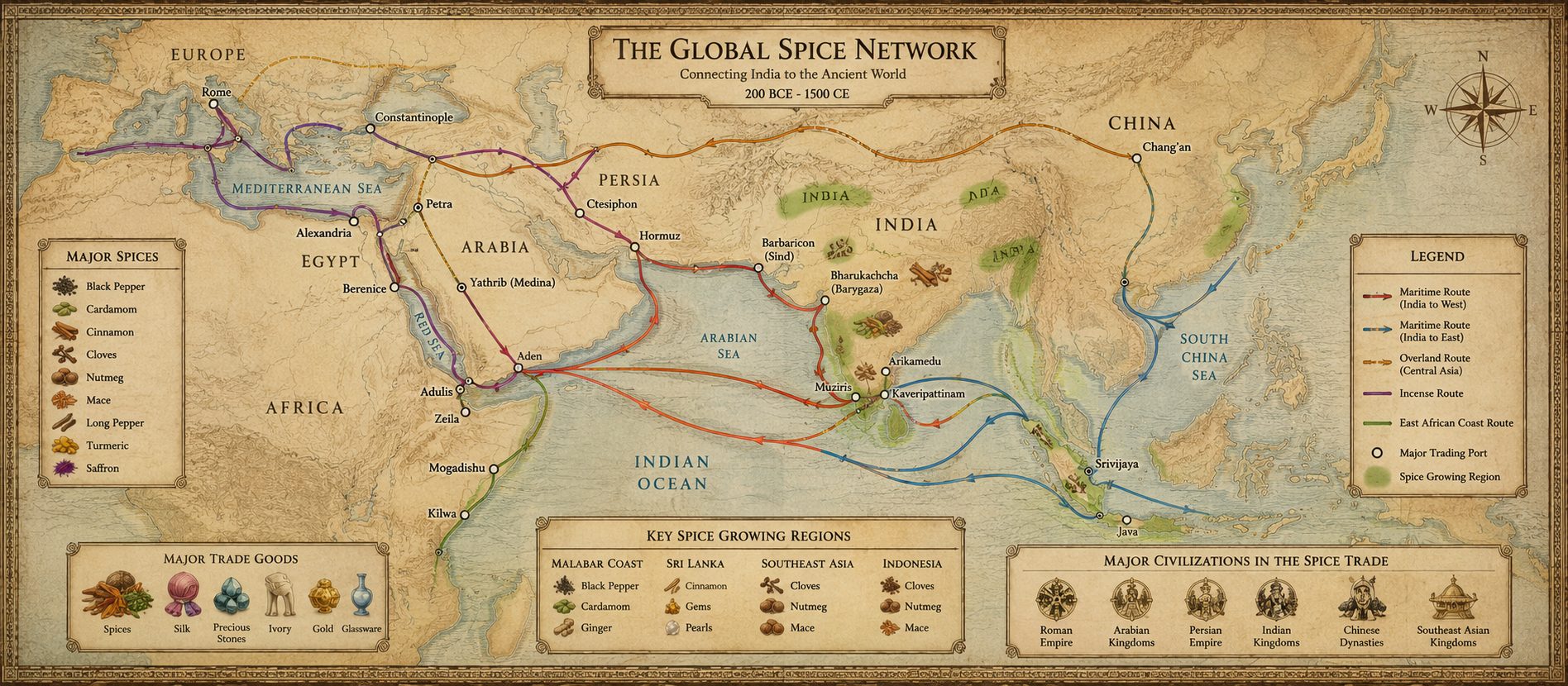 🔍 Click to enlarge
One of the most important things the Indian spice trade reveals is that the ancient world was far more connected than popular history suggests. The standard narrative presents globalisation as a modern phenomenon — a product of the industrial revolution, container shipping, and the internet. But the reality is that meaningful, sustained commercial connections between distant civilisations were operating at least three thousand years ago, and Indian spices were at the centre of those connections.
Consider what the ancient spice trade required: agricultural production of specific crops in specific geographic locations; processing and preservation of those crops for long-distance transport; ships capable of sailing ocean routes; navigational knowledge of monsoon wind patterns; commercial infrastructure (weights, measures, credit, contracts) allowing transactions between parties who did not share a language; and political stability sufficient to make trade more profitable than piracy or seizure. All of this was in place around the Indian Ocean by at least the 1st century BCE, and probably much earlier.
The monsoon winds were the key technology. The summer monsoon blows consistently from the southwest — from the Arabian coast toward India — between May and September. The winter monsoon reverses, blowing from the northeast — from India toward Arabia and Africa — between November and February. A merchant who understood this pattern could sail from the Red Sea or Persian Gulf to the Malabar Coast in roughly three months, trade, and return home on the return monsoon. The round trip was possible within a single year. This knowledge — almost certainly developed gradually by Arab and Indian fishermen and coastal traders over many centuries — made the annual spice trade mechanically feasible. The Periplus documents it in matter-of-fact terms: the monsoon system was common knowledge among the Indian Ocean's maritime communities by the time the text was written.
"India sends to no region of the world a greater plenty of her goods than to Rome. Every year, India drains the Roman Empire of fifty million sesterces. That is the price our luxury and our pleasure costs us."
Pliny the Elder, Natural History, c. 77 CE
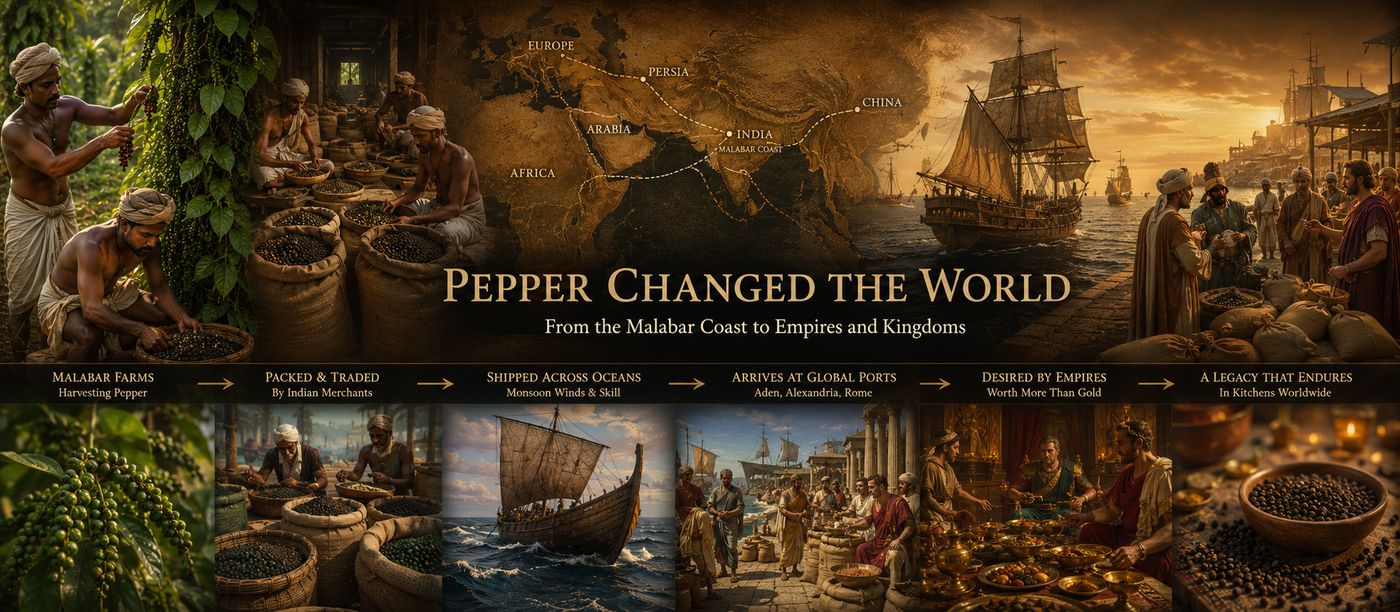
Black pepper is the most traded spice in human history. It grows as a climbing vine — Piper nigrum — on the humid, heavily forested hillsides of India's Western Ghats, particularly in the region that is now Kerala. It requires specific conditions: high rainfall, warm temperatures, rich laterite soil, and shade from taller trees. It cannot be grown in Mediterranean Europe, Arabia, or China. It cannot be synthesised or substituted. If you wanted black pepper in the ancient world, you needed India. And the ancient world wanted black pepper very badly indeed.
Why? Pepper provided something that no local European spice could provide: genuine heat. The pungency of black pepper — caused by the compound piperine — was not simply a pleasant flavour note. Before refrigeration, pepper's antimicrobial and preservative properties were practically valuable. Strong-tasting food was also a marker of wealth and status in a world where most people ate monotonously. And pepper's rarity and long-distance origin gave it the psychological cachet of the exotic — the same cachet that expensive imported goods carry today.
In Rome at the height of the empire, black pepper was used not just in cooking but as currency, tribute, and ransom. When the Visigoth king Alaric sacked Rome in 410 CE, his ransom demand included 3,000 pounds of black pepper alongside gold and silver. Pepper was hoarded, bequeathed in wills, and used to pay soldiers' wages. The Latin word for a pepper dealer — piperarim — gives us the English word "peppercorn rent" — a notional payment implying something of minimal value, which is a historical irony given that pepper was once among the most valuable commodities in the world.
Of all the places in the history of the Indian spice trade, none is more important and more tantalisingly obscure than Muziris. The Periplus of the Erythraean Sea describes it as "the first emporium of India" — the primary destination for western merchants arriving on the Malabar Coast. Roman coins have been found in enormous quantities in Kerala, particularly around the area of modern Kodungallur-Pattanam, which most scholars identify with or near the ancient port. The Sangam Tamil poetry of the same period describes a port city of extraordinary cosmopolitan life — foreign ships, foreign merchants, foreign languages, warehouses full of imported goods alongside the pepper, cardamom, and cotton that were being exported.
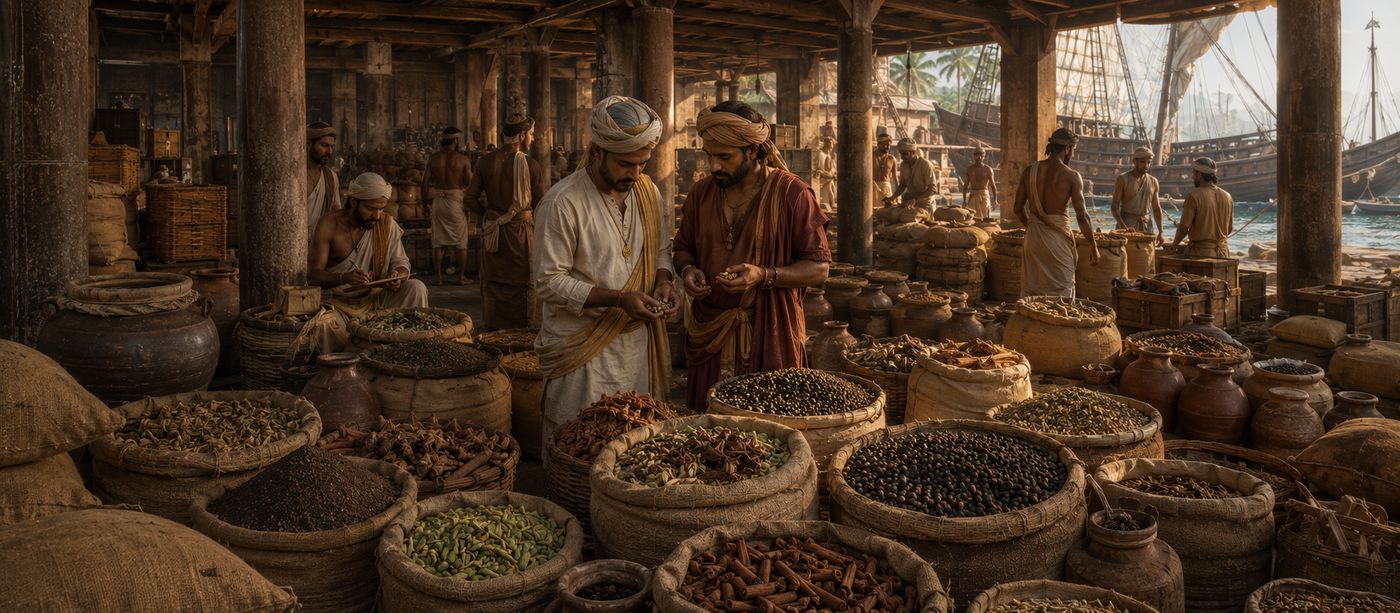
What the Periplus describes at Muziris gives us a concrete picture of the trade at its height. Roman ships — large merchant vessels capable of carrying hundreds of tonnes of cargo — arrived riding the summer monsoon, typically in July or August. They brought gold and silver coins, coral, glass, copper, lead, tin, wine, and cloth. They left, after several months of trading, with black pepper as their primary cargo, alongside cardamom, fine cotton textiles, pearls, and ivory. The return journey on the winter monsoon brought them back to the Red Sea ports — Berenice or Myos Hormos — from which the goods were transported overland to Alexandria and then by Mediterranean ship to Rome.
The Muziris Papyrus — an extraordinary document discovered in Egypt and dated to approximately 150–180 CE — preserves the terms of a loan contract for a single spice trading voyage. The cargo being financed consisted primarily of pepper, nard (spikenard — a Himalayan aromatic), and ivory. The loan amount was seven million sesterces. This single document confirms that individual Muziris trading voyages were financed at a scale that only major Roman banking operations could support.
The ancient spice trade was not a simple two-party transaction between India and Rome. It was a complex network of overlapping routes, intermediaries, and markets, with spices often changing hands a dozen times between the pepper vine in Kerala and the Roman dinner table. Understanding this network explains both the astronomical price of pepper in Rome and the extraordinary wealth it generated for the communities along the route.
Cardamom (Elettaria cardamomum) is native to the forests of the Western Ghats — the same mountain range that produces black pepper, growing at elevations between 800 and 1,500 metres. It has been traded from India since ancient times, and like pepper, it reached the Mediterranean world via Arab intermediaries long before European ships arrived on the Malabar Coast. Cardamom appears in ancient Egyptian medical papyri, in Greek and Roman spice lists, and in Arab medical texts from the medieval period.
Cardamom's journey is different from pepper's in one important respect: it never acquired the same economic dominance in European markets, partly because its flavour is more subtle and harder to use, and partly because it requires more careful handling during transport. But in Arab and Persian culinary traditions — where cardamom-scented coffee, rice dishes perfumed with cardamom, and meat preparations spiced with it are central — cardamom from the Malabar and Coorg highlands was a spice of extraordinary cultural significance. The Arab spice trade and Indian cardamom grew up together.
The cinnamon traded in the ancient Mediterranean world came primarily from Sri Lanka (then known as Taprobane), not mainland India. But the trade passed through Indian coastal ports, and cinnamon was regularly associated with India in ancient Western accounts. The confusion between "true cinnamon" (Cinnamomum verum from Sri Lanka) and cassia (Cinnamomum cassia from China and Vietnam, which is what most "cinnamon" sold today actually is) was present in ancient texts and was in some cases deliberately maintained by Arab spice traders who kept their sources secret to protect their trading advantage.
Before black pepper became the dominant spice of Western cooking, long pepper (Piper longum) was the primary heat-providing spice traded from India to the Mediterranean. Long pepper is more pungent than black pepper, with a complex flavour that includes notes of ginger, cardamom, and resinous depth alongside its heat. It was the pepper described in ancient Roman recipes, and it traded at a premium over black pepper in early Roman markets. The arrival of easier-to-grow black pepper eventually displaced long pepper in European markets, but long pepper remains in use in Indian, Indonesian, and North African cooking, and has been experiencing a revival in serious Western cooking in recent years.
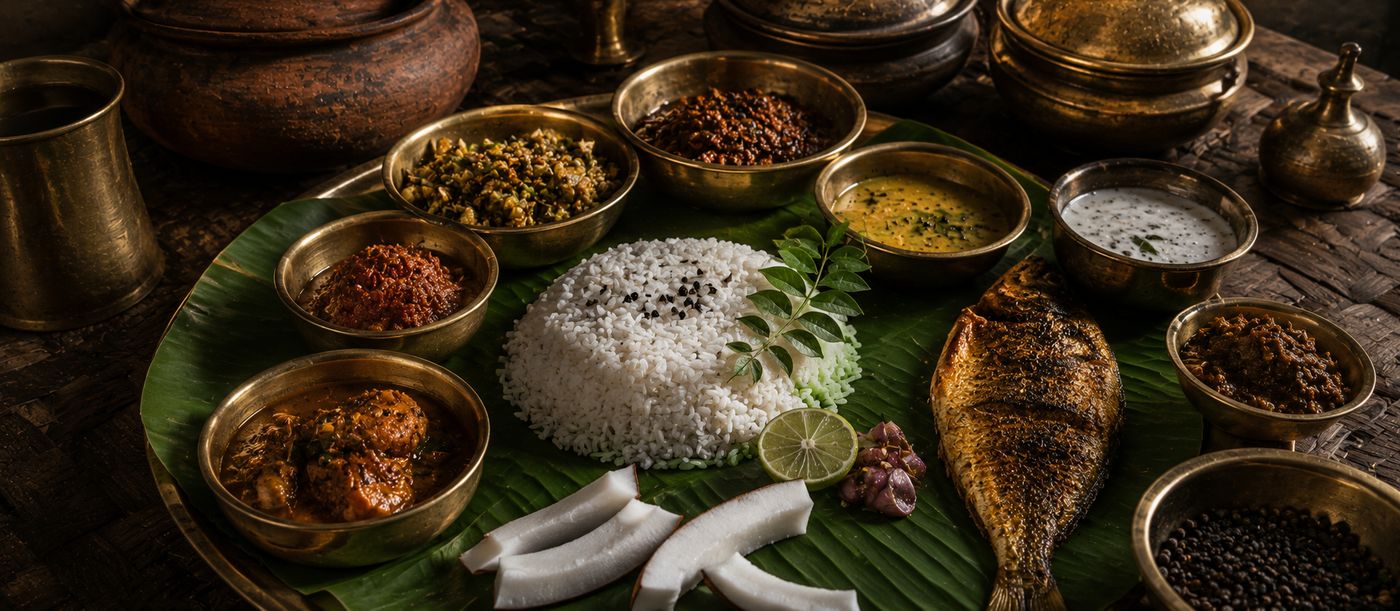
The merchant has been in Muziris for three months. He arrived with a Roman ship in July, riding the southwest monsoon, carrying amphorae of Italian wine, bolts of fine linen, and copper ingots. He has traded most of his cargo for black pepper — sacks of it, stacked in the warehouse near the harbour — plus a smaller quantity of cardamom, nard, and a few fine pearls for personal trade. Tomorrow the winter monsoon will begin its northeast flow, and the ship will sail for the Red Sea.
Tonight's meal is not Roman. It is the food of Muziris — the coastal Kerala food that has been shaped by three centuries of trade with the world beyond India. The merchant sits cross-legged on a woven mat in the trading house maintained by a prosperous local spice merchant who hosts foreign traders. The meal arrives on banana leaves.
First, a rice preparation — the rice of Kerala's coastal region, shorter and stickier than the long-grain rice of the Gangetic plain, cooked with coconut milk until it is slightly sweet and extraordinarily fragrant. Alongside it, a fish curry: the abundant fish of the Malabar coast — probably kingfish or mackerel — cooked in a sauce of kokum (the souring fruit native to this coast), coconut, and black pepper. The pepper is not the dried commodity in his warehouse sacks. It is fresh — recently harvested, still green, with an aromatic intensity that the dried version does not carry. He has eaten it before in Rome, dried and ground, as a powder. He has never tasted it like this.
There is also a preparation of cooked lentils with mustard seeds and curry leaves — the curry leaf that is native to this coast and does not survive drying well enough to export, which means it will remain unknown to European cooking for more than another thousand years. Coconut sambal. Fresh ginger. A final touch of cardamom in a warm drink of sweetened coconut milk.
The merchant has eaten Roman food, Egyptian food, Arab food. He is not sure he has ever eaten anything as extraordinary as this.
What did people eat at the nodes of the ancient spice network — and how did the trade itself shape regional food cultures?
The Sangam Tamil poetry of the 1st–3rd centuries CE describes coastal Kerala life in considerable detail. Rice from the coastal paddy fields was the staple. The Arabian Sea provided abundant fish. Coconut — native to the coast — flavoured both the cooking oil and the curries. Black pepper grew literally outside the door on climbing vines. The meal is described with sufficient specificity in Sangam literature to reconstruct with high confidence: fish cooked in coconut and sour ingredients, rice, and the fresh aromatics of the coast including pepper and ginger.
Apicius — the 4th-5th century CE Roman cookbook — uses pepper in the majority of its recipes. Black pepper, long pepper, cumin, ginger, and coriander appear throughout. A wealthy Roman dinner of this period would have used Indian spices as a constant background note — not as a single exotic flavour but as the expected aromatic foundation of complex dishes. The Roman elite diet was substantially shaped by Indian spice imports. Specific pepper-heavy preparations like pepper sauce (ius piperati) appear in the texts.
The heat of black pepper is produced by a single compound: piperine (1-piperoyl piperidine). Piperine is an alkaloid — a nitrogen-containing organic molecule — that is unique to plants in the Piper genus. It is the compound that makes black pepper pungent, and it is structurally and chemically quite different from the compound that makes chillies hot.
Chilli heat comes from capsaicin, which activates TRPV1 receptors — the same nerve receptors that respond to actual heat above about 43°C. This is why chilli creates a burning sensation: it is literally triggering the heat-detection system of your nervous system. Piperine activates a different receptor — TRPA1, the "wasabi receptor" — which is associated with chemical irritation and is also activated by mustard, horseradish, and allyl isothiocyanate. The sensation is similar in some ways but different in character: pepper heat is sharper, more immediate, and fades faster than chilli heat.
Why this matters for cooking: Piperine is fat-soluble and relatively heat-stable, but it volatilises significantly when freshly ground pepper is added at the start of cooking. The standard culinary advice to add pepper at the end of cooking or at the table is chemically correct: the most volatile aromatic compounds in pepper — the terpenes like caryophyllene, limonene, and pinene that give pepper its complex fragrance — are destroyed by prolonged heat, leaving only the piperine-based heat without the aromatics. Freshly ground pepper added at the end retains both heat and fragrance.
The preservative function of spices — one of the practical reasons the ancient world valued them — is now well-understood scientifically. Piperine in black pepper, eugenol in cloves and cinnamon, allicin in garlic, and the volatile oils of many other spices have documented antimicrobial activity against specific bacterial and fungal pathogens.
The mechanism is primarily disruption of bacterial cell membranes: the hydrophobic (fat-loving) terpene and phenolic compounds in spice essential oils insert themselves into bacterial cell membranes and disrupt their integrity, causing the bacteria to lose the selective permeability that they need to maintain their internal chemistry. In sufficient concentration, this kills the bacteria. At lower concentrations, it slows their growth — which is the preservative mechanism relevant to food.
The practical significance: in a pre-refrigeration world, where food spoilage was a constant threat, heavily spiced food genuinely lasted longer than unseasoned food. The ancient and medieval use of spices in meat preparations was not simply about flavour — it was a practical food safety technology, even though the people using it had no knowledge of germ theory. The spice trade served a preservation function as well as a culinary one, and this practical value was part of what sustained the extraordinary demand and extraordinary prices.
The concentration of spice production on India's Malabar Coast — modern Kerala — is not accidental. The Western Ghats create a specific microclimate: the mountains trap the summer monsoon, producing some of the highest rainfall in India (3,000–5,000mm annually) on their western slopes. This rainfall, combined with warm temperatures (25–32°C year-round), high humidity, and rich laterite soil, creates ideal conditions for the cultivation of Piper nigrum, Elettaria cardamomum, and other tropical spice crops.
The same mountains that create the climate also created geographic barriers that concentrated spice trade at specific coastal ports — Muziris, Calicut, Quilon — where the mountain passes met the sea. These ports became the natural interface between the spice-producing interior and the maritime trade routes. The geography that made Kerala's spices possible also made Kerala's ports inevitable. The Malabar Coast's dominance of the ancient spice trade is as much a function of mountains and monsoon as of any human commercial decision.
Because the consequences of the spice trade are still with us. The Americas exist in their current political and demographic form partly because Columbus was searching for India's pepper. The British presence in India — which lasted until 1947 and shaped the modern Indian state — began as a commercial enterprise motivated by the desire to access Indian spice more cheaply. The entire colonial infrastructure of the modern world has roots in the European desire to control the spice trade that India had been at the centre of for two thousand years.
Kerala's food culture is also a direct product of the trade. The Arab merchants who settled on the Malabar Coast to manage the spice trade brought with them dates, dried fruits, rice preparations, and cooking techniques that became integrated into Mappila Muslim cooking. The trade brought Roman, Greek, Jewish, and later Chinese commercial communities to Kerala's ports, each leaving traces in the food culture. The extraordinary diversity of Kerala's regional cuisines — Mappila, Syrian Christian, Nair, Jewish — is partly a product of two thousand years of the world passing through its ports.
And black pepper itself? It is still the most traded spice in the world. The vine that Pliny complained about, the berry that ransomed Rome, the crop that sent Columbus west and da Gama south — is still being grown, harvested, dried, and ground into the spice that appears on virtually every table in the world. The piperine that makes it hot is the same compound that it has always had. The flavour that Roman merchants tasted at Muziris is the flavour in your pepper grinder today.
| Ancient Spice Trade | Modern World |
|---|---|
| Pepper monopoly gave India extraordinary economic power | India no longer dominates pepper production — Vietnam is the world's largest exporter. The geographic monopoly that held for 2,000 years ended with colonial-era transplanting. |
| Arab intermediaries controlled the trade for centuries | Global commodity markets and container shipping have eliminated intermediary monopolies — pepper moves from Vietnamese farms to your kitchen via direct supply chains |
| Spices as luxury goods, priced beyond most people's reach | Black pepper costs less per gram than table salt in most countries — the most dramatic price collapse in commodity history |
| Monsoon winds as the enabling technology | Container ships follow the same Indian Ocean routes, in the same seasonal patterns — the geography hasn't changed, only the engines |
| Muziris as the world's most important spice port | Kochi (Cochin) — near the site of ancient Muziris — is still India's primary spice export port. The port function has persisted for 2,000+ years |
| Spices used partly for preservation | Refrigeration eliminated the preservation function — spices are now used purely for flavour, which has changed how they are used and in what quantities |
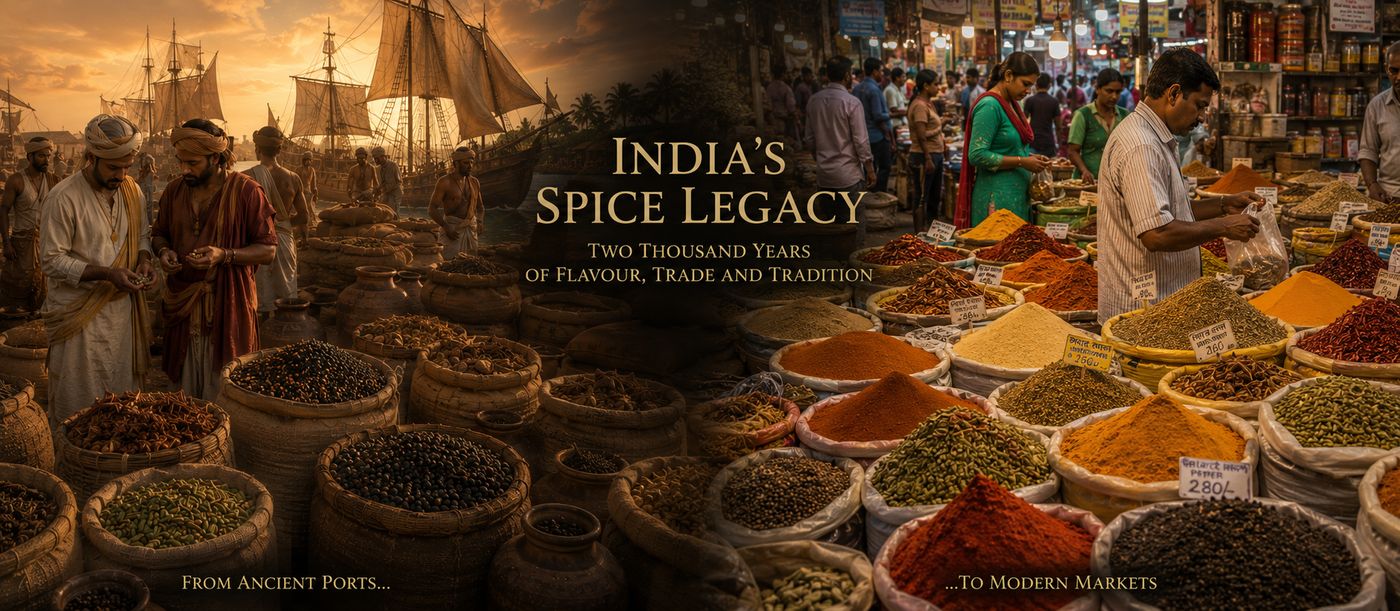
The Indian spice trade reshaped the world. Its legacy is visible in the political map of the modern world, in Kerala's food culture, and in the pepper grinder on your kitchen counter.