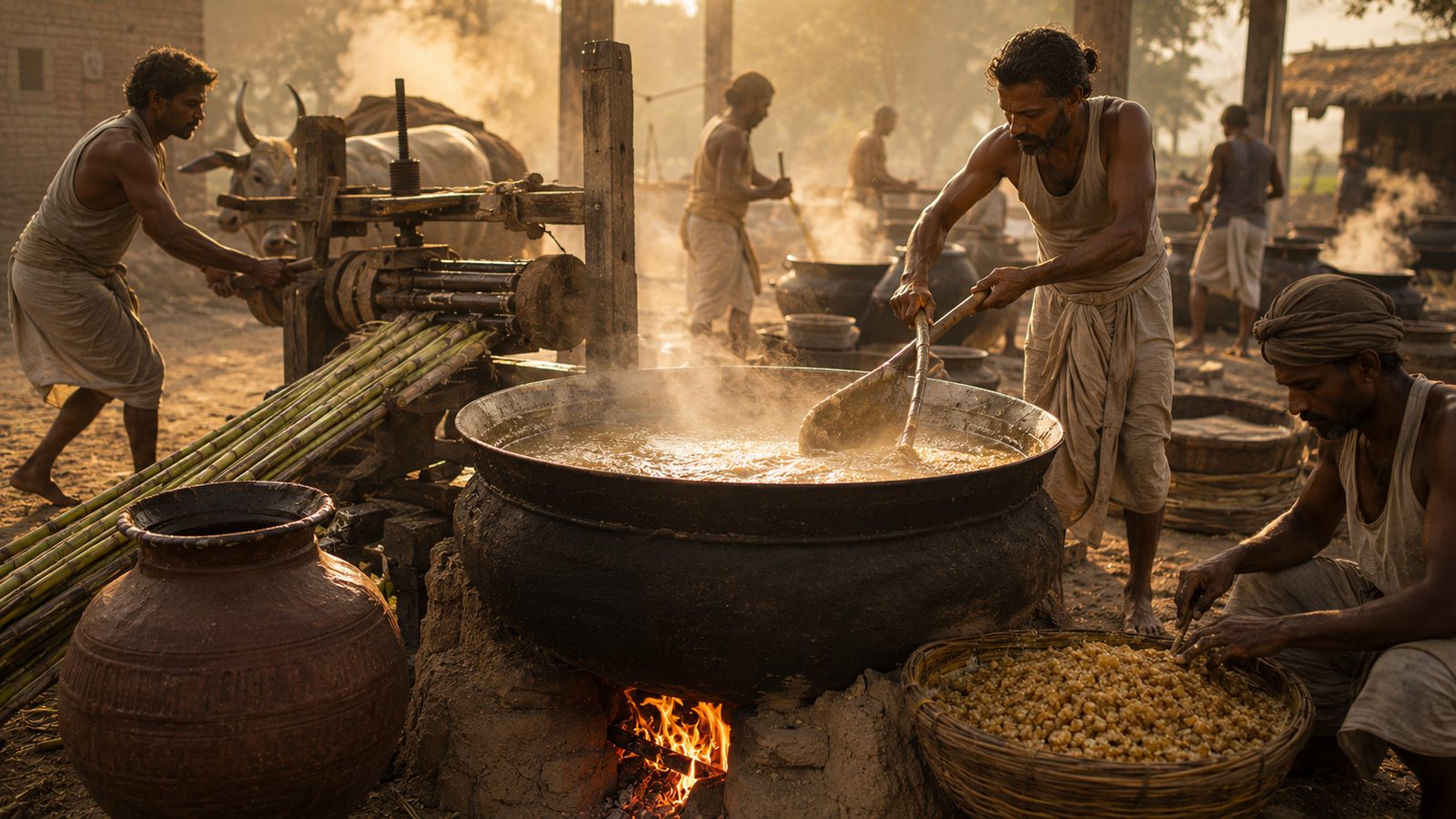
The word sugar traces back to Sanskrit. The technology that made sweetness available to the world was developed in India. The linguistic trail from sharkara to sugar passes through Persia, Arabia, Italy, France, Spain, and England — and every step of that journey follows the actual physical movement of a product invented on the Gangetic plain two and a half thousand years ago.
A World Before Crystallised Sugar
For most of human history, sweetness was rare, precious, and almost entirely sourced from honey. Honey required finding wild bee colonies, enduring stings, and processing a product that was variable in quality and impossible to produce at scale. In ancient Rome, honey was used as a preservative and medicine as much as a sweetener. In ancient India, honey (madhu) appears in Vedic texts as a sacred substance, a medicine, and a food — but not as an everyday sweetener for ordinary cooking.
The development of crystallised sugar changed this equation permanently. Sugar could be produced at scale, stored for months or years without spoiling, transported across vast distances without deteriorating, and eventually made cheap enough for ordinary households to use daily. This transformation — from rare luxury to everyday commodity — is one of the most consequential changes in human food history, and it began in India.
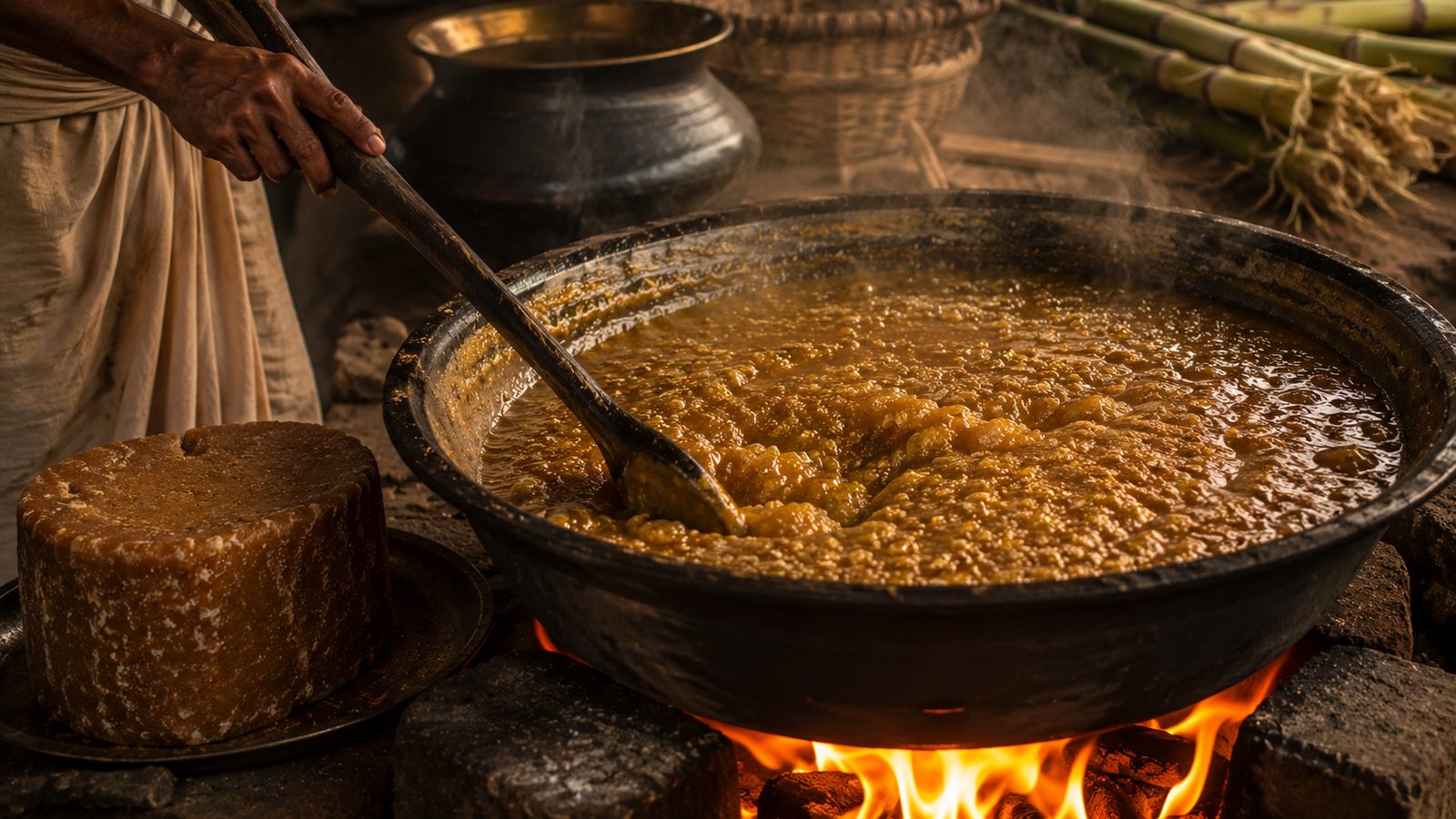
Ancient Indian sugar production: boiling concentrated sugarcane juice until crystallisation occurs — the technological breakthrough that changed the world's relationship with sweetness.
What the Archaeology Tells Us
Archaeological Evidence at a Glance
c. 2000 BCE: Sugarcane cultivation established in India. The plant had arrived from New Guinea via Southeast Asia. Initial use: chewing the cane directly, pressing for fresh juice.
c. 350 BCE: Earliest evidence of sugar crystallisation technology in India. The Arthashastra, compiled around this period, references sharkara as a traded commodity — indicating an established production industry.
Mauryan Period (322–185 BCE): Sugar documented in the Arthashastra as a regulated trade commodity with documented production methods.
Gupta Period (320–550 CE): Sugar production well-established. Persian visitors and traders encounter Indian sugar and begin transmitting the technology westward.
7th Century CE: Arab adoption of sugar technology following Islamic conquests of Persia. The Islamic world becomes the next major sugar-producing civilisation.
Timeline of Sugar's Journey
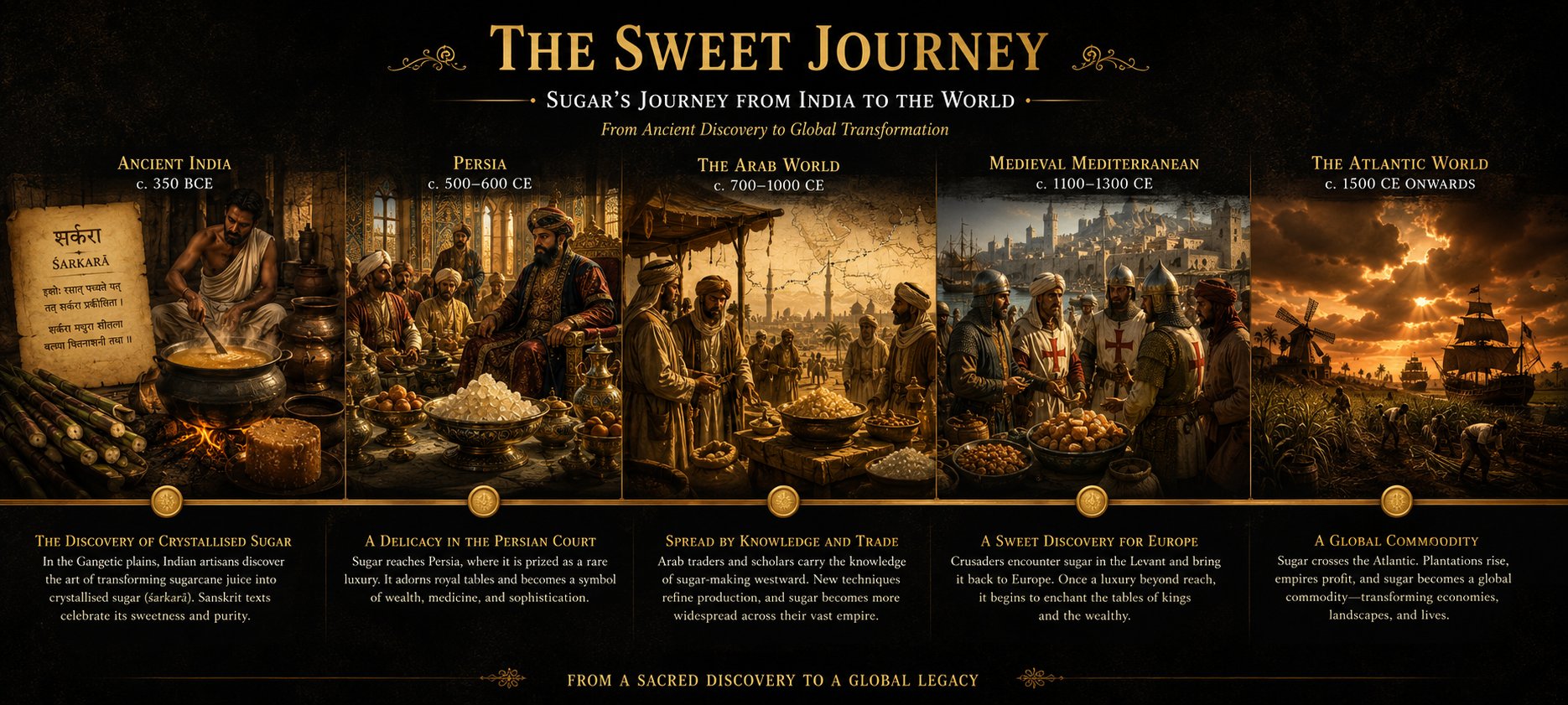
From ancient Indian crystallisation to global commodity — the four-thousand-year journey of sugar. Click to enlarge.
| Date | Event |
|---|---|
| c. 2000 BCE | Sugarcane cultivation established in India. Fresh juice consumed but no solid sugar yet. |
| c. 350 BCE | Earliest documented evidence of sugar crystallisation technology in India. Arthashastra references sharkara as traded commodity. |
| Mauryan Period | Sugar production and trade documented in state records. India establishes itself as the world's primary sugar-producing civilisation. |
| Early CE | Sugar knowledge reaches Persia through trade. Persian literature begins referencing Indian sugar. |
| 7th Century | Arab adoption of sugar technology following Islamic conquests of Persia. Arab merchants spread sugar production westward. |
| Medieval Period | Arab traders bring sugar to Sicily, Spain, and the Mediterranean. European Crusaders encounter sugar in the Near East. |
| 15th–16th Century | Portuguese and Spanish establish sugar plantations in the Atlantic islands and the Americas. |
| 17th–19th Century | Atlantic plantation system at its height. Same Indian technology, now powering one of history's greatest crimes. |
| Present | India is one of the world's largest sugar producers. Jaggery survives as India's ancient sweetener alongside refined sugar. |
The Word That Proves the Journey
The Sanskrit word sharkara — meaning gritty or granular substance, referring to crystallised sugar — is the origin of every European word for sugar. It became shakar in Persian, sukkar in Arabic, zucchero in Italian, sucre in French, Zucker in German, azúcar in Spanish, and sugar in English. This linguistic trail maps the actual physical journey of the product and the technology across the ancient world, from India westward through Persia and the Arab world into Europe.
Every time someone says the word sugar in any European language, they are using a word that traces back to an ancient Indian technological achievement. The etymological chain is unbroken. It is one of the clearest linguistic proofs of any ancient technology transfer in food history.
"Every European word for sugar — sucre, zucchero, Zucker, azúcar — traces directly to the Sanskrit sharkara. The linguistic chain is the map of the actual journey: India, Persia, Arabia, the Mediterranean, the world."
The Discovery That Changed the World
The precise moment when Indian cooks or farmers first discovered that boiling cane juice, concentrating it, and inducing crystallisation could produce a stable solid is not documented. What the evidence strongly suggests is that this technology was developed in India — almost certainly in the Gangetic plains — and that the earliest clear evidence of it dates to around 350 BCE.
The process is not obvious: it requires understanding that cooling a sufficiently concentrated sugar solution causes crystals to form, that these crystals can be separated from the remaining liquid (molasses), and that the resulting dry product is stable in ways that juice never is. This was a genuine technological breakthrough — as consequential in the ancient world as the transformation from iron ore to iron. It converted a raw agricultural product into a versatile, durable, globally tradeable material.
The Science of Sugar — Why Crystallisation Matters
Why crystallisation was revolutionary: Raw cane juice ferments within hours and cannot be stored or transported. Crystallised sugar is stable for years — making it the first portable, durable sweetener in history.
Jaggery vs refined sugar: Jaggery (unrefined solidified cane juice) retains minerals, molasses compounds, and plant substances — producing a sweetener with complex flavour that refined sugar lacks. Jaggery caramelises at lower temperatures due to its molasses content.
Caramelisation: Pure sucrose caramelises between 160°C and 180°C, producing hundreds of complex flavour compounds. This is why different sugars cannot always be directly substituted in Indian sweets — the caramelisation behaviour differs, and Indian sweet-making is calibrated to specific sugar properties.
Umami from sugar: Sugar's role in Indian cooking extends beyond sweetness — a small amount in a savoury dish rounds and balances other flavours, particularly bitterness and acidity. This understanding was already present in ancient Indian cooking through jaggery long before refined sugar arrived.
Jaggery — The Ancient Sweetener That Survived
Before refined sugar became the global standard, and persisting strongly in India to the present day, jaggery (gur) was the primary solid sweetener. Jaggery is unrefined solidified cane juice — the liquid is boiled and concentrated but not refined through crystallisation. The result retains the minerals, molasses compounds, and plant substances of the original cane juice, producing a sweetener with a deep, complex flavour that refined sugar entirely lacks: slightly smoky, slightly caramel, with an earthiness that comes from the molasses content.
Jaggery is not an inferior precursor to refined sugar. It is a different product with different culinary properties. Til ke ladoo, chikki, puran poli, and gur ki kheer all depend on jaggery's specific flavour profile — refined sugar would produce a technically similar result that tastes wrong. Jaggery has been in continuous use in India for at least two thousand years and represents the most direct connection between modern Indian sweet-making and the ancient sugar technology that the subcontinent developed.
Before vs After: Global Sweetness
How Sugar Travelled West
Sugar knowledge moved westward from India through well-established trade networks. Persian traders brought the technology from India, and Persian literature from the Sassanid period references sugar production. When Arab armies conquered Persia in the seventh century CE, they inherited the Persian sugar industry and spread it further — across North Africa, into Sicily, and eventually to Spain and Portugal.
When Crusaders encountered sugar in the Near East in the eleventh and twelfth centuries, they described it as an extraordinary luxury — a product that had been in continuous use in India for over a thousand years. The chain runs clearly: India → Persia → Arab world → Mediterranean → Atlantic. At each stage, sugar production expanded. Eventually it became the basis for the Atlantic plantation system of the seventeenth and eighteenth centuries — the largest forced labour system in human history. The same Indian technological discovery that sweetened the world's food also drove one of the world's greatest crimes.
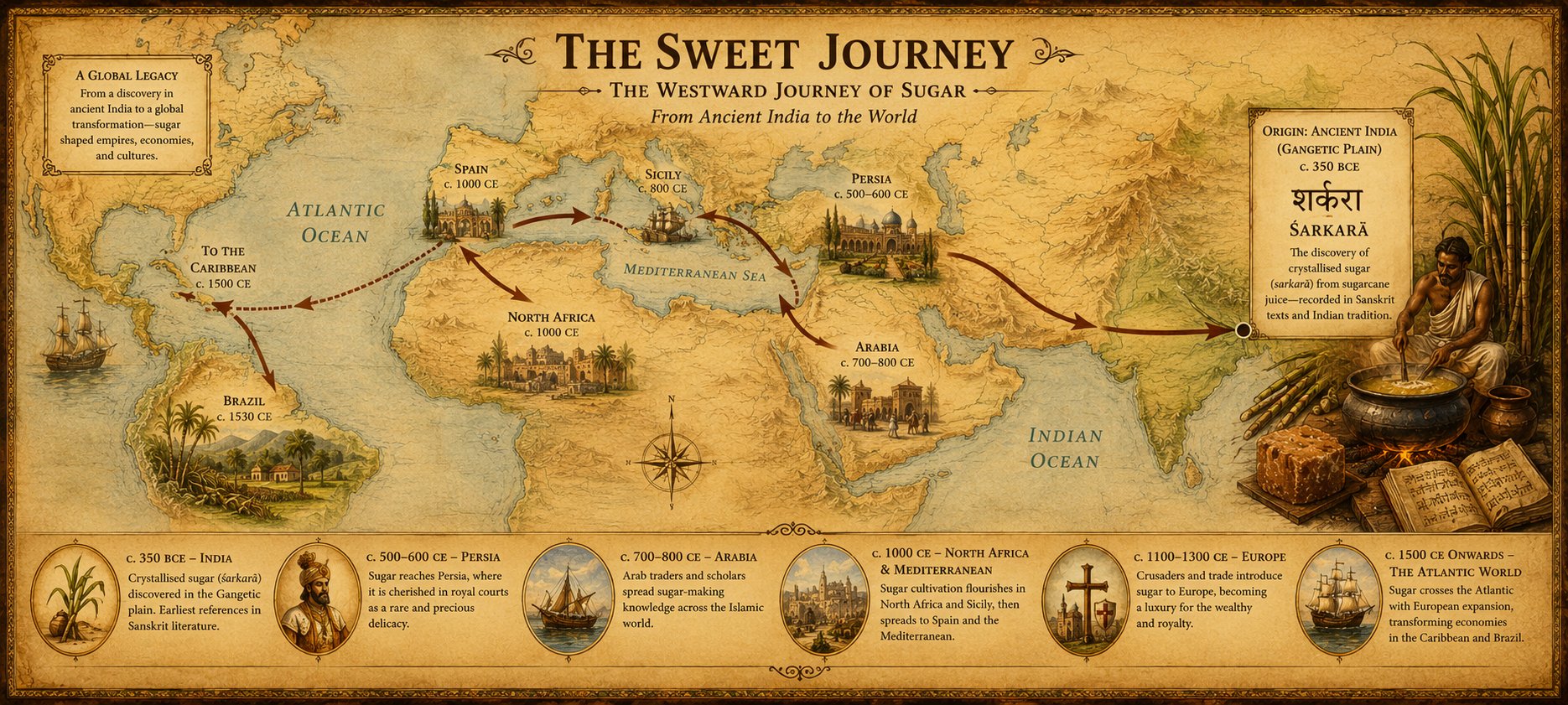
The sugar route: from ancient India westward through Persia, Arabia, and the Mediterranean to the Atlantic plantation system. Click to enlarge.
Regional Impact on Indian Cooking
Debate & Myths
Did India Really Invent Crystallised Sugar?
The evidence strongly suggests yes, with the standard scholarly caveat that it is difficult to prove a negative — that no other civilisation independently developed crystallisation technology before Indian contact. What the evidence shows positively: the earliest documented crystallised sugar is Indian; the technology transmits westward through Persia and the Arab world in a direction consistent with an Indian origin; and the universal linguistic evidence — sharkara → sugar in every European language — is unambiguous.
A minority of scholars suggest that parallel developments in China or Southeast Asia may have occurred. But the documentary record most clearly supports India as the primary origin and the Persian-Arab-Mediterranean route as the primary vector of global transmission.
Should India Be Held Responsible for the Atlantic Slave Trade?
No — and this is worth stating clearly. The Atlantic plantation system that enslaved millions of Africans was created by European colonial powers who chose to scale a production technology through forced labour. India developed crystallisation technology. Portugal, Spain, Britain, France, and the Netherlands made the decision to use that technology as the basis for one of history's greatest crimes.
The connection between Indian sugar technology and the Atlantic slave trade is real and worth acknowledging in any honest account of sugar's history. But moral responsibility follows the decisions made by the people who built the plantation system — not the people who first boiled cane juice to crystallisation two thousand years earlier on the Gangetic plain.
What If India Had Kept Sugar Secret?
Without the westward transmission of sugar crystallisation technology, sweetness would have remained a luxury for most of the world for much longer. The Mediterranean confectionery tradition — marzipan, nougat, Turkish delight — could not have developed. European cake and pastry culture, which depends on refined sugar, would not exist in its current form. The Atlantic plantation system — a direct consequence of European demand for cheap sugar — would not have occurred in the same way.
India itself would have retained global dominance in sugar production for far longer, and the Gangetic plain's sugar industry — already enormous in the Mauryan period — would have remained the primary source of the world's most valuable sweetener. The geopolitics of the ancient and medieval world would have been different in ways that cascade through subsequent history.
What Survived
The Ancient Sugar Tradition That Remains
Modern Legacy
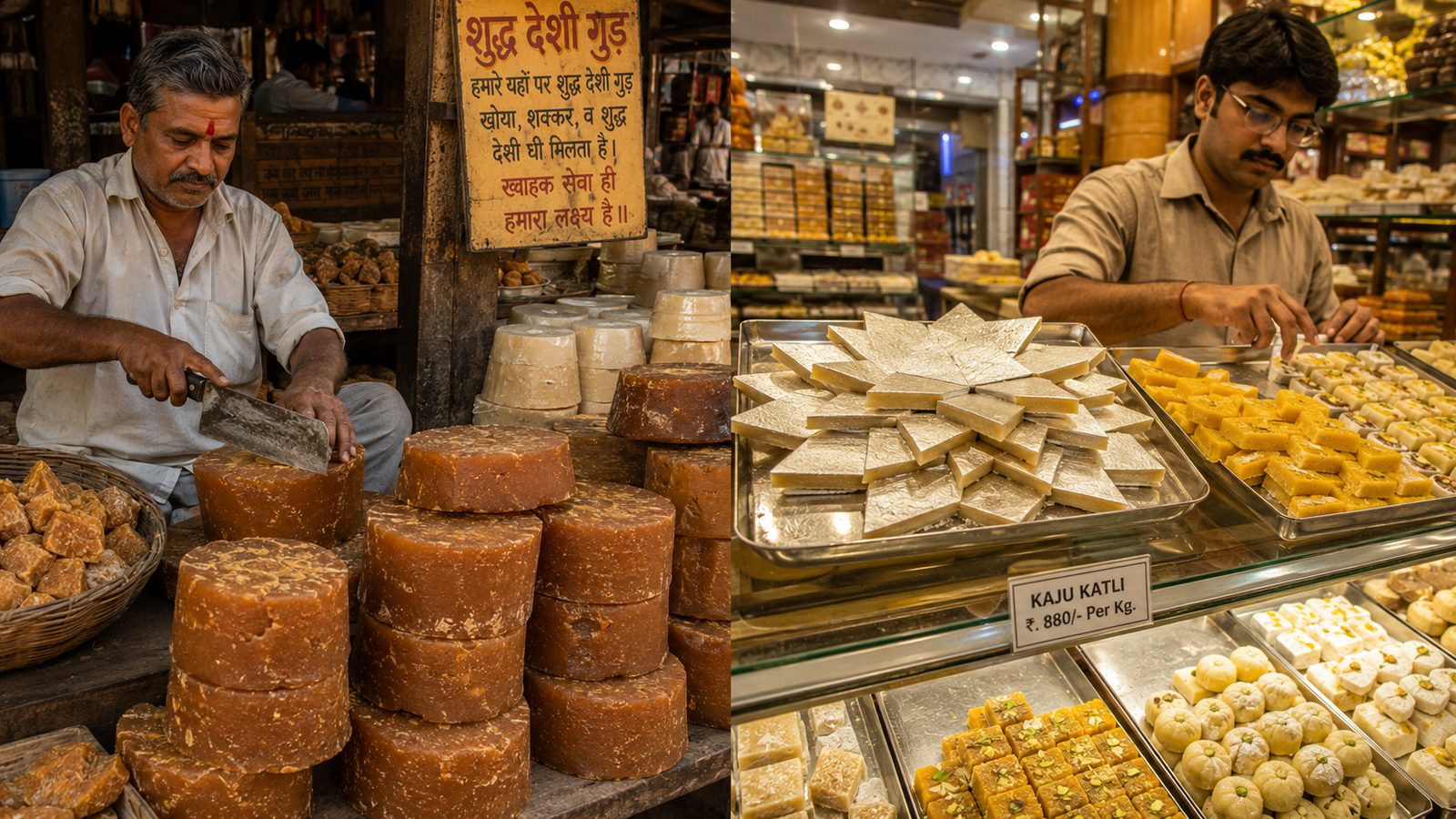
Modern India: jaggery and refined sugar coexisting — the ancient and the industrial, both descended from the same Gangetic plain crystallisation technology developed 2,400 years ago.
India today is one of the world's largest sugar producers and consumers. The refined white sugar in every Indian kitchen is the industrialised descendant of the same technology that ancient Indian farmers and cooks developed on the Gangetic plain — a technology that transformed the world's relationship with sweetness and set in motion a chain of events that included the global spread of confectionery culture, the establishment of the Arab sugar industry, and the tragedy of the Atlantic plantation system.
The jaggery that still sits in Indian kitchens, used for puran poli and til ladoo and gur ki chai, is the same product that ancient Indian cooks made before sharkara became sukkar became sugar and changed the world. It is one of the most direct connections between modern Indian cooking and the ancient Indian technological achievement that the entire global food industry depends on.
Food History Scorecard
| Impact Area | Change | Still Visible? |
|---|---|---|
| Global Food History | Extreme | Every sweet food tradition in the world depends on India's crystallisation technology |
| Indian Confectionery | Extreme | Mithai tradition built entirely on sugar and jaggery; one of the world's most elaborate sweet traditions |
| Jaggery Tradition | None | Ancient sweetener survives in continuous use — festival food, daily cooking, Ayurvedic practice |
| Global Trade | Extreme | Sugar as a traded commodity changed the economics of the ancient and medieval world |
| Agricultural Significance | Extreme | India is one of the world's largest sugarcane producers; the crop shapes entire regional economies |
| World History (dark) | Extreme | Atlantic plantation system and its consequences trace directly to the westward spread of Indian crystallisation technology |
Confidence Scale
| Claim | Confidence | Basis |
|---|---|---|
| Crystallised sugar was first developed in India | High | Earliest documentary and archaeological evidence is Indian. Linguistic transmission (sharkara → sugar) supports Indian origin. Some scholarly debate about parallel developments. |
| The Sanskrit sharkara is the origin of the English word sugar | Very High | Linguistically unambiguous. The chain sharkara → shakar → sukkar → zucchero/sucre/sugar is well-established. |
| Sugar technology transmitted westward through Persia and the Arab world | Very High | Well-documented in historical records of Sassanid Persia and early Islamic trade. |
| Jaggery has been in continuous use in India for at least 2,000 years | Very High | Documented in Ayurvedic texts, classical Sanskrit literature, and regional food traditions. |
| The Atlantic plantation system was a direct consequence of the westward spread of sugar technology | Very High | Established in historical scholarship. The causal chain is clear. |
Further Reading
- K.T. Achaya — Indian Food: A Historical Companion
- Colleen Taylor Sen — Feasts and Fasts
- Sidney Mintz — Sweetness and Power
- Arthashastra (attributed to Kautilya — references to sugar trade)
- Michael Coe and Sophie Coe — The True History of Chocolate