Series 1 · The Chronological Story · Chapter 16 of 17
Partition
When a Border Divided a Kitchen — 1947 and Its Food Legacy
1947 CE – Present·24 min read·Political History · Migration · Food Identity
Historical reconstruction based on documentary evidence
Reading Time by Section
Quick Facts1 min
Timeline2 min
Shared Food Before Partition4 min
Recipes Crossed the Border4 min
What the Border Created4 min
The Refugee Kitchen4 min
Legacy Today3 min
1947 — A Kitchen Divided
Refugees Carrying Recipes
The Shared Heritage That Borders Cannot Erase
Historical reconstruction based on documentary evidence
At A Glance
Date
14–15 August 1947
India and Pakistan independence; Partition begins
Displacement
14–17 Million People
The largest mass migration in human history
Deaths
200,000–2 Million
Estimates vary widely — the violence was catastrophic
Border Drawn
5 Weeks
The Radcliffe Line — drawn in weeks, dividing centuries
Food Legacy
Immense and Complex
Shared dishes, disputed origins, new traditions in exile
What Refugees Carried
Recipes in Memory
Many families brought nothing but knowledge of what they cooked
Key Food Legacy
Punjabi Diaspora Cuisine
The dominant flavour of North Indian restaurants worldwide
Chapter Theme
Food as Memory
What happens to a food tradition when its context disappears overnight
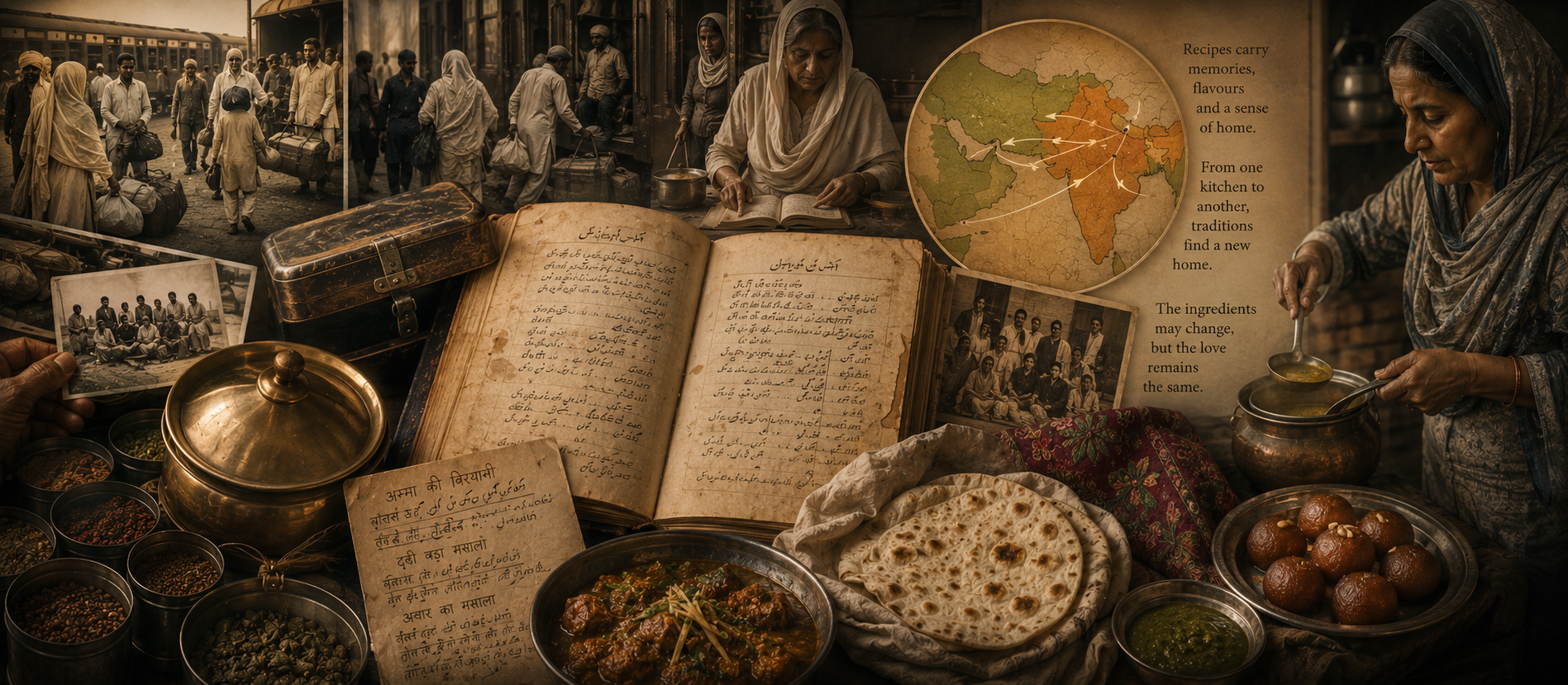
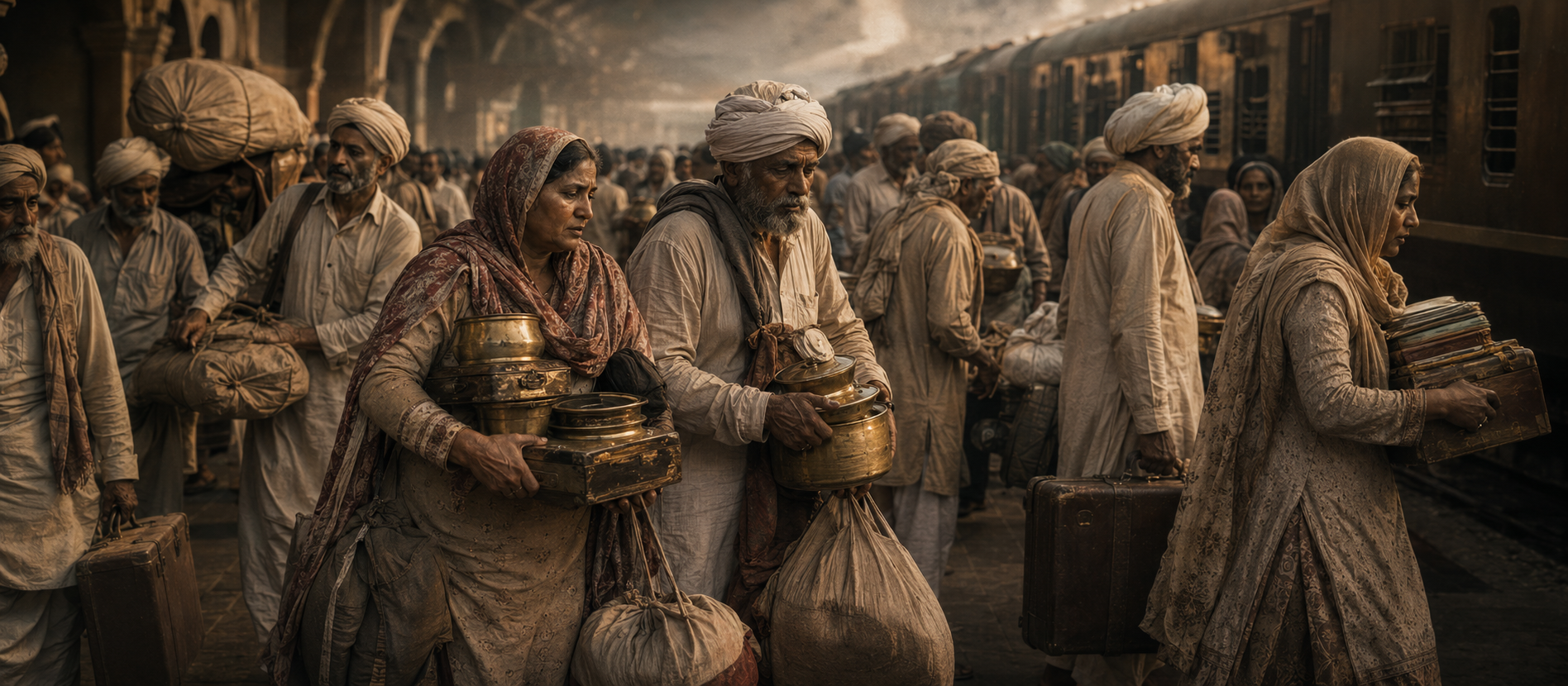
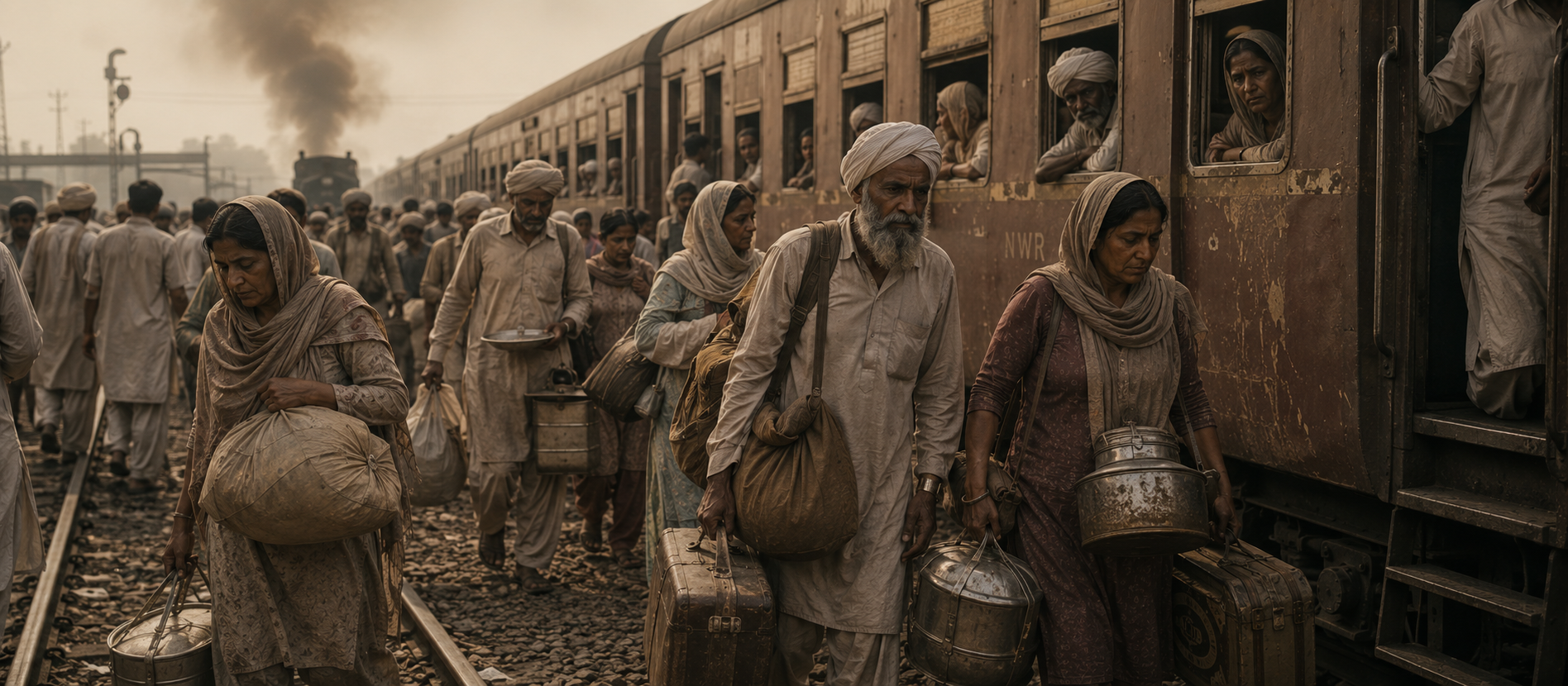
In August 1947, approximately fifteen million people crossed the newly drawn border between India and Pakistan in what remains the largest mass migration in human history. They carried what they could — sometimes only the clothes they were wearing. Many families arrived on the other side of a border that had not existed six weeks earlier with nothing but the knowledge of what they cooked. Recipes committed to memory by people who had no time to write them down. Taste memories of dishes that would now be cooked in kitchens in cities they had never seen, with spices sourced from markets in streets they didn't know, for children who had been born into a world that no longer contained the places where the food had been made before. The Partition of 1947 is one of the most traumatic political events in modern history. It is also one of the most significant events in the history of Indian food.
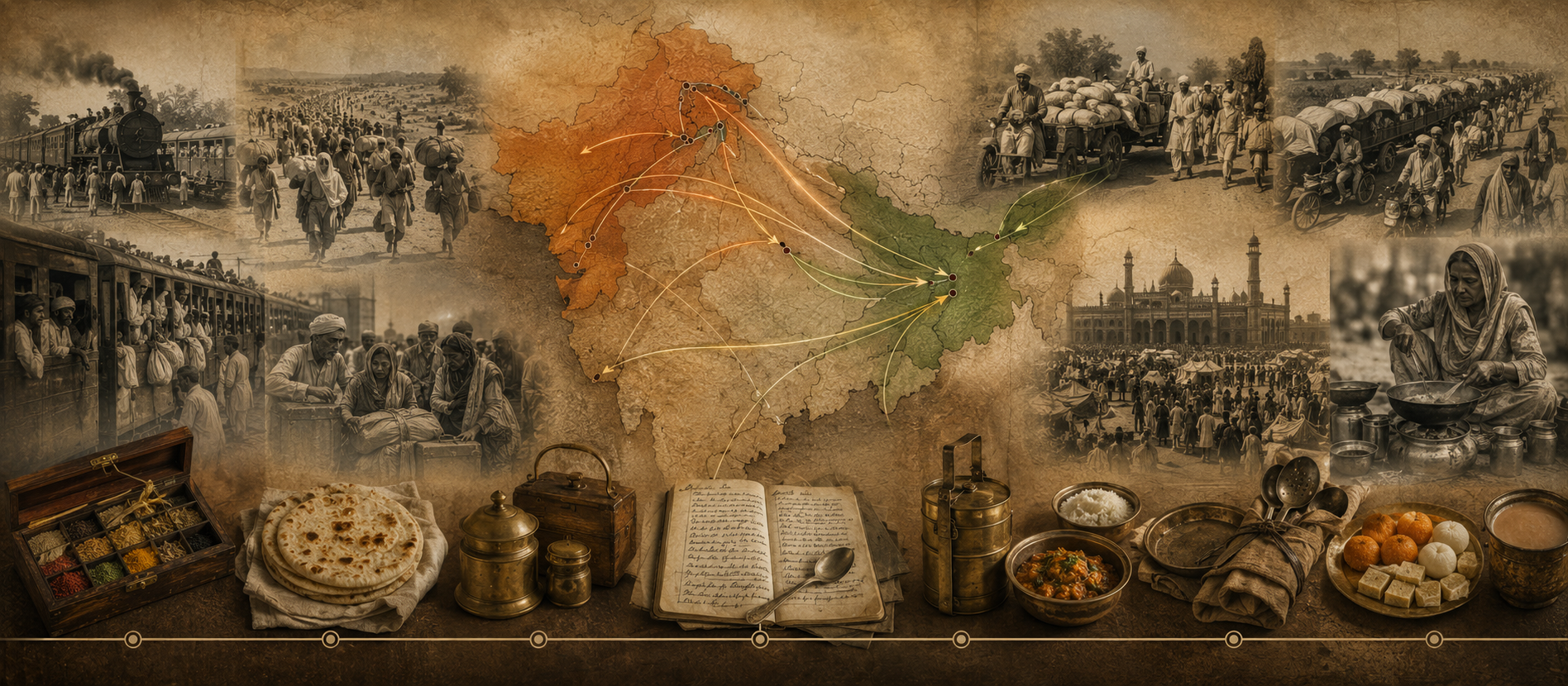
Timeline of Partition and Its Food Legacy
🔍 Click to enlarge
🔍 Click to enlarge
Historical documentation — the Partition and its food legacy across eight decades
June 1947
The Mountbatten Plan — Partition Announced
Lord Mountbatten announces the partition of British India into two dominions — India and Pakistan — effective August 15, 1947. The Radcliffe Commission is given five weeks to draw the borders. Cyril Radcliffe, who had never been to India before his appointment, draws a line through the Punjab and Bengal that will divide not just land but agricultural systems, food networks, families, and centuries of shared food culture.
August 1947
Independence and the Migration Begins
As India and Pakistan celebrate independence, the largest forced migration in human history begins. Hindus and Sikhs move toward India from what becomes Pakistan; Muslims move toward Pakistan from India. The violence is catastrophic. Families leave overnight with whatever they can carry. Food memories travel with them.
1947–1955
Refugees Settle and Begin Cooking
In Delhi, Amritsar, Ludhiana, and other Indian cities, Punjabi Hindu and Sikh refugees begin building new lives. They cook the food they knew — in new kitchens, with locally available ingredients, adapting to what Delhi and Indian Punjab could provide. The cooking evolves in the adaptation. Specific refugee communities cluster in specific neighborhoods; their food traditions concentrate and begin to define those areas.
1950s–1970s
Refugee Communities Create New Food Economies
Punjabi refugees from Pakistan establish the food businesses that will eventually define North Indian restaurant cuisine — dhaba culture, tandoor restaurants, specific sweet shops. The Punjabi cooking traditions they brought — robust, butter-rich, tandoor-oriented — become the most visible face of North Indian food in India's growing cities. Delhi's food culture is permanently reshaped by the refugee community's culinary traditions.
1971
Bangladesh Liberation — A Second Partition
The Bangladesh Liberation War creates a second partition — East Pakistan becomes Bangladesh, and a second wave of migration reshapes Bengal's food culture. Bengali Hindu and Muslim communities shift across borders. Kolkata's food culture absorbs a new wave of East Bengali culinary traditions. The already complex layering of Bengali food identities becomes more intricate.
Present
The Food Legacy Continues
Butter chicken, dal makhani, tandoori preparations — the dishes that define Indian restaurant food globally were developed primarily by Punjabi refugees and their descendants in post-Partition Delhi. The most internationally recognised Indian cuisine is, at its root, a refugee cuisine — the food of people who rebuilt their culinary lives in a new country from the memory of what they had cooked before.
✓
What Historians Know
The Punjab that was divided had a highly developed and shared food culturePre-Partition Punjab — a region that is now divided between Indian Punjab, Pakistani Punjab, and Haryana — had a food culture characterised by rich dairy traditions, tandoor cooking, and specific grain preparations (particularly wheat-based) that were shared across religious communities. Hindus, Muslims, and Sikhs in pre-Partition Punjab often ate similar food. The Partition was a political and religious division of a culturally mixed population.
Punjabi refugee communities established much of Delhi's food economyThe Punjabi Hindu and Sikh refugees who settled in Delhi in 1947–48 established the dhaba culture, the specific tandoor restaurant tradition, and the sweet shop traditions that still define Delhi's food landscape. The specific taste of Delhi's street food — robust, butter-rich, tandoor-forward — is substantially a product of the refugee community's culinary contributions.
Specific iconic dishes of modern North Indian cuisine were created by Partition refugeesButter chicken (murgh makhani) is directly documented as the invention of Kundan Lal Gujral (Moti Mahal restaurant, Delhi) and later developed by Kundan Lal Jaggi — both Punjabi Hindus who came to Delhi from what became Pakistan. Dal makhani is similarly attributed to the same restaurant tradition. These are not ancient dishes: they are post-Partition creations by refugee restaurateurs in the 1950s.
The Bengal Partition created a complex food identity between West Bengal and BangladeshEast Bengal — now Bangladesh — had a distinct food culture from West Bengal, with specific fish preparations, rice varieties, and sweet traditions that were different from the Calcutta-centered West Bengali tradition. The partition and subsequent migration created a complex layering of food identities in Kolkata as East Bengali refugees brought their distinct culinary traditions.
⚠
What Historians Debate
The origins of specific dishes claimed by both India and PakistanMany dishes have disputed origins across the Partition border. Nihari, haleem, specific biryani styles, various Punjab and Sindh preparations — all have communities on both sides claiming them as their own. The reality is usually that these dishes predate the Partition and belong to the shared culture that the border divided. Nationalism and culinary identity are deeply entangled in these disputes.
Whether the Partition made Indian and Pakistani food cultures more or less similar over timeSeparated for over seventy years, Indian and Pakistani food cultures have both maintained the shared foundation they inherited from pre-Partition India and developed in divergent directions shaped by their different political, agricultural, and cultural contexts. Whether the divergence is greater or less than the shared foundation is a matter of genuine debate — and of political sensitivity.
Shared Food Before the Border — What Was Lost
To understand what Partition did to food culture, you first have to understand what existed before. Pre-Partition Punjab was one of the most agriculturally productive regions in India — the breadbasket of the subcontinent, irrigated by the five rivers whose name (Panj-ab = five waters) defines the province. Its food culture reflected this agricultural abundance: rich in wheat, dairy, and the cooking fat — ghee and white butter — that a dairy-rich agricultural society produces in abundance.
More importantly, this food culture was substantially shared across the Muslim, Hindu, and Sikh communities that made up Punjab's population. The specific preparations might vary — Muslim households would use meat freely in ways that many Hindu households would not; Sikh households might have specific cooking prohibitions — but the basic grain-and-dairy foundation, the tandoor culture, the specific bread traditions, and the robust, unhesitating cooking style were common to the whole population.
Lahore — the cultural capital of Punjab, which fell on the Pakistani side of the Radcliffe Line — had a food culture of extraordinary sophistication that drew on Muslim court traditions, Hindu merchant traditions, and Sikh community cooking. Its food markets, its specific sweet shops, its street food culture — all of this was lost to India overnight. The refugees who came to Delhi, Amritsar, and Ludhiana brought memories of Lahori food but could not bring the city, its markets, or its specific culinary ecosystem.
"What we carried was not recipes written on paper. We carried the taste in our mouths. We cooked by memory, and the memory was sometimes exact and sometimes was what we wished had been true."
Historical documentation — the migration of 1947: fifteen million people crossed a border that had not existed six weeks before, carrying recipes in their memories because there was nothing else to carry
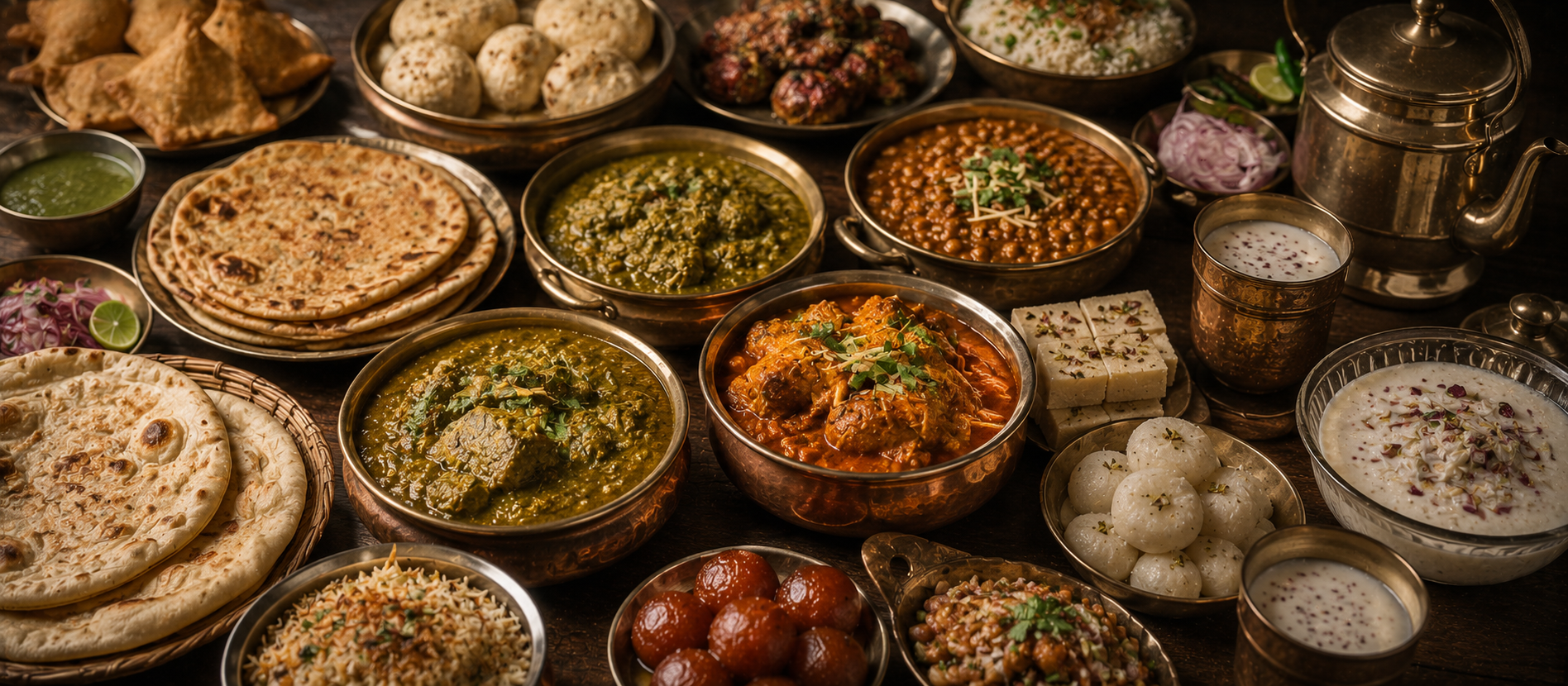
Historical reconstruction — recipes that crossed the border: dishes that now exist in different versions on both sides of a line drawn in 1947
The Signature Section
Recipes That Crossed the Border — Dishes That Changed When Their Context Did
Food does not travel with perfect fidelity. When families carry recipes across a border in their memories rather than on paper, what arrives on the other side is not a copy of the original — it is a reconstruction, shaped by what is available in the new location, what can be remembered accurately, and what emotional weight the cook brings to the recreation.
The dishes that Partition refugees recreated on both sides of the border tell the story of this imperfect transmission. Specific ingredients were no longer available. The specific water of a particular region — which affects bread texture, dal cooking, and fermentation — was different. The local climate affected how ingredients aged and fermented. The emotional register was different: food cooked in exile carries grief alongside flavour.
Butter Chicken (Murgh Makhani)
Created in Delhi, 1950s, by Punjabi refugees
Kundan Lal Gujral of Moti Mahal restaurant — a Punjabi Hindu from Peshawar, Pakistan — developed butter chicken in Delhi in the 1950s from leftover tandoori chicken simmered in tomato, butter, and cream. A post-Partition invention that became the most internationally recognised Indian dish. Its origin is specifically in the refugee experience.
Dal Makhani
Delhi refugee restaurant tradition — 1950s
The overnight-cooked whole black lentil preparation, finished with butter and cream, is also attributed to the Moti Mahal tradition of Punjabi refugee restaurateurs in Delhi. A refinement of the Punjabi whole urad dal tradition, elevated by refugee cooks who built the post-Partition Delhi restaurant scene.
Nihari
Claimed by both sides of the border
The slow-cooked early morning meat preparation — associated with Delhi's Mughal heritage and with Lahore's street food culture — exists in versions on both sides of the border that each claim as authentic. The dish predates Partition; both claims are partly correct. Nihari is a shared heritage divided by a border.
Lahori Chargha
Lahore recipe, recreated in Indian Punjab
The deep-fried whole chicken of Lahore — marinated, steamed, then fried whole — was a specific Lahori preparation that refugees attempted to recreate in Delhi and Amritsar. The versions made outside Lahore are acknowledged by their makers to be approximations of what is remembered rather than exact replications.
Sindhi Cuisine
Sindh (Pakistan) → Indian cities
Sindhi Hindus who migrated to Bombay, Delhi, and other Indian cities brought a distinct food tradition — sindhi curry, koki, papad — that had no home in India before Partition. This tradition now exists exclusively in diaspora form within India; Sindh itself is entirely in Pakistan.
East Bengali Fish Preparations
East Bengal (Bangladesh) → Kolkata
The fish preparations of East Bengal — particularly the mustard-based hilsa preparations and specific freshwater fish curries — arrived in Kolkata with East Bengali refugees and created a distinct layer in Bengali food culture. West Bengali and East Bengali food traditions are now both present in Kolkata's kitchens, sometimes distinguished and sometimes merged.
What the Border Created — New Food Identities in Exile
The most extraordinary aspect of Partition's food legacy is what it created rather than what it destroyed. The Punjabi refugee community that settled in Delhi and other Indian cities did not simply attempt to recreate what they had left behind. They built a new food economy in their new home — and in doing so, they created what is now the dominant expression of North Indian food culture both domestically and internationally.
The dhaba — the roadside eating house with simple seating, robust food, and democratic pricing — was substantially a creation of Punjabi refugee entrepreneurs who had the culinary skills to feed people quickly and cheaply, the entrepreneurial necessity of starting businesses with minimal capital, and the specific repertoire of tandoor cooking and dairy-rich preparations that their Punjabi background had given them. Delhi's dhaba culture, which spread along the highways of North India with the trucking industry, is a refugee creation that is now one of the most recognisable features of Indian food life.
The specific taste of North Indian restaurant food — the butter-rich gravies, the tandoor-cooked breads and meats, the specific use of cream and dairy to finish dishes — is substantially a product of the Punjabi refugee cooking tradition that established itself in Delhi in the 1950s and then spread through the restaurant industry across India and eventually globally through the diaspora.
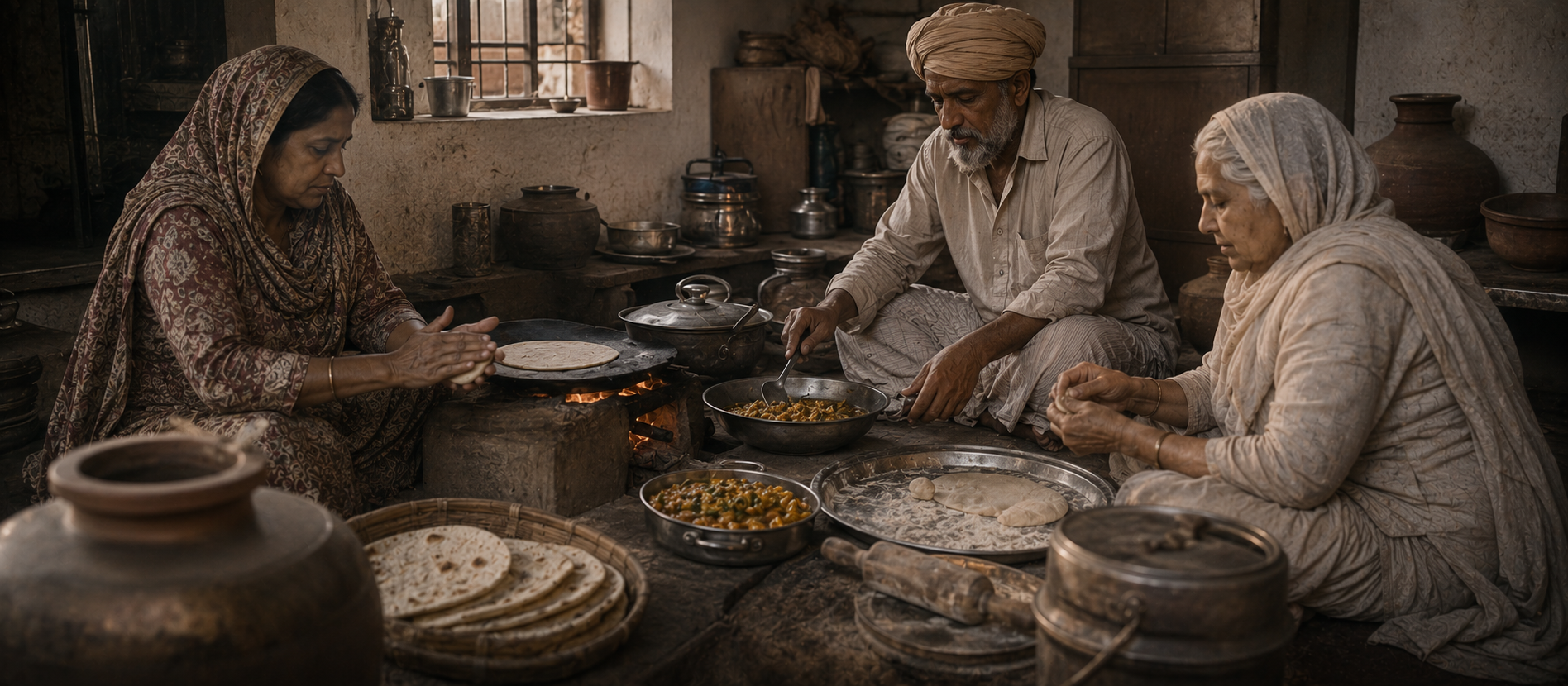
Historical reconstruction — the refugee family kitchen: cooking by memory, adapting to available ingredients, building a new food culture from the fragments of the old
Why This Matters Now
Why Is Understanding Partition Essential to Understanding Indian Food?
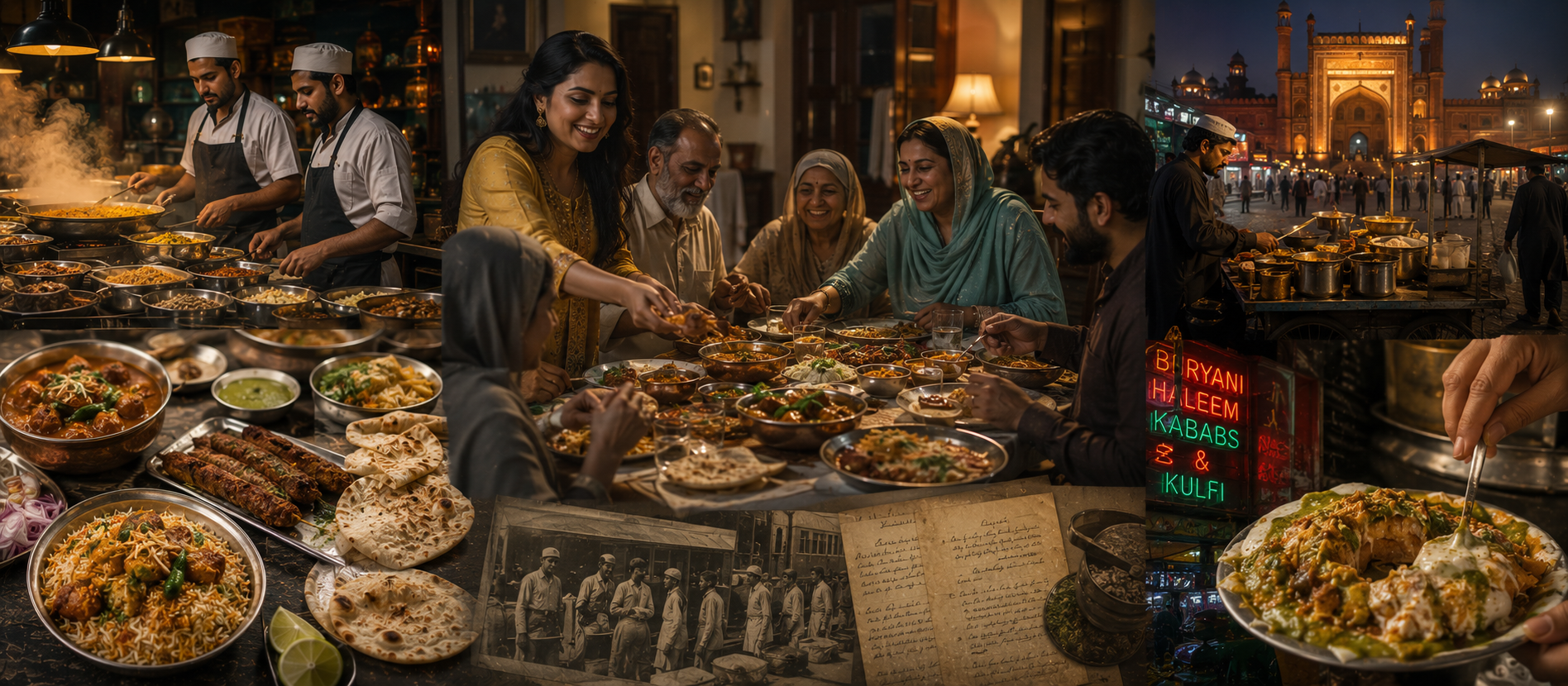
Because the most internationally visible Indian food — the dishes that define "Indian restaurant food" globally — is substantially a product of the Partition refugee experience. Butter chicken, dal makhani, the specific tandoor-forward, dairy-rich North Indian restaurant tradition that has spread from London to Sydney to New York — this is Punjabi refugee food. It is the food of people who lost their homes in 1947 and built new ones through cooking.
Understanding this history matters for two reasons. The first is respect: knowing that these dishes carry not just flavour but memory, grief, and the specific experience of displacement gives them a different kind of weight. Eating butter chicken in a restaurant in Manchester is participating, at a very long remove, in the story of a family that left Peshawar with nothing in August 1947 and rebuilt their lives around a clay oven and a pan of tomato and butter.
The second reason is accuracy: knowing that the most iconic "Indian" food is actually specific to one region and one historical moment — the Punjabi diaspora experience post-Partition — helps correct the simplification that treats India's extraordinary culinary diversity as a single thing. India's food is not what you find in most Indian restaurants. Those restaurants serve one tradition — a beautiful and historically significant one — but only one. The full picture is vastly richer.
The living legacy of Partition — butter chicken, dal makhani and Delhi's food identity
Legacy Today
Butter Chicken
The world's most ordered Indian dish — a 1950s creation by Punjabi refugees in Delhi. The most direct food legacy of Partition, now eaten on every continent.
Dal Makhani
The overnight-cooked black lentil dish that has become a standard in Indian restaurants worldwide — another post-Partition refugee restaurant creation from the same tradition as butter chicken.
Delhi's Food Identity
Delhi's specific food culture — dhaba cooking, tandoor restaurants, the butter-and-cream richness of its gravies — is substantially a product of the Punjabi refugee community that rebuilt their lives in the city after 1947.
Sindhi Cuisine in India
The entire Sindhi food tradition exists in diaspora form within India — Sindh is entirely in Pakistan. Every Sindhi dish cooked in India is food cooked away from home, preserved by memory and community.
The Shared Heritage Dispute
The ongoing arguments between India and Pakistan over the ownership of specific dishes — nihari, haleem, various biryani styles — are food expressions of the unresolved political relationship between two countries that share a culinary tradition they cannot fully share.
 🔍 Click to enlarge