Series 1 · The Chronological Story · Chapter 17 of 17 — Final Chapter
Modern
Indian Food
Street Food, Diaspora, Fine Dining —
What Indian Cooking Is and What It Is Becoming
Contemporary documentation
Street Food, Diaspora, Fine Dining —
What Indian Cooking Is and What It Is Becoming
Contemporary documentation
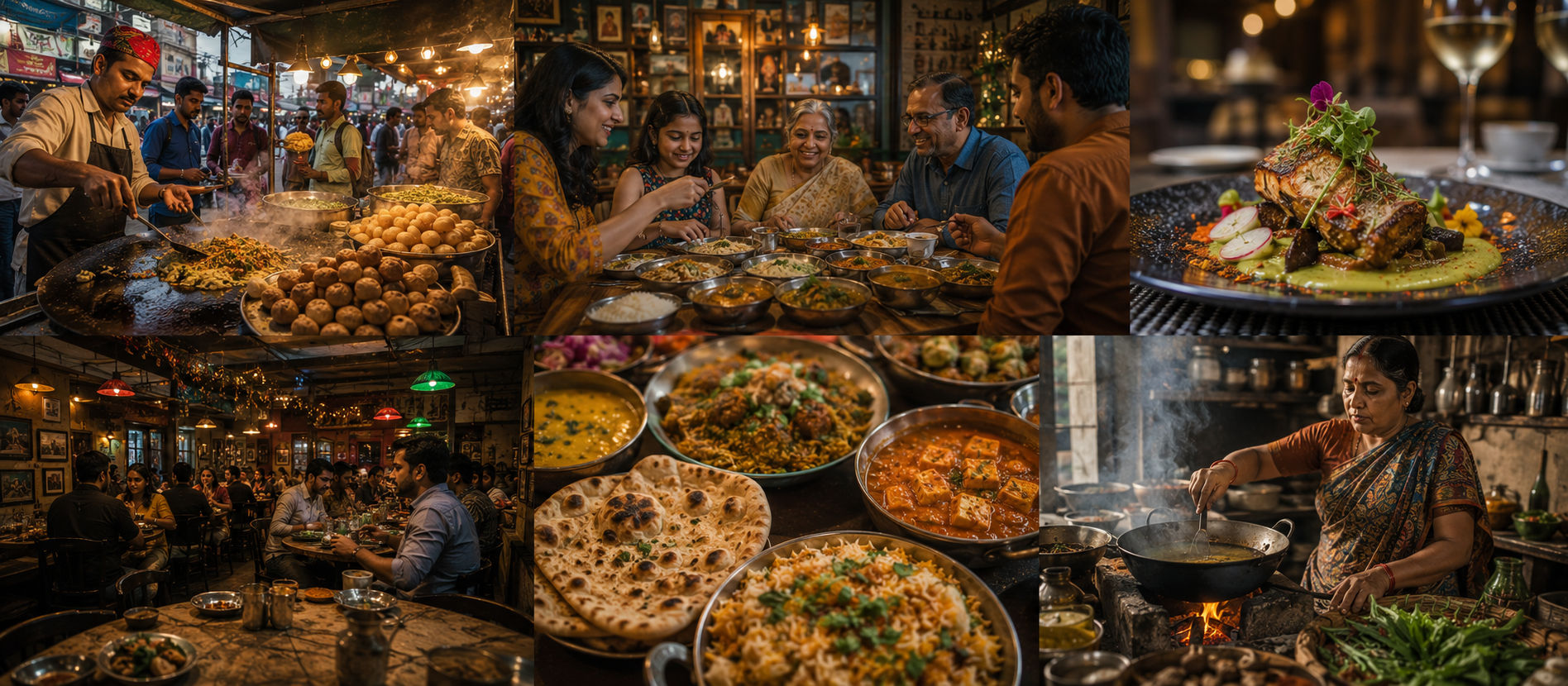
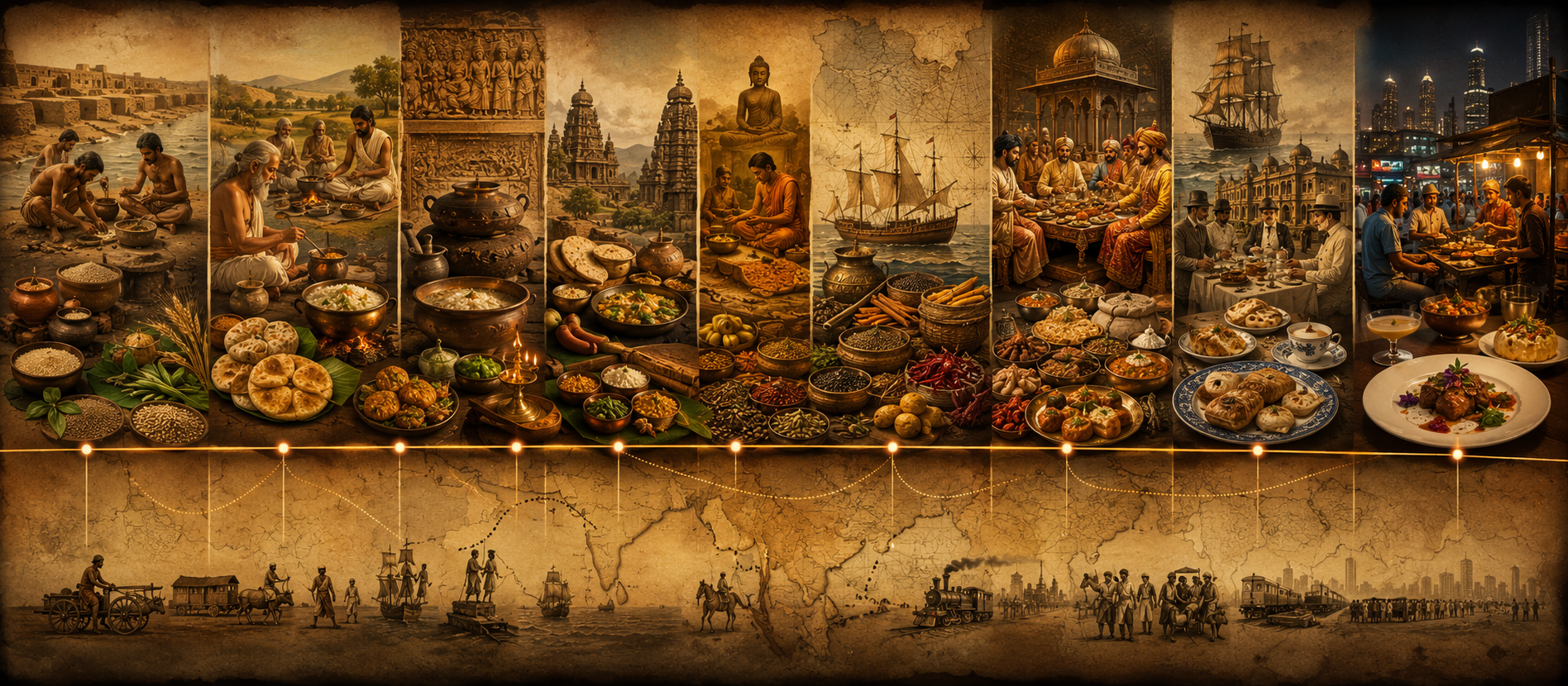
Indian food in 2026 is simultaneously the most internationally present cuisine in the world and the most misunderstood. It is the food in the takeaway container in London and the food on the street cart in Mumbai; the food served at three-Michelin-star restaurants in New York and the food eaten by 1.4 billion people every day in the most diverse food culture on earth. Four thousand years of continuous development — from the turmeric-scented kitchens of Mohenjo-daro to the Instagram-documented tasting menus of contemporary Indian fine dining — arrive at this moment simultaneously preserving and transforming everything that came before. This is where the story stands today.
 🔍 Click to enlarge
The transformation of India's food security between 1965 and 1980 is one of the most significant events in the history of food — not just Indian food, but global food. In 1965, India was importing grain from the United States under the PL-480 food aid programme, facing genuine famine conditions in parts of the country, and dependent on international charity for basic food security. By 1980, India was food-sufficient. By 2000, it was a significant food exporter. The Green Revolution that achieved this is one of the most dramatic transformations in agricultural history.
But the Green Revolution's effects on Indian food culture were not uniformly positive. The high-yield varieties of wheat and rice that replaced traditional varieties produced more calories per acre but less nutritional diversity. The traditional millets — jowar, bajra, ragi, and others — that had been staples in dryland regions for thousands of years were displaced from large areas of cultivation as wheat and rice became more economically rewarding to grow. Pulse cultivation — the protein partner of Indian grain agriculture for four thousand years — declined relative to its historical importance as the focus on caloric yield crowded out legume cultivation.
These shifts had long-term nutritional consequences. The "hidden hunger" of micronutrient deficiency — affecting hundreds of millions of Indians who consumed enough calories but insufficient zinc, iron, and other nutrients — is partly a Green Revolution consequence. The recent revival of interest in traditional millets — now rebranded as "superfoods" — is partly a response to the nutritional losses that came with the Green Revolution's caloric focus.
"Indian food is not one cuisine. It is many hundreds of cuisines, each the product of specific geography, specific history, specific religion, and specific agricultural tradition. To speak of 'Indian food' as a single thing is like speaking of 'European food' — the phrase is useful but the reality is far too vast and varied to be contained by it."
Indian Cooking Guide — Series 1 Conclusion
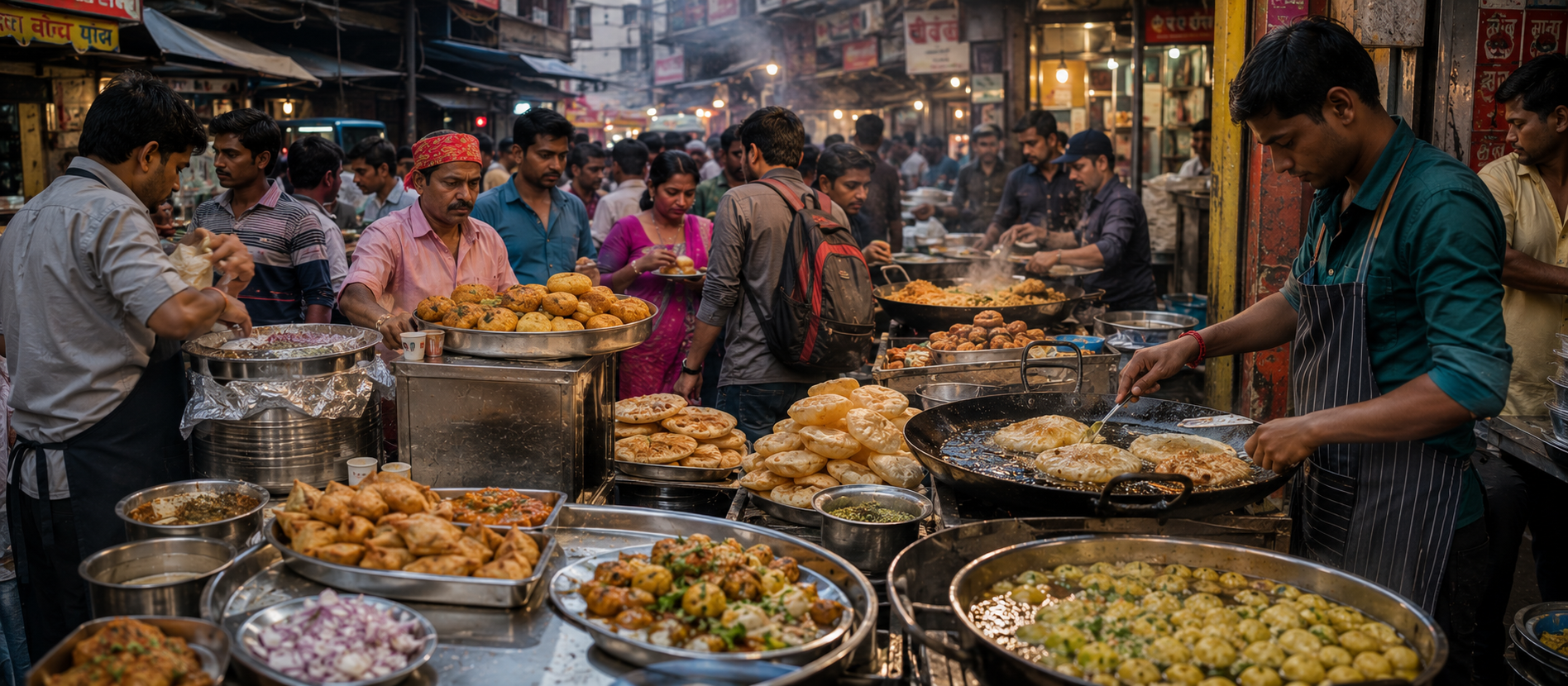
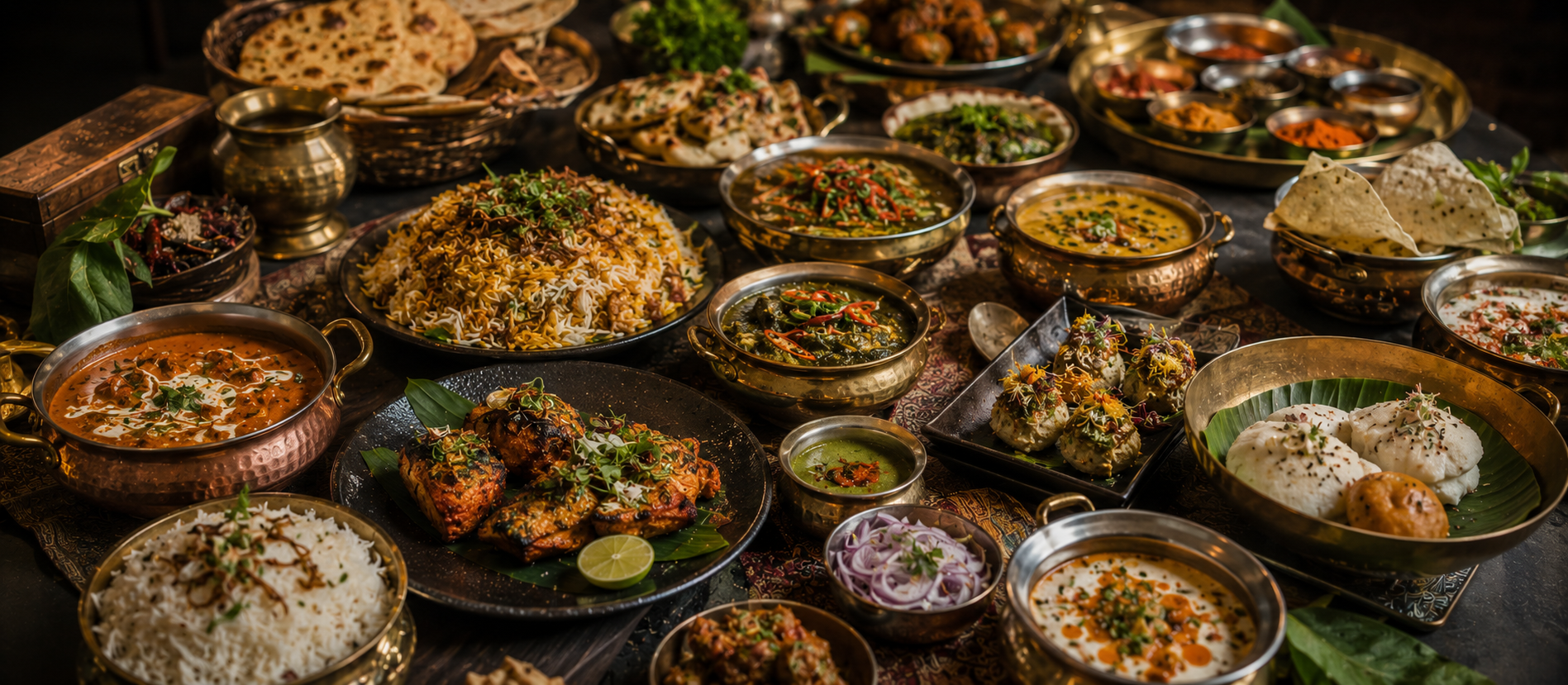
Indian street food is not a minor feature of the food landscape. It is, by volume, the primary way that most Indians eat. The informal food economy — chai wallahs, vada pav carts, chaat stalls, thali shops, dosa counters, biryani vendors — feeds hundreds of millions of people daily at prices accessible to the poorest urban worker. It is simultaneously among the most historically layered, regionally diverse, and technically sophisticated informal food cultures in the world.
Each city's street food is a palimpsest of history. Mumbai's vada pav — a spiced potato patty in a bread roll, with multiple chutneys — contains: the Portuguese introduction of the potato, the British introduction of the bread roll (pav comes from the Portuguese pão), the chilli, the coconut chutney of the Konkan coast, and the Maharashtrian spice tradition. Every element of the dish arrived from a different direction at a different time. The dish tastes like Mumbai because Mumbai is where those elements came together.
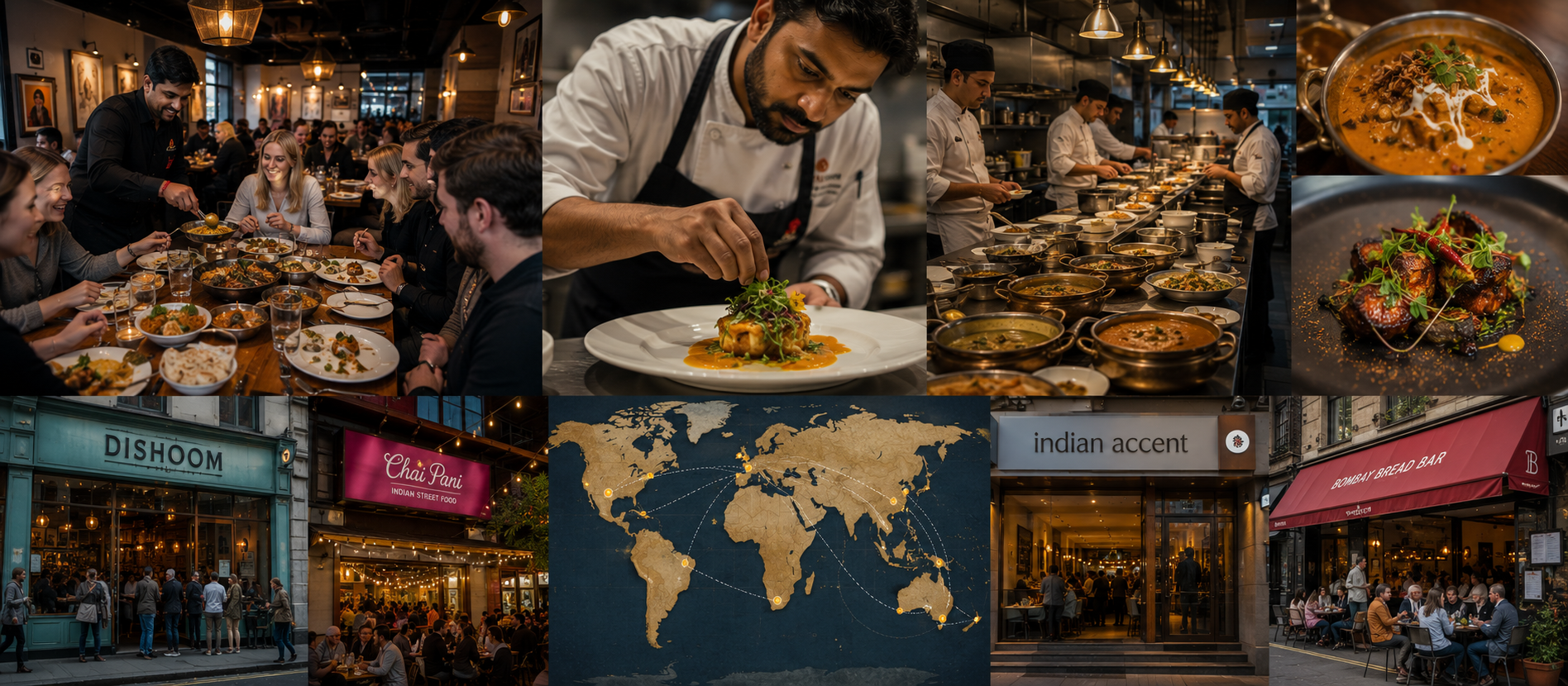
With approximately 32 million people, India has the world's largest diaspora — spread across every continent, established in virtually every country of any significant size. Wherever Indian migrants have settled, Indian food has followed. The global Indian restaurant industry is one of the largest food service sectors in the world. But the story of global Indian food is more complex than a simple export of the homeland's cuisine.
In every country where Indian food has established itself, it has adapted — to local ingredients, local taste preferences, local regulatory environments, and the specific backgrounds of the migrants who brought it. British Indian food is not the same as Indian American food, which is not the same as Indian food in Fiji, or South Africa, or Malaysia, or Mauritius. Each diaspora community has produced its own version of Indian food, shaped by the specific history of migration, the specific community's regional background, and the specific requirements of the local market.
No single dish better illustrates the complexity of global Indian food than chicken tikka masala. It is consistently ranked as the most popular Indian dish in Britain and one of the most popular in the world. In 2001, the British Foreign Secretary Robin Cook declared it "Britain's true national dish." And it was, in all likelihood, invented in Britain — almost certainly in Glasgow, probably in the 1970s, by a cook adapting Indian tandoori chicken to British preferences for a sauce-based preparation.
The dish has some Indian roots: chicken tikka is a genuine tandoor-cooked preparation; the spice combination is recognisably Indian. But the specific preparation — tandoori chicken in a tomato-cream sauce seasoned with spice, developed specifically to meet British demand for a saucier, milder preparation than authentic Indian dishes — is a British creation. It is Indian food adapted by British palates, cooked by Indian-British restaurant workers, served in a format designed for British eating habits.
Does this make it inauthentic? No. Indian food has been absorbing and adapting foreign influences for four thousand years. Chicken tikka masala is simply the latest product of that ongoing process — except that in this case, the foreign influence came from the consuming culture rather than the cooking culture. The dish is a conversation between British preferences and Indian culinary tradition, and it speaks in both languages simultaneously.
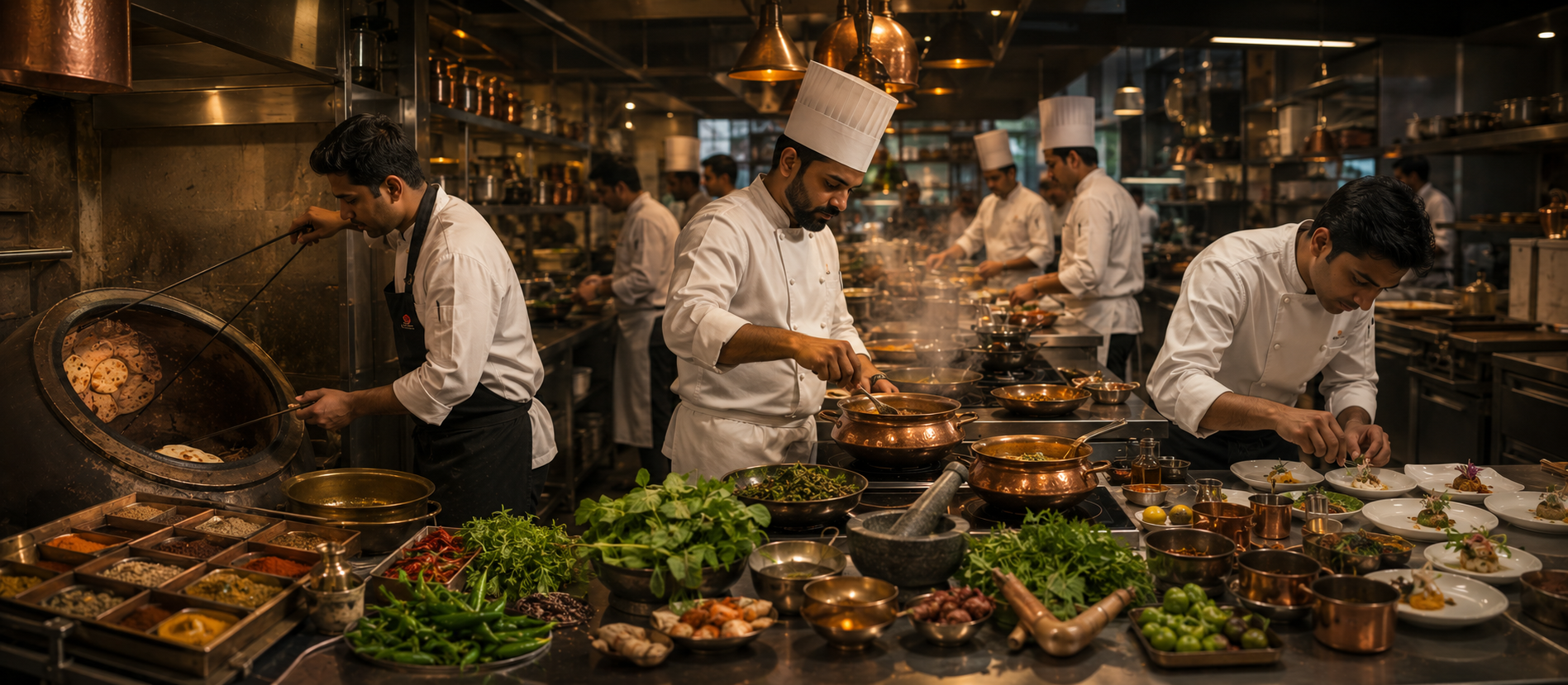
For most of its global history, Indian food has been represented in the fine dining world by a version of the curry house template — comfortable, informal, accessible, but not engaging with the technical vocabulary of high-end international cuisine. This has changed dramatically in the last two decades. Indian restaurants are now winning Michelin stars in London, New York, Mumbai, and Singapore. Indian chefs are placing in the World's 50 Best Restaurants. The Indian culinary tradition is being presented to global audiences with the same technical rigour and intellectual ambition as French, Japanese, and Scandinavian cuisine.
What this new Indian fine dining does is not substitute Western technique for Indian tradition — at its best, it uses the vocabulary of contemporary global gastronomy to make the full complexity of Indian regional food cultures visible to audiences that might otherwise never encounter it. A tasting menu that progresses through the spice routes of the Indian Ocean, or traces a specific regional cuisine through twelve courses, or deconstructs a specific historical preparation to expose its components — these are not Westernised Indian food. They are Indian food presented with the full seriousness it has always deserved.
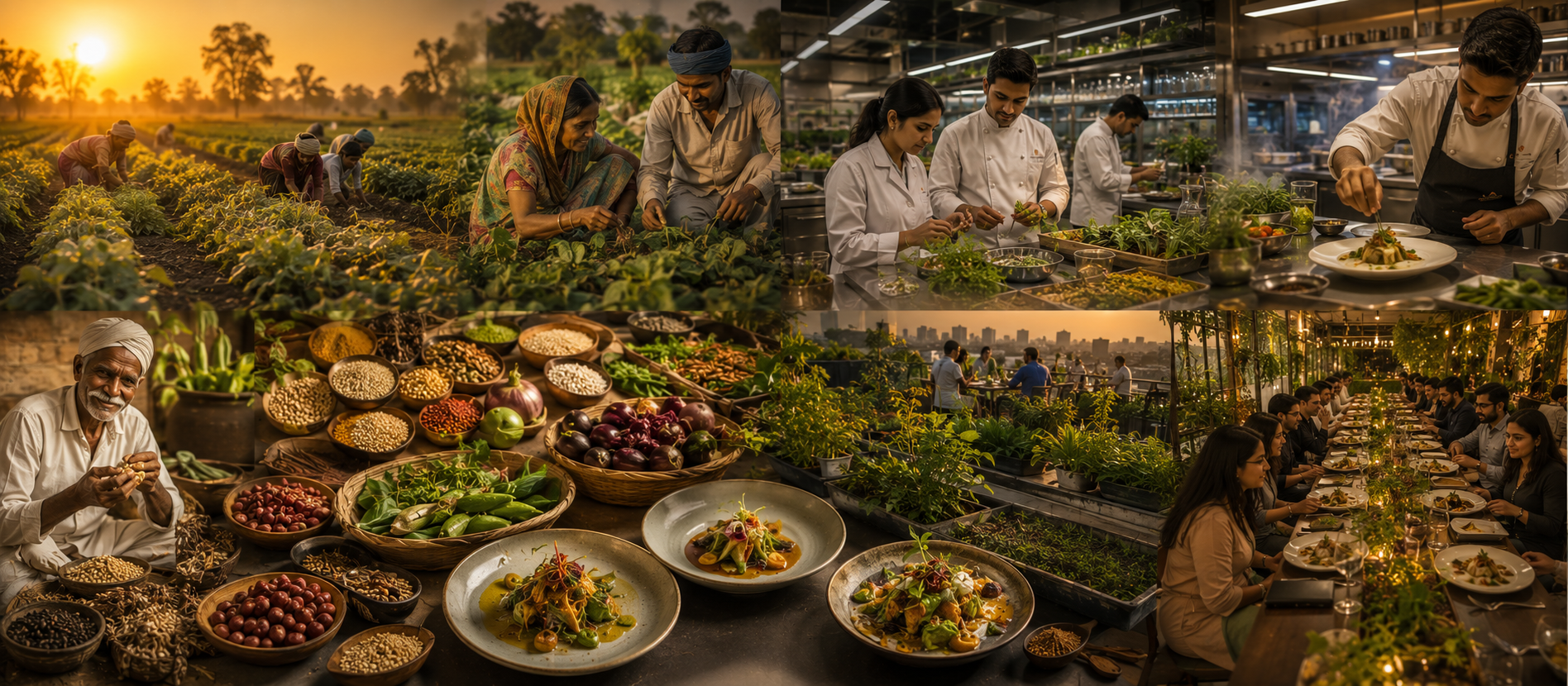
The Millet Revival. Ancient grains — jowar, bajra, ragi, and other millets displaced by the Green Revolution — are being rediscovered as nutritionally superior alternatives to the wheat and rice that replaced them. The Indian government designated 2023 the International Year of Millets. Ancient grains cooked with modern technique are appearing in both high-end restaurants and mainstream packaged food. The food traditions of India's tribal and dryland farming communities, long marginalised, are being looked at with new respect.
Regional Food Becoming Visible. The story that Indian food is primarily North Indian and Mughal-influenced — the legacy of how the diaspora and the tourism industry presented it to the world — is being corrected. Kerala, Tamil Nadu, Odisha, the Northeast, Rajasthan, Maharashtra — each of these regions has culinary traditions of extraordinary sophistication that are now reaching national and international audiences for the first time. This is one of the most exciting developments in Indian food culture in a generation.
Street Food Goes Premium. The extraordinary culinary heritage of Indian street food is being taken seriously by a new generation of chefs, food writers, and entrepreneurs. Not as informal fast food to be consumed quickly, but as one of the world's great culinary traditions — with its own history, its own technique, its own vocabulary. Documentation, preservation, and elevation of street food traditions is a growing movement in Indian food culture.
Diaspora Reclamation. The second and third generation of the Indian diaspora — in Britain, the United States, Canada, Australia — is rediscovering and reinterpreting the food traditions of their heritage with a seriousness and sophistication that their parents' generation rarely applied to them. This reclamation — using contemporary culinary technique to engage with ancestral food memories — is producing some of the most interesting food being made anywhere in the world right now.
The Sustainability Turn. Indian traditional food systems — their emphasis on plant-based protein, seasonal cooking, minimal waste, fermentation, and the use of every part of every ingredient — are increasingly recognised as models of sustainable eating. The pulse-and-grain combination that India has used for four thousand years is precisely the low-carbon, high-nutrition dietary pattern that food scientists recommend for a warming planet. Ancient Indian food wisdom and contemporary sustainability science are arriving at the same place from different directions.
We began this series in 3300 BCE, in the kitchens of Mohenjo-daro, with the smell of turmeric and sesame in clay pots. We end here, in the present, with a food tradition that has been continuously evolving for more than four thousand years — absorbing the Vedas, the Buddhist ethics of non-harm, the Persian court's aesthetic refinement, the Mughal emperor's imperial ambition, the Portuguese sailor's American cargo, the British colonial's railway network, and the refugee's memory of a kitchen left behind in the middle of the night.
Indian food is not a single tradition. It is four thousand years of the world's most diverse subcontinent absorbing every influence, adapting every ingredient, and producing something that is simultaneously ancient and perpetually new. The chilli feels ancient because Indian food made it ancient in a generation. The biryani feels royal because it was royal, and the dignity of that origin persists in every grain. The dal feels eternal because it is eternal — the same nutritional logic, the same combination, the same daily act of feeding people that the people of the Indus Valley performed forty centuries ago.
Every time you cook Indian food — or eat it, or think about it — you are participating in the longest, most continuous, most diverse culinary story in human history. That is what this series has tried to document. Not the food of a country, but the food of a civilisation, across all the time it has taken to become what it is today.
You have reached the end of the chronological history of Indian food. Explore Series 2 for the ingredient stories, or visit the Encyclopedia, Science Academy, and Food Atlas to go deeper into the subjects this series has introduced.