Series 1 · The Chronological Story · Chapter 15 of 17
The British Raj
and Indian Food
Railways, Tea, and the
Strange Invention of "Curry"
Historical reconstruction based on documentary evidence
Railways, Tea, and the
Strange Invention of "Curry"
Historical reconstruction based on documentary evidence
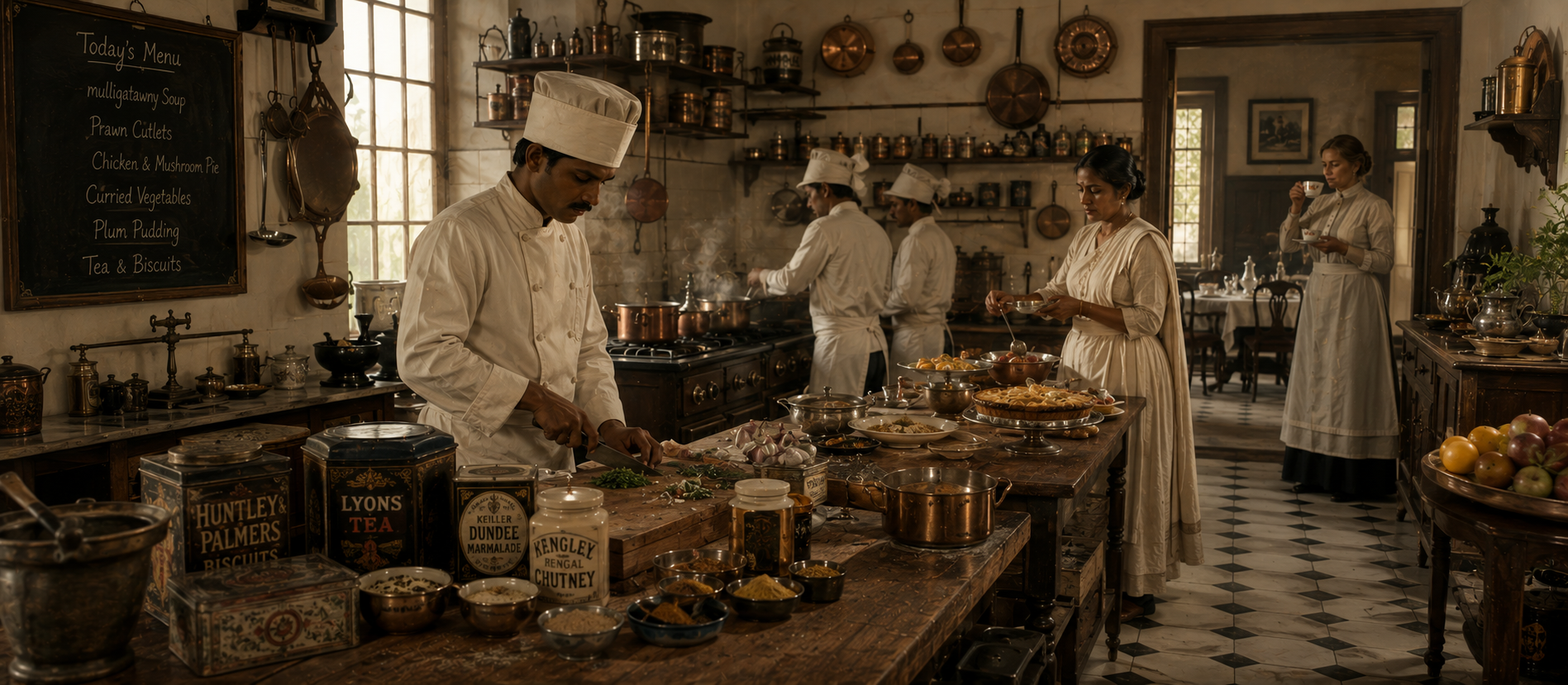
The British colonial relationship with Indian food was one of the strangest in culinary history. The colonisers arrived in a country with one of the world's most sophisticated food cultures, failed to understand it, simplified it into a single category called "curry," and then became so obsessed with that simplified version that it eventually became the most popular food in Britain. Meanwhile, they introduced a drink — tea — that India had not previously consumed in any significant quantity, and within a century Indians were drinking more tea per capita than the British themselves. The colonial food story is a story of misunderstanding, exploitation, and extraordinary irony in roughly equal measure.
 🔍 Click to enlarge
Chai — sweet, milky, heavily spiced tea — is now so thoroughly embedded in Indian identity that it seems impossible to imagine India without it. Politicians drink it. Street vendors build careers around it. It is offered to guests as the first act of hospitality. The Prime Minister of India is defined partly by his chai wallah origin story. It feels ancient. It is not.
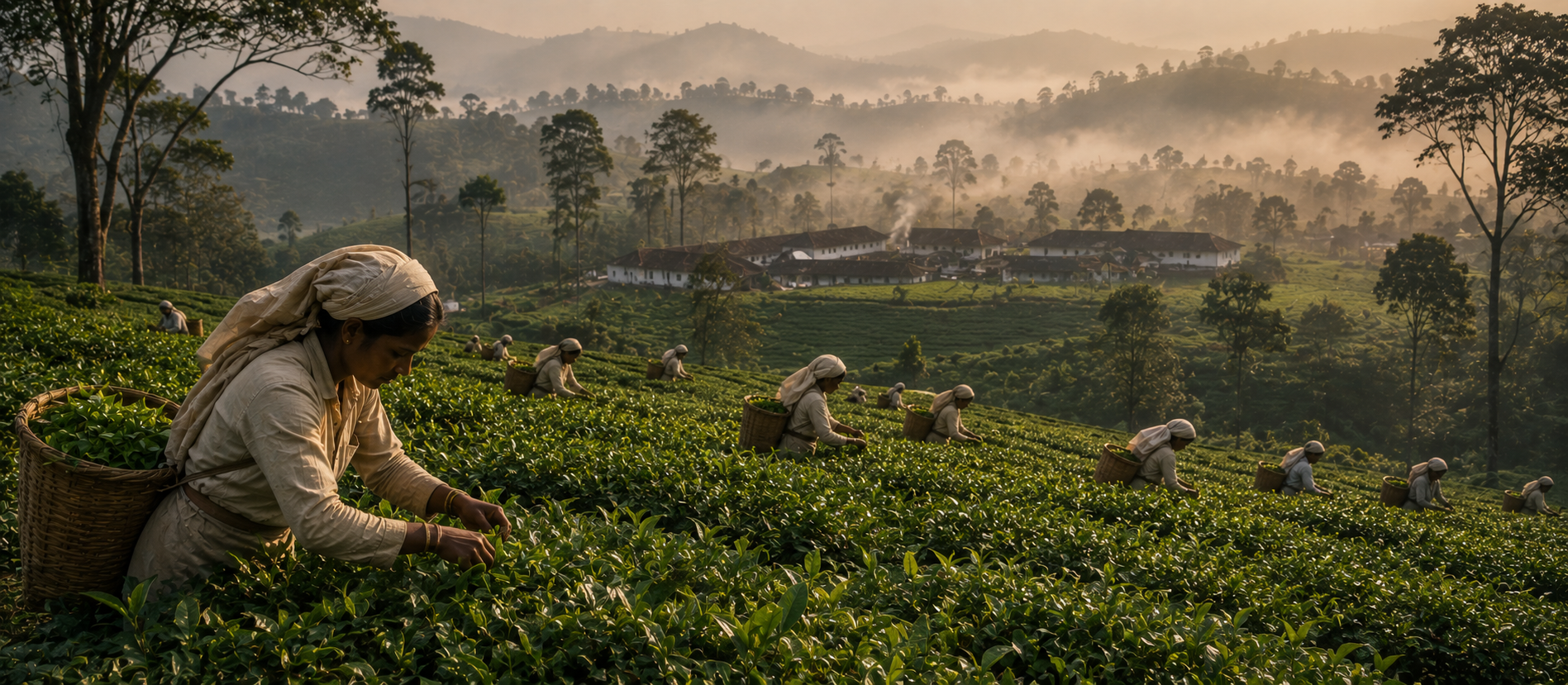
India has had indigenous infusions for centuries: decoctions of ginger, tulsi (holy basil), and various medicinal herbs. But Camellia sinensis — the tea plant — was not consumed in large quantities by ordinary Indians before the British established commercial cultivation and then deliberately created a domestic market. The story of how this happened is one of the most effective marketing campaigns in history.
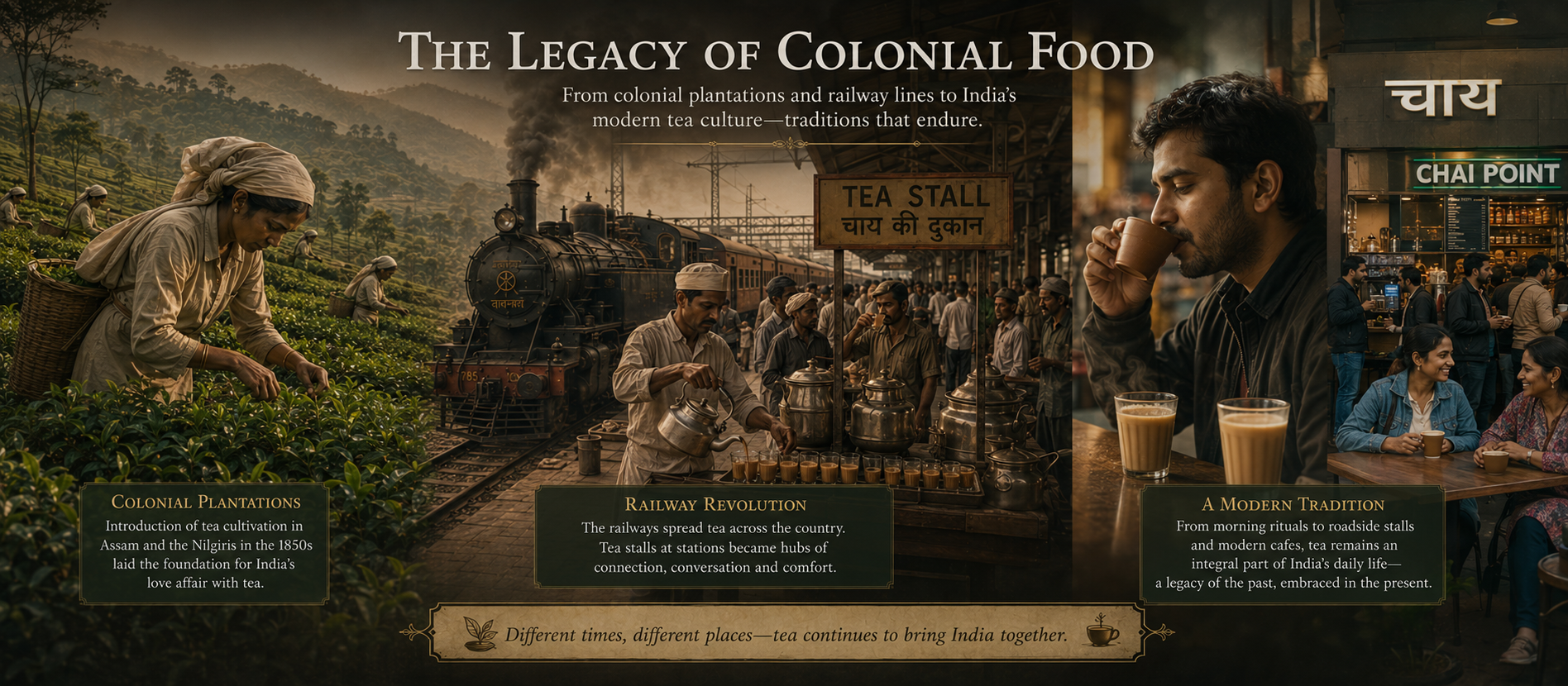
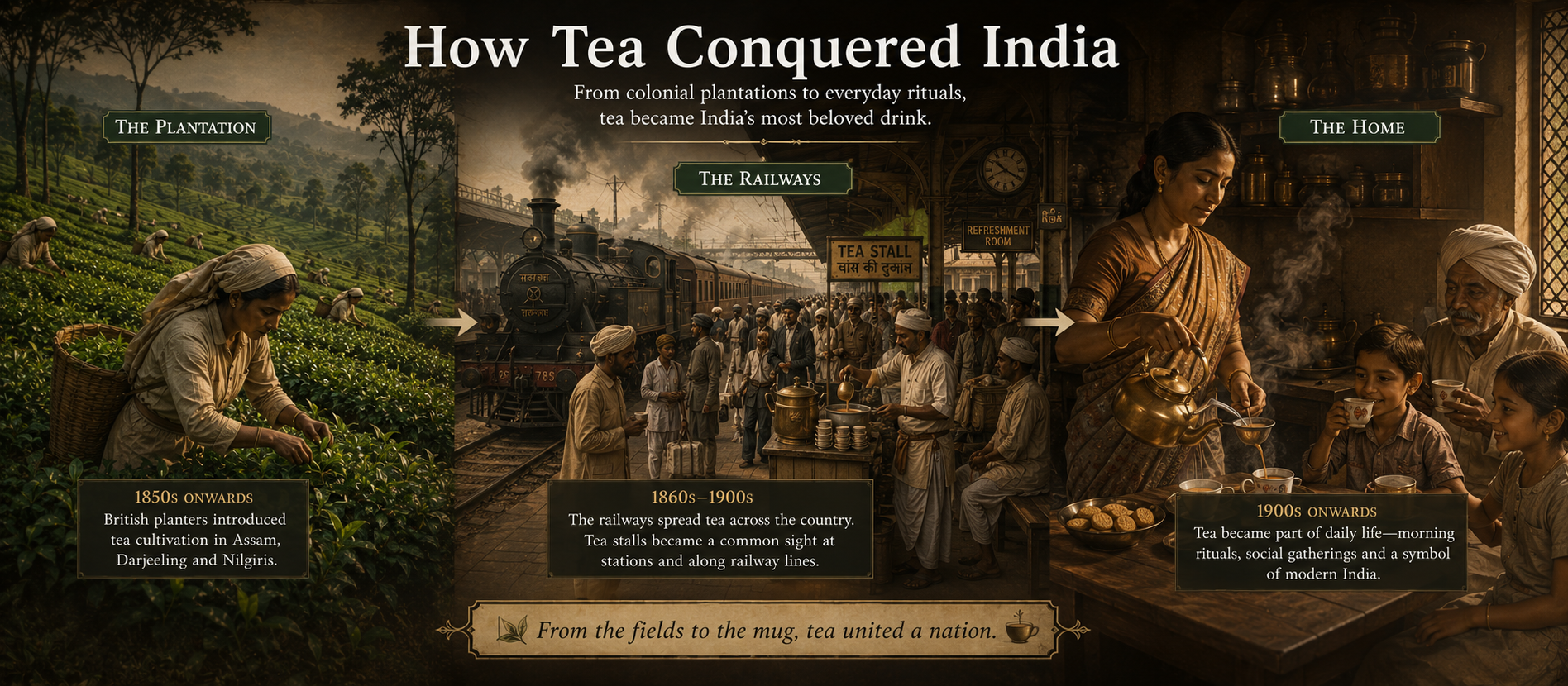
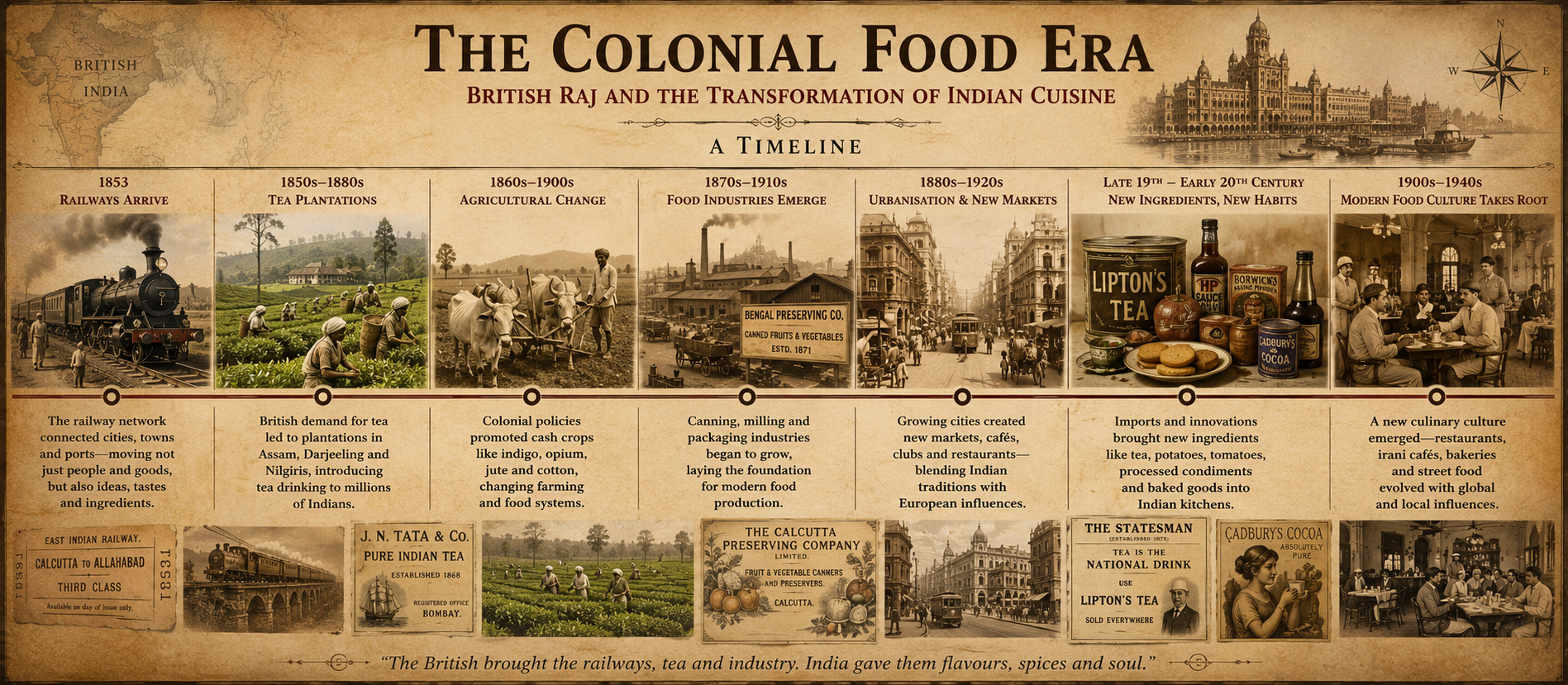
The Indian Tea Association, established in 1881, faced a specific problem: India was producing enormous quantities of tea for export to Britain, but the domestic Indian market was negligible. In 1903, the ITA began a systematic campaign to create an Indian chai-drinking culture. They paid factories and mills to introduce tea breaks. They subsidised chai wallahs at railway stations — paying vendors to sell tea at minimal cost to build the habit. They promoted the idea of chai as an energising work drink. They adapted the preparation to Indian tastes: stronger, sweeter, with more milk and with the addition of spices (particularly ginger and cardamom) that made it more familiar to a culture already accustomed to spiced hot drinks.
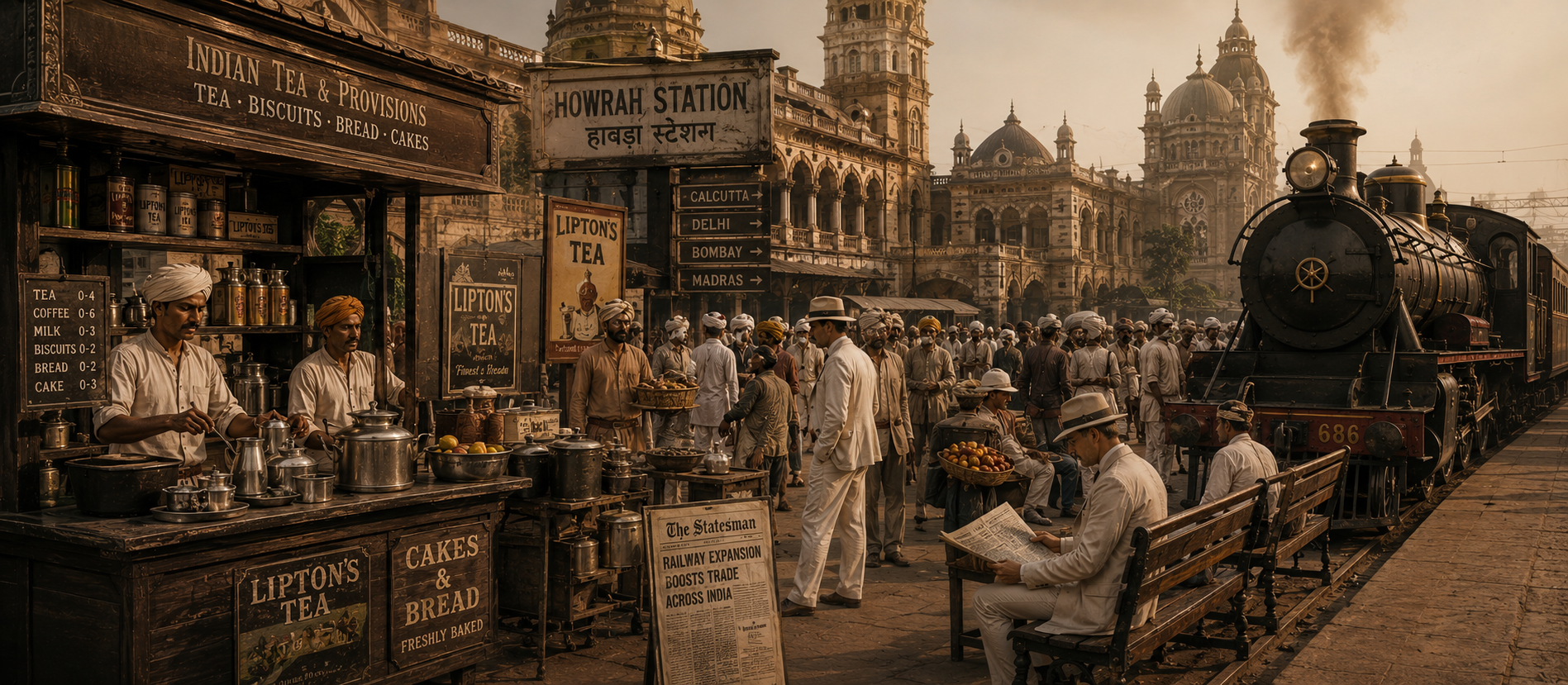
The Indian railway network is one of the most significant facts in the history of Indian food distribution. By 1947, India had over 65,000 kilometres of track — the fourth largest railway network in the world, built primarily by British colonial labour under British colonial administration to serve British colonial commercial interests. The grain it moved was often grain moving away from Indian farmers toward export markets. The famines it might have prevented were sometimes made worse by railway lines that moved grain toward port cities rather than toward famine-affected populations.
But the railways also changed Indian food culture in ways that were genuinely transformative for ordinary people. They connected previously isolated food markets — allowing surplus grain from Punjab to reach deficit areas in Bihar and Bengal in ways that the pre-railway bullock cart system could not. They enabled the creation of a national food trade that standardised prices across vast distances. They created railway station food culture — the specific ecosystem of chai wallahs, samosa vendors, and refreshment room cooks that is still one of the most distinctive features of Indian food life today.
The specific food of Indian railway travel became a distinct culinary tradition in its own right. Railway mutton curry — developed in colonial-era refreshment rooms to feed British officers traveling on the newly built network — is now a classic of Anglo-Indian cooking. The railway tiffin system — multi-tier stainless steel containers carrying home-cooked food to office workers — became an institution in Mumbai that continues today with the famous dabbawalas, who deliver approximately 200,000 tiffin boxes daily with a precision that Harvard Business School has studied as a logistics case study.
"The progress of the railway and the telegraph is changing the face of India. Whether it changes Indian food for better or worse is a question that will be answered only in the next generation."
Lord Dalhousie, Governor-General of India, c. 1853 — on the introduction of railwaysThe word "curry" comes from the Tamil word kari — meaning a sauce or relish. It was adopted by Portuguese traders and then by the British as a generic term for virtually all Indian spiced preparations. By the 18th century, British cookbooks were treating "curry" as a single dish category that could be replicated by adding pre-mixed "curry powder" to whatever ingredients were available.
The problem is that curry powder does not exist in Indian cooking. Indian cooks use specific spice combinations — different for each dish, region, season, and household. The spices for a Chettinad preparation are different from those for a Kashmiri rogan josh, which are different from those for a Bengali mustard fish curry, which are different from those for a Goan vindaloo. The idea that a single commercial blend could represent all of these — let alone replicate any of them — is a simplification so radical it constitutes a different category of cooking entirely.
The British curry powder tradition did something important, however: it globalised the concept of Indian flavour. Even if the product was a simplified caricature, the word "curry" and the idea of spiced Indian preparation reached every British colony, every merchant navy, every Indian diaspora community. It was the vehicle through which Indian food arrived in countries that had never seen an Indian cook. The curry house tradition that developed in Britain — initially through Bangladeshi and Pakistani immigrants serving simplified Mughal-style cooking adapted to British tastes — is now one of the most important food industries in the UK, and it traces its origins partly to the British colonial simplification that created "curry" as a category.
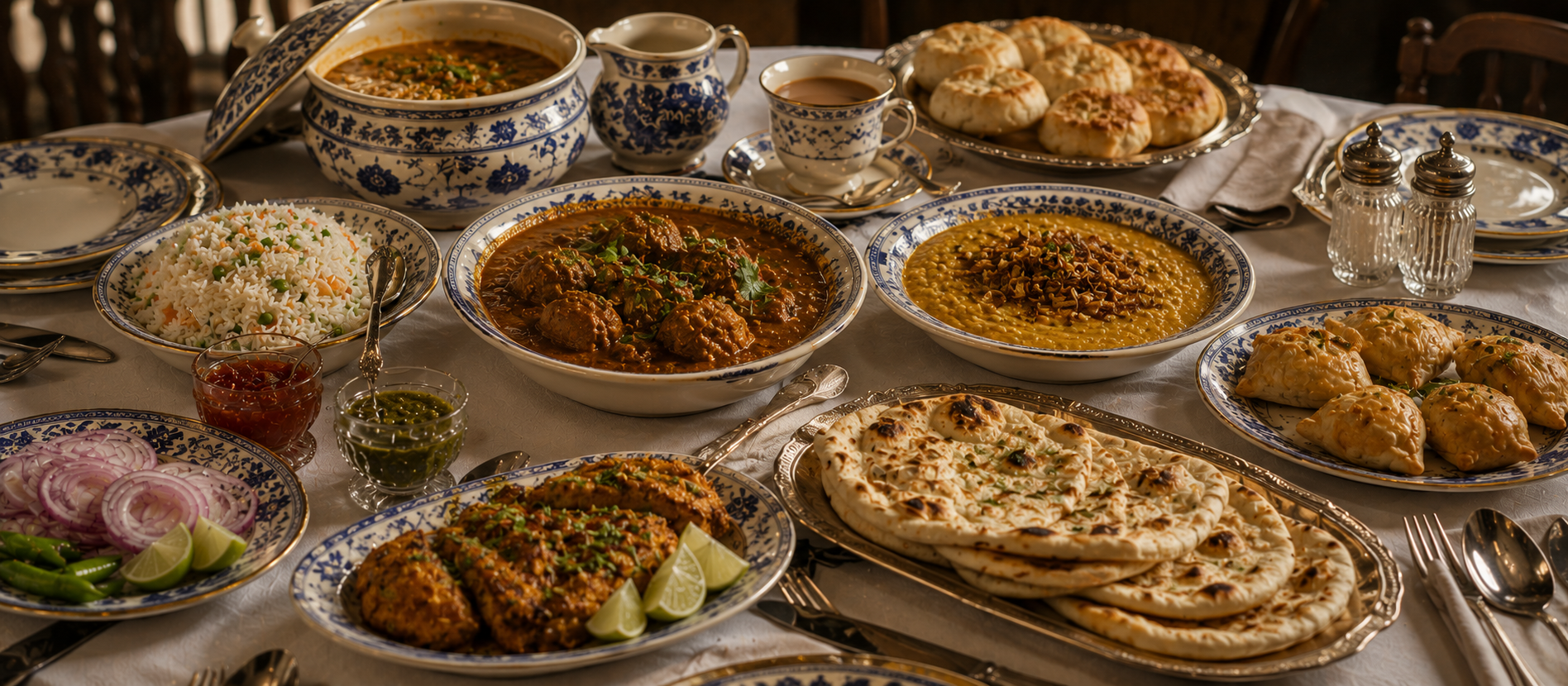
The interaction between British and Indian food cultures produced a specific hybrid cuisine that belongs to neither parent tradition. Anglo-Indian food — the cooking of the mixed British-Indian community and of British households that employed Indian cooks — developed specific dishes that are fascinating historical documents of cultural negotiation.
Mulligatawny soup comes from the Tamil milagutannir — "pepper water." Tamil rasam, a spiced tamarind broth, was adapted by British cooks (with the help of Indian khansamas — household cooks) into a thick, meaty soup that was more acceptable to British palates than the original. The dish is now neither Indian nor British — it is specifically Anglo-Indian.
Kedgeree comes from the Indian khichdi — a simple rice and lentil preparation. British adaptations replaced the lentils with smoked haddock (not an Indian ingredient), added hard-boiled eggs, and produced a breakfast dish that became standard in Victorian British households. Khichdi and kedgeree are the same word — and virtually unrecognisable as the same dish.
Railway mutton curry — developed in the refreshment rooms of colonial-era railway stations to feed British officers — was an attempt by Indian cooks to produce "curry" in the British understanding while using available ingredients. The result was a specific preparation that is neither traditional Indian nor British: a colonial border food that carries the history of the encounter in its flavour.
The British practice of adding milk to tea — and the Indian adoption of this practice in the masala chai tradition — has a specific chemical explanation. Tea contains tannins — specifically, catechins and theaflavins — that are responsible for tea's characteristic astringency. These tannins bind to proteins: they react strongly with the proteins in the mucous membranes of the mouth, producing the dry, puckering sensation of strong unsweetened tea.
Milk proteins — particularly casein — bind to tannins before they reach the mouth, effectively blocking the astringent reaction. A cup of tea with milk has demonstrably less perceived astringency than the same tea without milk, because the casein has already neutralised the tannin before it reaches your tannin-sensitive receptors. The practice of adding milk to tea is not arbitrary cultural preference: it is a practical solution to the mouth-feel problem of strong black tea, and it works through specific protein-tannin binding chemistry.
Why Indian chai is sweeter than British tea: Indian masala chai typically uses more tea, more milk, and significantly more sugar than British tea. The higher tannin content of stronger brewing requires more milk to neutralise; the milk fat and sugar together create a richer, more satisfying beverage in a food culture where sweet dairy has a long and valued history. The spices — particularly ginger and cardamom — add aromatic complexity that makes the drink more interesting at reduced temperature, which matters in a culture that often sips chai at a street stall rather than drinking it immediately at the table.
Masala chai is technically a more complex extraction than plain tea. The specific technique of simmering spices in water before adding tea and milk — common in many Indian chai preparations — extracts specific compounds from each spice: gingerols and shogaols from ginger, terpineol and linalool from cardamom, eugenol from cloves, cinnamaldehyde from cinnamon. These compounds are largely fat-soluble; the milk fat in chai helps dissolve and carry them, distributing aromatic compounds more effectively than water alone could do. The result is a beverage with a significantly more complex aromatic profile than plain tea with milk — which is why masala chai tastes better than tea with a pinch of spice added at the end.
The British colonial period did something paradoxical to Indian food: it simultaneously impoverished and globalised it. The famines, the extraction, the curry powder simplification — these were genuine harms. But the railway network, the tea culture that became authentically Indian, and the global reach that British colonialism gave to Indian food — these created the conditions for Indian food's current position as one of the world's most widely eaten and most influential culinary traditions.
The chai story is perhaps the most instructive. The British introduced tea to India as a commercial crop and then marketed it to Indians as a cultural practice, primarily to sell their product. Indians adopted it and made it entirely their own — adding the spice tradition that makes masala chai specifically Indian, the street culture of the chai wallah that is specifically Indian, and the hospitality ritual of offering chai to guests that carries specifically Indian social meaning. A foreign drink introduced for commercial reasons became, within a century, an authentic expression of Indian identity.
This is the same story as the chilli — a foreign introduction that was absorbed so completely it became definitional. Indian food culture has an extraordinary capacity to take what the world offers and make it Indian. The colonial period is the most dramatic example of this capacity, under the most difficult circumstances.
| British Colonial Period | Today |
|---|---|
| Tea introduced as commercial crop; India not a tea-drinking culture | India is the world's second-largest tea producer and one of its largest consumers — chai is now inseparable from Indian identity |
| Railway network built for colonial commercial interests | Indian Railways still the fourth largest network globally — the colonial infrastructure now serves independent India's food distribution system |
| Curry powder invented in Britain as a simplification | Curry house industry in Britain worth billions; "curry" as a global food category — the simplification globalised Indian flavour even while misrepresenting it |
| Dabbawalas emerging as railway tiffin system develops | Mumbai's 5,000 dabbawalas deliver 200,000 lunches daily — the colonial-era logistics system evolved into one of the world's most studied supply chain operations |
| Colonial famines killing millions | India now food-sufficient — the transition from colonial food insecurity to Green Revolution abundance is one of independent India's most significant achievements |