← HomeHistory Hub
Portuguese ships arriving at Calicut Goa 1498
Series 1  ·  The Chronological Story  ·  Chapter 14 of 17

The Portuguese
Revolution

How Chilli, Tomato, Potato and Cashew
Permanently Transformed Indian Food

1498–1700 CE·28 min read·Columbian Exchange · Colonial History · Food Science

Artist's reconstruction based on historical evidence
Reading Time by Section
Quick Facts1 min
Timeline3 min
The Paradox3 min
Four Plants That Changed Everything6 min
The Chilli Story5 min
Goa — The Laboratory4 min
Science of Capsaicin3 min
Why So Fast?3 min
Portuguese arrival Malabar coast Goa
1498 — The Arrival That Changed Everything
Goa colonial trading port Portuguese
Goa — The Laboratory of Exchange
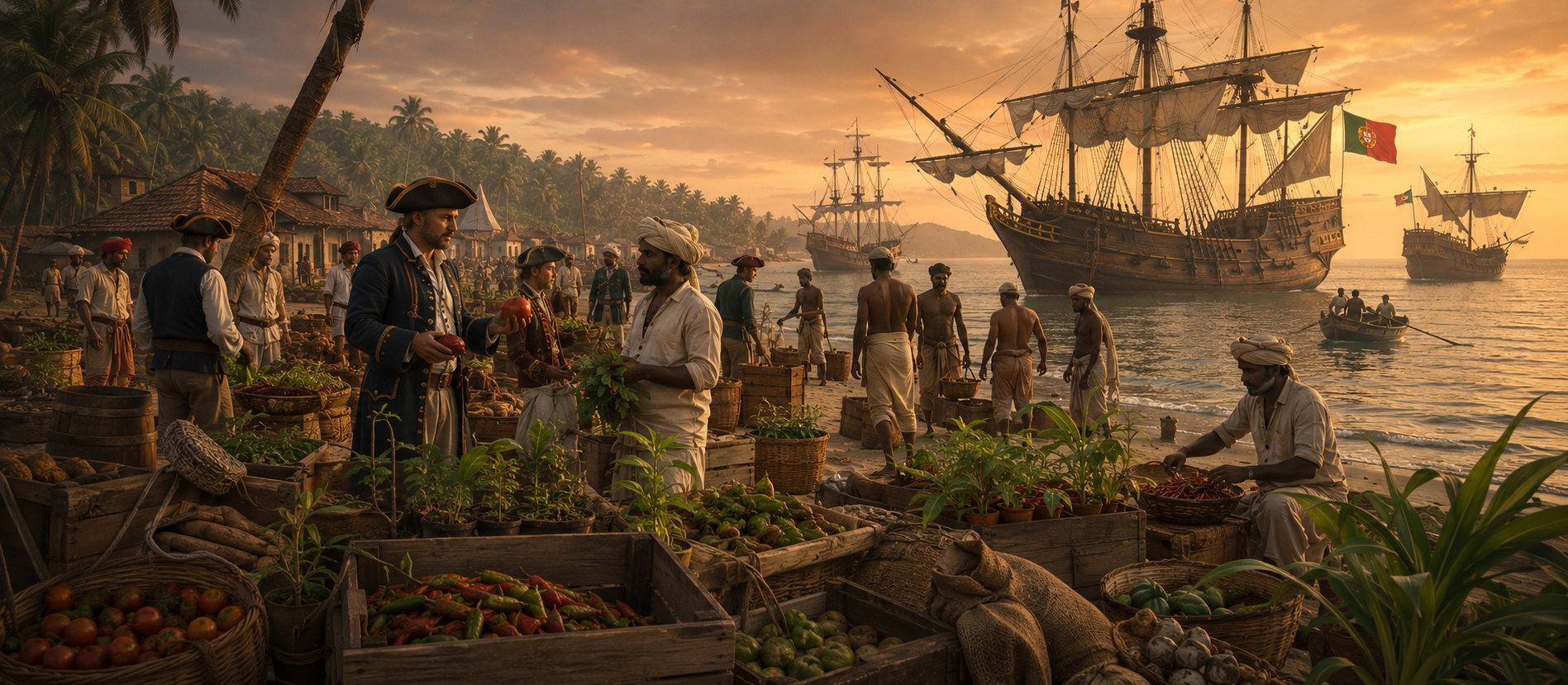
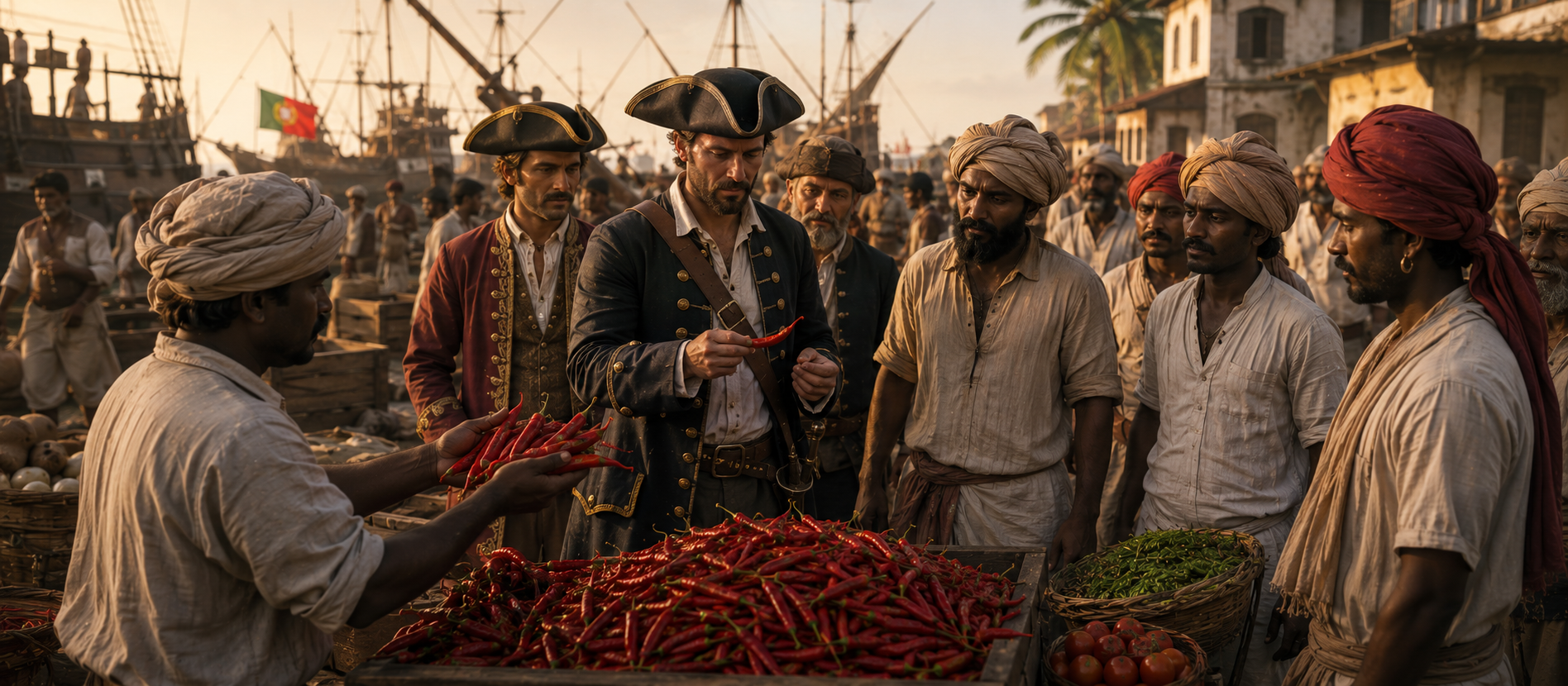
Chilli arriving in India Portuguese Columbian exchange
The Chilli — 500 Years That Feel Like Forever
Artist's reconstruction based on historical evidence
Arrival Date
1498 CE
Vasco da Gama reaches Calicut
Primary Base
Goa (from 1510)
Portuguese colonial capital on India's west coast
Most Important Plant
Chilli (Capsicum)
Now inseparable from Indian identity — only 500 years old
Other Key Plants
Tomato, Potato, Cashew
All South American — all now central to Indian cooking
Also Introduced
Corn, Pineapple, Papaya, Guava
The full Columbian Exchange reaches India via Portugal
Speed of Adoption
1–2 Generations
Chilli went from unknown to essential in ~50 years
Goan Legacy
Vindaloo, Sorpotel, Cafreal
Dishes born at the exact intersection of cultures
The Paradox
Conquerors Came for Pepper
Left behind a different spice — chilli — that replaced pepper's role

Here is the great paradox of the Portuguese arrival in India: they came for pepper — the black pepper that had been the engine of the world's most valuable trade route for two thousand years. They wanted to break the Arab monopoly on the spice that Pliny had complained about draining Rome of gold. They succeeded. And in the process, they introduced to India a different source of heat — the chilli — that would, within a generation, begin replacing pepper's role in Indian cooking and eventually become so thoroughly embedded in Indian food culture that most people assume it has always been there. The Portuguese came for an Indian spice. They left behind an American one.
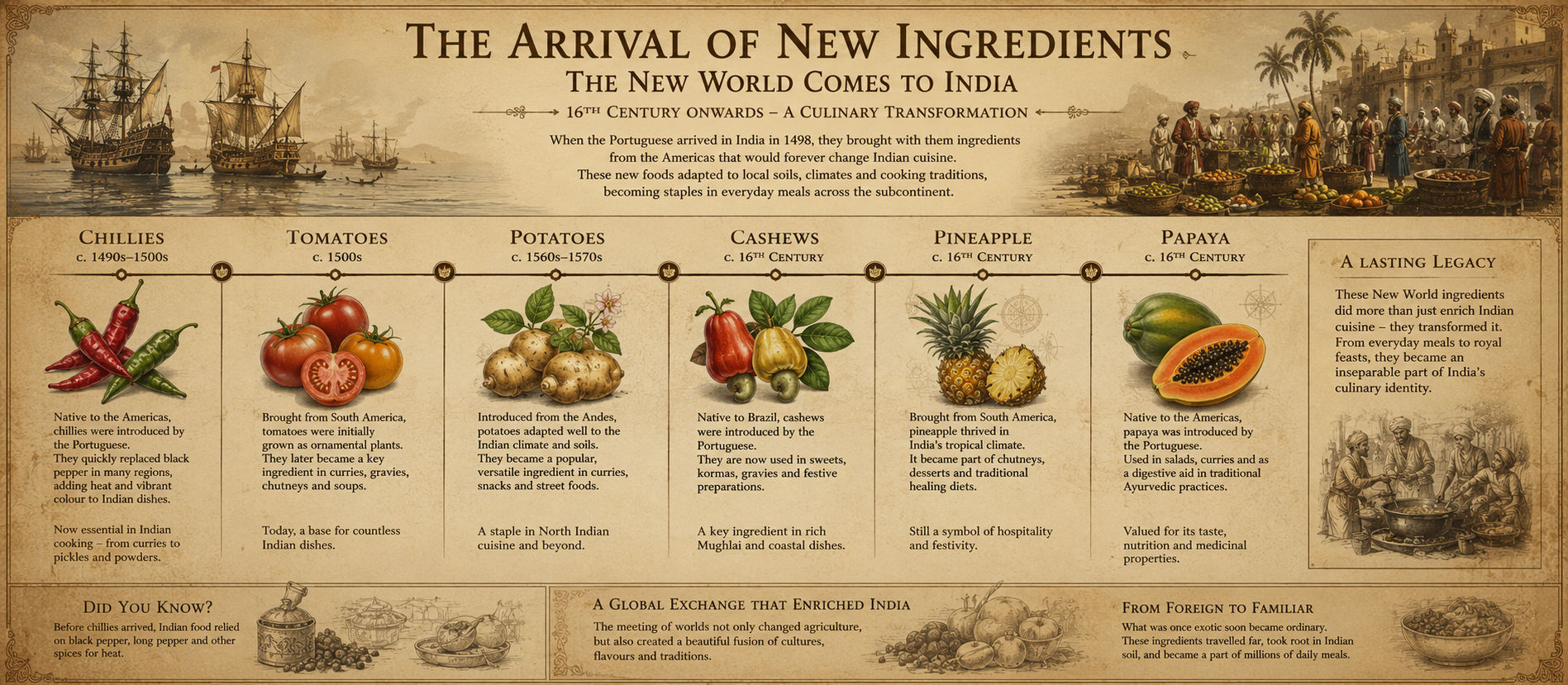
Timeline of the Portuguese in India

Timeline of New World foods arriving in India via Portugal 🔍 Click to enlarge
🔍 Click to enlarge
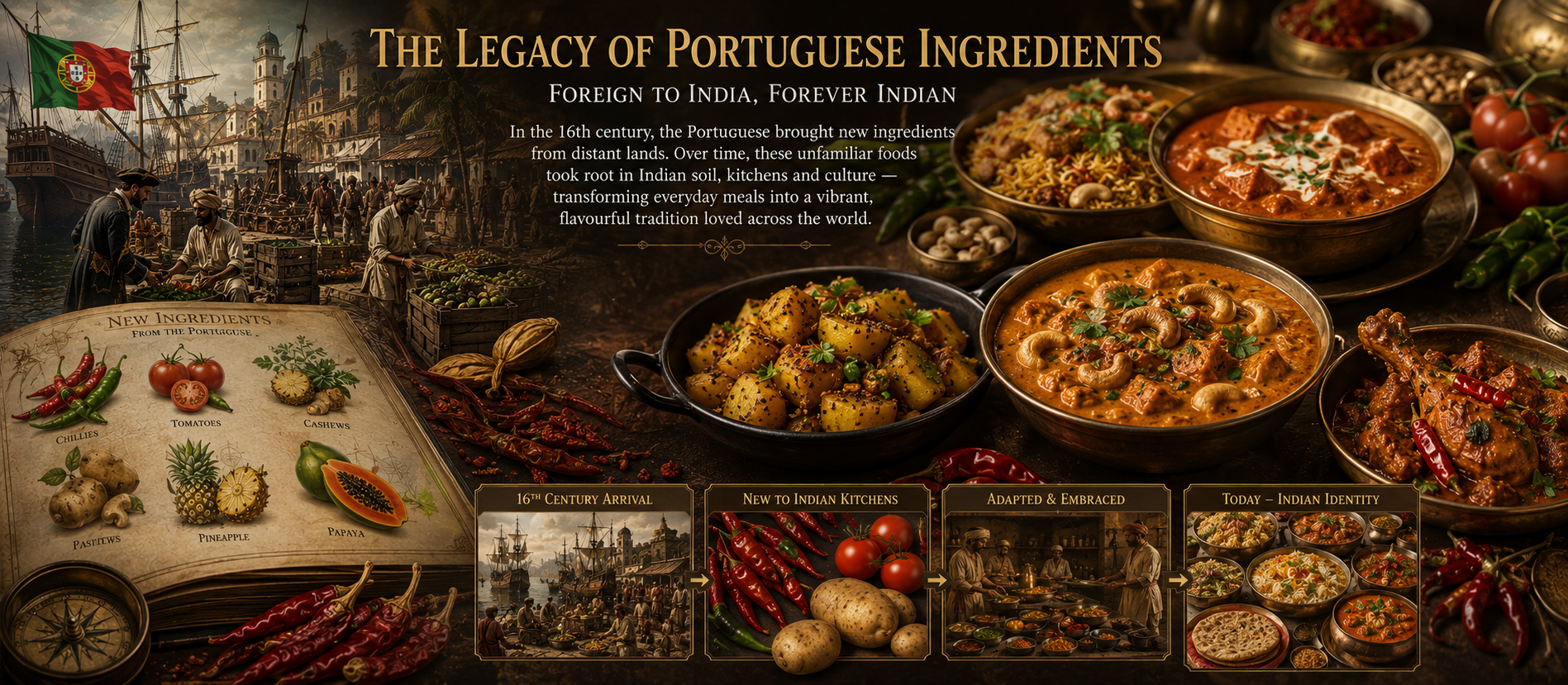
Artist's reconstruction — the Columbian Exchange reaches India: four plants that transformed a cuisine
1492 CE
Columbus Reaches the Americas — Looking for India
Columbus's westward voyage is motivated by the desire to find a direct route to India's spice coast, bypassing Arab and Venetian intermediaries. He finds the Americas instead. Among his first findings: Capsicum peppers, which he names "peppers" in the mistaken belief he has reached India. The chilli's path to India begins with Columbus's geographical error.
1498 CE
Vasco da Gama Reaches Calicut
The Portuguese navigator rounds the Cape of Good Hope and arrives at the Malabar Coast. He returns to Lisbon with a cargo of black pepper, cinnamon, and other spices worth sixty times the cost of his expedition. The Arab-Venetian monopoly on the Indian spice trade is broken. Portugal begins its century-long dominance of the Indian Ocean trade routes.
1510 CE
Portugal Captures Goa
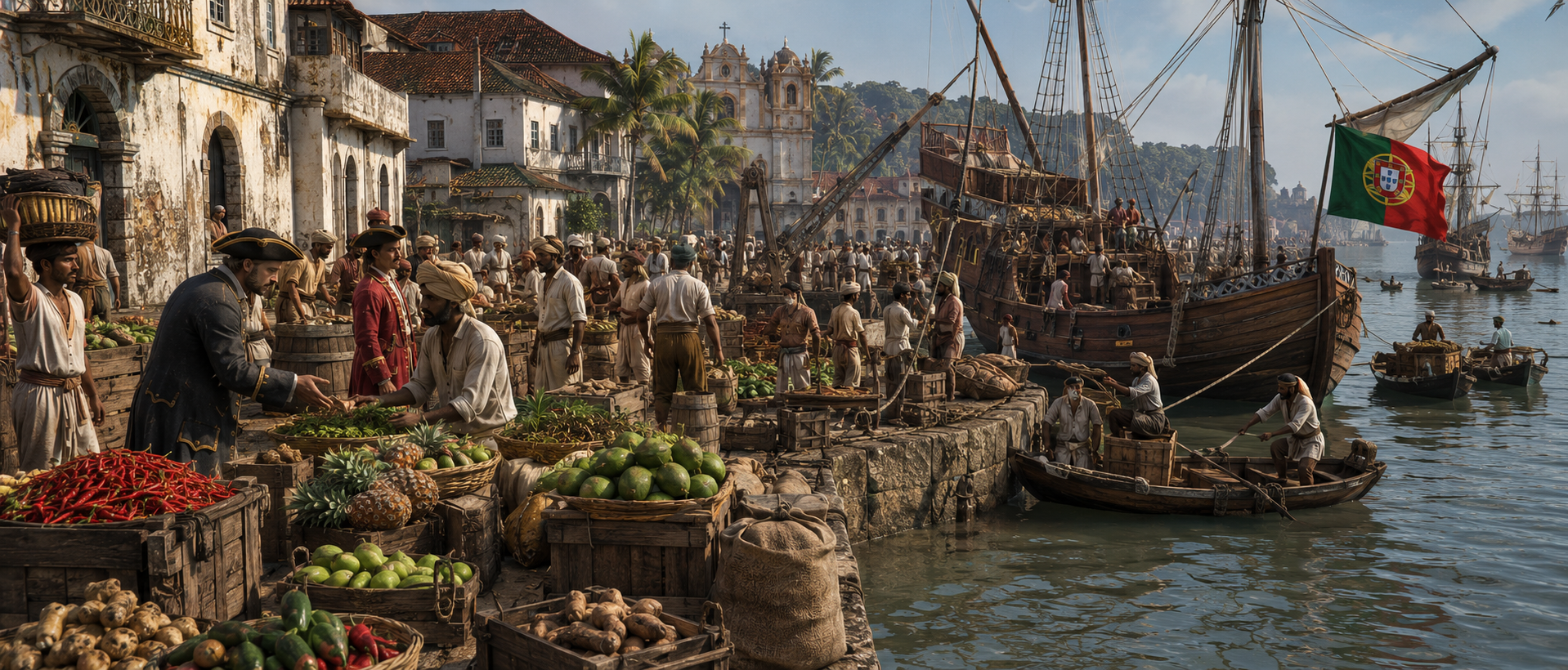
Alfonso de Albuquerque captures Goa from the Bijapur Sultanate, establishing the capital of Portuguese India. Goa will remain a Portuguese possession until 1961. It becomes the laboratory where two food cultures — Indian and Portuguese-Brazilian — mix most intensively, producing a culinary tradition of extraordinary originality.
c. 1500–1550 CE
Chilli Arrives and Spreads
Capsicum peppers — brought from Brazil and the Caribbean to Portugal, then to India via Goa — begin spreading along India's western coast. Within fifty years, the chilli is documented in cultivation across much of India. The speed of adoption is extraordinary — faster than almost any other food introduction in Indian history.
16th–17th Century CE
Tomato, Potato, Cashew Arrive
The full Columbian Exchange reaches India via Portuguese trade routes. Tomatoes, potatoes, cashews, corn (maize), pineapple, papaya, and guava all arrive in this period. Each will eventually transform Indian cooking — some rapidly (cashew in South Indian and Goan cooking), some more slowly (tomato and potato taking longer to become central to everyday cooking).
1961 CE
Goa Returns to India
After 451 years of Portuguese rule, Indian military forces liberate Goa. The Portuguese culinary legacy — vindaloo, sorpotel, cafreal, bebinca, the entire Goan Catholic food tradition — survives and continues to develop as a distinct regional cuisine within independent India.
What Historians Know
The chilli was unknown in India before the Portuguese arrivalThis is not contested. Capsicum species are native to the Americas and were not present anywhere in the Old World before Columbus's 1492 voyage. Every reference to "chilli" in Indian texts before approximately 1500 CE is either referring to black pepper, long pepper, or another pungent spice. The chilli's apparent antiquity in Indian food is an illusion created by its extraordinary speed of adoption.
The chilli spread through India within approximately fifty years of its arrivalBotanical and historical records document the chilli's spread across the subcontinent with remarkable speed. By 1550 CE — a mere fifty years after the Portuguese arrival — the chilli is documented in cultivation across much of India. By 1600 CE, it is described as a standard ingredient in many regional cooking traditions. The adoption rate is extraordinary by any historical standard of ingredient introduction.
Goa was the primary laboratory of Portuguese-Indian culinary exchangeThe specific dishes of Goa — vindaloo, sorpotel, cafreal, xacuti — are documented products of the Portuguese-Indian encounter, each showing the specific combination of Portuguese technique and ingredient with Indian spice tradition. These dishes are the clearest archaeological evidence of the exchange.
Cashew was introduced by the Portuguese and is now integral to several Indian regional cuisinesCashew (Anacardium occidentale) is native to Brazil. It was introduced to Goa by the Portuguese specifically for cashew feni production (cashew spirit) and as a food crop. It spread rapidly along the Konkan and Malabar coasts and is now central to Goan, Kerala, and Karnataka coastal cooking, as well as to North Indian Mughal-derived cooking as a nut paste thickener.
What Historians Debate
How the chilli spread so rapidly across IndiaThe speed of chilli adoption — fifty years from introduction to widespread cultivation — is remarkable and requires explanation. The most plausible theory is that Indian cooks recognised immediately that the chilli could provide the heat and pungency that black pepper and long pepper had previously provided, but more cheaply, more reliably, and with a different flavour character. The chilli didn't introduce heat to Indian cooking — it provided a more economical and differently flavoured substitute for an existing function.
The timing and route of tomato and potato adoptionUnlike the chilli, which spread rapidly, the tomato and potato appear to have taken longer to become central to everyday Indian cooking. The exact timing of their widespread adoption — and whether they spread primarily through Portuguese coastal routes, Mughal court channels, or general agricultural diffusion — is less well-documented than the chilli's trajectory.
Goa colonial trading port Portuguese India exchange
Artist's reconstruction — Goa as colonial trading port: the entry point through which four South American plants entered Indian food culture and changed it permanently
New World plants arriving in India chilli tomato potato cashew
Artist's reconstruction based on historical evidence

Before and After — What Each Plant Did to Indian Cooking

🌶️
Chilli (Capsicum)
Native to Mexico and the Caribbean · Arrived c. 1500 CE
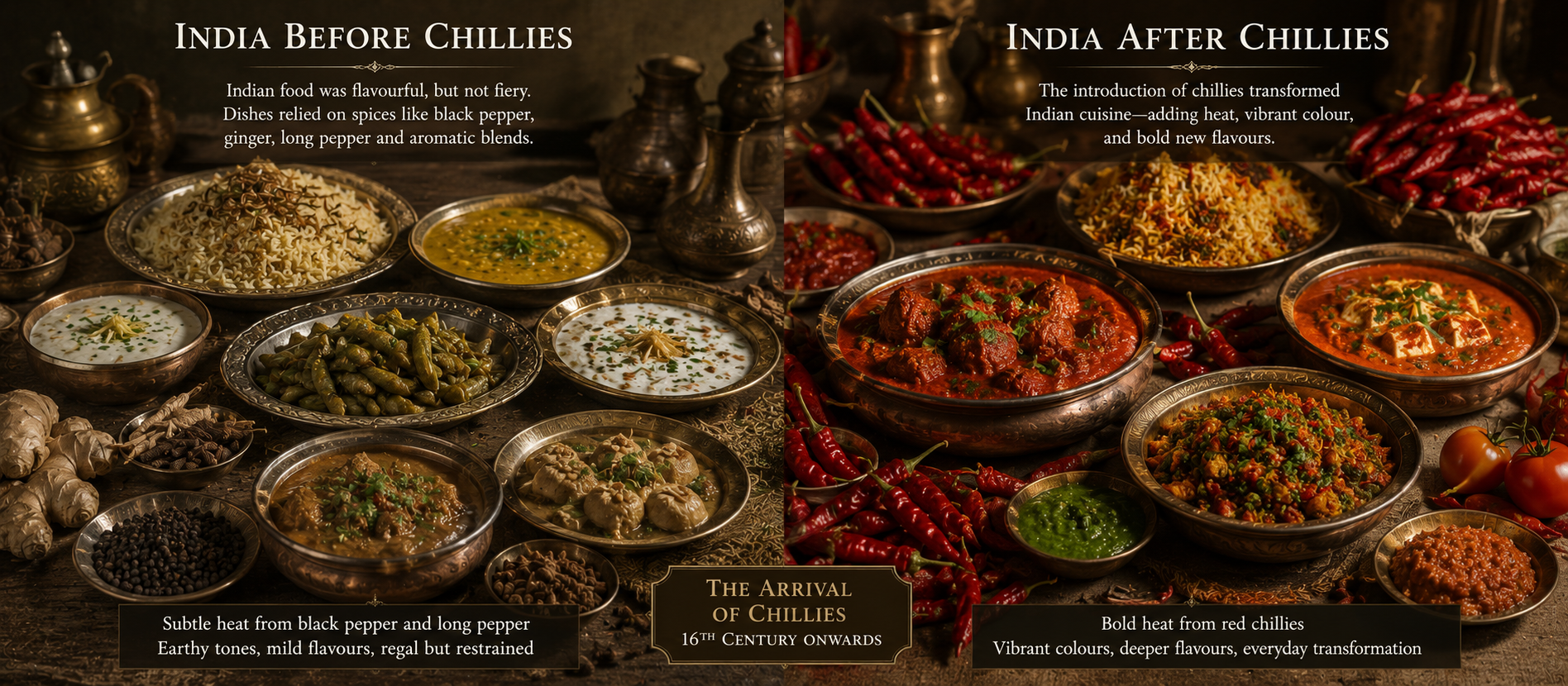
Before: Heat came from black pepper, long pepper, and ginger. Indian food was aromatic and warm but not intensely hot. The dominant cooking heat was the deep, slow warmth of piperine and gingerols.
After: A new category of intense, immediate, versatile heat that could be grown cheaply anywhere in tropical India. Within a generation, chilli was supplementing and then in many regional cuisines largely replacing the role of black pepper. Indian food changed its flavour character permanently.
🍅
Tomato
Native to the Andes · Arrived 16th–17th Century
Before: Sourness in Indian cooking came from tamarind, kokum, dried mango (amchur), yogurt, and citrus. Gravies were thickened with nut pastes, ground seeds, or reduced cooking liquids. Indian food had no tomato-based anything.
After: Tomato became the dominant souring and thickening agent for gravies across North and South India. The tomato-onion base that forms the foundation of most restaurant Indian curries today is a post-1600 development. Butter chicken, tikka masala, and most "curry" sauces are tomato-based — entirely unimaginable before the Portuguese arrival.
🥔
Potato
Native to the Andes · Arrived 17th Century
Before: Starchy vegetables in Indian cooking came from lotus root, yam, raw banana, taro, and other indigenous tubers. North Indian vegetarian cooking had no universally available, cheap, versatile starchy filler vegetable.
After: Aloo became central to North Indian vegetarian cooking within a century. Aloo gobi, aloo matar, aloo paratha, samosa filling — all post-1700 dishes that now feel impossibly ancient. The potato democratised vegetarian cooking by providing a cheap, filling, versatile base ingredient with extraordinary adaptability to Indian spice traditions.
🥜
Cashew
Native to Brazil · Introduced to Goa by Portugal c. 1560
Before: South Indian coastal cooking used coconut for richness. North Indian court cooking used almond and walnut paste as gravy thickeners. Neither had cashew — the more delicate-flavoured, creamier, more easily processed nut that would eventually displace many of these applications.
After: Cashew became central to Goan and coastal Karnataka cooking, to the nut-paste gravies of Mughal-derived North Indian cooking, and to the sweet-making tradition across India. Kaju katli — cashew fudge — is now one of the most iconic Indian sweets. It did not exist before 1560.

The Chilli — The Most Transformative Ingredient in Indian Food History

Of all the plants the Portuguese introduced to India, the chilli is the most historically significant by far. It did not simply add a new flavour to Indian cooking. It changed the fundamental character of the cuisine — the way it tastes, the way it is perceived internationally, the way Indians themselves describe and think about their food. The chilli transformed Indian food more completely than any other single ingredient in four thousand years of culinary history, and it did so in a single generation.

Why did adoption happen so fast? The answer lies in what the chilli replaced and what it improved upon. For thousands of years, the primary sources of heat in Indian cooking had been black pepper (piperine-based heat), long pepper (also piperine), and ginger (gingerol-based warmth). These were expensive — particularly black pepper, which was the world's most valuable traded commodity. They provided heat, but in relatively modest quantities and with specific flavour profiles that were attached to the heat.

The chilli offered something different: intense heat that was more accessible, could be grown cheaply in any tropical or subtropical Indian climate, and produced a qualitatively different heat sensation — sharper, more immediate, more intense, more versatile. A small quantity of dried chilli provided more heat than a much larger quantity of black pepper. It could be dried and stored for months. It could be ground into powder, soaked in water, made into paste, cooked whole in oil, or eaten fresh green. Its versatility was extraordinary.

For Indian cooks who had been working with heat as a central element of their culinary vocabulary for four thousand years, the chilli was not a foreign import: it was a better tool for a job they had always done. They adopted it with the speed of people who recognised immediately what it could do.
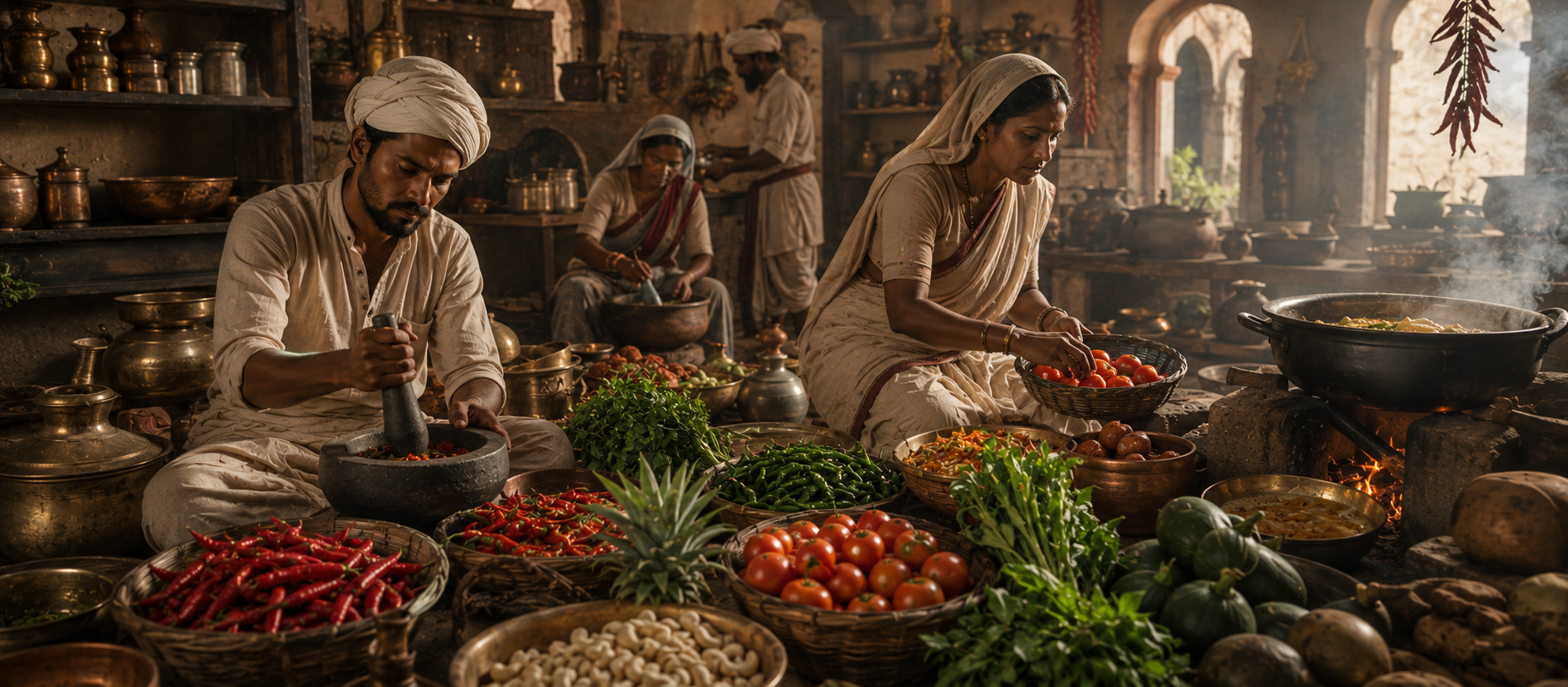
Portuguese colonial kitchen in Goa where two food cultures merged
Artist's reconstruction — the Goan colonial kitchen where Portuguese and Indian traditions merged

Goa — Where Two Food Cultures Collided and Created Something New

Goa is the most important single location in the history of Portuguese-Indian culinary exchange — the place where the meeting of cultures was most intense, most prolonged, and most productive. For 451 years, Goa was a Portuguese colony. In that time, Portuguese cooking techniques and ingredients (including those brought from Brazil and the wider Portuguese empire) met Konkani Hindu and Goan Muslim food traditions, creating a cuisine that belongs entirely to neither parent tradition.

The mechanism of exchange was social: intermarriage between Portuguese settlers and local Goan communities, the conversion of many Goan Hindus to Catholicism (which removed certain Hindu food restrictions while adding Portuguese ones), and the daily practical negotiation of households that combined ingredients and techniques from two completely different culinary systems. The result is a set of dishes that are among the most interesting in Indian food history.
Vindaloo
From Portuguese vinha d'alhos — wine (or vinegar) and garlic marinade. Indian cooks substituted palm vinegar for wine, added chilli and Indian spices. The dish that the world associates with extreme heat began as a Portuguese preservation technique.
Sorpotel
Portuguese sarapatel — offal cooked in vinegar and spice. Adopted by Goan Catholics, adapted with local spices and chilli. One of the most complex offal preparations in Indian cooking — entirely a product of cultural mixing.
Cafreal
From the Portuguese adaptation of African cafreal (peri peri chicken) encountered in Mozambique. Reaches Goa via the Portuguese African connection. Green chilli-based marinade — another product of the extended Portuguese empire meeting Indian cooking.
Xacuti
A specifically Goan creation — complex spice masala using coconut, red chillies, and a specific spice combination that has no parallel in either Portuguese or North Indian cooking. Born entirely in Goa.
Bebinca
The iconic Goan layered dessert — egg yolks, coconut milk, sugar, ghee, layered and baked. Portuguese egg-based dessert tradition meets Indian coconut milk and ghee. A sweet that could only exist at this specific cultural intersection.
Feni
Cashew or coconut spirit — distillation technology brought by the Portuguese meets the cashew they introduced to Goa. The GI-tagged spirit of Goa is itself a product of the Portuguese arrival.
Indian food before and after chilli comparison
Artist's reconstruction — before and after: what Indian food looked and tasted like before the chilli, and what it became after

Why Capsaicin Creates Heat — and Why Humans Seek It

Capsaicin (8-methyl-N-vanillyl-6-nonenamide) is the primary heat-producing compound in chilli peppers. Like piperine in black pepper, it creates a sensation of heat — but through a completely different mechanism. Capsaicin binds specifically and powerfully to TRPV1 receptors — thermoreceptors that normally respond to temperatures above approximately 43°C (the threshold of painful heat). When capsaicin binds to these receptors, it sends the same neural signal to the brain as actual burning heat: the burning sensation of chilli is not metaphorical. The TRPV1 receptor is genuinely being told that the tissue is dangerously hot.

Why do humans seek this experience? The pain response triggered by capsaicin causes the brain to release endorphins — natural analgesics — as a pain management response. These endorphins produce a mild euphoric effect. Regular chilli eaters develop a tolerance to capsaicin (TRPV1 receptors become desensitised with repeated exposure) that requires progressively more capsaicin to produce the same effect. Chilli heat is genuinely mildly addictive — which helps explain its extraordinary global adoption once it became available.

Why Chilli Spread Faster Than Pepper — The Agricultural Economics

Black pepper requires specific tropical conditions — the Western Ghats' combination of monsoon rainfall, humidity, and specific soil — that exist in a limited geographic range. A pepper vine takes several years to produce its first harvest. The plant is a perennial that requires support and specific agricultural management. Scaling pepper production is slow and geographically constrained.

Chilli is an annual plant that grows in a wide range of tropical and subtropical conditions, produces abundantly within months of planting, and can be cultivated at small scale in kitchen gardens. A single chilli plant produces dozens of fruits. Dried chilli stores well for months. The agricultural economics of chilli versus black pepper — lower barriers to entry, faster production, wider geographic range — meant that chilli could spread through agricultural diffusion far faster than any other high-value spice in history. The speed of chilli adoption in India reflects not just culinary preference but the straightforward economics of a more accessible heat source.

Why Tomato Changed the Physics of Indian Curry

The tomato's importance to modern Indian cooking goes beyond its flavour. Tomatoes are approximately 95% water — this water content, combined with the organic acids and pectin they contain, fundamentally changes the texture of Indian curry gravies. When tomatoes are cooked down (bhuna — the process of cooking tomato paste until the fat separates), they provide: acidity (from citric and malic acids, which brighten and balance the dish), body and viscosity (from the pectin and cooked protein), and a specific sweet-sour-savoury flavour baseline that was simply not available from any pre-Portuguese Indian souring agent. No combination of tamarind, yogurt, and ground seeds achieves the same result. The tomato didn't just replace an existing ingredient — it enabled a new category of gravy.

The Extraordinary Irony at the Heart of This Story

The chilli — the ingredient that the world most associates with Indian food, the flavour that most defines "Indian" to international palates, the spice that Indian cuisine is most famous for — has been part of Indian cooking for approximately 500 years. In a food tradition that stretches back 4,000 years, the chilli is a recent arrival. It represents 12% of Indian food history. Yet it feels ancient, inevitable, inseparable.

This is not a historical accident. It is evidence of Indian food culture's extraordinary capacity for absorption and integration. The chilli was adopted not because it was imposed by colonial power — the Portuguese did not force Indians to eat chillies — but because Indian cooks recognised its value immediately and made it their own so completely that its foreign origin was forgotten within a generation.

The same is true of the tomato, the potato, the cashew, and the other Columbian Exchange plants. They are now so thoroughly Indian that removing them from Indian cooking would be not just impractical but culturally inconceivable. Aloo gobi without aloo. Butter chicken without tomato. Kaju katli without cashew. These are not Indian dishes with foreign ingredients. They are Indian dishes, full stop — created by Indian cooks from whatever the world provided, integrated so completely into the tradition that their origins are invisible.

This is what food culture at its best does. It does not preserve itself unchanged. It absorbs, adapts, and makes everything its own.

Then and Now

Indian Food Before 1500 CEIndian Food Today
Heat from black pepper, long pepper, gingerHeat primarily from chilli in most regional cuisines — the Portuguese arrival changed the character of Indian heat permanently
No tomato — sourness from tamarind, kokum, yogurtTomato-onion base in the majority of restaurant Indian curries — the post-Portuguese development that most defines "curry" internationally
No potato — starchy vegetables from local tubers and yamAloo in hundreds of Indian preparations — the Andes-born tuber now inseparable from North Indian vegetarian cooking
No cashew — almonds and walnuts for nut paste graviesCashew paste in korma, cashew in biryani garnish, kaju katli — the Brazilian nut now central to multiple Indian traditions
No corn/maize — grains from wheat, rice, barley, milletsMakki ki roti (Punjabi cornbread) — now so traditional-feeling that most people have no idea it is post-Columbian
Modern Indian cuisine legacy of Portuguese influence — chilli tomato potato
The living legacy — chilli, tomato, potato and cashew now inseparable from Indian cooking

Legacy Today

The Chilli
The most complete transformation of Indian food in four thousand years. Five hundred years old; feels ancient. The food identity of a billion people depends on an ingredient that arrived five centuries ago.
Goan Cuisine
Vindaloo, sorpotel, cafreal, bebinca — a living laboratory of Portuguese-Indian exchange. One of India's most distinct regional food traditions, born from 451 years of colonial encounter.
Aloo — The Potato
Aloo gobi, aloo matar, aloo paratha, samosa — the potato in its Indian forms is now one of the most widely eaten foods in the world. An Andean crop that became Indian in a century.
Tomato-Based Curries
The tomato-onion base that most of the world knows as "Indian curry" is a post-1600 invention. Butter chicken, tikka masala, and the majority of restaurant Indian dishes could not exist without the Portuguese arrival.
Kaju Katli
The most iconic Indian sweet — cashew fudge — made from a Brazilian nut introduced by Portuguese colonisers. A sweet that is now synonymous with Indian celebration.

Sources & Evidence

Primary Sources

  • Vasco da Gama's voyage logs (1497–1499) — first Portuguese contact with Malabar coast
  • Garcia de Orta, Colloquies on the Simples (1563) — first botanical account of chilli in India
  • Portuguese colonial records from Goa (16th–18th century)
  • Duarte Barbosa, A Book of the East (c. 1516) — description of Indian coast trade and food
  • Early Jesuit letters from India — food references in missionary correspondence

Secondary Sources

  • Lizzie Collingham — Curry: A Tale of Cooks and Conquerors
  • K.T. Achaya — Indian Food: A Historical Companion
  • Colleen Taylor Sen — Feasts and Fasts
  • Andrew Dalby — Food in the Ancient World
  • Gary Paul Nabhan — research on Columbian Exchange crop diffusion