Series 1 · The Chronological Story · Chapter 13 of 17
Mughal Influence
on Indian Food
The Imperial Kitchen and the
Birth of North Indian Cuisine
Artist's reconstruction based on historical evidence
The Imperial Kitchen and the
Birth of North Indian Cuisine
Artist's reconstruction based on historical evidence
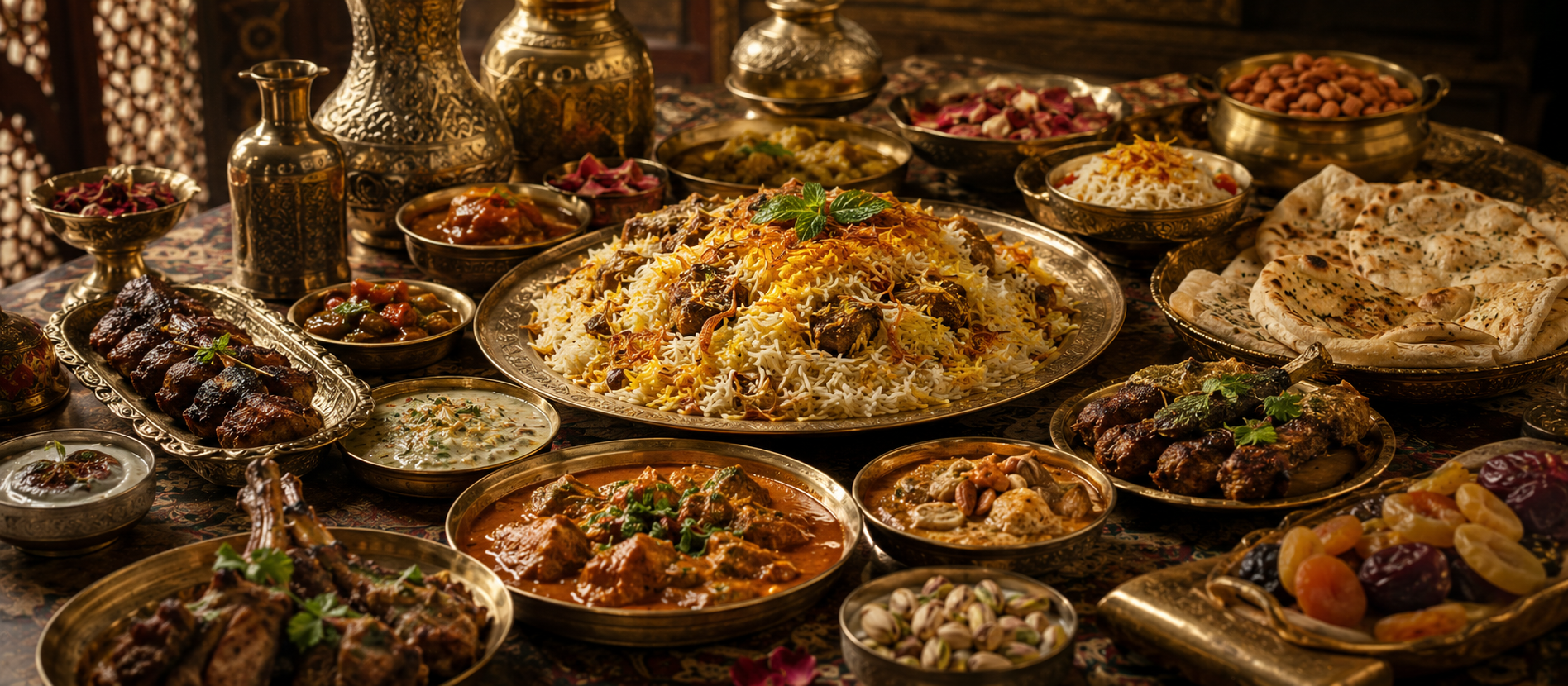
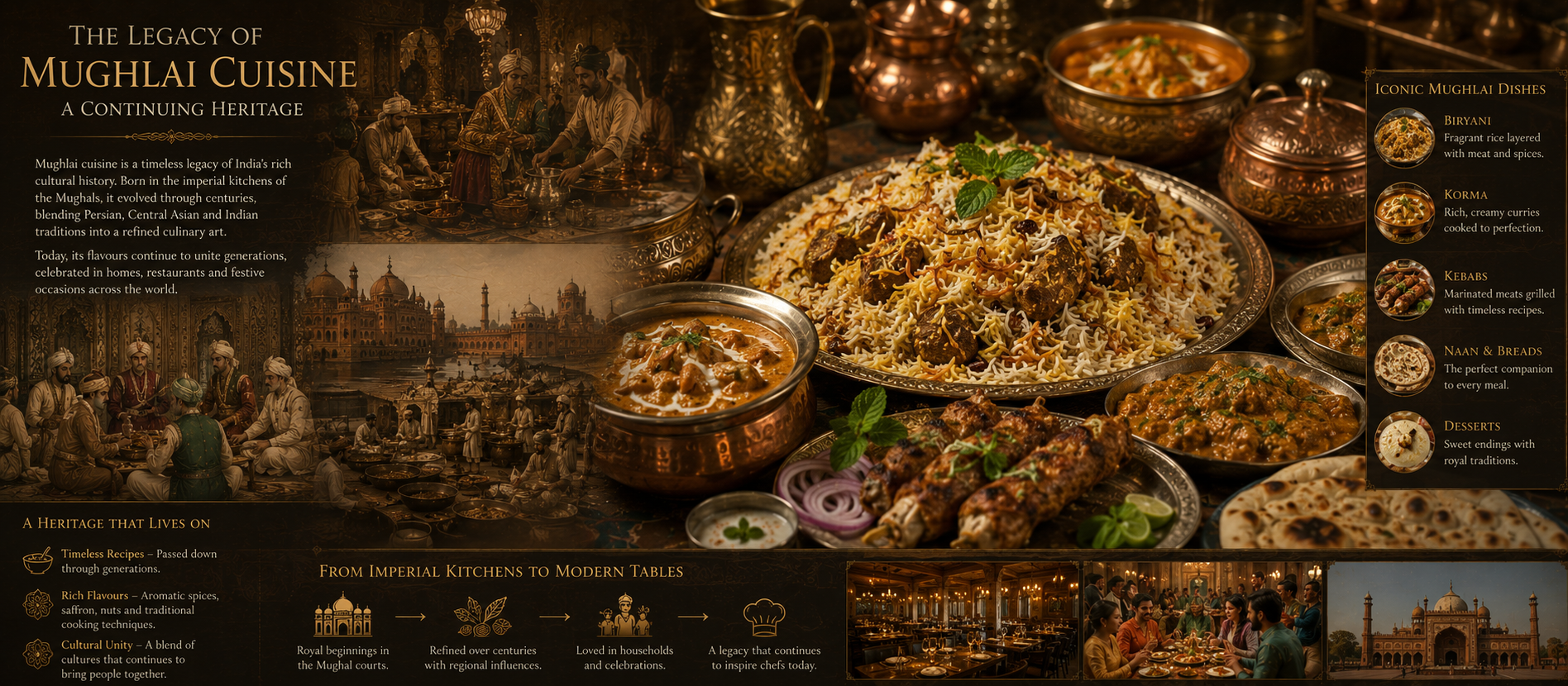
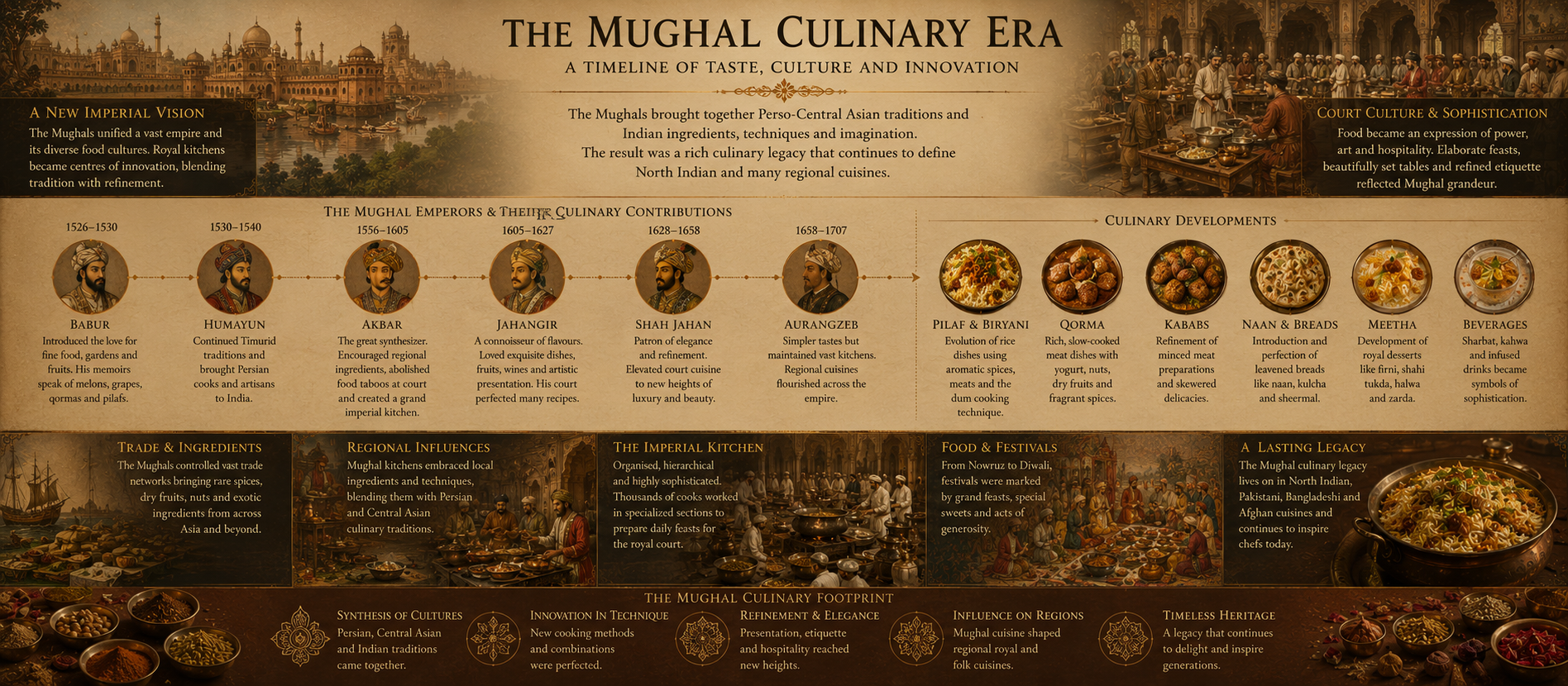
When most people around the world eat "Indian food" — whether in London, Sydney, New York, or Tokyo — they are eating Mughal food. The rich, aromatic gravies; the biryani; the tandoor-cooked breads and meats; the korma; the roganjosh — these are not pan-Indian dishes that represent the full breadth of the subcontinent's culinary diversity. They are dishes from one specific tradition: the court cuisine of the Mughal empire, developed over three centuries in the royal kitchens of Agra, Delhi, and Lahore, then disseminated across the world by the Indian diaspora. Understanding the Mughal kitchen is not optional background knowledge for understanding Indian food. It is the central story.
 🔍 Click to enlarge
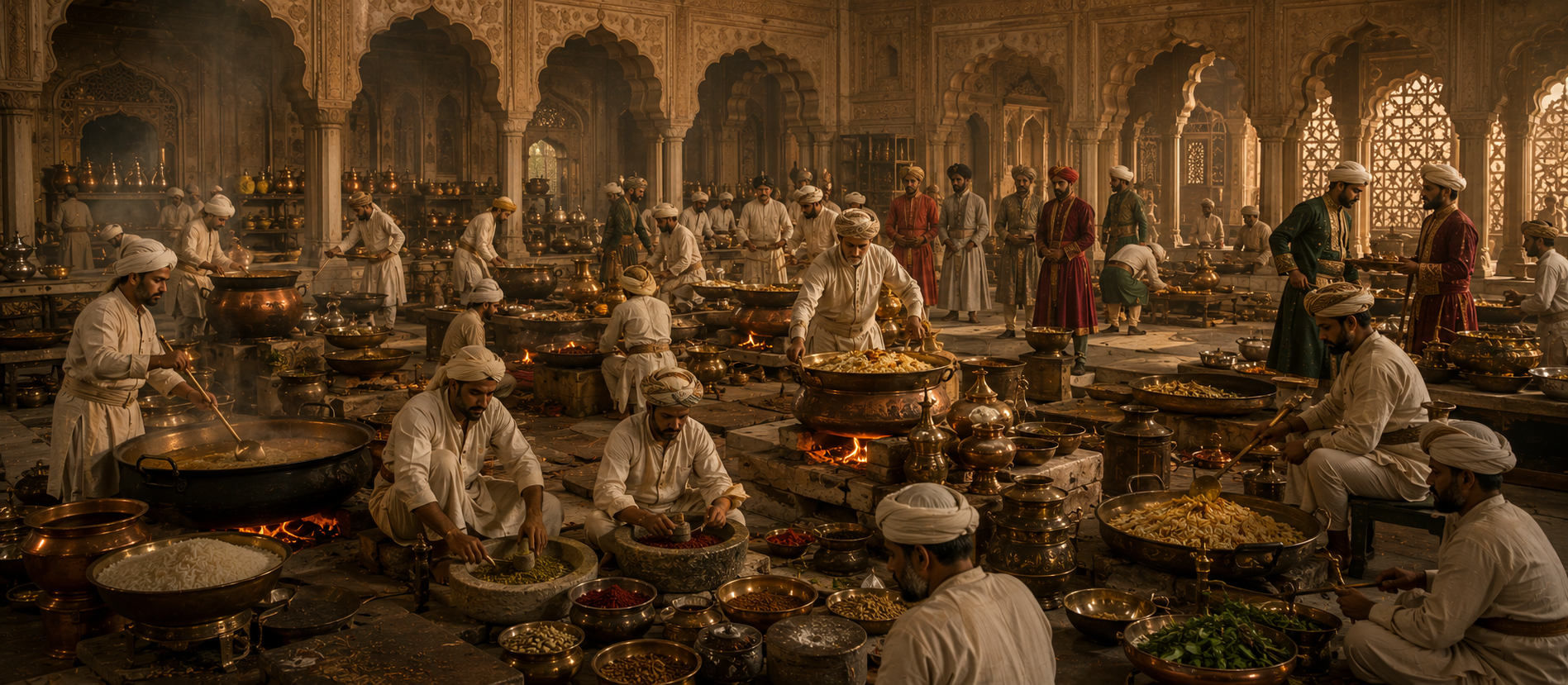
The Mughal imperial kitchen was not a kitchen in any domestic sense. It was an industrial food operation — more comparable in scale and organisational complexity to a military supply operation than to anything that had previously existed in the Indian culinary context.
The Ain-i-Akbari describes the kitchen (bawarchikhana) as divided into separate departments for different categories of food: one department for rice preparations, one for meat, one for bread, one for sweets, one for beverages and sherbets, one for preserves. Each department had its own specialist staff, its own equipment, its own supply chain, and its own accounting. The entire operation was overseen by a darogha (controller) who maintained records of everything — every ingredient purchased, every dish prepared, every person who ate — and reported to the royal household administration.
Food safety procedures were extensive and specifically documented. Every dish was tasted by designated tasters before reaching the emperor. Dishes were covered and sealed when transported from kitchen to table. Specific vessels (made of stone that was believed to change colour if poison was present, or made of rhinoceros horn) were used for certain royal preparations. The kitchen's security procedures treated food as a potential assassination vector — which, at the Mughal court, it sometimes was.
"His Majesty partakes of food once or twice a day. The kitchen is under the superintendence of a darogha. There are about fifty masalchis who wash the dishes and carry them. Tablecloths are spread; and His Majesty rarely touches a dish twice."
Abu'l-Fazl, Ain-i-Akbari, 1590 CE — describing Akbar's daily eating practices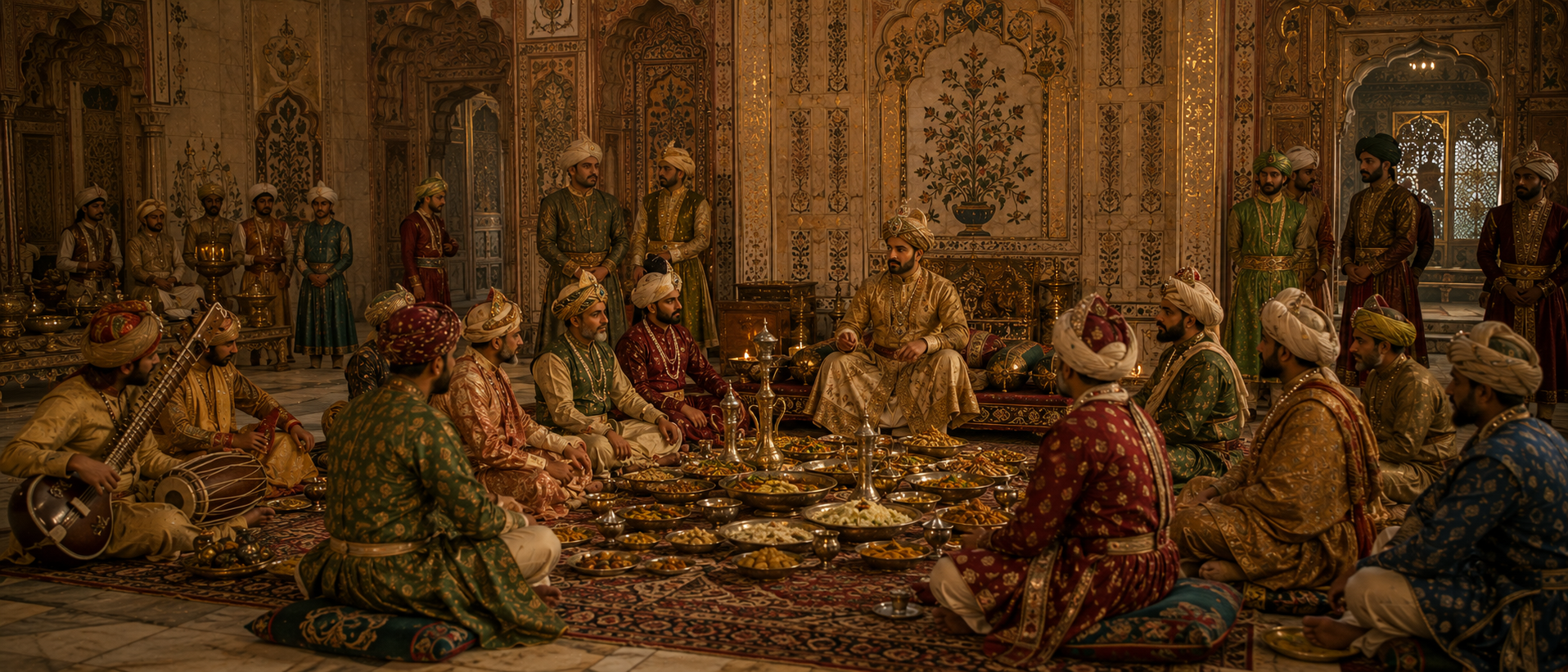
One of the most interesting aspects of Mughal food history is how differently each emperor related to food — and how those personal relationships shaped the evolution of the court cuisine. The Mughal kitchen was not a static institution. It evolved with each emperor, incorporating their personal preferences, their cultural backgrounds, and their specific interests.
The dishes that emerged from the Mughal imperial kitchen and its successor court kitchens — the Nawabi courts of Lucknow, Hyderabad, and Delhi — are now among the most widely eaten foods in the world. They are what most people mean when they say "Indian food." Understanding their origins in the imperial kitchen makes them more interesting, not less.
The Mughal kitchen developed the most sophisticated spice blending tradition in the world. The whole spice combinations, the ground spice masalas, and the specific aromatic elements used in Mughal court cuisine were not arbitrary — they represented accumulated empirical knowledge about which spice combinations produce the most complex, balanced aromatic profiles.
The key insight that distinguishes Mughal spice use from simpler traditions is the layering of different types of aromatic compounds. Whole spices in oil at the beginning of cooking (tempering) extract fat-soluble volatile compounds — the terpenes in cardamom, the eugenol in cloves, the cinnamaldehyde in cinnamon — early in the cooking process, allowing them to interact with and flavour the cooking fat and everything cooked in it. Ground spice pastes added in the middle of cooking contribute water-soluble compounds and undergo Maillard reaction products that develop new flavour molecules. Whole aromatic spices (star anise, bay leaf, black cardamom) added to slow-cooking liquids contribute their compounds gradually over long cooking periods. And finishing aromatics — saffron-milk, rose water, kewra — are added at the end to preserve their most volatile and fragrant compounds.
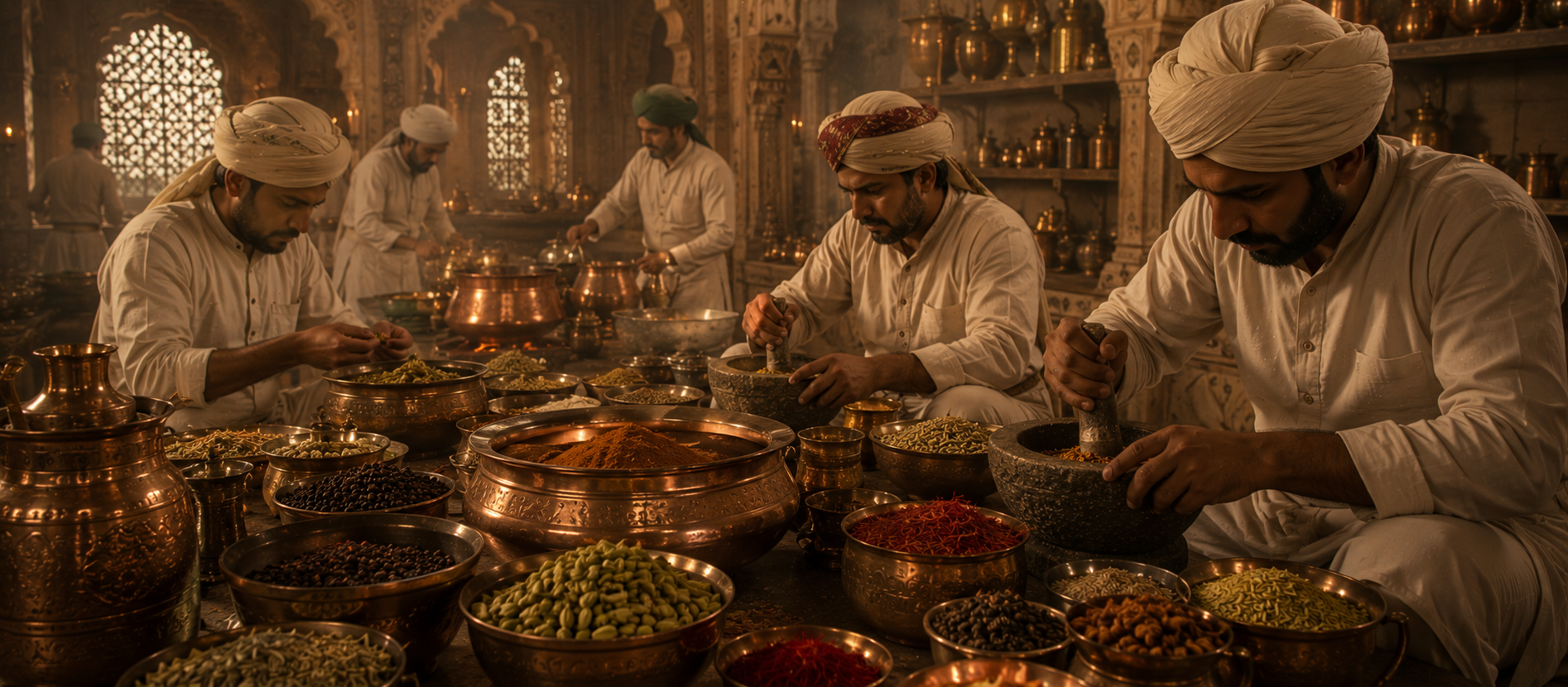
In a separate section of Akbar's imperial kitchen complex, the spice workshop operates under the supervision of a master spice blender. This is not a modest operation: the quantity of spices required for a kitchen serving thousands daily must be measured, blended, and prepared in industrial quantities. Stone mortars the size of buckets are used for initial grinding. Smaller stone mortars for fine blending. Clay storage vessels sealed with cloth for each specific masala blend — one blend for biryani, another for korma, another for the breakfast nihari, another for the sherbet-maker's flavoured waters.
Today the master blender is preparing the royal korma masala — a blend that has been refined over decades by successive spice masters in this kitchen. Coriander seeds, carefully sorted for size and freshness, are dry-roasted first — separately from everything else, because they need higher heat and longer roasting than the other spices. Cumin, also dry-roasted. Black peppercorns. Green cardamom. Then the aromatics that are added raw: cinnamon, cloves, black cardamom, star anise, mace, nutmeg. The proportions are not written down anywhere — they exist in the master blender's memory and in his hands, learned over twenty years of apprenticeship. He will teach his successor the same way he was taught.
Alongside the dry masala preparation, a separate operation is underway: the wet masala for the same korma. Caramelised onions ground to a smooth paste with water. Ginger-garlic paste prepared fresh daily. A cashew and almond paste that will provide the gravy's richness and body. These wet elements will be cooked out separately before the meat is added, each component developed to its correct stage before the next is introduced. The final dish — the lamb korma that will be served at tonight's court dinner — will take eight hours from start to finish. Twenty people are involved in its preparation.
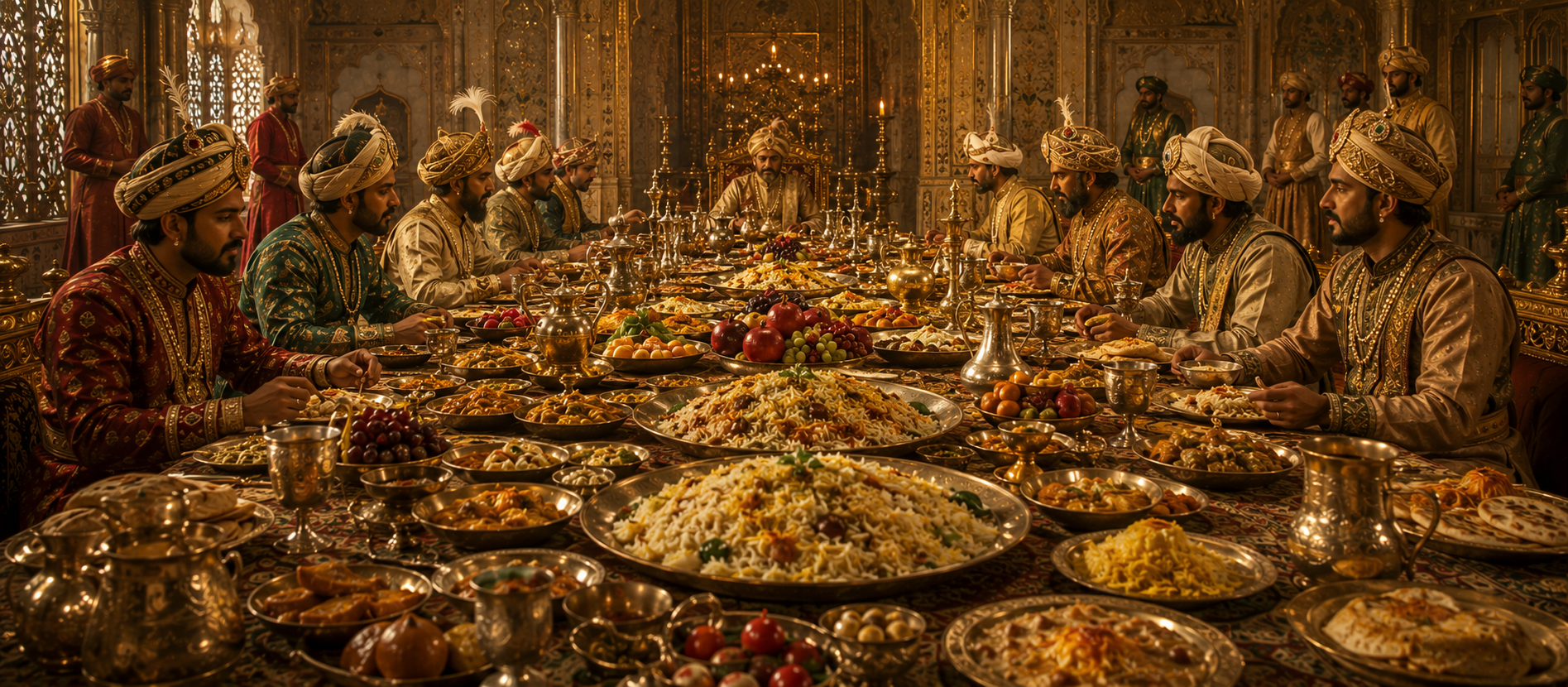
What a Mughal court meal actually consisted of — from the Ain-i-Akbari and related sources.
The Ain-i-Akbari describes over one hundred preparations available in the Mughal kitchen. A formal court dinner would include multiple rice preparations (including a biryani and a plain saffron rice), several meat dishes (lamb korma, a roasted preparation, a preparation with dried fruits), bread from the tandoor (naan, kulcha), several dairy preparations (including specific curd and yogurt preparations), a sweet preparation (likely a halwa or kheer), and sherbet or water with specific flavourings. The meal was served on individual portions, not shared platters — a specifically Mughal dining convention documented by multiple visitors to the court.
By the 17th century, Mughal court cuisine had filtered to the wider court nobility — the mansabdars, the jagirdars, and the senior officials who maintained their own households in the Mughal style. Their daily meals were less elaborate than the emperor's but followed the same structural principles: rice, meat, bread, dairy, and sweet. The specific preparations were adapted to their households' resources but maintained the characteristic Mughal flavour profile — long-cooked meat in aromatic gravy, dum-cooked rice, yogurt-based sides, and rose-water or cardamom-scented sweets.
Mughal korma — the defining preparation of the imperial court kitchen — achieves its extraordinary depth of flavour through a sequence of specific chemical transformations, each building on the previous one. Understanding the science makes the cooking more deliberate and the results more consistently excellent.
The foundation is the caramelised onion base. Onions contain large quantities of fructooligosaccharides — complex sugars that break down through long cooking into simple sugars, which then undergo caramelisation (above approximately 160°C) and Maillard reaction with the amino acids present. The result — the deep brown, intensely sweet, complex-flavoured paste that forms the base of korma — contains hundreds of flavour compounds, including specific furans and pyrazines that give caramelised onions their distinctive nutty, complex character. This base cannot be shortcut. The only way to produce it is time: 30–45 minutes of steady cooking, stirring, allowing the moisture to evaporate while the sugars concentrate and transform.
Why nut paste changes the texture: The almond and cashew paste that thickens korma is not simply a textural element — it changes the sauce's emulsion structure. Nut pastes contain proteins and fats that bind water and oil into a stable emulsion, preventing the sauce from "breaking" (separating into greasy and watery components) during long cooking. The Mughal cooks who discovered that nut paste produced more stable, richer gravies were empirically solving an emulsion chemistry problem that food scientists would not explain for another three centuries.
The tandoor oven produces bread and meat with specific characteristics that no other cooking method replicates. The clay walls of a fully-heated tandoor reach 350–450°C — far hotter than a domestic oven and comparable to a pizza oven. But the clay's high thermal mass means the temperature is very stable — it does not spike and dip as a gas oven does. And the clay walls radiate heat in the far-infrared spectrum, which penetrates food surface more deeply than the convective heat of a conventional oven.
For bread: naan pressed against the tandoor wall cooks simultaneously from both sides — the hot clay from one side, the radiant heat from the coals below from the other. The rapid surface charring from the clay wall creates the characteristic leopard-spot markings; the bread's interior remains soft and slightly chewy. For meat: the intense heat chars the outside of tandoori chicken or seekh kebab in seconds, creating the Maillard browning that produces complex flavour, while the interior cooks more gently in the radiated heat. The result — exterior char, interior moisture — cannot be achieved in a domestic oven.
Because the diaspora carried it. When Indian migrants settled in Britain, the United States, Canada, Australia, and other countries in the 20th century, the food they brought with them — and the food they put on restaurant menus — was predominantly from the Mughal tradition. Not because other Indian food traditions are less interesting or less delicious, but because Mughal court cuisine was the prestige cuisine of North India, the food that was associated with wealth and celebration, the food that could be adapted to restaurant service in ways that many South Indian or regional specialties could not.
The result is a global understanding of "Indian food" that is heavily skewed toward Mughal dishes. When most Western people think of Indian food, they think of biryani, korma, rogan josh, tandoori chicken — all Mughal-tradition dishes. This is not the full picture of Indian food's extraordinary diversity. But it is the face that Indian food presents to most of the world, and understanding the Mughal kitchen is the only way to understand why.
The Mughal kitchen also demonstrates something important about food and power: great cuisine requires great resources, great organisation, and great intellectual investment. The Mughal emperors — particularly Akbar, Jahangir, and Shah Jahan — invested in their kitchens the same way they invested in architecture and literature: as an expression of civilisational achievement. The food that resulted was genuinely extraordinary, and its legacy is genuinely global.
| Mughal Imperial Kitchen, 16th–17th Century | Today |
|---|---|
| Biryani as imperial court preparation | India's most-ordered dish on delivery platforms — democratised from court to street over 400 years |
| Korma as imperial braised meat preparation | On restaurant menus worldwide — the Mughal synthesis now a global dish |
| Tandoor as imperial kitchen technology | Every Indian restaurant has one — the imperial kitchen's central technology globalised |
| 4,000+ kitchen staff for one emperor | Industrial food production at similar scale — the organisation principles, if not the poetry, remain |
| Saffron as the luxury aromatic marker | Still marks celebratory and festive food — the status marker unchanged across 400 years |
| Dum pukht as sealed steam technique | Used from street biryani operations to three-star restaurants — the technique universalised |
| Mughal court food exclusive to elite | Nihari for breakfast at Rs.100, biryani delivery to apartments — the full democratisation of imperial food |