← HomeHistory Hub
Persian-influenced royal banquet medieval India
Series 1  ·  The Chronological Story  ·  Chapter 12 of 17

Persian Influence
on Indian Food

Refinement, Rice and the
Road to Biryani

10th–17th Century CE· 26 min read· Court Culture · Culinary Refinement · Linguistic History

Artist's reconstruction based on historical evidence

Reading Time by Section
Quick Facts1 min
Timeline3 min
Persian Courts & Food Culture4 min
New Ingredients3 min
The Road to Biryani5 min
Culinary Language2 min
Science of Saffron3 min
Kitchen Reconstruction2 min
Legacy Today2 min
Persian court dining India
The Persian Court Table
Medieval Indo-Persian court life food
Court Culture — Where Refinement Began
Persian Indian fusion feast
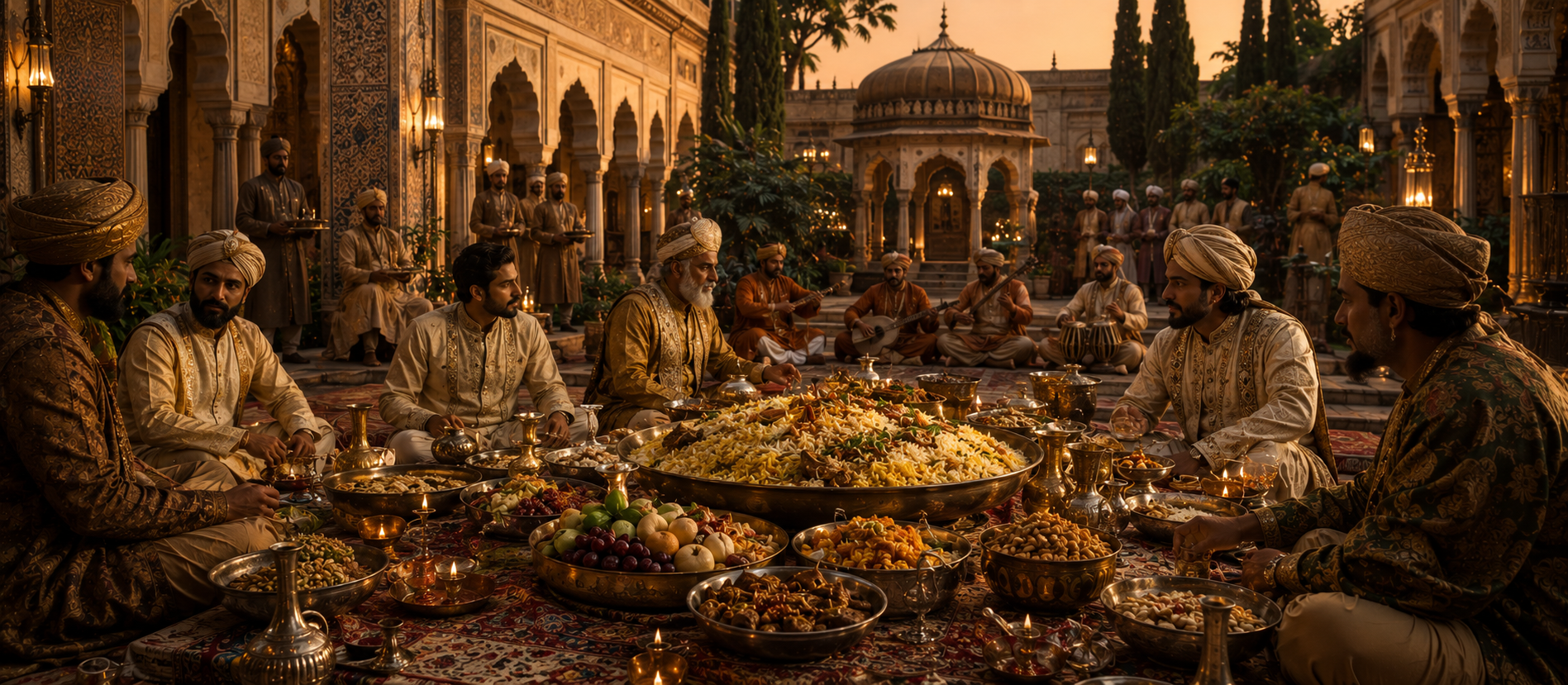
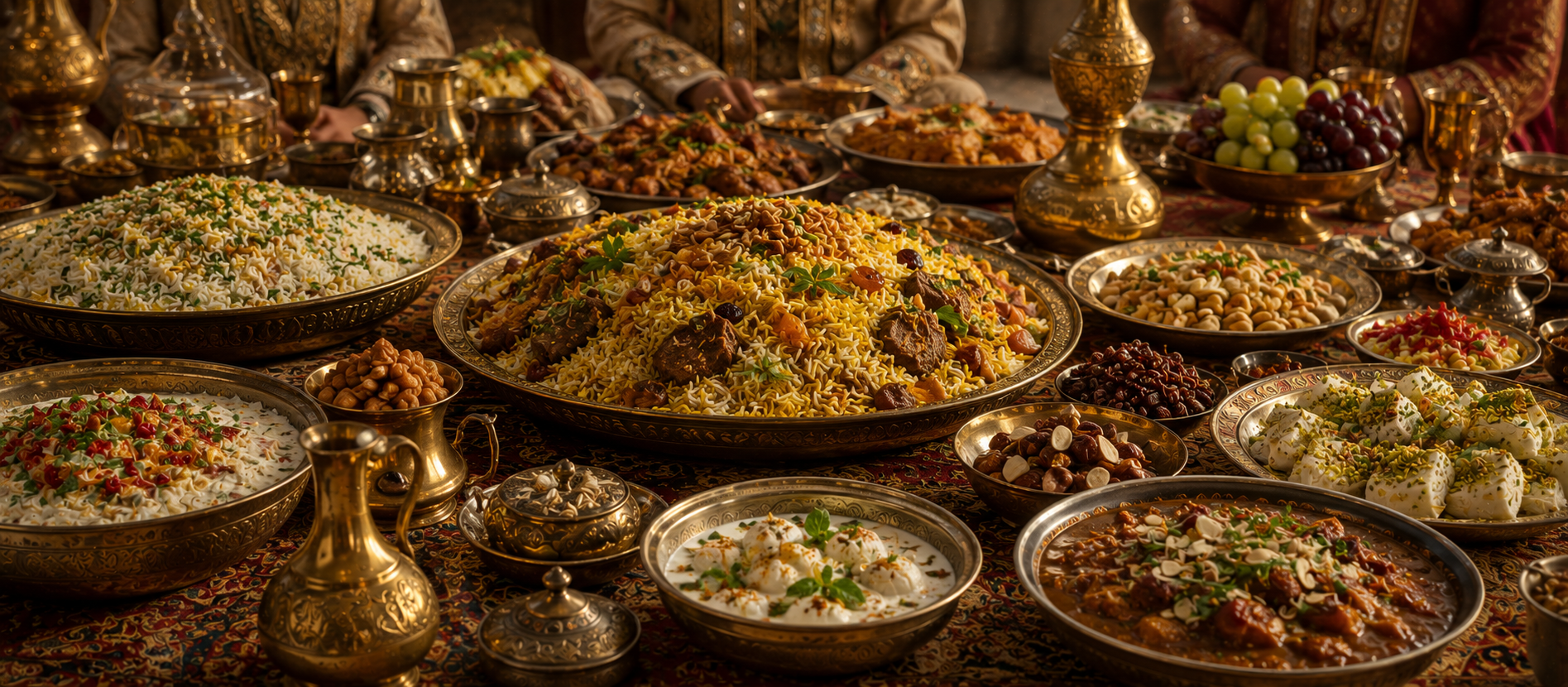
The Indo-Persian Feast
Artist's reconstruction based on historical evidence
Period
10th–17th Century CE
Particularly intense during Delhi Sultanate and Mughal eras
Entry Point
Delhi Sultanate Courts
Persian was the language of Islamic courts in India
Signature Ingredient
Saffron
The world's most expensive spice — symbol of Persian luxury
Key Technique
Dum (Sealed Steam Cooking)
Persian in origin; transformed Indian rice dishes
New Ingredients
Dried Fruits, Nuts, Saffron, Rose Water
The Persian pantry enters Indian court cuisine
Key Dish
Biryani (via pulao)
The most complex product of Persian-Indian exchange
Language Legacy
Persian Words in Indian Food
Biryani, korma, qorma, pilaf, halwa — all Persian-origin
Chapter Theme
Adaptation, Not Imitation
Persian ideas became Indian dishes — not Persian food in India

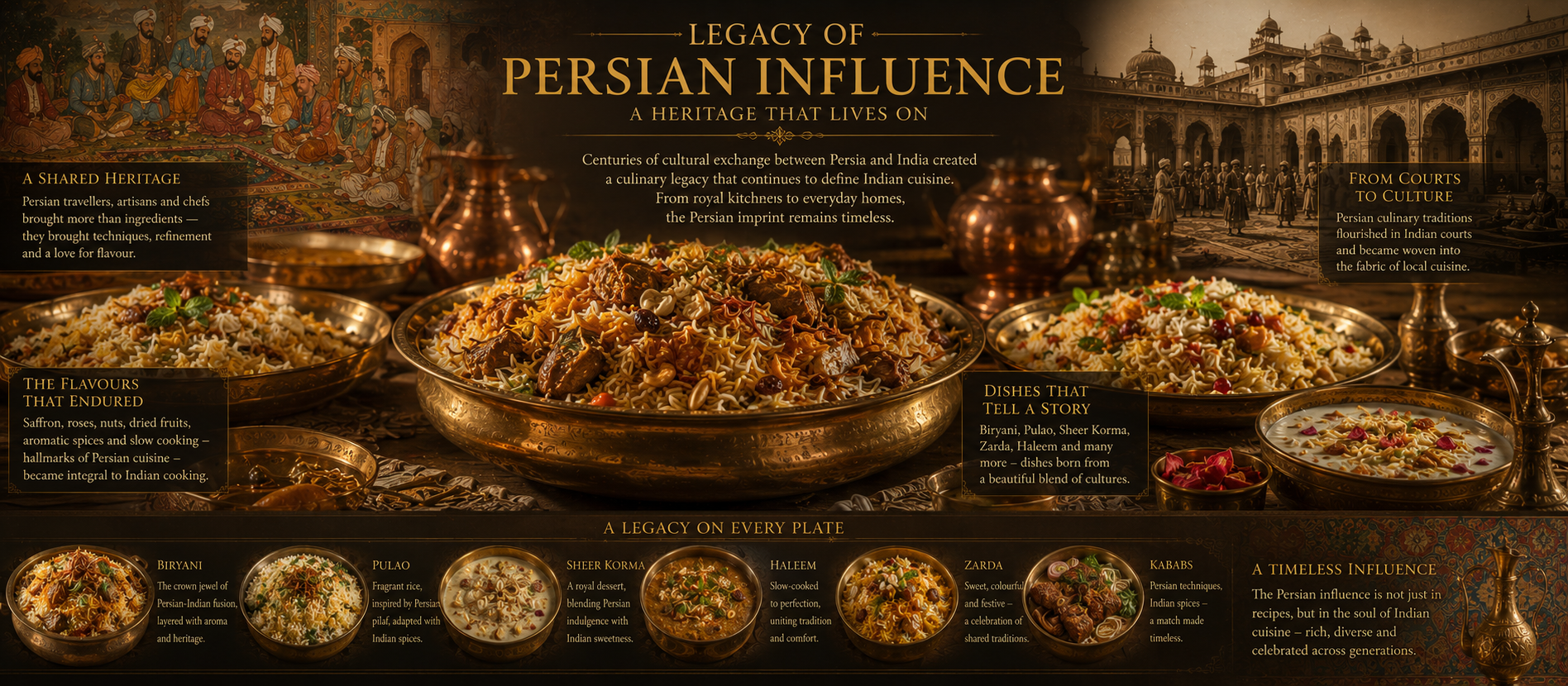
Some of the most iconic dishes associated with Indian food today — biryani, korma, pulao, halwa — carry names that are Persian in origin. Yet calling these dishes "Persian food" would be wrong. They are Indian dishes, created by Indian cooks, reflecting Indian spice traditions and Indian ingredients. What Persian culture provided was not a set of recipes but a set of ideas: about how to combine rice and meat, how to use dried fruits for textural contrast, how to build flavour through slow sealed cooking, how to use saffron as the defining luxury note. Indian cooks took those ideas and made something new. The result is one of the world's great culinary traditions.
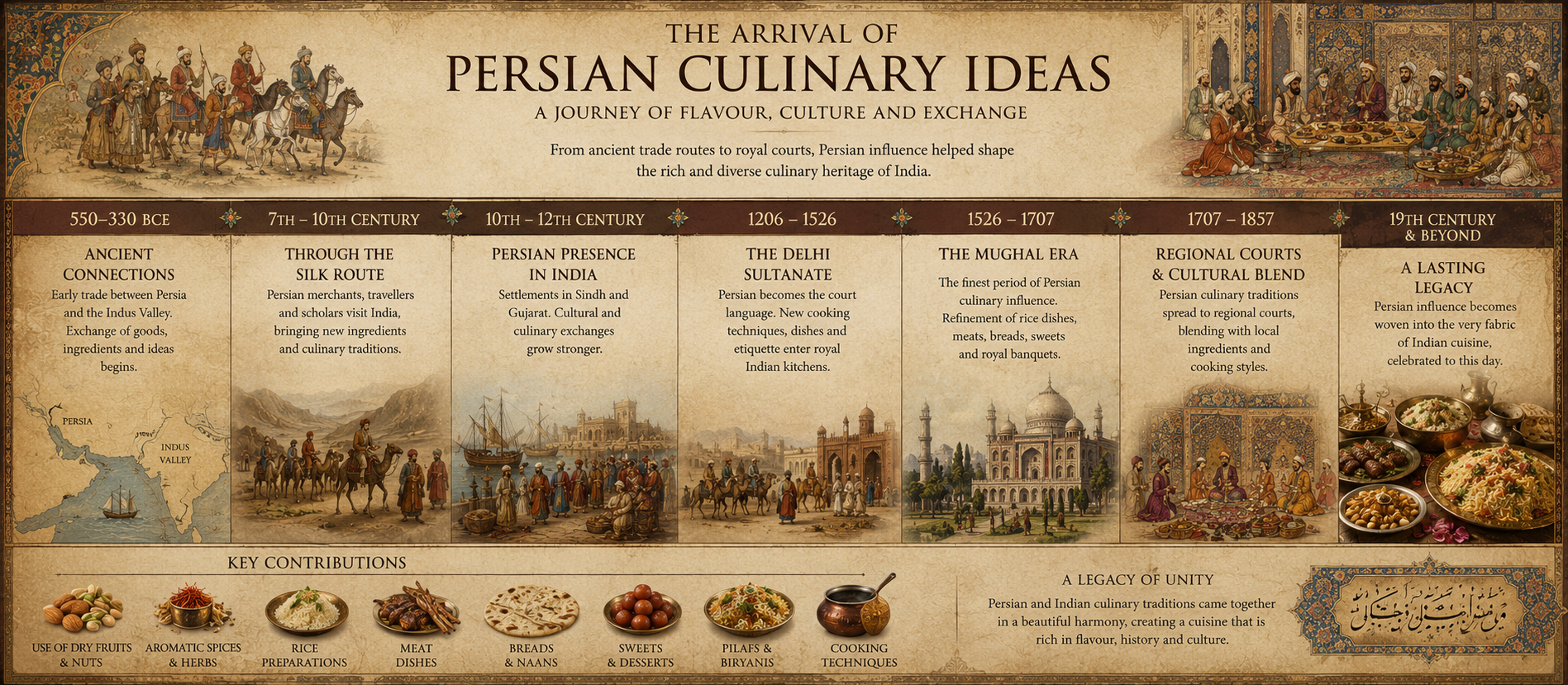
Timeline of Persian-Indian Culinary Exchange

Persian Indian culinary exchange timeline 🔍 Click to enlarge
🔍 Click to enlarge
Artist's reconstruction — the arc of Persian influence on Indian court cuisine
10th–12th Century CE
Ghaznavid and Ghorid Contacts — Persian Culture Arrives
The Ghaznavid and Ghorid Muslim dynasties, centred in Afghanistan and Central Asia, conduct raids and eventually establish power in the Punjab and Sindh. They bring with them Persian court culture — including Persian as the language of administration, Persian aesthetic standards, and Persian culinary ideas. This is the first substantial exposure of North Indian court culture to Persian food traditions.
1206–1526 CE
The Delhi Sultanate — Persian as the Language of Power
The Delhi Sultanate — five successive dynasties ruling from Delhi — conducts its court life entirely in Persian. Persian poets, Persian administrators, Persian architects, and Persian cooks all come to Delhi in this period. The court cuisine of the Sultanate is the first sustained development of Indo-Persian cooking — specifically in the synthesis of Persian rice preparations with Indian spice traditions. The Ni'matnama, a 15th-century cookbook from the Sultanate of Malwa, is the earliest surviving Indian cookbook and shows Persian influence throughout.
1526 CE
The Mughals Arrive — Persian Culture Reaches Its Peak
Babur, the founder of the Mughal dynasty, was a Timurid prince from Central Asia whose court was thoroughly Persianised. He writes in his memoirs about missing the fruits of Central Asia and Persia — grapes, melons, pomegranates. The Mughals bring Persian culinary culture to India at the highest level of sophistication, and under their patronage, Indo-Persian court cooking achieves its fullest expression. (We cover the Mughal contribution in full in Chapter 13.)
16th–17th Century CE
The Synthesis Matures
Over several generations of Mughal rule, Persian culinary ideas are thoroughly absorbed into Indian court cooking. The result is not Persian food cooked in India but a genuinely new synthesis: Indian spice complexity combined with Persian rice technique, Persian dried fruit richness, and Persian aesthetics of presentation. The great dishes of Mughal India — biryani, korma, qorma, various rice preparations — are this synthesis at its mature form.
What Historians Know
Persian was the prestige language of Islamic courts in India for five centuriesFrom the Delhi Sultanate through the Mughal period, Persian was the language of administration, literature, poetry, and court life. All court records, literary works, and — critically — cookbooks were written in Persian. This linguistic dominance means Persian culinary vocabulary entered Indian food culture at every level where literate court culture had influence.
The Ni'matnama (c. 1500 CE) is the earliest surviving Indian cookbook and shows Persian influenceThis cookbook from the Sultanate of Malwa is an extraordinary document — it shows the synthesis already underway by 1500: Indian spices in Persian-style preparations, local ingredients adapted to Persian techniques, and Persian-style meat and rice dishes adapted to Indian taste.
Specific ingredients entered North Indian court cooking from PersiaSaffron (produced in Kashmir and Persia), dried apricots, prunes, pomegranate seeds, almonds, pistachios, and specific dried fruit preparations are all Persian or Central Asian in origin and entered North Indian court cooking through the Persian connection. They remain central to North Indian festive cooking today.
The dum technique of sealed steam cooking is Persian in originThe technique of sealing a cooking vessel with dough or a tight lid (dum pukht — literally "steam cooking") and cooking the contents in their own steam is documented in Persian cookbooks before its appearance in Indian texts. Its adoption in Indian court cooking — most famously in the preparation of biryani — is one of the most important technical transfers of the Persian-Indian exchange.
What Historians Debate
The origin of biryani — the most contested question in Indian food historyNo single dish has generated more historical debate than biryani. Did it develop from the Persian pilaf tradition brought by Mughal cooks? From Arab layered rice dishes arriving via coastal trade? From an indigenous Indian rice preparation that was elaborated through Persian influence? Or from multiple simultaneous developments in different regional courts? The honest answer is that multiple influences converged. We address this fully in the section below.
How much Persian food culture filtered beyond court circlesThe cookbooks, the texts, and the historical records document elite court cuisine. How much of Persian culinary influence penetrated to urban middle classes and rural populations — and how quickly — is much less clear. Persian influence on Indian food was almost certainly concentrated in court and urban contexts for most of this period.

Persian Courts and the Culture of Food Refinement

To understand Persian influence on Indian food, you first need to understand what Persian court food culture actually was. Persian cuisine by the medieval period was one of the most sophisticated in the world — not in the sense of the most complex or most spiced, but in the sense of most refined: most focused on balance, restraint, the careful combination of sweet and sour, the use of luxury ingredients as markers of status and taste.

The Persian culinary aesthetic was built around specific principles. Sweet and sour balance — the combination of fruit sourness with meat richness — was a Persian signature absent from Indian cooking, which used other souring agents (tamarind, yogurt, citrus) but rarely in combination with dried fruit sweetness. The use of dried fruits (raisins, apricots, barberries) as flavour elements within savoury dishes rather than as dessert ingredients was distinctly Persian. The visual presentation of food — specific colour combinations, the use of saffron for golden colouring, the arrangement of dishes — was a Persian preoccupation that Indian court cooking largely adopted.

Medieval Indo-Persian court life food culture Delhi Sultanate
Artist's reconstruction — the court dining culture of medieval India: Persian aesthetic standards applied to Indian ingredients and spice traditions

What Persia Brought to the Indian Kitchen

The ingredients that entered Indian court cooking through Persian influence are still central to North Indian festive and celebratory cooking today. They are not everyday ingredients — they remain special-occasion items, used at weddings, at Eid, at formal dinners — which accurately reflects their original status as luxury markers of Persian court culture.
Saffron
Persia & Kashmir
The world's most expensive spice. Used for colour (golden-amber), aroma (distinctive honey-hay-metallic), and as the ultimate luxury marker. The saffron rice of biryani and the saffron-scented korma are direct Persian inheritances.
Dried Apricots (Khumani)
Central Asia & Persia
Used in meat dishes to provide the sweet-sour balance that is the Persian flavour signature. Khumani ka meetha — a Hyderabadi dessert of dried apricots — carries the Persian tradition directly into South Indian Muslim cooking.
Almonds & Pistachios
Central Asia & Persia
Both are Central Asian in origin, neither native to India. Used in korma gravies (almond paste as a thickener), in biriyani garnish (fried in ghee), and in sweets. Their presence in North Indian festive cooking is a direct Persian-Mughal legacy.
Rose Water
Persia
Distilled from Damascus rose petals, rose water arrived in India through Persian court culture. Used in rice dishes, in sweets (gulab jamun — the name means "rose water fruit"), and in beverages. Now pan-Indian in festive contexts.
Pomegranate Seeds (Anar)
Persia & Central Asia
Both fresh seeds and dried anardana (pomegranate powder) entered North Indian cooking through Persian influence. Anardana as a souring agent is a specifically Persian-Indian innovation not found in non-Persian-influenced Indian traditions.
Barberries (Zereshk)
Persia
The tart red berry central to Persian rice dishes. Less common in Indian cooking than the other Persian ingredients, but present in some North Indian Muslim traditions — a marker of direct Persian culinary heritage.
The road to biryani layered rice Persian Indian evolution
Artist's reconstruction based on historical evidence

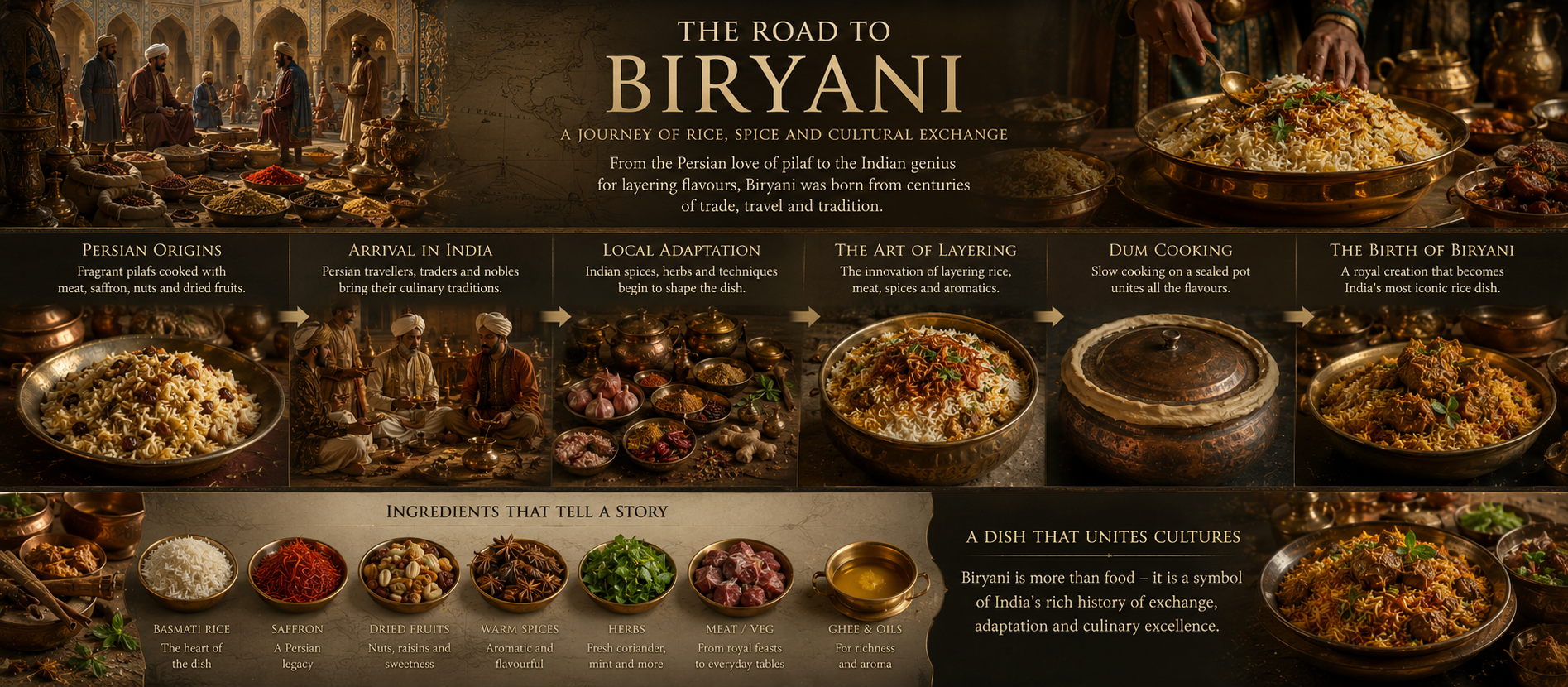
The Road to Biryani — The Honest History

Biryani is the most debated dish in Indian food history. Its origin has been claimed by multiple regions, multiple dynasties, and multiple cuisines — often with more passion than evidence. Before making any claims, let's be clear about what the evidence actually shows.

The word biryani comes from the Persian word biriyan — meaning "fried before cooking" or possibly from birinj — "rice." The cooking technique at biryani's core — dum pukht, sealed steam cooking in a vessel whose lid is sealed with dough — is documented in Persian cookbooks before it appears in Indian texts. The combination of layered meat and rice, with dried fruits and saffron as key aromatic elements, follows Persian culinary aesthetics. These things point clearly to Persian influence.

But what makes biryani Indian — and what makes it one of the world's great rice dishes — is everything that was added to that Persian framework by Indian cooks: the complexity of the Indian spice masala, the specific caramelised onion base that is not in Persian pilaf, the use of yogurt to marinate and tenderise the meat, the incorporation of South Asian aromatic traditions, and the regional variation that has produced Hyderabadi, Lucknowi, Kolkata, Ambur, and dozens of other distinct biryani styles. What Persian culture provided was the technical and aesthetic framework. What Indian culture provided was everything else.

1
The Persian Pilaf (Pilav / Polo)
Rice cooked with meat or dried fruits in stock, often with saffron for colour. The predecessor that established the concept of rice as a vehicle for layered flavour rather than a simple side dish.
2
The Delhi Sultanate Synthesis (13th–15th Century)
Persian pilaf technique meets Indian spice culture. The caramelised onion base, the Indian spice masala, and the use of yogurt as a marinade appear. The dish begins to become distinctly Indian.
3
The Mughal Court Elaboration (16th–17th Century)
Under Mughal patronage, the technique is refined to extraordinary sophistication. Dum pukht sealing is perfected. Saffron layers create visual contrast. Multiple layers of par-cooked rice and marinated meat are assembled with great care.
4
Regional Divergence (17th–19th Century)
As Mughal power declines, regional courts develop their own biryani styles. Hyderabadi biryani (with its raw meat dum technique), Lucknowi biryani (with its subtle kewra aromatics), Kolkata biryani (with its potato addition — a colonial-era poverty innovation turned signature) all develop distinct identities.
5
Today — A Dish That Belongs to India
Biryani is cooked in 26 Indian states with dozens of distinct regional styles. It is the most-ordered dish on Indian food delivery platforms. A dish that began as a Persian court preparation is now one of the most democratic, widely-eaten foods in the world.

The Language of Persian Food in Indian Cooking

One of the most durable legacies of Persian influence on Indian food is linguistic. Persian food vocabulary entered the Indian culinary lexicon during the Sultanate and Mughal periods, and much of it has never left. The words we use for some of India's most famous dishes and cooking techniques are Persian in origin — a linguistic record of cultural exchange embedded in everyday speech.

Persian Words Now Central to Indian Food Vocabulary

Biryani — from Persian biriyan (fried before cooking) or birinj (rice). Pulao / Pilaf — from Persian pilav, itself from earlier Central Asian origins. Korma — from Persian and Urdu qorma (braised meat). Halwa — from Arabic halwa via Persian, meaning "sweet." Naan — from Persian nan (bread). Kabab / Kebab — from Arabic/Persian, meaning roasted meat. Shorba — from Persian shorba (soup/broth). Zafran — the Persian word for saffron, still used alongside the Hindi kesar.

These are not marginal or archaic terms. Biryani, korma, pulao, halwa, and naan are among the most widely consumed and commercially significant foods in the Indian food ecosystem today. Every time someone orders a biryani or makes a korma, they are using a Persian word to describe a dish that Persian influence helped create.
Persian-influenced royal kitchen medieval India
Artist's reconstruction based on historical evidence

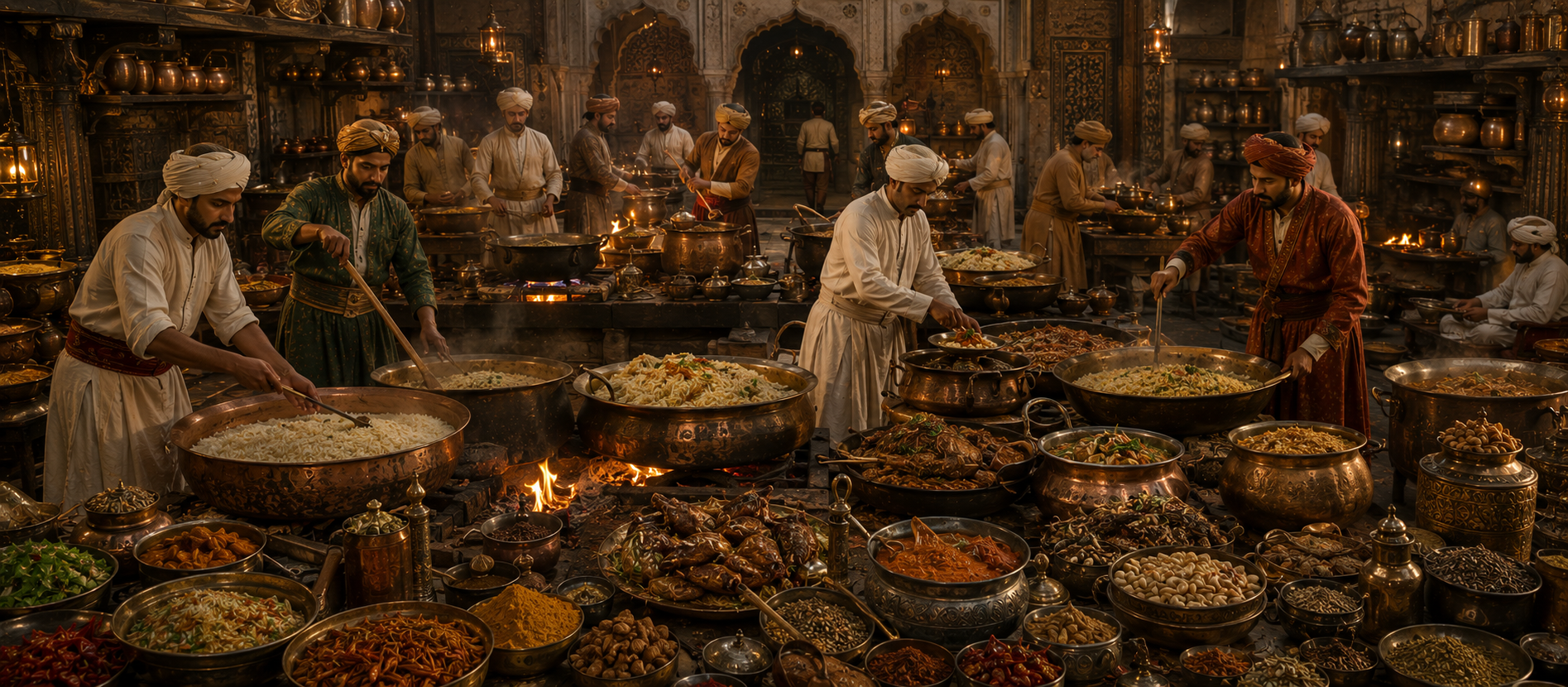
A Royal Kitchen, Delhi Sultanate, c. 1400 CE

The royal kitchen of a Delhi Sultanate court operates in a different register from anything the Indian culinary tradition had previously produced. It is large — feeding hundreds of courtiers and servants daily, plus the formal banquets that political life requires. It is hierarchical — master cooks (rakabdars) with Persian training supervising teams of Indian cooks who understand local spices and ingredients. It is linguistically hybrid — instructions given in Persian, ingredients known by both their Persian and Indian names, recipes existing simultaneously in both culinary vocabularies.

Today's preparation is a qorma — the slow-braised meat dish that is becoming one of the defining preparations of the court kitchen. The meat is lamb, marinated overnight in yogurt, ginger-garlic paste, and a ground spice mixture whose base is Indian (coriander, cumin, cardamom) but whose finishing notes are Persian (a pinch of ground dried rose petals, a few strands of saffron dissolved in warm milk). The braising liquid is built on caramelised onions cooked in ghee until they are deeply brown and sweet — a technique the Indian cooks have contributed to what was, in its Persian original, a simpler preparation.

Alongside the qorma, a rice preparation: long-grain basmati from the Gangetic plains, washed and soaked, then par-cooked in spiced water, then layered in a sealed handi with the braised meat. The handi is sealed with a thick dough rope — dum pukht — and placed over a low flame while more hot coals are placed on the lid. The steam that builds inside the sealed vessel will finish the rice and infuse it with the aromatics of the meat. When the seal is broken at the table, the first burst of steam carries the combined fragrance of saffron, cardamom, caramelised onion, rose water, and braised lamb. It is, by any standard, one of the most complex and beautiful aromas that cooking can produce.

Why Saffron Is the World's Most Aromatic Spice — The Chemistry

Saffron (Crocus sativus) is the dried stigmas of a specific crocus flower. Each flower produces exactly three stigmas. A single gram of saffron requires approximately 150–200 flowers — harvested by hand, in the brief morning window when the flowers are open. This is why saffron costs more per gram than gold at various points in history, and why it remains the world's most expensive spice today.

Saffron's aromatic profile is produced by three main compounds: crocin (responsible for its golden colour — a carotenoid that is water-soluble and extremely stable), picrocrocin (responsible for its bitter taste), and safranal (responsible for its distinctive hay-honey-metallic aroma). Safranal is not present in the fresh stigma — it develops from picrocrocin during the drying process, which is why fresh saffron has relatively little aroma and why the quality of saffron depends enormously on the drying process used.

The golden colour chemistry: Crocin is one of the most powerful natural food dyes known — a tiny quantity produces intense golden colouring. A mere 0.1 gram of high-quality saffron can colour a litre of water a deep amber-gold. The visual impact of saffron in biryani — golden layers of rice against white, with the colour gradient showing exactly where the saffron-milk was poured — is a direct visual consequence of crocin's extraordinary tinctorial strength.

The Dum Pukht Technique — Steam as a Cooking Medium

The dum pukht technique — sealing a vessel with dough and cooking the contents in their own steam — creates a specific physical environment inside the pot that produces distinctly different results from open cooking. When the lid is sealed, water vapour that would normally escape is retained, creating pressure that raises the boiling point of the liquid slightly above 100°C. More importantly, the steam that circulates inside the sealed vessel carries aromatic volatile compounds from the spices and aromatics through the entire preparation — distributing fragrance evenly in ways that open cooking cannot achieve.

The par-cooked rice at the top of the biryani continues to cook by the steam rising from the meat layer below, absorbing that steam — and all the aromatic compounds it carries — as it finishes cooking. The bottom layer cooks by direct heat and develops a slight crust (the sought-after socarrat of Indian biryani terminology — the caramelised base that is considered the best part by connoisseurs). Each layer of biryani experiences a slightly different cooking environment, which is why a well-made biryani has variation within it — different layers at different stages of doneness, all contributing to the whole.

Why Does a 600-Year-Old Court Cuisine Still Shape What India Eats?

Because biryani is the most ordered food on Indian food delivery platforms. Because korma appears on restaurant menus from Mumbai to Manchester. Because the Persian food vocabulary — biryani, pulao, korma, halwa — is now so thoroughly Indian that most people who use these words have no idea they are using Persian terms for dishes that existed before they acquired their Indian form.

The Persian influence on Indian food demonstrates something important about how culinary exchange works at its best: when a new food culture encounters an existing one from a position of prestige rather than dominance, the result can be extraordinary. Persian court culture brought aesthetic refinement, specific techniques, and specific ingredients. Indian culinary culture brought spice complexity, local ingredient knowledge, and centuries of accumulated cooking tradition. The synthesis they produced together — at its height in the Mughal courts we will explore in the next chapter — is one of the greatest culinary achievements in human history.

Then and Now

Persian-Indian Court Cuisine, 13th–17th CenturyToday
Biryani as court preparation requiring specialist cooksIndia's most-ordered dish on delivery platforms — democratised from court to street
Korma as luxury braised meat with nut and dairy sauceKorma on restaurant menus worldwide — the Persian-Indian synthesis gone global
Saffron as the ultimate luxury marker in foodStill the most expensive spice in the world; still marks festive and celebratory food in Indian cooking
Dum pukht as court cooking techniqueThe sealed steam technique is now used from street biryani pots to fine dining restaurant presentations
Persian food vocabulary in the courtBiryani, korma, pulao, halwa, naan — Persian words for dishes now eaten daily by hundreds of millions
Dried fruits as luxury flavour elements in meat dishesRaisins, almonds, and pistachios in biriyani, in korma, in festive rice — the Persian flavour legacy lives on
Modern legacy of Persian influence on Indian food
Persian influence living on — saffron rice, biryani and korma in modern India

Legacy Today

Biryani
From Persian pilaf to India's national dish. The most direct and most celebrated product of Persian-Indian culinary exchange — still evolving in hundreds of regional variations.
Korma
The Persian braised meat tradition, absorbed and transformed by Indian cooks into one of the most complex and varied categories of Indian cooking — from mild nut-and-cream korma to intensely spiced variants.
Saffron in Indian Cooking
In festive rice, in sweets, in kheer — saffron signals celebration in Indian cooking exactly as it did in Persian court food. The luxury association, six centuries later, is intact.
The Dum Technique
Dum pukht as a specific cooking method — used in biryani, in slow-cooked meat preparations, in specific regional dishes — is a direct Persian technical inheritance still practiced daily.
Halwa
From the Persian/Arabic halwa to India's most widely varied sweet category — semolina halwa, carrot halwa, moong dal halwa — a Persian name attached to an Indian sweet tradition of extraordinary diversity.

Sources & Evidence

Primary Sources

  • Ni'matnama (c. 1500 CE) — earliest surviving Indian cookbook, Sultanate of Malwa
  • Ain-i-Akbari (Abu'l-Fazl, 1590 CE) — Mughal court accounts including kitchen organisation
  • Baburnama (Babur, c. 1530 CE) — Mughal founder's memoirs including food references
  • Humayun-nama — food at the Mughal court under Humayun
  • Persian culinary texts — various, documenting pilaf and related preparations

Secondary Sources

  • Lizzie Collingham — Curry: A Tale of Cooks and Conquerors
  • K.T. Achaya — Indian Food: A Historical Companion
  • Colleen Taylor Sen — Feasts and Fasts
  • Charles Perry — research on Persian pilaf and its spread
  • Michael Krondl — on spice trade and court cuisine