Series 1 · The Chronological Story · Chapter 11 of 17
Arab Influence
on Indian Food
A Thousand Years of Trade, Migration
and Culinary Exchange on the Indian Ocean
Artist's reconstruction based on historical evidence
A Thousand Years of Trade, Migration
and Culinary Exchange on the Indian Ocean
Artist's reconstruction based on historical evidence
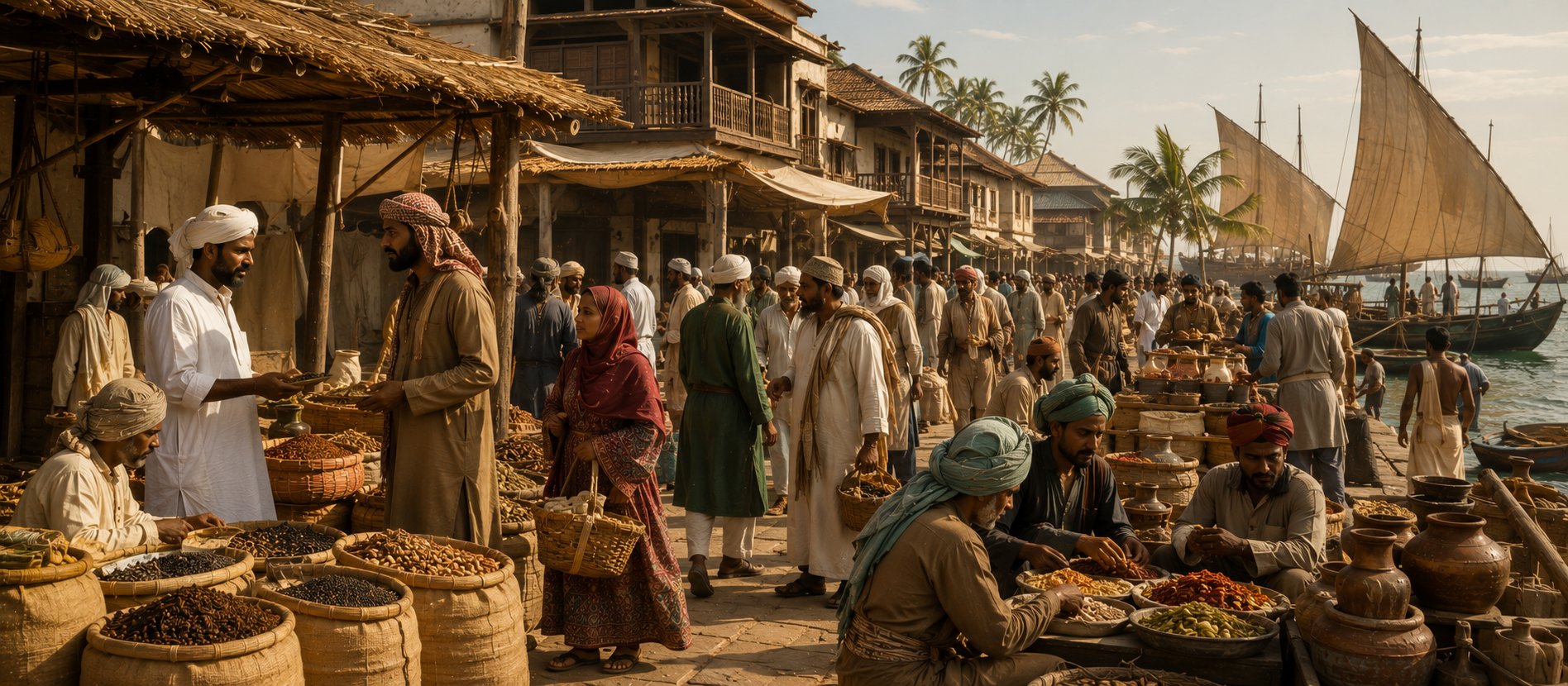
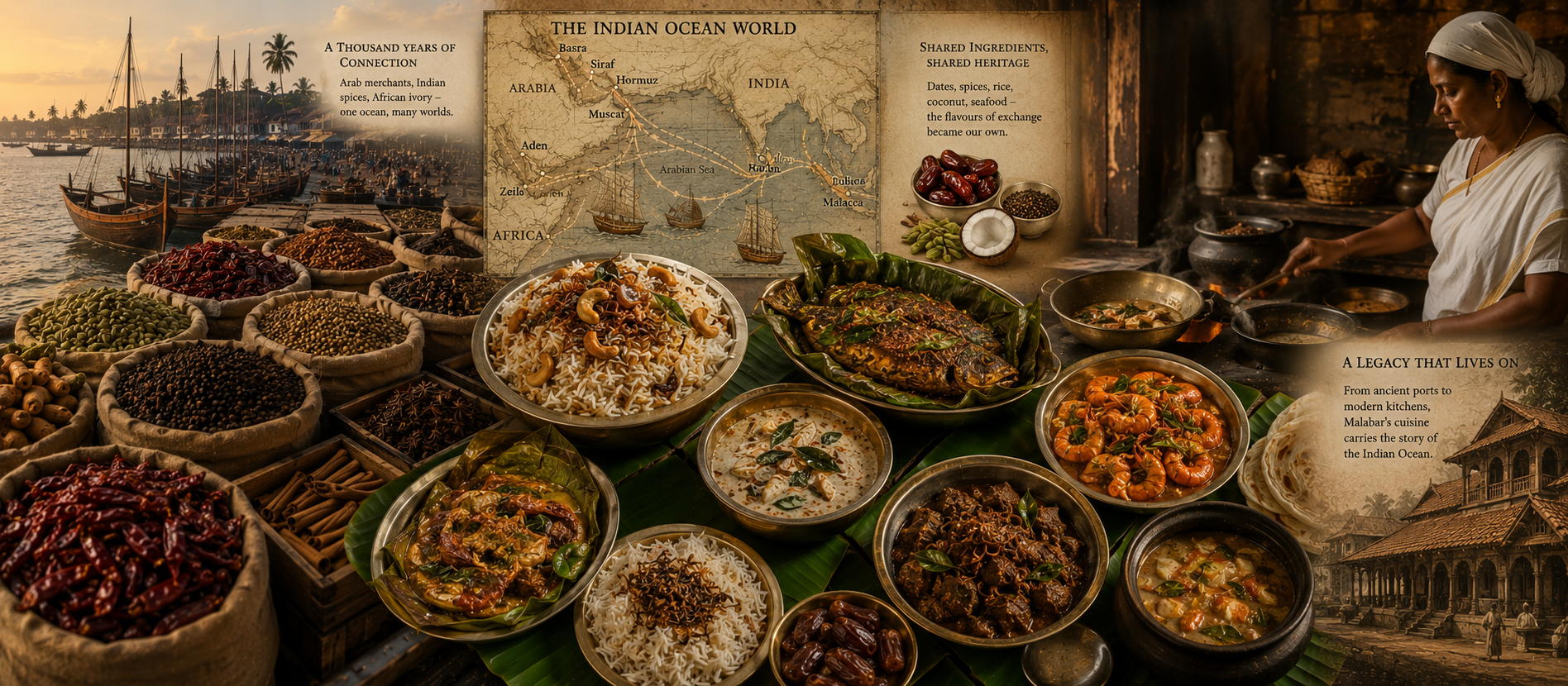
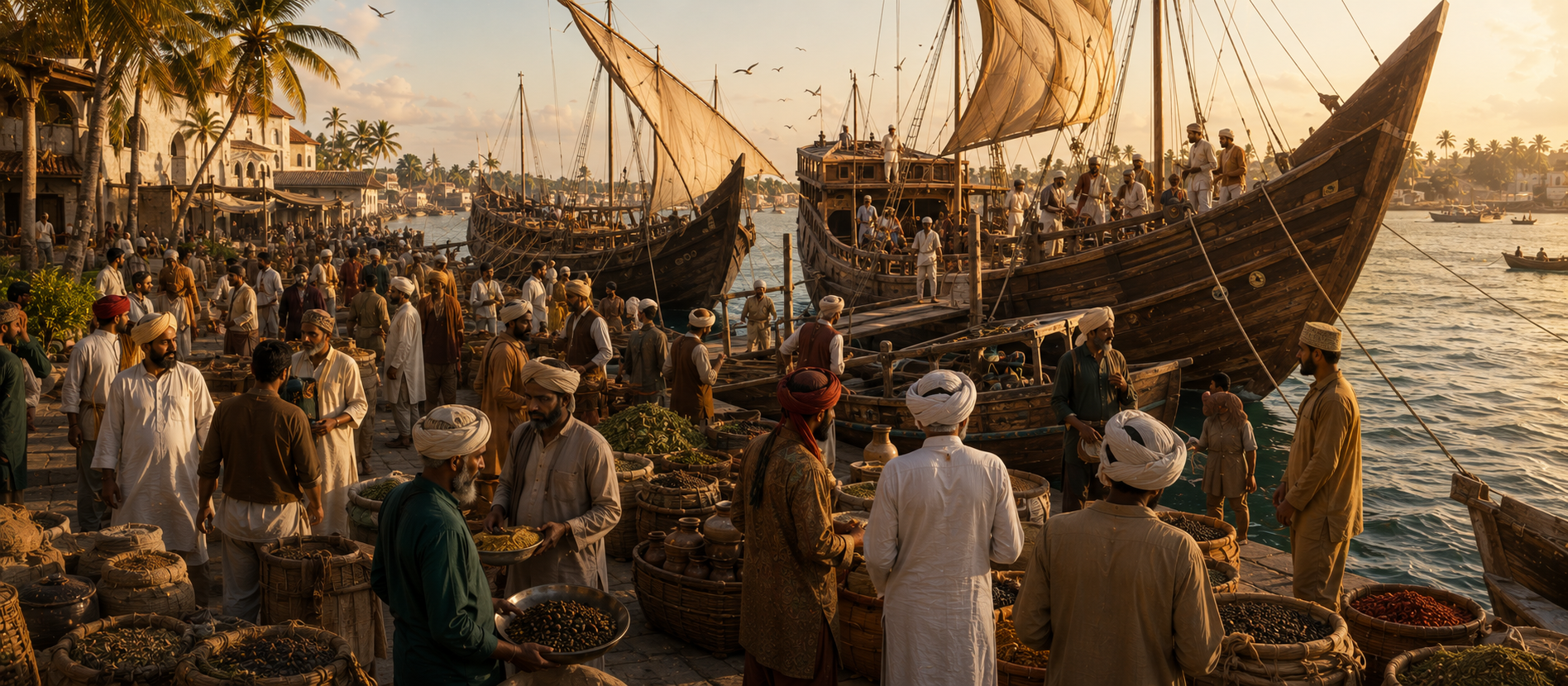
Long before European ships arrived in India, Arab merchants were already familiar visitors to Indian ports — not as occasional traders but as permanent residents, seasonal settlers, and in time, founding members of entirely new communities whose identity was neither purely Arab nor purely Indian, but something new that the Indian Ocean had created. They came for spices and textiles. They brought with them dates, dried fruits, new rice preparations, and cooking techniques. Over a thousand years, these exchanges didn't merely add ingredients to Indian coastal cooking — they created new cuisines.
 🔍 Click to enlarge
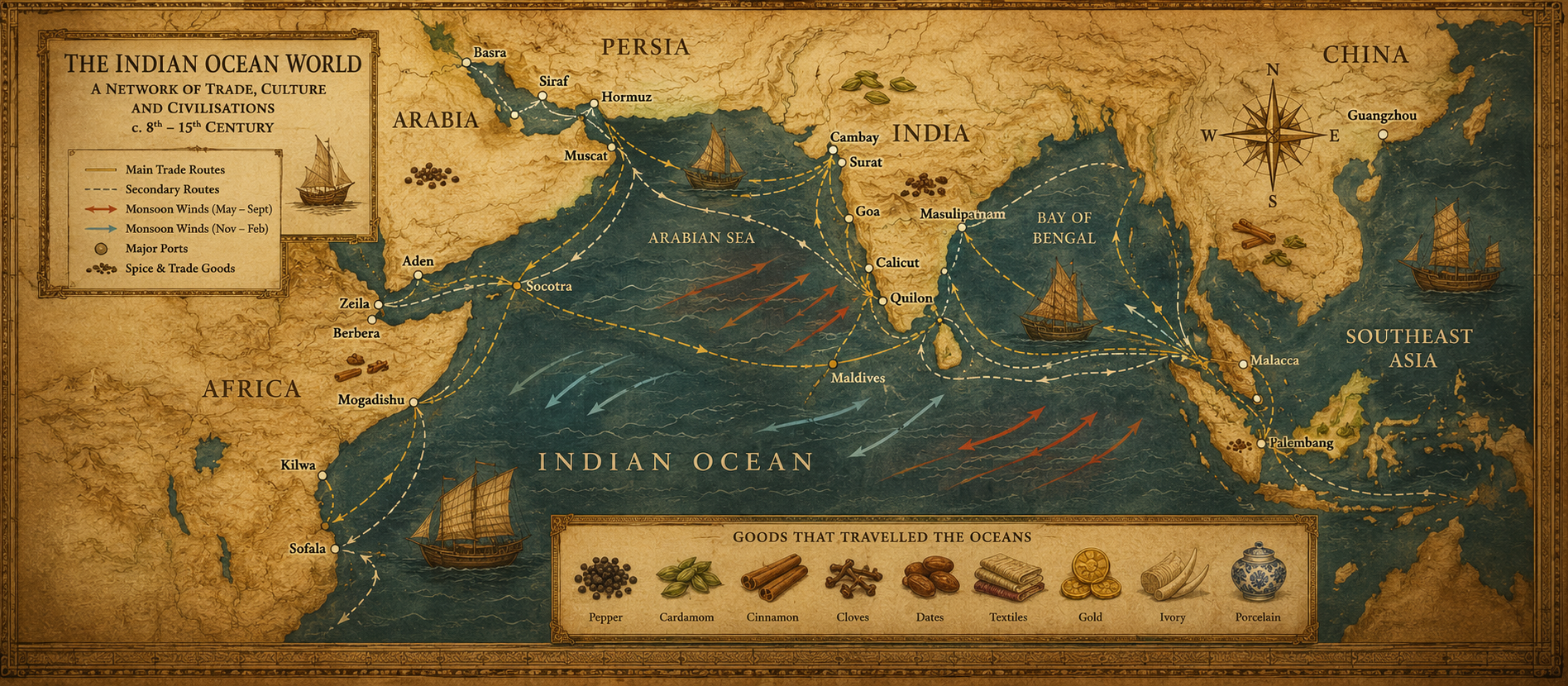
The Indian Ocean is not a barrier. For the communities that understood its monsoon wind system, it was a highway — the world's first true highway of international commerce. Every summer, the southwest monsoon brought ships from Arabia to India's western coast. Every winter, the northeast monsoon carried them home. For communities on both sides of this ocean, the other shore was not a foreign country in any meaningful sense. It was a regular destination, a place of business, a source of goods that could not be obtained locally.
The world historian K.N. Chaudhuri described the Indian Ocean as a "civilisational space" — a region where cultures, religions, languages, and food traditions mixed and influenced each other over millennia in ways that transcended the boundaries of any individual political unit. The Arab-Indian food exchange is one of the most important expressions of this civilisational mixing. It is not a story of one culture imposing its food on another, but of two food cultures meeting in the middle of an ocean and producing something that neither could have produced alone.
"The merchants of Calicut are Muslims from Arabia, Persia, and other countries. They come to India to buy spices and return laden with them. They mix freely with the local people, marry their daughters, and over time become part of the land."
Ibn Battuta, Rihla, c. 1355 CE — describing the merchant communities of Calicut
The Indian Ocean kitchen is not a single cuisine but a family of related food cultures that share specific ingredients, techniques, and flavour principles across an enormous geographic range — from East Africa to the Malabar Coast of India, from Yemen to the Konkan and Gujarat. What makes this family recognisable is the combination of Indian spice knowledge with Arab and Persian dried fruit and nut traditions, the use of rice as a vehicle for layered flavour, and specific aromatic signatures — rose water, kewra, dried lime — that distinguish Indian Ocean Muslim cooking from the cuisines of either the Arab interior or the Indian subcontinent proper.
The Mappila biriyani of Kerala is perhaps the most famous product of this kitchen. Unlike the Mughal-derived biriyani of North India — which we will explore in Chapter 12 and 13 — Mappila biriyani has a distinct character: shorter-grain, coconut-milk-enriched rice; the fish or beef that reflects Kerala's coastal protein sources; the dried fruits, ghee-fried cashews, and rose water aromatics that signal Arab heritage; and the black pepper, cardamom, and green chilli (post-Portuguese) that are unmistakably from the Malabar landscape. It is a dish that could only have been created at the precise junction of the Arab world and Kerala.
The most tangible evidence of Arab influence on Indian coastal cooking is in the ingredients that are now integral to Mappila, Bohra, and coastal Muslim cuisines but are not native to India. These ingredients travelled the same trade routes as spices — in the opposite direction, from Arabia and Persia toward India.
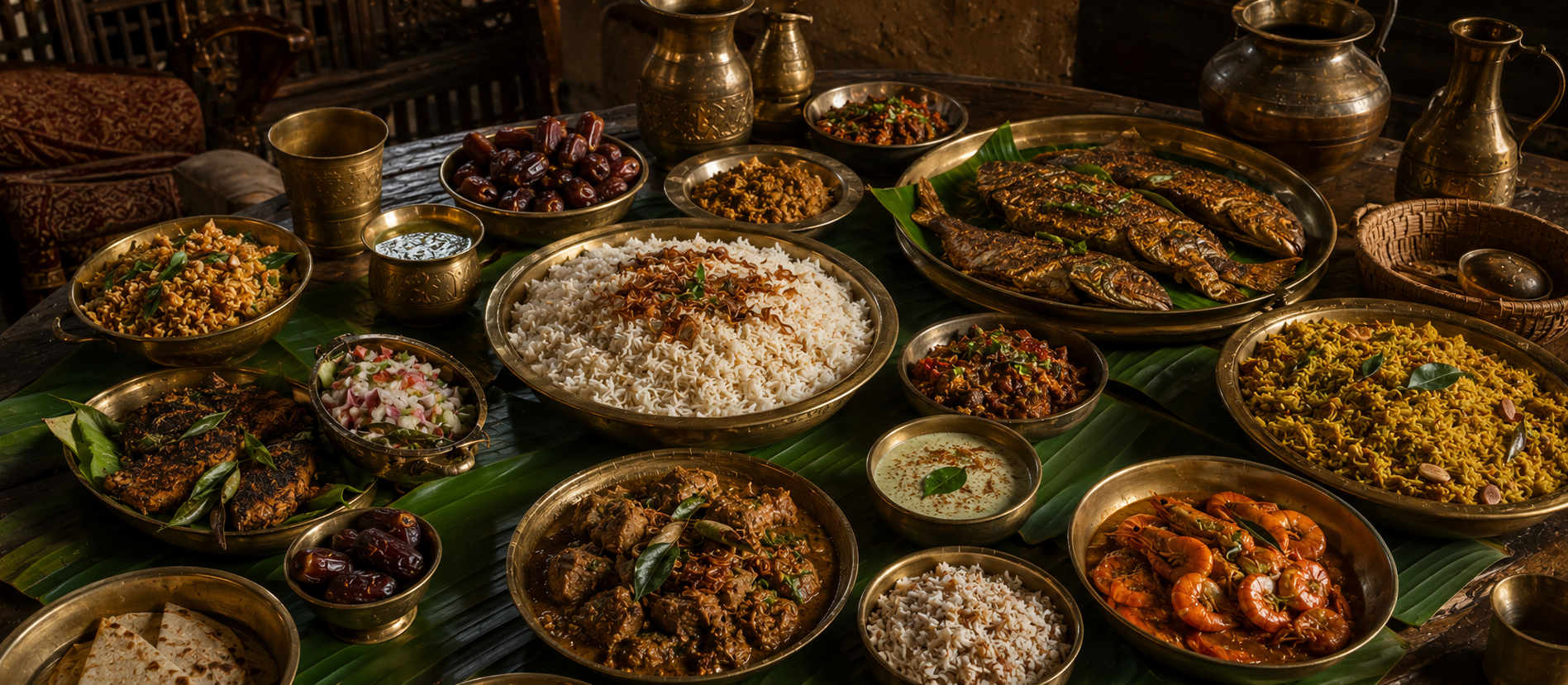
Dates (Phoenix dactylifera) are native to the Arabian Peninsula and North Africa. They do not grow on India's humid west coast. Yet they are central to the food culture of Kerala's Mappila community — consumed at iftar during Ramadan, used in sweet preparations, and incorporated into specific festive foods. Their presence in Mappila cooking is direct evidence of the Arab trade connection: these are ingredients that Arab merchants brought with them as provisions, that became familiar to coastal communities, and that were eventually incorporated into local food traditions.
Arabia's wheat-based food culture — harees (wheat porridge with meat), various flatbread traditions, and wheat-enriched preparations — entered coastal Indian Muslim cooking through prolonged Arab presence. The Mappila dish ari pathiri (rice flour flatbread) and wheat-based preparations in Bohra cuisine both show the influence of a wheat-centred food culture on communities whose indigenous food base was rice-dominated. The crossover is not complete — rice remains the foundation — but the wheat element is real and traceable to Arab origin.
The use of rose water (gulab jal) and kewra (pandanus extract) as flavouring agents in Indian coastal Muslim cooking reflects Persian and Arab aromatic traditions. Both are distilled aromatic waters used to perfume rice dishes, sweets, and beverages. They are absent from non-Muslim coastal Kerala food traditions. Their appearance in Mappila biriyani, in the sweets served at Mappila weddings, and in the sherbet traditions of coastal Muslim communities is a direct signature of Persian-Arab culinary influence transmitted through the trading settlements.
The Mappila community of Kerala is the most extensively documented product of Arab-Indian culinary exchange, but it is not the only one. The Dawoodi Bohra community of Gujarat and Maharashtra — with roots in Yemeni Ismaili Muslim traders who settled on India's northwest coast — has developed a distinct food tradition that shows similar patterns of Arab-Indian fusion but with a Gujarati rather than Keralan base. Bohra cuisine features rice preparations layered with meat and dried fruits, sweet-sour flavour combinations that reflect both Gujarati and Arab taste preferences, and specific festive foods that have no parallel in either purely Arab or purely Gujarati cooking.
The Navayath Muslim community of Karnataka's coast — descended from Arab traders who settled on the Konkan coast — developed yet another distinct coastal Muslim cuisine, featuring the rice and seafood of Karnataka combined with Arab spice sensibilities and dried fruit traditions. Each of these communities represents a different node in the Indian Ocean network, each producing a slightly different culinary expression of the same underlying process: Arab trade creating new food identities at the points where it intersected with India's coastal cultures.
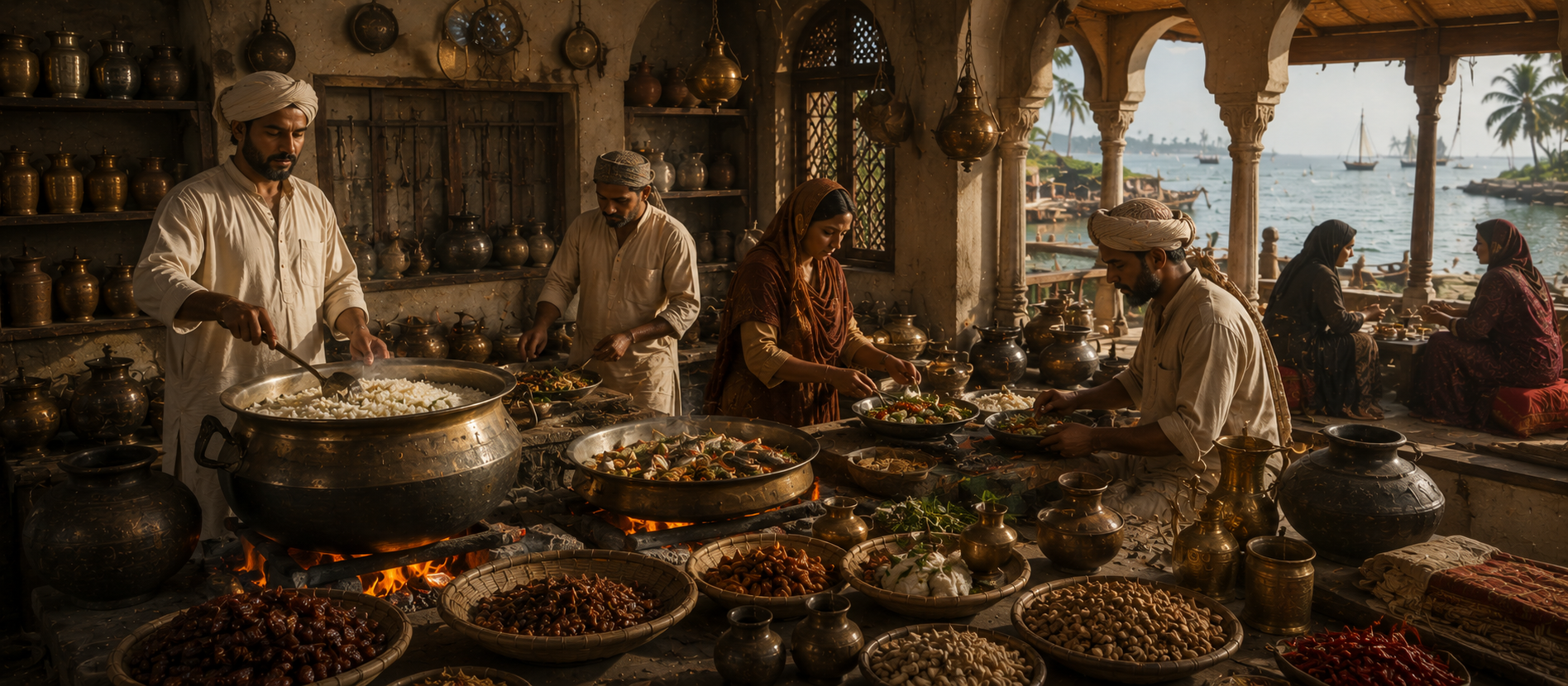
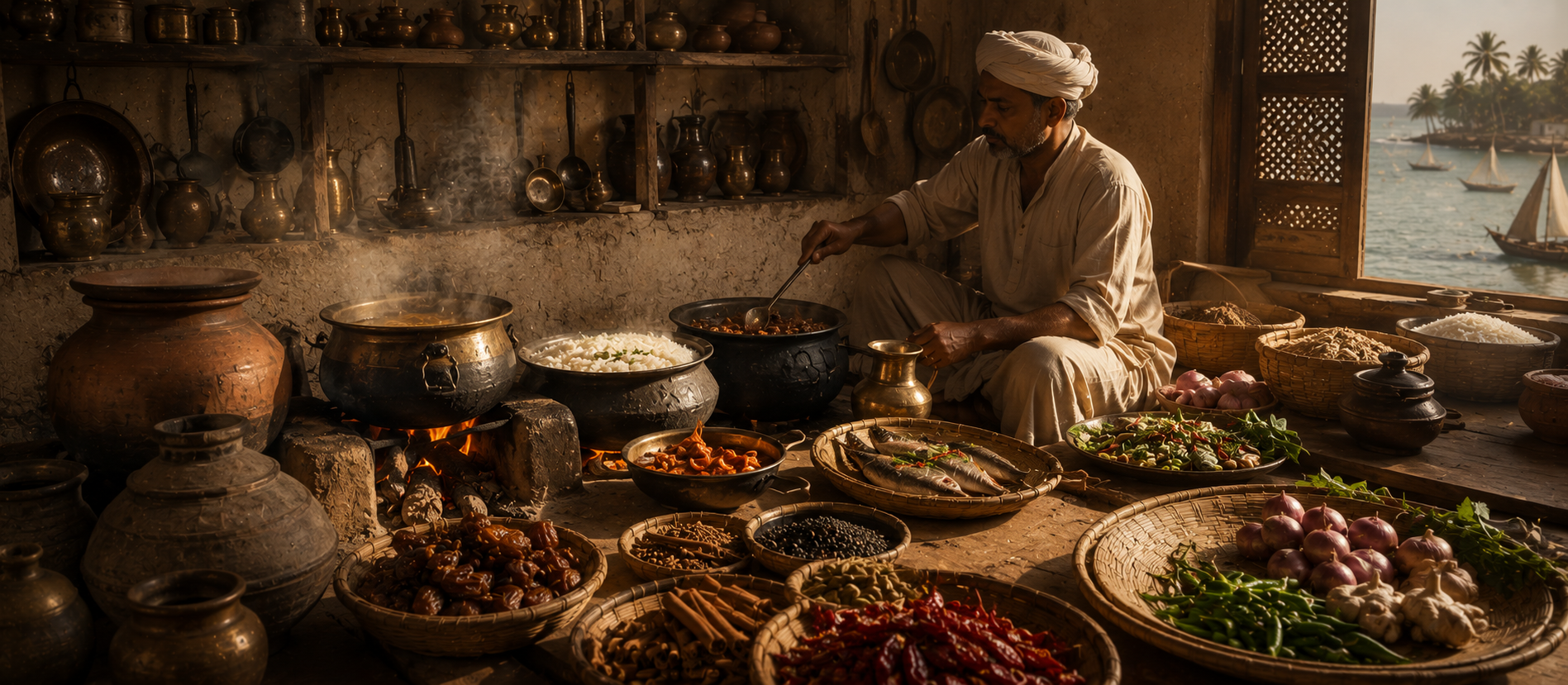
The kitchen is in a substantial merchant's house near the harbour at Calicut. The merchant's grandfather was from Yemen; his grandmother was from a local Kerala fishing family. The family has been Muslim for three generations. The kitchen reflects this: it is recognisably a Kerala kitchen in its basic organisation — the clay cooking vessels, the coconut shell ladles, the grinding stone for fresh coconut — but with elements that would be foreign in a non-Muslim Kerala household.
Against one wall, sealed clay jars hold provisions that came on the last monsoon ship from Aden: dates, dried raisins, a small quantity of dried apricots, and a sealed bottle of rose water. Alongside them, the local provisions: coconut oil, fresh green coconuts, rice from the paddy fields outside the city, dried black pepper and cardamom from the family's own trading stock, and fresh ginger. The spice combination available in this kitchen is more diverse than in any kitchen in Europe or the Arab world at this date — the intersection point of two spice traditions.
Today's main meal is a fish preparation — the kingfish from the morning market — cooked in a gravy of fresh coconut, black pepper, turmeric, and a souring agent (kodampuli, the Malabar tamarind native to this coast). Alongside it, rice cooked in coconut milk, perfumed with a few drops of rose water and topped with fried cashews and raisins. The rice preparation has no single origin: the coconut milk is Kerala; the dried fruits are Arab; the technique of layering aromatics into rice while it cooks is coming from a Persian tradition, arriving via Arab merchants who have themselves absorbed it. The cook, stirring the pot, would not describe any of this as fusion. She would describe it as cooking.
What the documentary and culinary evidence allows us to reconstruct.
Ibn Battuta's description and later Mappila food traditions allow high-confidence reconstruction of the everyday Mappila meal. Fish from the Arabian Sea — typically the abundant kingfish or mackerel of the Malabar coast — cooked with coconut, local spices including abundant black pepper and turmeric, and kodampuli for sourness. Rice cooked in coconut milk. Pathiri — rice flour flatbread — alongside. The meal is unmistakably Keralan in its base ingredients but carries Arab influence in specific spice combinations and in the dried fruit garnishes used at more celebratory occasions.
The festive Mappila biriyani — the dish that most clearly expresses the dual heritage of the community — is reconstructed from later written recipes, oral tradition, and the logic of the available ingredients. Short-grain Kerala rice cooked in coconut milk, layered with beef or chicken prepared with a spice paste of black pepper, cardamom, and fennel, topped with fried onions, cashews, raisins, and a fragrance of rose water. The coconut milk and black pepper are Kerala; the dried fruits, fennel, and rose water are Arab-Persian. The layering technique is itself a technique that Arab contact brought to coastal India.
Arab merchants crossing the Indian Ocean on a three-month voyage had a specific food preservation problem: how to carry enough food to sustain a crew of twenty to forty people across an open ocean with no possibility of resupply, in temperatures that ranged from 25°C to 40°C. The solutions they developed represent some of the most sophisticated pre-modern food preservation technology in the world.
Dates were the primary provision food precisely because of their extraordinary shelf life — a consequence of their very low water activity (approximately 0.6 for dried dates) combined with their high sugar content, which inhibits microbial growth through osmotic pressure. A date carries approximately 280 calories per 100 grams in a form that is stable for months without refrigeration. The Arab sailor's reliance on dates as primary sea provision was not cultural preference alone: it was the optimal solution to the caloric density and shelf stability requirements of long-distance ocean travel.
Dried lime (noomi basra) as both flavouring and preservative: The black dried limes of Gulf cooking are prepared by boiling fresh limes in salt water and then sun-drying them to very low water content. The resulting dried limes are shelf-stable for years. When added to cooking, they provide sour complexity from citric and other organic acids, plus a distinctive floral-bitter note from the peel oils that have concentrated during drying. The same preservation chemistry that made them safe for ocean transport made them a flavouring ingredient: the drying process concentrates and transforms their flavour compounds in ways that fresh lime cannot replicate.
The use of coconut milk as a cooking medium in Mappila and coastal Indian Muslim cuisines is not simply a flavour choice — it changes the fundamental chemistry of how spices interact with the dish. Most Indian spice compounds are either fat-soluble or water-soluble. Water-based cooking extracts the water-soluble compounds; oil-based cooking extracts the fat-soluble ones. Coconut milk is an emulsion — it contains both fat and water in suspension — which means it extracts both categories of spice compounds simultaneously.
The result is a more complete extraction of the full spice flavour profile than either pure water or pure oil cooking can achieve. Dishes cooked in coconut milk with complex spice combinations have a richer, more layered aromatic character precisely because the emulsion is dissolving more of the available flavour compounds. This is why Mappila fish curry — coconut milk, black pepper, turmeric, cardamom — has a flavour depth that the same spice combination cooked in water cannot achieve.
Because Mappila cuisine is not history — it is one of the most vibrant living food traditions in India, with millions of practitioners, a growing international diaspora, and a culinary sophistication that serious food writers and chefs are only beginning to document properly. The Mappila biriyani is eaten daily by millions of people in Kerala and Kerala diaspora communities worldwide. The pathiri, the fish curry with coconut and black pepper, the festive meat preparations perfumed with rose water and studded with dried fruits — these are not museum pieces. They are what people cook for dinner.
The Arab-Indian food exchange also demonstrates a principle that applies throughout food history: the most interesting food cultures are created at points of sustained contact between different culinary traditions. The Malabar Coast was a contact zone for a thousand years. The food it produced — Mappila cuisine, the coastal Muslim cuisines of Gujarat and Karnataka — is the direct product of that sustained contact. It is richer and more complex than either of its parent traditions precisely because it draws from both.
| Arab-Indian Exchange, 7th–15th Century | Today |
|---|---|
| Arab merchants settling on Malabar Coast | Mappila Muslim community — millions strong in Kerala and diaspora — the living legacy of a thousand years of settlement |
| Dates and dried fruits arriving from Arabia | Central to Mappila festive food, iftar traditions, and rice preparations — the ingredient connection is direct and unbroken |
| Rose water and kewra as aromatic agents | Still defining aromatic signatures in Mappila biriyani, Bohra cuisine, and coastal Muslim sweets |
| Layered rice preparations from Arab contact | Mappila biriyani — one of Kerala's most celebrated dishes globally — is the direct product of this exchange |
| Coconut-spice fusion cooking of the coast | Kerala's coastal cuisine — now internationally celebrated — carries the Arab-Indian synthesis in every coconut fish curry |