★★★☆☆ All India
★★★★★ South East Asian cooking (reference)
What Does Star Anise Taste Like?
Star Anise in Every Indian Language
| Language | Name | Pronunciation |
|---|---|---|
| English | Star Anise | STAR AN-iss |
| Hindi | चक्रफूल — Chakraphool | CHAK-rah-phool |
| Bengali | তারকা মৌরি — Tara Mouri | TAH-rah MOW-ree |
| Tamil | தக்கோலம் — Thakolam | THAH-koh-lum |
| Telugu | అనాస్ పువ్వు — Anasphoola | ah-NAS-phoo-lah |
| Malayalam | തക്കോലം — Thakkolam | THAK-oh-lum |
| Kannada | ಚಕ್ರ ಫೂಲ್ — Chakra Phool | CHAK-rah phool |
| Gujarati | ચક્રફૂલ — Chakraphool | CHAK-rah-phool |
| Marathi | चक्रफूल — Chakraphool | CHAK-rah-phool |
| Punjabi | ਚੱਕਰ ਫੁੱਲ — Chakkar Phull | CHAK-kar phull |
| Urdu | بادیان — Badayan | BAH-dee-ahn |
| Sanskrit | शतपत्री — Shatapatri | sha-tah-PAH-tree |
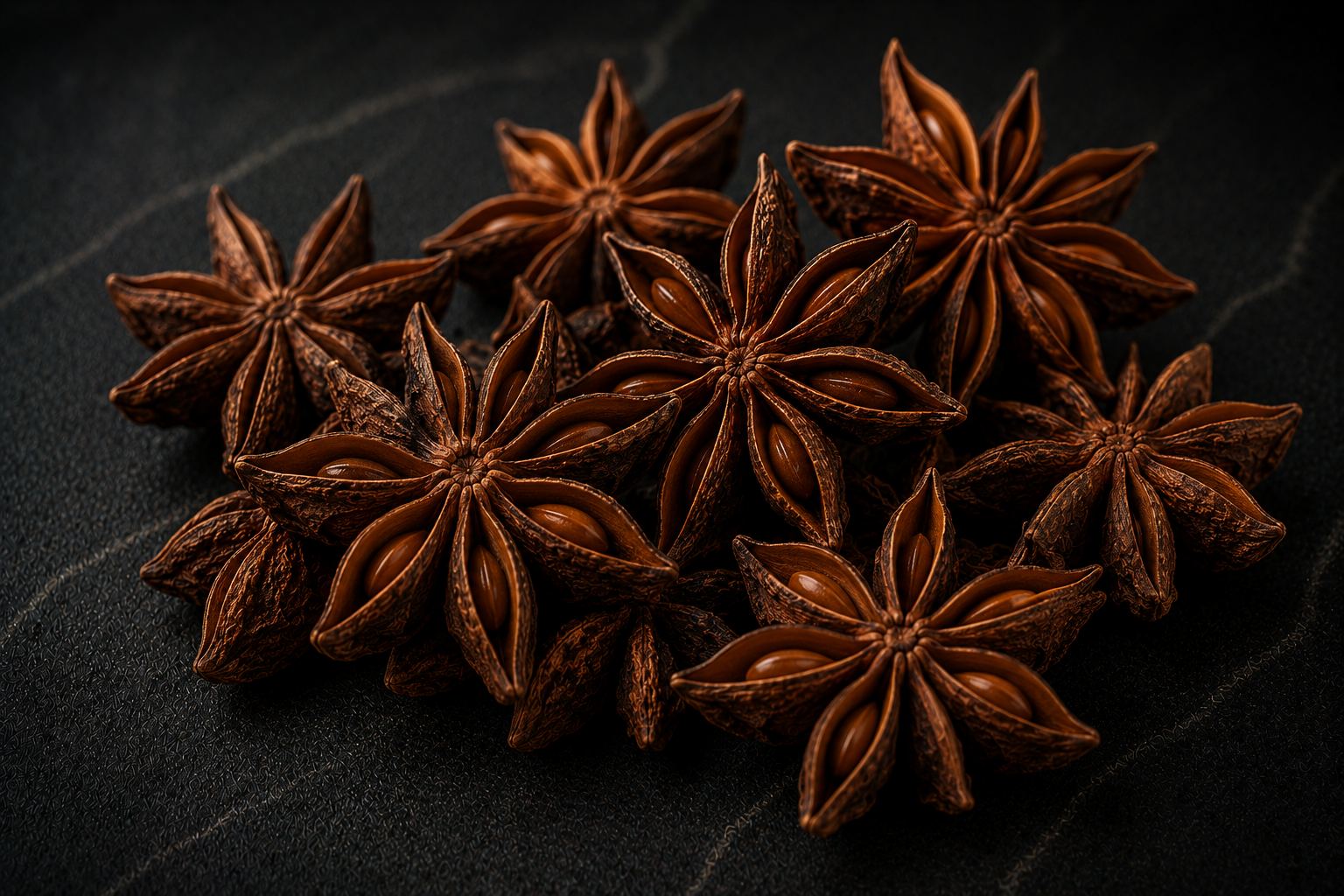
What Is Star Anise?
Star anise — chakraphool — is the dried star-shaped fruit of Illicium verum, an evergreen tree native to southern China and northern Vietnam. Despite its similar flavour to anise seeds and fennel (all three contain anethole as their primary compound), star anise is botanically unrelated to both — it belongs to a completely different plant family.
In Indian cooking, star anise occupies a more selective role than in Chinese or South East Asian cooking. It is used primarily in North Indian biryanis (alongside cinnamon, cardamom, and cloves), in some versions of garam masala, and in slow-cooked meat preparations. South Indian cooking uses it occasionally but it is not as central as in North Indian preparations.
- Certain regional biryani styles (Kolkata biryani, some Hyderabadi versions) use star anise as a distinctive aromatic element
- Garam masala variations from certain regions include star anise for a sweet, anise-forward character
- Slow-cooked meat preparations in North India benefit from star anise's ability to hold its anethole character through long cooking times
- The Chinese five-spice connection — star anise is one of the five — explains its presence in India's Indo-Chinese culinary tradition
- Without star anise, Kolkata-style biryani tastes subtly different — the distinctive sweet-anise undertone is missing
Star Anise Through History
Star anise is native to southern China and northern Vietnam, and was brought to India through maritime trade with China. It appears in Indian spice trade records from the medieval period, but its adoption into Indian cooking was gradual and geographically selective — most concentrated in Bengal (through Kolkata's Chinese community influence) and in North India's Muslim cooking traditions that maintained connections to Persian and Central Asian food culture.
Northeast India (Nagaland, Manipur) cultivates star anise locally and uses it extensively in local cooking — closer in tradition to its South East Asian use patterns than to the North Indian biryani applications. The plant also grows wild in the forests of the Northeast.
The Science of Star Anise
How to Store Star Anise
How to Buy Good Star Anise
How to Use Star Anise Correctly
- Biryani: add 1–2 whole stars to hot ghee with other whole spices at the start
- Chai: add half a star per cup for a sweet-anise note
- Remove before serving — not meant to be eaten whole
- Quantity: 1–2 whole stars per dish for 4 people maximum
- For slow-cooked meat: add whole, remove after cooking
- Ground: use sparingly — 1/4 tsp is often sufficient
What Star Anise Pairs Well With
Dishes That Use Star Anise
Where Star Anise Matters Most
| North Indian Cuisine | Common |
| Bengali Cuisine | Common |
| Kashmiri Cuisine | Occasional |
| Northeastern Indian Cuisine | Essential |
| Mughlai Cuisine | Occasional |
| South Indian Cuisine | Rare |
| Jain Cooking | Rare |
Star Anise vs Fennel vs Anise Seeds
| Feature | Star Anise | Fennel Seeds | Anise Seeds |
|---|---|---|---|
| Botanical family | Schisandraceae | Apiaceae | Apiaceae |
| Key compound | Anethole (80–90%) | Anethole (80–90%) | Anethole (80–90%) |
| Flavour | Sweetest, most complex | Sweet, warm | Stronger, more direct |
| Form | Star-shaped pod | Small oval seed | Tiny oval seed |
| Indian use | Biryani, some masalas | Widely used (panch phoron) | Occasionally |
| Interchangeable? | Partially with fennel | Partially with star anise | Partially with fennel |