★★★★☆ North India
★★★☆☆ South India
What Does Nutmeg Taste Like?
Nutmeg in Every Indian Language
| Language | Name | Pronunciation |
|---|---|---|
| English | Nutmeg | NUT-meg |
| Hindi | जायफल — Jaiphal | JYE-ful |
| Bengali | জায়ফল — Jaifal | JYE-ful |
| Tamil | ஜாதிக்காய் — Jathikai | JA-thee-kye |
| Telugu | జాజికాయ — Jajikaya | jah-JEE-kye-yah |
| Malayalam | ജാതിക്ക — Jathikka | jah-THEEK-kah |
| Kannada | ಜಾಯಿಕಾಯಿ — Jayikayi | jah-yee-KYE |
| Gujarati | જાયફળ — Jayfal | JYE-ful |
| Marathi | जायफळ — Jayfal | JYE-ful |
| Punjabi | ਜਾਇਫਲ — Jaiphal | JYE-ful |
| Urdu | جائفل — Jaiphal | JYE-ful |
| Sanskrit | जातीफल — Jatiphala | jah-tee-FAH-lah |
What Is Nutmeg?
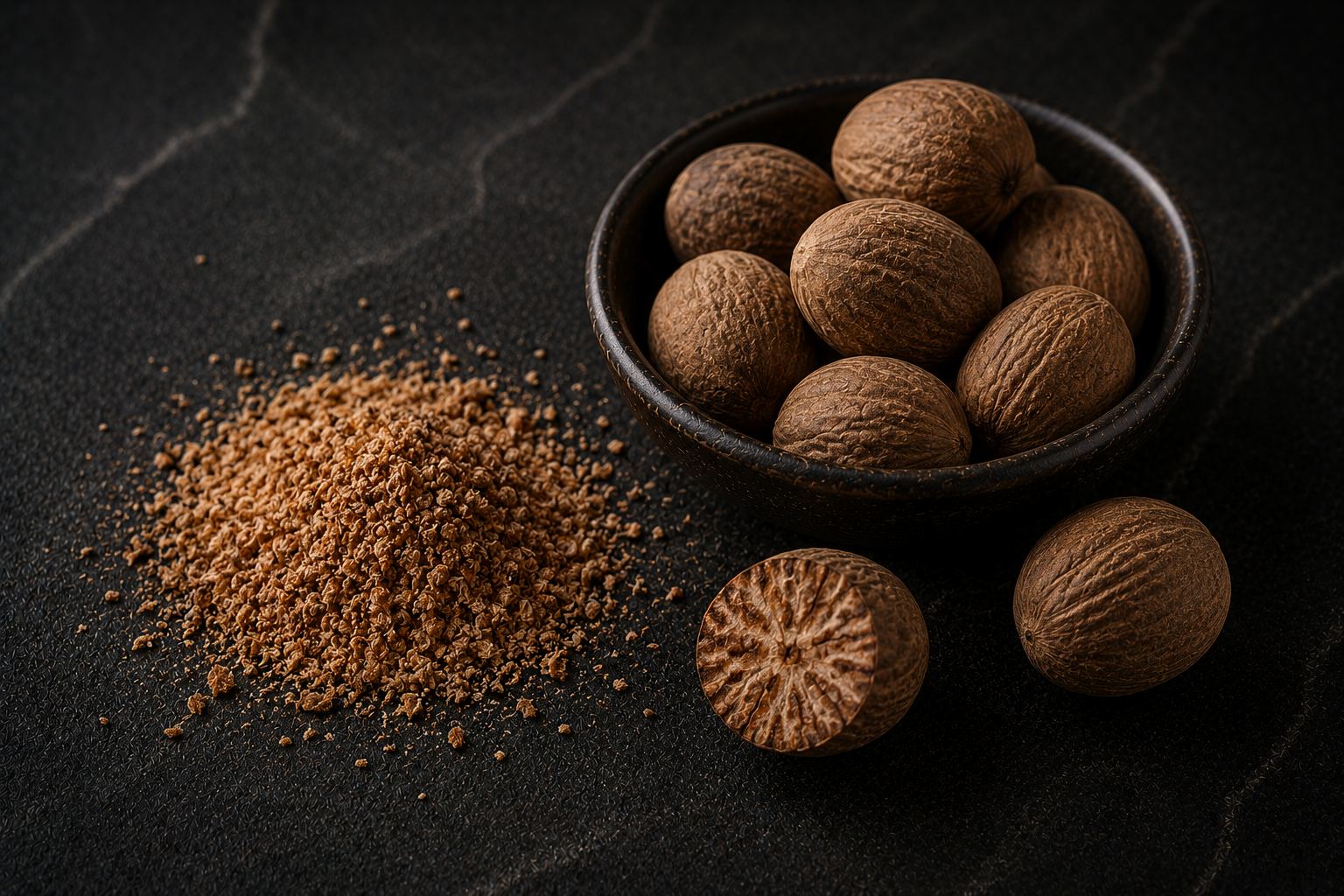
Nutmeg is the seed kernel of Myristica fragrans, the same plant that produces mace (the lace-like aril surrounding the nutmeg shell). The fruit resembles a peach — the outer flesh, a hard shell, the nutmeg seed inside, and mace surrounding the shell. When the shell is removed and the seed dried, the result is the familiar hard, round-oval nutmeg.
In Indian cooking, nutmeg serves as one of the warm spices in garam masala and is used in Mughlai cooking, milk-based desserts, and occasionally in biryani. It is richer and heavier than mace — its more robust compounds survive higher heat better, making it more suitable for ground spice blend applications where mace's delicate compounds would be lost.
- Garam masala without nutmeg lacks its characteristic warm-resinous depth — nutmeg provides a woody backbone
- Mughlai korma and biryani use nutmeg as part of the complex warm spice profile alongside mace, cloves, and cardamom
- Kheer and milk-based desserts benefit from a grating of fresh nutmeg over the finished dish — the fresh-grated aroma is dramatically superior to pre-ground
- Kerala Christmas cake and rich festive preparations traditionally use generous nutmeg
- Without nutmeg, Mughlai preparations taste simpler and less complex in their warm spice background
Nutmeg Through History
Nutmeg and its companion spice mace are native to the Banda Islands of Indonesia — the original Spice Islands. Control of these tiny islands was the primary goal of Dutch colonialism in Southeast Asia in the 17th century. The Dutch VOC seized control of the Banda Islands in 1621, massacring most of the indigenous population to establish a monopoly on nutmeg and mace.
In India, nutmeg arrived via Arab traders centuries before European involvement, and appears in Sanskrit texts as jatiphala. Mughal court cooking adopted nutmeg as a warming element in the complex spice architecture of biryani and korma. Kerala developed domestic cultivation as the European monopoly on nutmeg eventually broke down through French and British horticultural theft of plants from the Dutch.
The Science of Nutmeg
How to Store Nutmeg
How to Buy Good Nutmeg
How to Use Nutmeg Correctly
- Garam masala: add a small piece (1/4 nutmeg) when making a batch — grate in directly
- Fresh grating: use a microplane to grate over finished kheer, biryani, or meat dishes
- Ground: add 1/8 tsp to curry masala base for warm depth
- Quantity: very small — 1/8 tsp ground or a few gratings fresh per dish
- Never use in large quantities — becomes bitter and medicinal quickly
- For milk desserts: grate 5–6 scrapings of fresh nutmeg just before serving
What Nutmeg Pairs Well With
Dishes That Use Nutmeg
Where Nutmeg Matters Most
| Mughlai Cuisine | Essential |
| North Indian Cuisine | Common |
| Kashmiri Cuisine | Common |
| Keralan Cuisine | Common |
| South Indian Cuisine | Occasional |
| Bengali Cuisine | Occasional |
| Jain Cooking | Occasional |
Nutmeg vs Mace (from the Same Fruit)
| Feature | Nutmeg (Jaiphal) | Mace (Javitri) |
|---|---|---|
| Part of fruit | Seed kernel | Aril (lace wrapper) |
| Flavour | Richer, heavier, slightly bitter | More delicate, floral, sweet |
| Heat tolerance | Better — suited to ground blends | Delicate — better in gentle heat |
| In desserts? | Yes — grated fresh | Yes — infused in milk |
| In garam masala? | Yes — structural component | Yes — aromatic element |
| Price | Lower than mace | Higher than nutmeg |
| Form used | Whole grated / ground | Whole blade / ground |