★★★★★ Bengal
★★★☆☆ North India
What Does Mustard Seeds Taste Like?
Mustard Seeds in Every Indian Language
| Language | Name | Pronunciation |
|---|---|---|
| English | Mustard Seeds | MUS-tard |
| Hindi | राई — Rai / सरसों — Sarson | RYE / SAR-son |
| Bengali | সরিষা — Sarisha | SAR-ee-sha |
| Tamil | கடுகு — Kadugu | KAH-doo-goo |
| Telugu | ఆవాలు — Aavalu | AH-vah-loo |
| Malayalam | കടുക് — Kaduku | KAH-doo-koo |
| Kannada | ಸಾಸಿವೆ — Saasive | SAH-see-veh |
| Gujarati | રાઈ — Rai | RYE |
| Marathi | मोहरी — Mohari | MOH-hah-ree |
| Punjabi | ਸਰ੍ਹੋਂ — Sarhon | SAR-hohn |
| Urdu | سرسوں — Sarson | SAR-son |
| Sanskrit | राजिका — Rajika | rah-JEE-kah |
What Is Mustard Seeds?
Mustard seeds are among the oldest cultivated spices in India, documented in the Indus Valley Civilisation circa 3000 BCE. In South Indian cooking they are the primary tadka spice — virtually every preparation from sambhar to thoran begins with mustard seeds in hot oil. In Bengal they appear in panch phoron and as mustard oil, the defining cooking fat. In Punjab and North India, mustard oil and seeds define winter cooking.
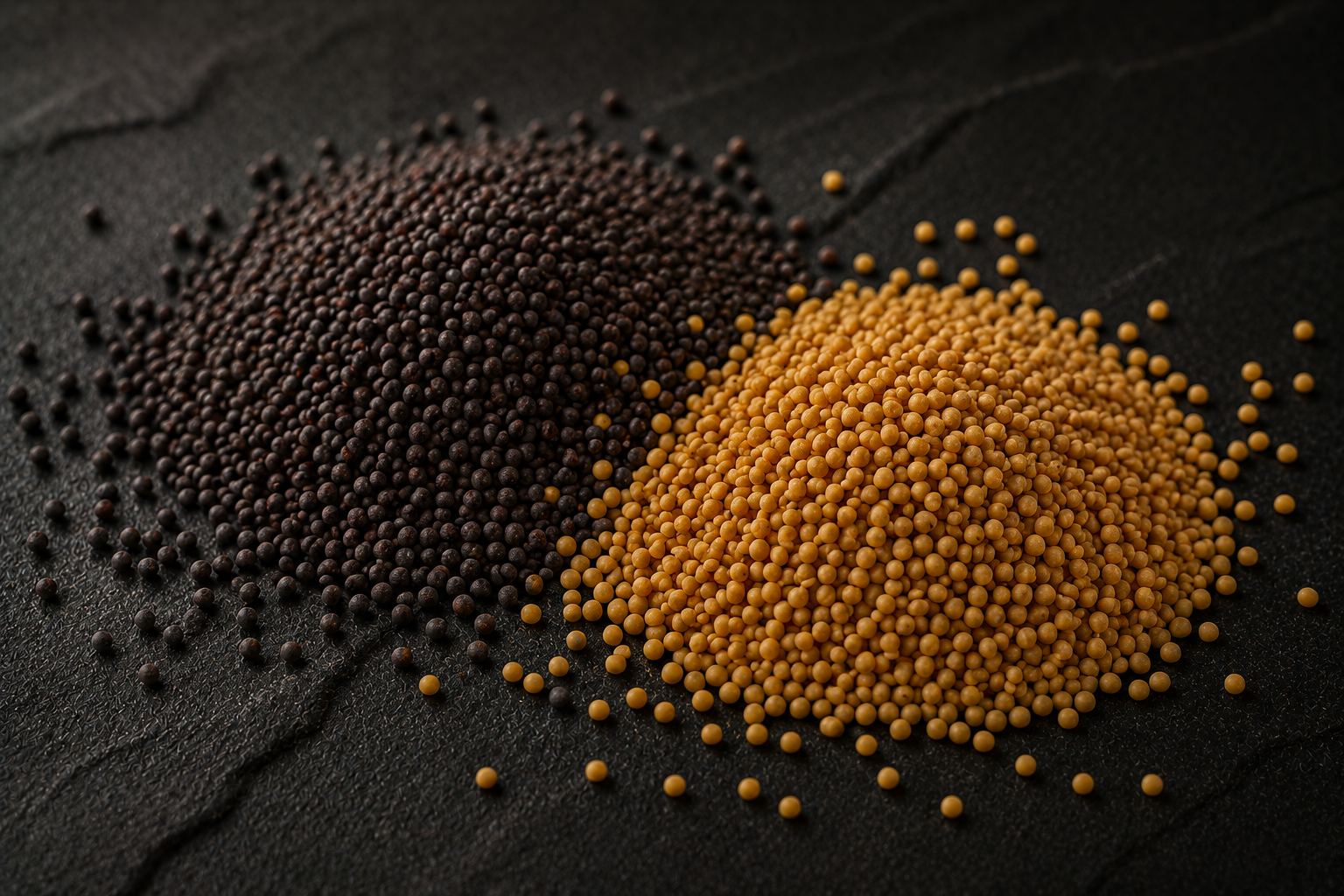
Three varieties exist with different culinary roles: black mustard (Brassica nigra) for South Indian tadka — small, pungent, and fast to pop; brown mustard (Brassica juncea) for mustard oil and pickling; and yellow mustard (Sinapis alba) for pickles and European-style preparations. In Indian cooking, black and brown are interchangeable for tadka purposes; yellow is a different culinary object.
- South Indian sambhar, rasam, kootu, and thoran all begin with mustard seed tadka — without it the dishes lack their foundational aroma
- Panch phoron — Bengal's defining spice blend — cannot exist without mustard as one of its five components
- Mustard oil provides the fat, the pungency, and the cultural identity of Bengali and Punjabi cooking
- The 'pop' of mustard seeds in hot oil is the auditory signal that Indian cooking has begun
- Without properly popped mustard seeds, South Indian cooking loses its characteristic nutty-pungent base
Mustard Seeds Through History
Mustard has been cultivated in India since the Indus Valley Civilisation — seeds have been found at Mohenjo-daro and Harappa archaeological sites, making it one of the few spices genuinely native to the subcontinent. Ancient Ayurvedic texts reference rajika (black mustard) for both culinary and medicinal use, and the Arthashastra (circa 300 BCE) references mustard oil as a cooking fat.
Mustard oil was the primary cooking fat of Bengal and Punjab long before refined vegetable oils arrived. The colonial period brought refined oils, but mustard oil retained its dominance in these regions — particularly in Bengal, where cooking in mustard oil is a cultural identity marker, not merely a culinary preference.
South Indian cooking adopted black mustard as its primary tadka spice in ancient times, and the tradition has remained unbroken. The mustard seed appearing in every South Indian kitchen is botanically the same seed that appears in Vedic cooking texts.
The Science of Mustard Seeds
How to Store Mustard Seeds
How to Buy Good Mustard Seeds
How to Use Mustard Seeds Correctly
- Add whole to hot oil (160–180°C) with a lid or splatter guard ready — seeds jump
- Seeds must pop before adding other ingredients — wait for the popping to slow
- For South Indian tadka sequence: mustard first → curry leaves → dried red chilli → urad dal (if used)
- Quantity: 1/2 to 1 tsp per dish for 4 people
- For panch phoron: equal parts with cumin, nigella, fennel, and fenugreek
- For pickles: add to oil or brine whole
What Mustard Seeds Pairs Well With
Dishes That Use Mustard Seeds
Where Mustard Seeds Matters Most
| South Indian Cuisine | Essential |
| Keralan Cuisine | Essential |
| Bengali Cuisine | Essential |
| Maharashtrian Cuisine | Common |
| North Indian Cuisine | Common |
| Odishan Cuisine | Essential |
| Jain Cooking | Common |
| Sattvic Cooking | Common |
Black Mustard vs Brown Mustard vs Yellow Mustard
| Feature | Black Mustard (Rai) | Brown Mustard (Sarson) | Yellow Mustard |
|---|---|---|---|
| Size | 1–1.5mm | 1.5–2mm | 2–3mm |
| Pungency | Highest | Medium-high | Mildest |
| Indian use | South Indian tadka | Bengal / mustard oil | Pickles, less common |
| Mustard oil source? | Yes — pungent | Primary source in India | Less common |
| Popping in oil? | Yes — essential use | Yes | Yes but larger pop |
| Colour | Dark brown-black | Reddish-brown | Yellow-tan |