★★★☆☆ South India (rasam)
★★☆☆☆ General cooking
What Does Long Pepper Taste Like?
Long Pepper in Every Indian Language
| Language | Name | Pronunciation |
|---|---|---|
| English | Long Pepper | LONG PEP-er |
| Hindi | पिप्पली — Pippali | PIP-pah-lee |
| Bengali | পিপুল — Pipul | PEE-pool |
| Tamil | திப்பிலி — Thippili | THIP-pih-lee |
| Telugu | పిప్పళ్ళు — Pippallu | PIP-pah-loo |
| Malayalam | തിപ്പലി — Thippali | THIP-pah-lee |
| Kannada | ಹಿಪ್ಪಲಿ — Hippali | HIP-pah-lee |
| Gujarati | પીપળ — Pipal | PEE-pul |
| Marathi | पिंपळी — Pimpali | PIM-pah-lee |
| Punjabi | ਪਿੱਪਲੀ — Pippli | PIP-lee |
| Urdu | پپلی — Pipli | PIP-lee |
| Sanskrit | पिप्पली — Pippali | PIP-pah-lee — same as Hindi, Ayurvedic name |
What Is Long Pepper?
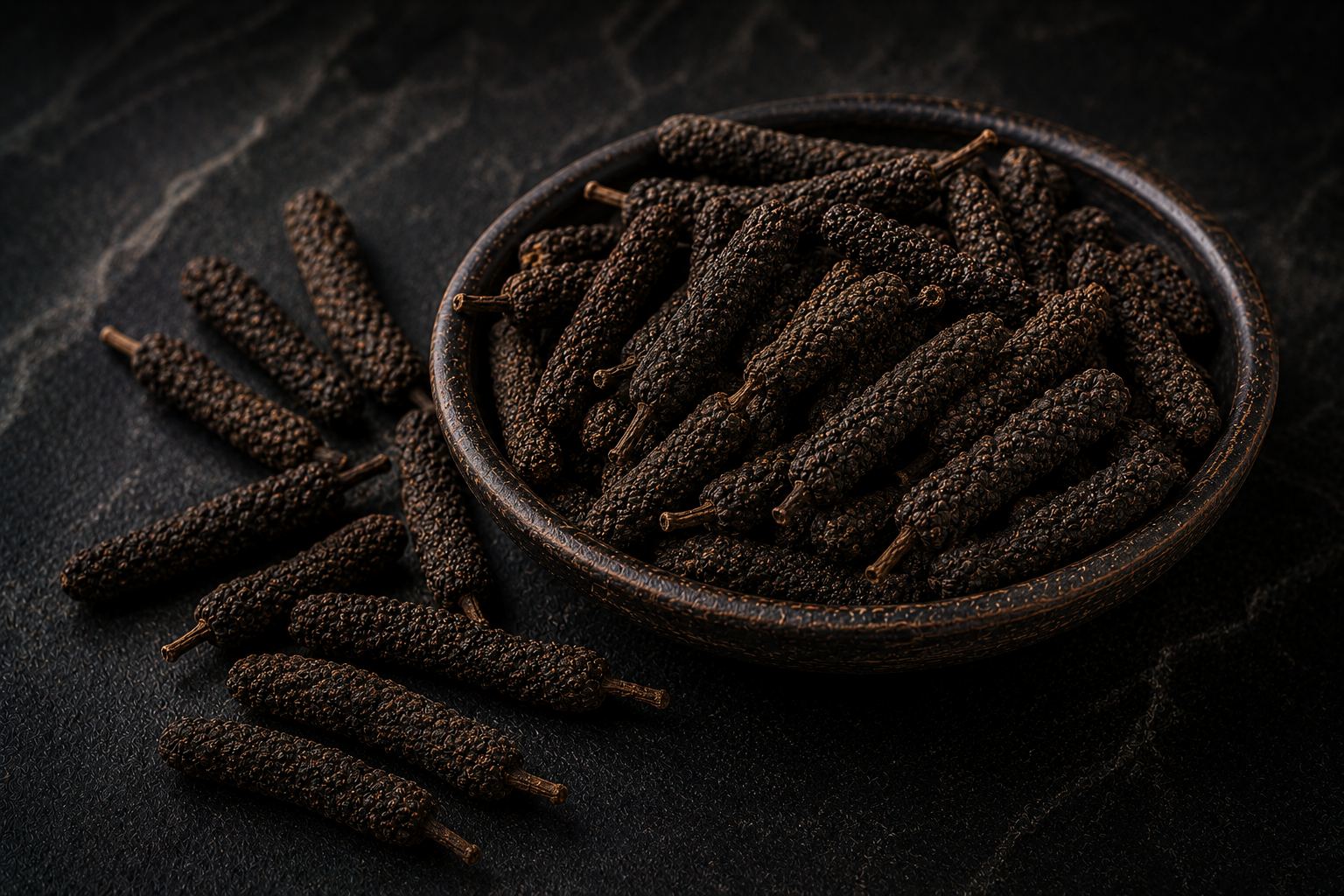
Long pepper — pippali — is the fruiting spike of Piper longum, a plant closely related to black pepper. For thousands of years before red chilli arrived from the Americas in the 16th century, long pepper and black pepper were the two primary heat sources in Indian cooking. Long pepper is more complex than black pepper — its heat is similar in intensity but more resinous, sweet-bitter, and aromatic. Ancient Roman cookbooks reference long pepper more frequently than black pepper.
Today, pippali occupies a reduced culinary role — its primary presence in Indian culture is in Ayurvedic medicine, where it is one of the most important medicinal spices. In Tamil Nadu, it is still used in traditional rasam recipes. In some regional cuisines of Northeast India and coastal Karnataka, it retains a culinary presence. For most Indian home cooks, it is a pharmacy product rather than a kitchen staple.
- Pippali is one of the three spices in Trikatu — Ayurveda's foundational respiratory and digestive formula (long pepper + black pepper + ginger)
- Traditional Tamil rasam uses pippali for a more complex heat than black pepper alone provides
- Long pepper is mentioned in the Charaka Samhita as a medicinal spice — its culinary and medicinal roles have always been intertwined
- Before chilli arrived in India, pippali and black pepper between them provided all the heat in Indian cooking across 4,000+ years of culinary history
- Historically, long pepper commanded higher prices than black pepper in ancient Rome and Arab trade — its complexity was recognised
Long Pepper Through History
Long pepper is native to India and has been used for at least 4,000 years. Sanskrit texts dating to 1200 BCE reference pippali as both a culinary and medicinal ingredient. Ancient Roman accounts (Pliny the Elder, writing around 77 CE) describe long pepper as more valuable and desirable than black pepper — a remarkable reversal from their modern relative obscurity.
The Arab and Roman spice trades brought long pepper to Europe and the Middle East, where it was extensively used in medieval European cooking before the Colombian Exchange introduced red chilli in the 16th century. Long pepper's decline in Indian cooking directly parallels red chilli's rise — the cheaper, more prolific chilli simply replaced it as a heat source, while long pepper retreated to Ayurvedic medicine where it retains an important role today.
The Science of Long Pepper
How to Store Long Pepper
How to Buy Good Long Pepper
How to Use Long Pepper Correctly
- Rasam: add 2–3 spikes to the simmering broth — remove before serving
- Ayurvedic kadha: simmer with black pepper and ginger for a warming tea
- Ground: use a pinch in place of black pepper for more complexity
- Trikatu churna (traditional): equal parts long pepper, black pepper, and dry ginger powder
- Quantity: use sparingly — 2–4 spikes per dish
- Specialty use: Naga and Manipuri cooking uses fresh green long pepper extensively
What Long Pepper Pairs Well With
Dishes That Use Long Pepper
Where Long Pepper Matters Most
| Ayurvedic Cooking | Essential |
| South Indian Traditional | Common |
| Northeastern Indian Cuisine | Essential |
| North Indian Cuisine | Rare |
| Jain Cooking | Occasional |
| Sattvic Cooking | Common |
Long Pepper vs Black Pepper vs Red Chilli
| Feature | Long Pepper | Black Pepper | Red Chilli |
|---|---|---|---|
| Botanical name | Piper longum | Piper nigrum | Capsicum spp. |
| Native to India? | Yes — ancient | Yes — Kerala | No — American import |
| Heat compound | Piperine + Piplartine | Piperine | Capsaicin |
| Heat character | Complex, resinous | Sharp, building | Immediate, lingering |
| Culinary role today | Reduced — mainly medicinal | Major spice | Major spice |
| Historical role | Ancient primary heat | Ancient primary heat | Post-16th century |
| Flavour complexity | High | Medium | Low-medium |