★★★★★ All chaat masala
★★★★☆ All India
What Does Black Salt Taste Like?
Black Salt in Every Indian Language
| Language | Name | Pronunciation |
|---|---|---|
| English | Black Salt / Kala Namak | BLAK SAWLT |
| Hindi | काला नमक — Kala Namak | KAH-lah NAH-mak |
| Bengali | কালো নুন — Kalo Nun | KAH-lo NOON |
| Tamil | கருப்பு உப்பு — Karuppu Uppu | kah-RUP-poo OOP-poo |
| Telugu | నల్ల ఉప్పు — Nalla Uppu | NAH-lah OOP-poo |
| Malayalam | കറുത്ത ഉപ്പ് — Karuttha Uppu | kah-ROOTH-ah OOP-poo |
| Kannada | ಕಾಳು ಉಪ್ಪು — Kaalu Uppu | KAH-loo OOP-poo |
| Gujarati | કાળું મીઠું — Kalun Meethu | KAH-lun MEE-thoo |
| Marathi | काळे मीठ — Kale Meeth | KAH-leh MEETH |
| Punjabi | ਕਾਲਾ ਨਮਕ — Kala Namak | KAH-lah NAH-mak |
| Urdu | کالا نمک — Kala Namak | KAH-lah NAH-mak |
| Sanskrit | कृष्ण लवण — Krishna Lavana | KRISH-nah LAH-vah-nah |
What Is Black Salt?
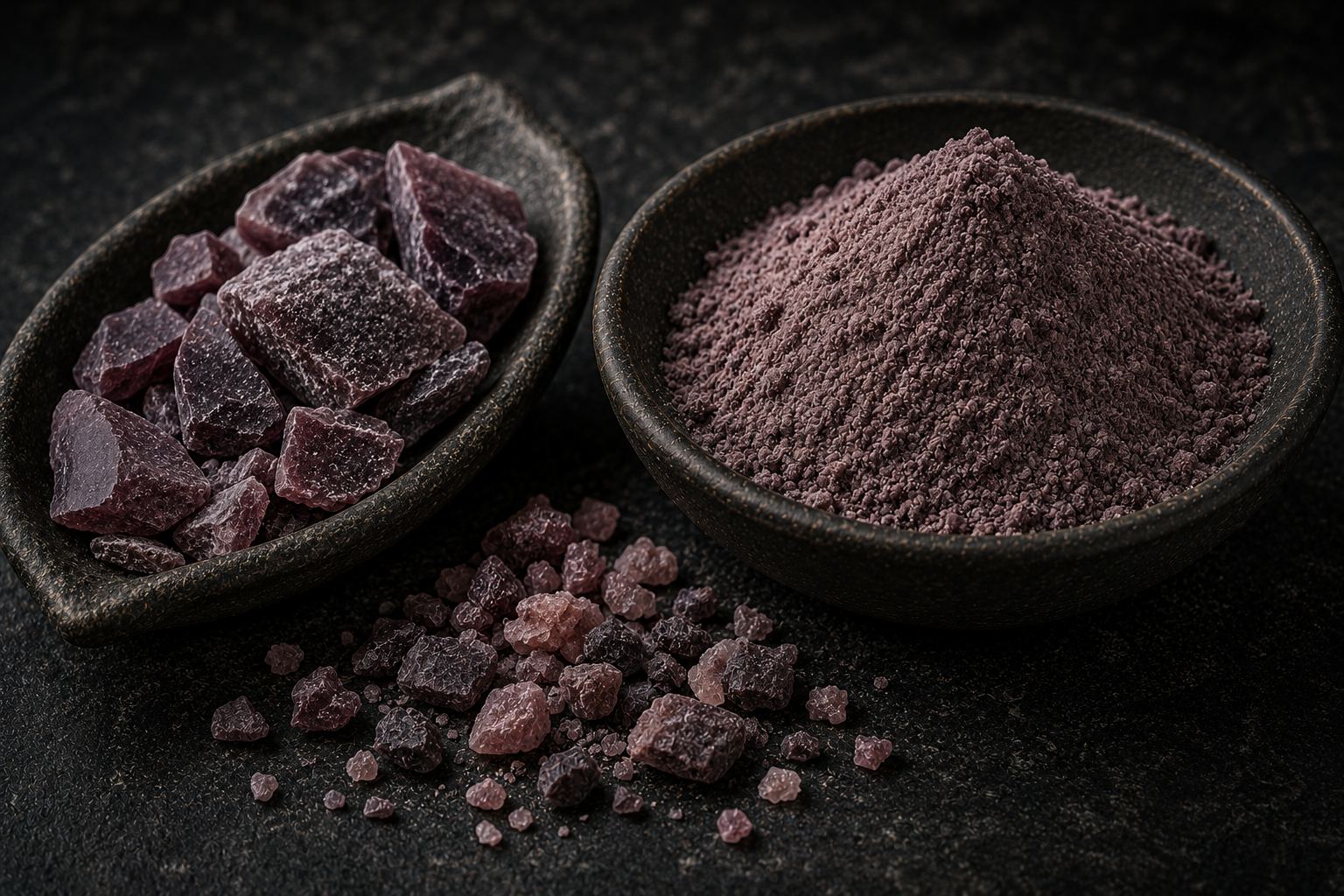
Black salt — kala namak — is an Indian volcanic rock salt mined from Himalayan salt deposits, processed with seeds and spices (traditionally harad and amla) to develop its distinctive sulphurous character. Despite the name, it is not black in its ground form — it is pale pink to lilac when freshly ground, turning whiter as the sulphur compounds escape. Whole unground crystals are darker, ranging from deep brown to black.
The defining flavour characteristic of kala namak is its eggy, sulphurous note — caused by hydrogen sulphide and iron sulphide compounds. This eggy quality is not a defect but a design feature: it adds a distinctive pungent savouriness to chaat, raita, and cooling drinks that regular salt cannot provide. Kala namak is one of the essential ingredients in chaat masala and is fundamental to Indian street food's flavour vocabulary.
- Chaat masala cannot exist without kala namak — the sulphurous eggy note is the defining character of chaat flavour across all chaat preparations
- Raita made with kala namak has a distinctly different, more complex character than raita made with regular salt
- Jaljeera and other cooling drinks use kala namak for the specific savoury-sulphurous depth that makes them more refreshing than plain lemon water
- The vegan egg-flavour in Indian cooking is increasingly provided by kala namak — the sulphur compounds genuinely mimic egg aroma
- Without kala namak, North Indian street food culture loses one of its most distinctive flavour signatures
Black Salt Through History
Kala namak has been used in Indian cooking and Ayurvedic medicine for at least 2,000 years. Sanskrit texts classify it as a type of lavana (salt) with specific digestive and medicinal properties. The Ayurvedic tradition values kala namak as a digestive aid — the sulphur compounds are considered helpful for flatulence and digestive discomfort, which may explain its traditional pairing with fried, rich chaat foods.
The traditional production method involves heating rock salt with Terminalia chebula (harad) in a clay pot — a process that develops and concentrates the sulphur compounds over many hours. Modern production industrialises this process but retains the essential chemistry. Pakistan and Nepal also have significant kala namak deposits and production.
The Science of Black Salt
How to Store Black Salt
How to Buy Good Black Salt
How to Use Black Salt Correctly
- Add raw as a finishing salt — at the table or in the last 30 seconds of cooking
- For chaat: sprinkle over chaat along with chaat masala just before serving
- For raita: season with a pinch of kala namak + regular salt together
- For lassi and drinks: add a pinch to salted lassi or jaljeera
- For chaat masala: one of the essential components — cannot be omitted
- Never use as the primary cooking salt — use with regular salt (50:50 maximum) for finishing
What Black Salt Pairs Well With
Dishes That Use Black Salt
Where Black Salt Matters Most
| North Indian Cuisine | Essential |
| Street Food Tradition | Essential |
| Chaat Culture | Essential |
| Gujarati Cuisine | Common |
| South Indian Cuisine | Common |
| Jain Cooking | Essential |
| Sattvic Cooking | Common |
Kala Namak vs Himalayan Pink Salt vs Regular Salt
| Feature | Kala Namak | Himalayan Pink Salt | Regular Salt |
|---|---|---|---|
| Colour (ground) | Pale pink-purple | Pink | White |
| Sulphur content | High — distinctive eggy note | Low — mild mineral | None |
| Flavour | Eggy, sulphurous, savoury | Mild mineral | Clean salty |
| In chaat masala? | Essential — cannot omit | No | No |
| Cooking use? | Finishing only | Cooking and finishing | All cooking |
| Indian origin? | Yes — Himalayan deposits | Yes — Pakistani Himalayan | Various |
| Substitute for regular salt? | 50:50 maximum | Yes — freely | N/A |