★★★★★ Kashmir
★☆☆☆☆ South India
What Does Black Cardamom Taste Like?
Black Cardamom in Every Indian Language
| Language | Name | Pronunciation |
|---|---|---|
| English | Black Cardamom | BLAK KAR-dah-mum |
| Hindi | बड़ी इलायची — Badi Elaichi | BAH-dee eh-LYE-chee |
| Bengali | বড় এলাচ — Boro Elach | BOH-ro eh-LACH |
| Tamil | பெரிய ஏலக்காய் — Periya Elakkai | Peh-ree-yah eh-LAHK-kye |
| Telugu | నల్ల ఏలకులు — Nalla Elakulu | NAH-lah eh-LAH-koo-loo |
| Malayalam | ഇലത്തരി — Periya Elam | Peh-ree-yah EH-lahm |
| Kannada | ದೊಡ್ಡ ಏಲಕ್ಕಿ — Dodda Elakki | DOH-dah eh-LAHK-kee |
| Gujarati | મોટી એલચી — Moti Elchi | MOH-tee EHL-chee |
| Marathi | मोठी वेलदोडा — Mothi Veldoda | MOH-thee VEL-doh-dah |
| Punjabi | ਵੱਡੀ ਇਲਾਇਚੀ — Vaddi Ilaichi | VAH-dee ih-LYE-chee |
| Urdu | بڑی الائچی — Badi Ilaichi | BAH-dee ih-LYE-chee |
| Sanskrit | स्थूल एला — Sthula Ela | STOO-lah EH-lah |
What Is Black Cardamom?
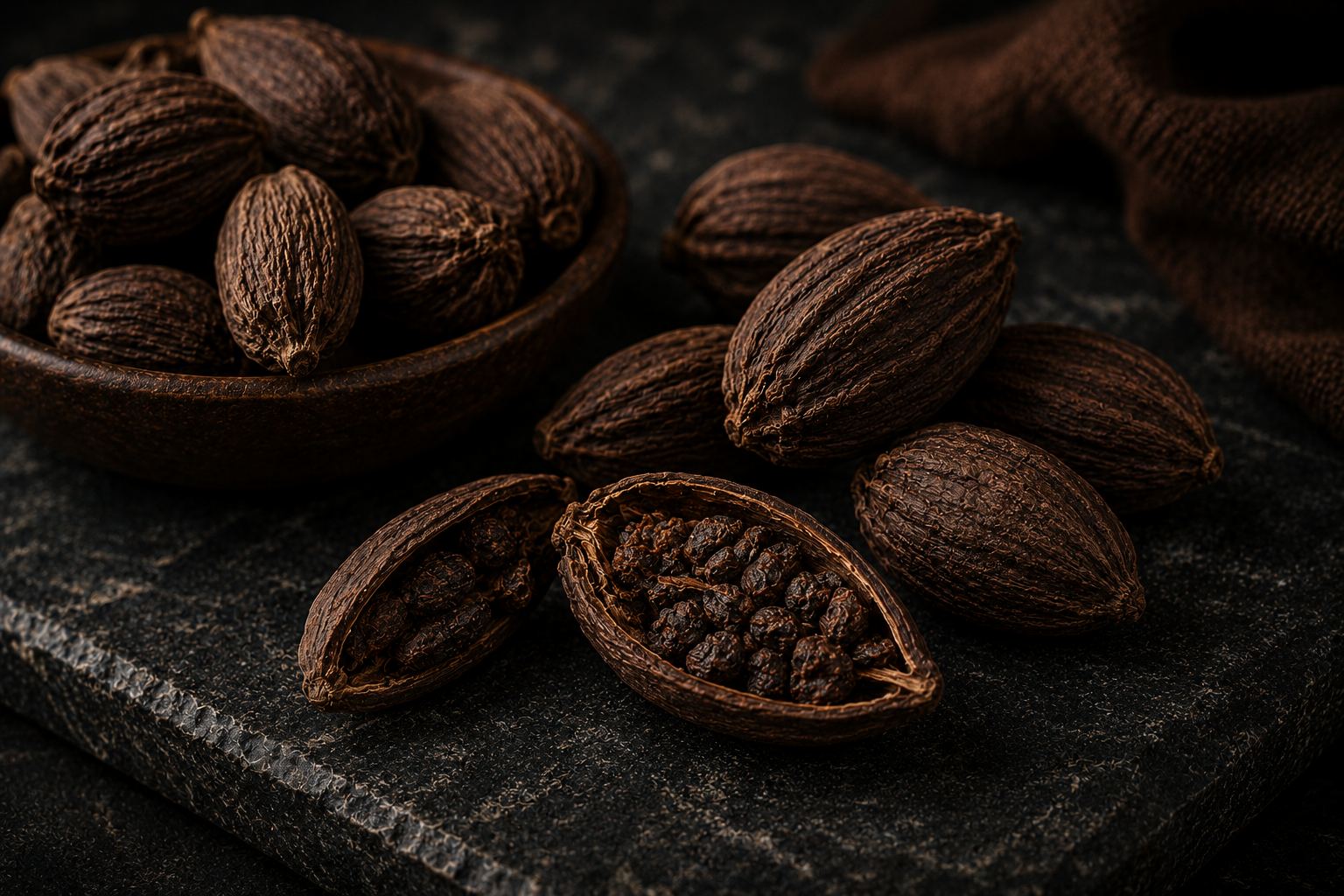
Black cardamom — badi elaichi — is botanically distinct from green cardamom despite sharing the name. It is the dried pod of Amomum subulatum, a plant native to the Himalayan foothills of Nepal, Sikkim, and Bhutan. The critical difference is in the drying process: while green cardamom is air-dried or shade-dried to preserve its delicate floral character, black cardamom is dried over open fires — giving it a distinctive smoky, camphor-like character that green cardamom entirely lacks.
Black cardamom is a savoury spice — it does not work in desserts or chai (unlike green cardamom). Its natural domain is long-cooked meat dishes, biryanis, and North Indian garam masala. The smokiness integrates into slow-cooked preparations over hours, providing a woody, complex backbone that is unmistakably northern Indian in character.
- North Indian biryani's depth and complexity comes significantly from black cardamom's smoky backbone in the cooking ghee
- Rogan Josh — Kashmir's defining lamb preparation — uses black cardamom as one of its primary whole spices
- Dal makhani's overnight cooking process extracts the smoky character of black cardamom slowly into the lentils
- Without black cardamom, North Indian garam masala tastes brighter and more floral but lacks the deep, woody undertone
- Slow-cooked nihari and paya (bone broth preparations) derive their characteristic smoky warmth from black cardamom
Black Cardamom Through History
Black cardamom's cultivation is concentrated in the Himalayan foothills — Nepal is the world's largest producer, with significant production in Sikkim and Bhutan. Historical trade routes carried it south into North India, where it became embedded in Mughal court cooking. The Mughal kitchen distinguished clearly between green cardamom (for its floral delicacy) and black cardamom (for its smoky depth) — using each in different preparations.
Kashmiri cooking, with its Persian and Central Asian influences, adopted black cardamom as a structural spice in meat preparations. The slow-cooked, heavily spiced meat traditions of Wazwan (Kashmir's ceremonial feast cuisine) rely significantly on black cardamom's ability to hold its character through many hours of cooking — where green cardamom's more delicate aromatics would dissipate entirely.
The Science of Black Cardamom
How to Store Black Cardamom
How to Buy Good Black Cardamom
How to Use Black Cardamom Correctly
- Add whole pods to hot ghee at the start of cooking — lightly crush first to expose seeds
- In biryani: 2–3 pods per dish with other whole spices in the initial ghee tempering
- For dal makhani: add 2 pods in the overnight slow-cook
- Remove before serving — the pod itself is not eaten
- Quantity: 2–3 pods per dish for 4 people in slow-cooked preparations
- Never use in desserts, chai, or sweets — smokiness is inappropriate in sweet contexts
What Black Cardamom Pairs Well With
Dishes That Use Black Cardamom
Where Black Cardamom Matters Most
| North Indian Cuisine | Essential |
| Kashmiri Cuisine | Essential |
| Mughlai Cuisine | Essential |
| Punjabi Cuisine | Essential |
| Bengali Cuisine | Occasional |
| South Indian Cuisine | Rare |
| Jain Cooking | Rare |
| Sattvic Cooking | Rare |
Black Cardamom vs Green Cardamom
| Feature | Black Cardamom | Green Cardamom |
|---|---|---|
| Botanical name | Amomum subulatum | Elettaria cardamomum |
| Drying method | Over open fire — smoky | Air/shade dried — floral |
| Flavour | Smoky, camphor, woody | Floral, sweet, eucalyptus |
| In desserts? | No | Yes — essential |
| In chai? | No | Yes — essential |
| Best application | Slow-cooked meat, biryani | Everything |
| Interchangeable? | No | No |
| Price | Lower | Higher |