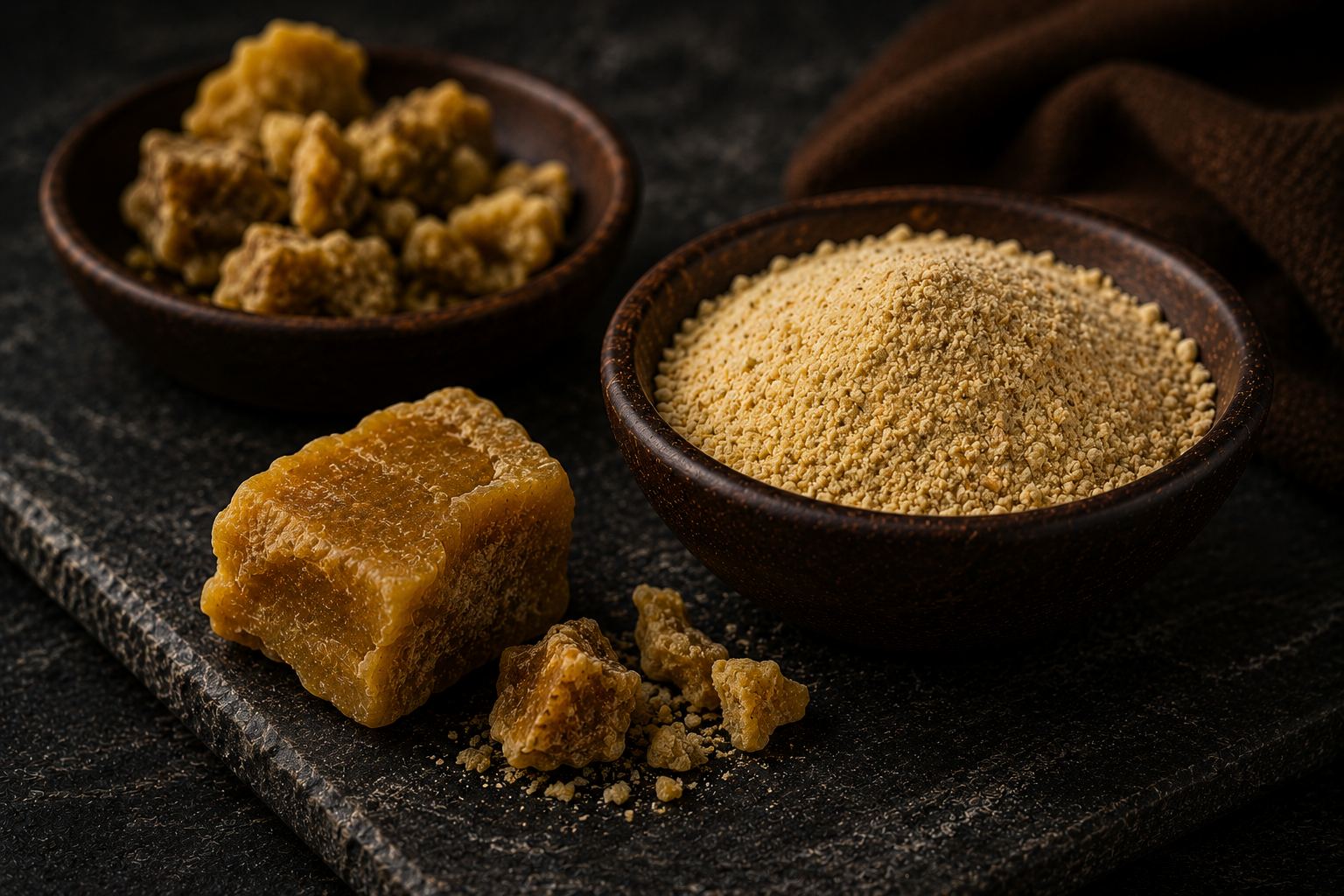
Ingredient identity
Ingredient DNA
Asafoetida — Hing
Ferula asafoetida · Family: Apiaceae · Genus: Ferula
Origin
Afghanistan · Iran (resin from Ferula plant)
Category
Ground Spice (resin, compounded with flour)
Form
Yellow-brown powder or solid resin
Primary Use
Tadka · Onion substitute (Jain/Sattvic) · Digestive spice
Flavour
Raw: sulphurous, pungent. Cooked: onion-leek, savoury, umami-adjacent
Key Compound
Ferulic acid · Disulfides (allyl, sec-butyl)
Heat Tolerance
Very brief — use 1/4 tsp in very hot oil for 10 seconds only
Regional Weight
★★★★★ Jain cooking
★★★★★ South India
★★★★☆ All India
Taste profile
What Does Asafoetida Taste Like?
Flavour Profile — Asafoetida
Savouriness (cooked)★★★★☆
Botanical classification
Names across India
Asafoetida in Every Indian Language
| Language | Name | Pronunciation |
|---|
| English | Asafoetida | ah-sah-FEH-tih-dah |
| Hindi | हींग — Hing | HING |
| Bengali | হিং — Hing | HING |
| Tamil | பெருங்காயம் — Perungayam | peh-run-GAH-yum |
| Telugu | ఇంగువ — Inguva | IN-goo-vah |
| Malayalam | കായം — Kayam | KAH-yum |
| Kannada | ಇಂಗು —Ingu | IN-goo |
| Gujarati | હિંગ — Hing | HING |
| Marathi | हिंग — Hing | HING |
| Punjabi | ਹਿੰਗ — Hing | HING |
| Urdu | ہینگ — Hing | HING |
| Sanskrit | हिङ्गु — Hingu | HIN-goo |
Origin and identity
What Is Asafoetida?
Asafoetida — hing — is the dried resin from the roots of Ferula asafoetida, a large plant native to Afghanistan and Iran. It is among the most pungent substances in the spice world — raw hing smells aggressively of sulphur and garlic, earning it the medieval European name 'devil's dung' and the contradictory Persian name 'food of the gods.'
The transformation that occurs when hing hits very hot oil is one of Indian cooking's most dramatic chemical reactions: the harsh, almost unpleasant raw sulphur aroma converts in seconds to a mellow, onion-leek savouriness that permeates the dish. This transformation is the entire point of hing in tadka. Raw hing in a dish is a mistake — cooked hing is a revelation. It is for this reason that hing is the essential substitute for onion and garlic in Jain and Sattvic cooking traditions.
What Indian Cooking Loses Without Asafoetida
- Jain cooking prohibits onion and garlic (root vegetables disturb underground organisms) — hing provides the essential onion-savouriness that defines savoury Indian food
- Sattvic diet traditions avoid onion and garlic — hing fills the flavour gap
- South Indian sambhar and rasam tadka traditionally include hing as one of the three or four primary tadka spices
- Dal without hing tadka loses a specific savouriness and digestive quality that other spices cannot provide
- Without hing, Jain cuisine would taste flat and missing its foundational savoury note
Historical significance
Asafoetida Through History
Historical Record
From Persian Medicine to Indian Tadka
Asafoetida originates in the mountains of Afghanistan and Iran, where the Ferula plant grows wild at high altitudes. The resin was extensively used in ancient Persian and Roman medicine — Roman cookbooks (Apicius, 1st century CE) refer to it as laserpicium, using it as a substitute for silphium, an extinct Mediterranean plant.
Arab traders brought hing to India via ancient trade routes, where it was immediately adopted into Ayurvedic medicine as a digestive aid — an application that persists in Indian home medicine today, where hing water is given for digestive issues. The cooking tradition developed alongside the medicinal one, with hing's onion-like savouriness making it particularly valued in traditions that prohibited onion and garlic.
India does not produce hing domestically — it is entirely imported from Afghanistan and Iran. This makes it one of the few important Indian spices that is not grown on the subcontinent.
Cooking science
The Science of Asafoetida
Sulphide Chemistry — The Smell That Transforms
Hing's pungency comes from organosulfur compounds — particularly allyl disulfide and sec-butyl propyl disulfide — the same family of compounds responsible for the smell of onion and garlic (allicin). These compounds are volatile and reactive. When hing hits very hot oil (180°C+), the disulfide compounds undergo rapid thermal decomposition, breaking down into less pungent but more savoury compounds that smell strongly of cooked onion and garlic. This is why hing must always be cooked briefly in very hot fat — not warm oil, not water, but very hot fat — for the transformation to occur. The Maillard-adjacent reactions that follow the thermal decomposition create additional savoury compounds similar to those produced when onion is fried.
Storage science
How to Store Asafoetida
Compounded powder
1–2 years (airtight container essential)
Critical note
Store in an absolutely airtight container — the sulphur compounds will permeate everything nearby
Buying guide
How to Buy Good Asafoetida
✓ Look For
- Yellow-golden powder (compounded with flour)
- Pungent sulphur smell when container is opened — this is correct
- No excessively bitter or chemical smell beyond sulphur
- From reputable Indian suppliers — adulteration is common
✗ Avoid
- Very pale or white powder — highly diluted or adulterated
- No smell at all — spent or entirely flour
- Brown or dark colour — improperly processed
- Excessively expensive in small quantities from non-Indian sources
Technique
How to Use Asafoetida Correctly
Technique, quantity, and what to avoid
- Add a very small pinch (1/8 to 1/4 tsp) to very hot oil — 10 seconds only
- It will sizzle, foam slightly, and the smell transforms from sulphur to savory onion
- Add remaining tadka spices immediately after the hing has cooked
- Never add to warm or cold preparations — only very hot fat
- Store the container far away from other ingredients — the smell permeates
- Jain cooking: use generously as the primary flavour base in place of onion
Pairings
What Asafoetida Pairs Well With
Best Pairings — Asafoetida
Famous dishes
Dishes That Use Asafoetida
Regional use
Where Asafoetida Matters Most
Regional Importance
★★★★★
Jain communities
The essential onion/garlic substitute — used generously
★★★★★
South India
Sambhar, rasam, and all tadka
★★★★★
Rajasthan
Jain-influenced vegetarian cooking
★★★★☆
Gujarat
Heavy Jain population — hing essential
★★★★☆
North India
Dal and vegetable tadka
★★★☆☆
Bengal
Used but less central than in South or Rajasthan
| Jain Cooking | Essential |
| Sattvic Cooking | Essential |
| South Indian Cuisine | Essential |
| Rajasthani Cuisine | Essential |
| Gujarati Cuisine | Essential |
| North Indian Cuisine | Common |
| Bengali Cuisine | Common |
Comparison
Hing vs Onion vs Garlic (As Flavour Sources)
| Feature | Asafoetida (Hing) | Onion | Garlic |
|---|
| Flavour when raw | Sulphurous, pungent | Mild onion | Pungent garlic |
| Flavour when cooked | Savory, onion-leek | Sweet, caramelised | Mellow, nutty |
| Jain/Sattvic? | Yes — permitted | No — prohibited | No — prohibited |
| Amount used | Tiny pinch (1/8 tsp) | 1–2 medium onions | 3–5 cloves |
| Replaces onion? | Partially | N/A | No |
| Replaces garlic? | Partially | No | N/A |
Nutrition
Nutrition and Key Compounds
Asafoetida — Honest Nutritional Picture
Culinary quantities — aromatic and flavour contribution, not macro nutrition
Asafoetida used in cooking quantities (1/8 to 1/4 tsp) contributes negligible nutrition. The organosulfur compounds have been studied for digestive properties — traditional use of hing as a carminative (gas-reducing) is supported by research. Hing also contains ferulic acid, which has antioxidant properties.
Substitutions
Substitutes for Asafoetida
What Works and What Does Not
Onion powder + garlic powder (for non-Jain cooking)
Provides similar savouriness without the hing-specific sulphide transformation. Use 1/4 tsp each.
For Jain and Sattvic cooking
The entire point of hing in these traditions is that it provides savouriness without violating dietary restrictions. No replacement achieves the same thing within these constraints.
Leek or shallot greens (for general cooking)
The green parts of allium vegetables are sometimes permitted in Jain traditions — they provide similar savouriness when hing is unavailable.
Chef's notes
Practical Insight
From the Kitchen
The critical technique: hing must go into very hot fat, not warm fat. In oil that is hot enough, hing sizzles dramatically for 5–10 seconds and transforms. In oil that is too cool, it sits and turns bitter rather than transforming. Test the oil with a single mustard seed — if it pops immediately, the oil is hot enough for hing. Less than 1/4 teaspoon for a dish serving 4 people is usually enough.