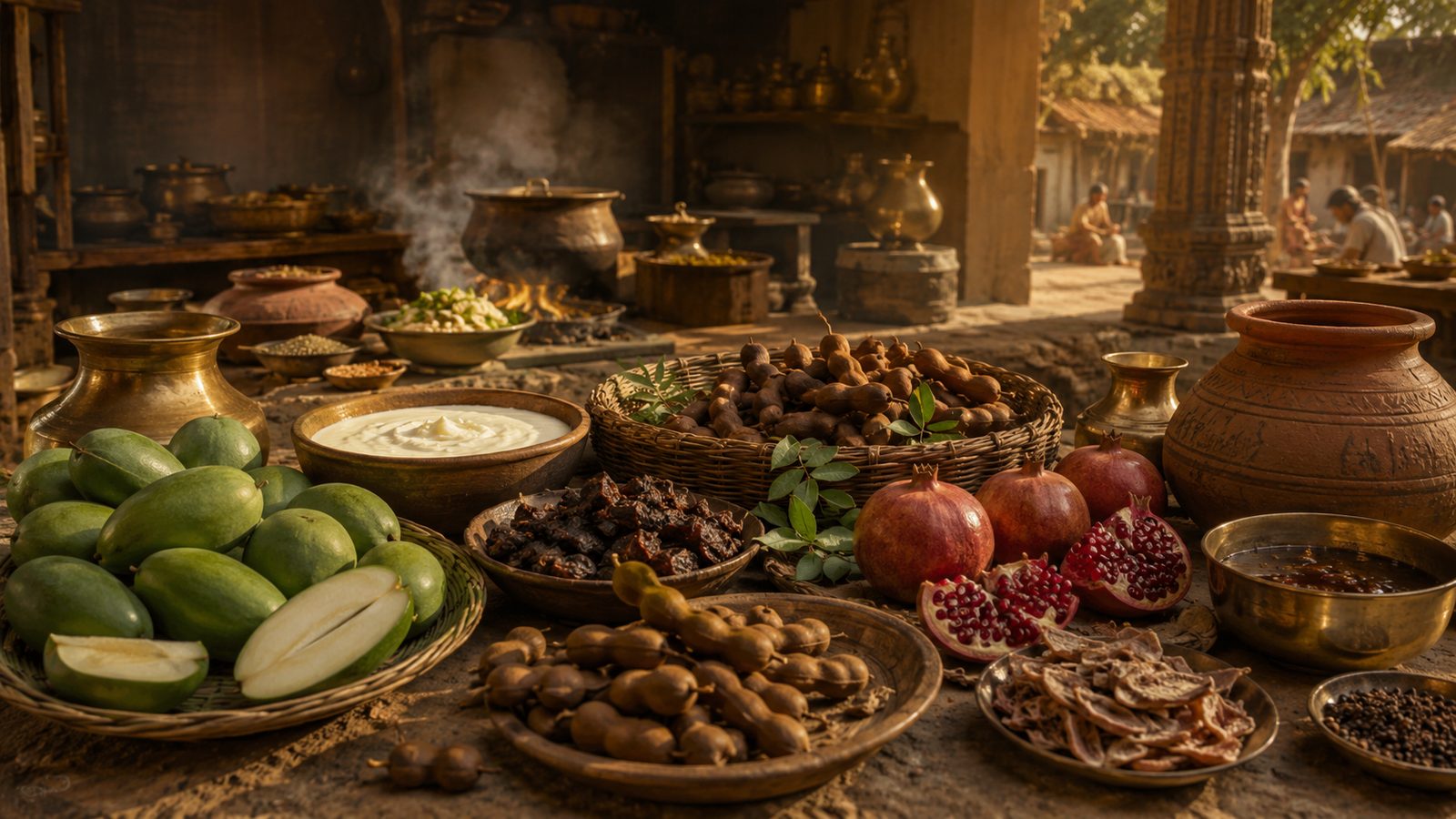
Before the tomato, Indian cooking had already built one of the world's most sophisticated souring systems. Tamarind, kokum, amchur, pomegranate, yoghurt — five entirely different acids, five entirely different flavour profiles, each dominant in a different region. The tomato did not fill a gap. It simplified a complexity that had taken three thousand years to develop.
The World Before Tomatoes
Today tomatoes are among the world's most widely consumed foods — present in cuisines from Mexico to India to Italy. Yet for most of human history they existed only in Central and South America. The civilisations of India, Persia, Arabia, China, Greece, and Rome all developed their culinary systems entirely without them.
Entire traditions of sauce-making, souring, and flavour-building evolved without a single tomato. When tomatoes arrived in India via the Portuguese in the sixteenth century, they entered a culinary system that had already developed sophisticated, regionally specific answers to every problem the tomato would eventually solve.
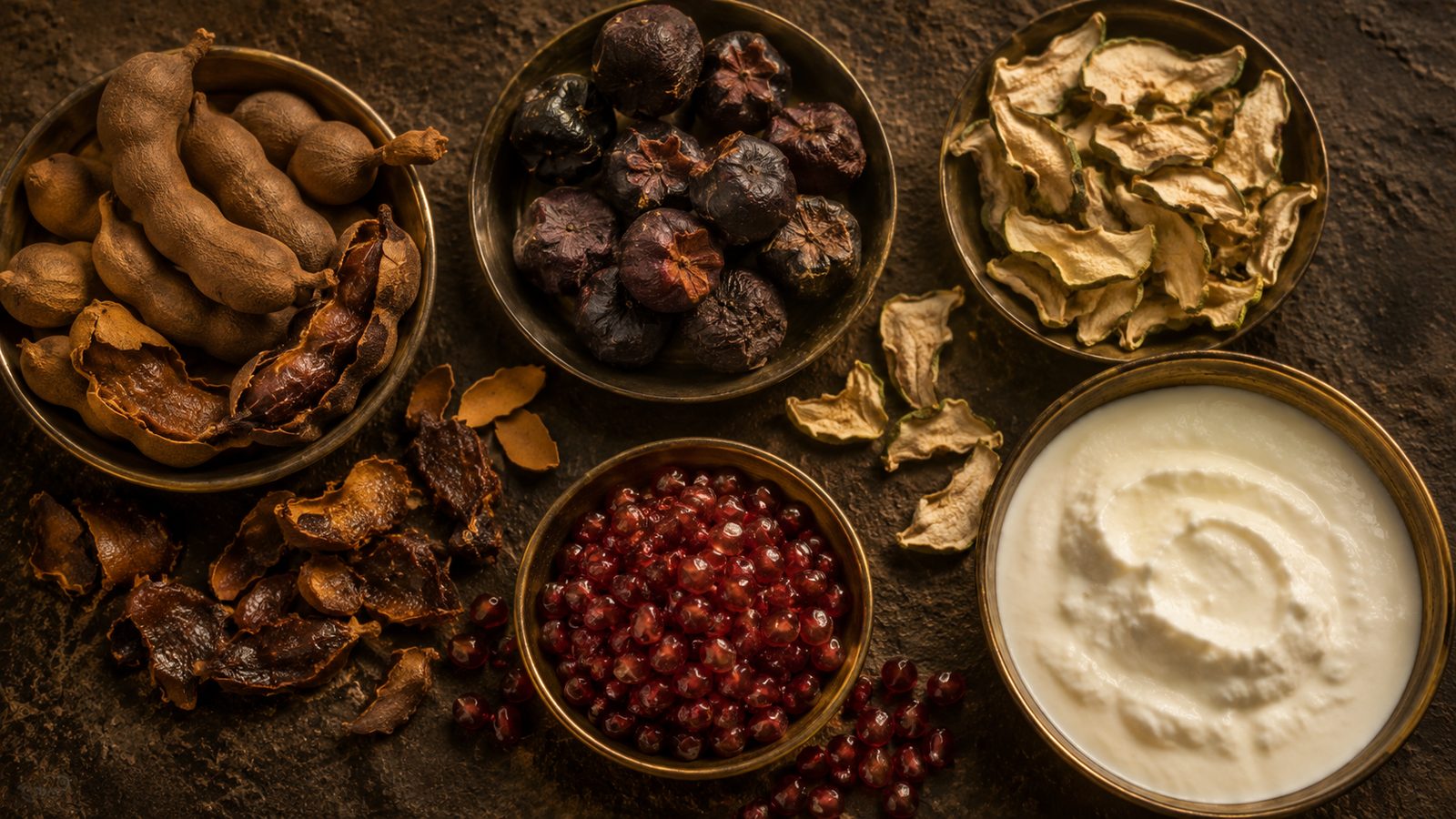
The ancient Indian souring agents: tamarind, kokum, amchur, anardana, raw mango. Five entirely different acids, five different flavour profiles — a system far more complex than the tomato that eventually displaced most of them.
Why Indian Food Needed Sourness
Before exploring what provided sourness before tomatoes, it is worth understanding why sourness matters so much in Indian cooking. Acidity performs several crucial functions simultaneously. It balances richness — a dal cooked in ghee, a korma enriched with yoghurt, a coastal curry built on coconut cream all need an acidic counterpoint to prevent them tasting heavy and flat. It enhances digestion — acids stimulate digestive secretions, which is why Ayurvedic cooking actively incorporates souring agents as therapeutic as well as flavour ingredients. It preserves food — in a hot climate before refrigeration, acid inhibits bacterial growth. And it brightens the palate — a dish with no acidity often tastes oddly muted.
Indian cooks understood all of this for thousands of years before the tomato arrived, and they had developed a toolkit of souring agents that was more complex, more regionally varied, and in many ways more interesting than the tomato that eventually replaced most of them.
Archaeological Evidence at a Glance
Vedic Period (c. 1500–500 BCE): Tamarind referenced in Sanskrit texts as a culinary and medicinal ingredient. Yoghurt documented as a souring agent in cooked preparations.
Arthashastra (c. 4th century BCE): References souring agents in the regulation of food trade. Tamarind and sour fruits documented as traded commodities.
Charaka Samhita: Extensive discussion of the six tastes (shad rasa), with sourness (amla) as one of the fundamental flavour categories. Tamarind, raw mango, and kokum all referenced.
Medieval texts: Regional cooking manuscripts document distinct souring traditions — tamarind in the south, amchur in the north, kokum on the west coast — centuries before any tomato arrived.
Timeline of Souring in Indian Cooking
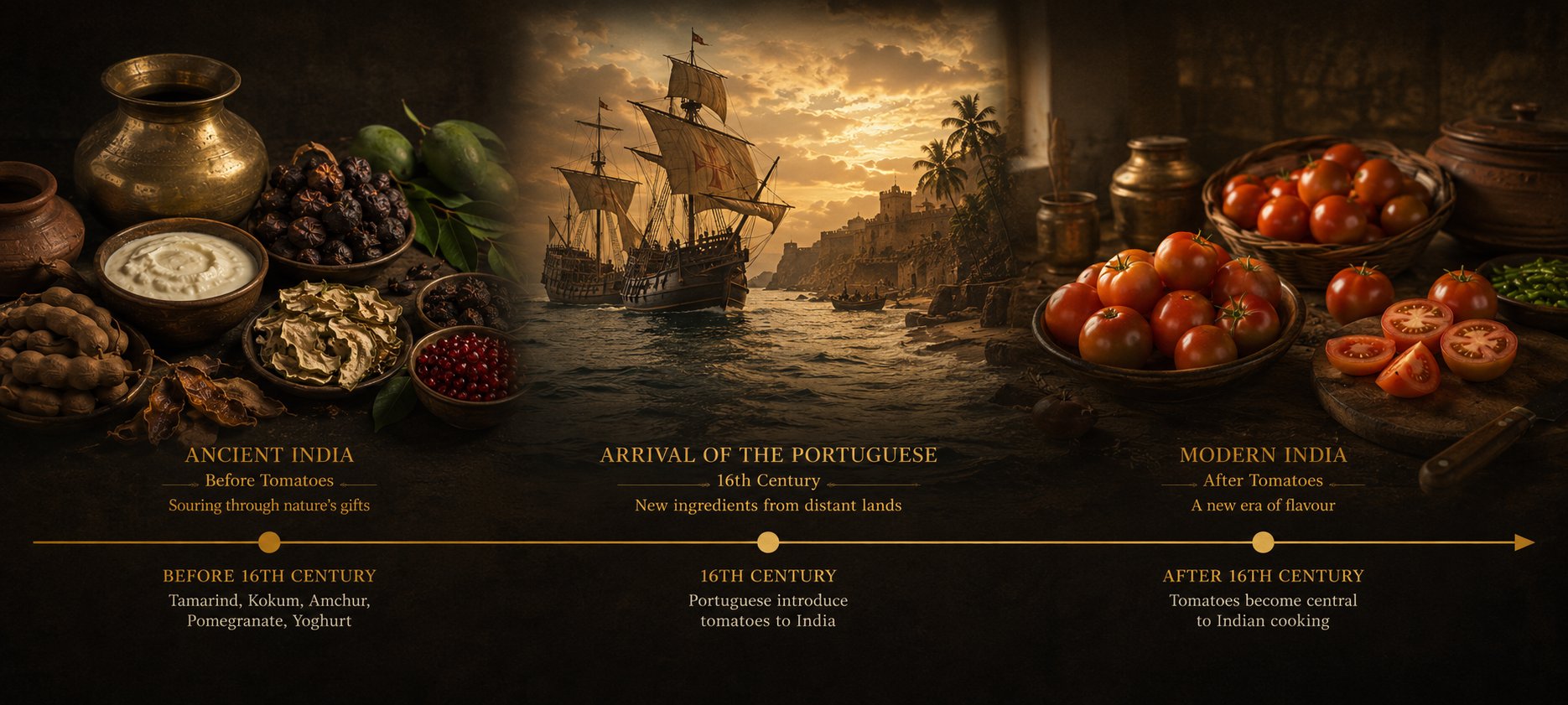
Three thousand years of Indian sourness — from the first tamarind cultivation to the tomato's slow conquest of the Indian kitchen. Click to enlarge.
| Date | Event |
|---|---|
| Ancient India | Tamarind dominant as primary souring agent in South Indian cooking. |
| Ancient India | Amchur (dried green mango powder) widespread in North Indian cooking and spice blends. |
| Ancient India | Kokum used as the primary souring agent along India's west coast — Konkan and Kerala. |
| Ancient India | Yoghurt souring used across dairy-rich regions for gravies, marinades, and sauces. |
| 1492 | Columbus reaches the Americas. Tomatoes encountered by Europeans for the first time. |
| 1500s | Portuguese introduce tomatoes to India via Goa. |
| 1700s | Tomatoes in limited Indian use; regarded with suspicion in some communities. |
| 1800s–1900s | Gradual mainstream adoption across most regions. Onion-tomato gravy base becomes standard. |
| Present | Tomato dominant in North Indian restaurant cooking. Tamarind still dominant in South India. Ancient souring agents survive in traditional and regional cooking. |
The Five Great Ancient Souring Agents
Tamarind is the most important souring agent in ancient Indian cooking and remains dominant across South India, Maharashtra, and many other regions. Its sourness is deep, fruity, and complex — it darkens a dish, adds body, and has a distinctive flavour profile that no tomato can replicate. The acidity comes from tartaric acid, which produces a different sensory experience from the citric acid of tomatoes — rounder, heavier, with more persistence on the palate. Sambar, rasam, tamarind rice, and pulihora are all built around this ancient souring agent.
Amchur — dried green mango powder — was particularly important in North Indian cooking, providing a sharp, fruity acidity that worked well in dry dishes and spice blends where tamarind's moisture would be unwelcome. It remains essential in chhole, certain dals, and street food chutneys. Kokum, a coastal fruit related to mangosteen, provided the souring agent along India's western coastline — from Goa through the Konkan to Kerala — giving dishes a distinctive colour and a mild, cooling acidity quite different from tamarind's depth. Dried pomegranate seeds (anardana) were particularly important in Punjab and Kashmir, providing a tart, slightly sweet acidity in dishes now often made with tomatoes. And yoghurt — the most versatile souring agent of all — provided mild dairy acidity in gravies, marinades, and sauces across the entire subcontinent.
"Different acids genuinely taste different. Tamarind's tartaric acid is heavy and persistent. Tomato's citric acid is bright and clean. The substitution is not neutral — it is a flavour decision masquerading as a practical one."
The Science of Sourness — Why Different Acids Taste Different
Tartaric acid (tamarind): Heavy, persistent, rounds on the back of the palate. Interacts with spices to create depth and complexity.
Citric acid (tomato, kokum): Bright, clean, immediate. Lightens a dish and creates freshness. The most familiar sourness in modern cooking.
Lactic acid (yoghurt): Mild, rounded, dairy. Creates creaminess alongside sourness. Particularly effective in marinades where it also tenderises protein.
Malic acid (amchur, raw mango): Sharp, fruity, fades quickly. Works best in dry preparations where moisture is unwanted.
Hydroxycitric acid (kokum): Mild, slightly sweet, with a distinctive fruity note. Creates a cooling effect on the palate unique in Indian souring.
Before vs After: What Actually Changed
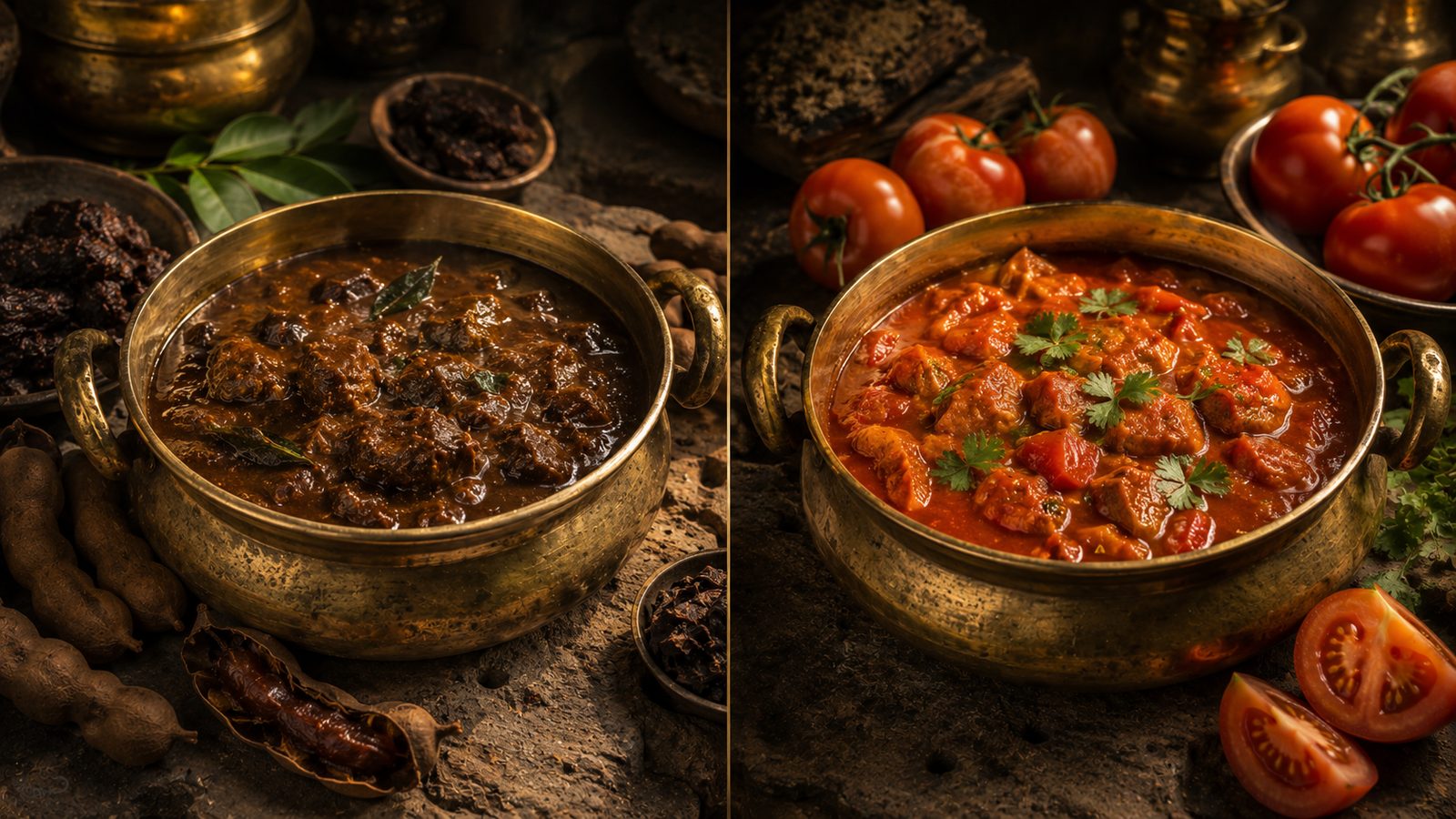
Before and after: a tamarind-based curry (left) and a tomato-based curry (right). Different acids, different colours, different flavour profiles — not a simple substitution.
Why Tomatoes Won
Why Tomatoes Replaced the Ancient Souring System
Dual function. Tomatoes provide both acidity and body in a single ingredient — tamarind provides acidity but requires processing; coconut provides body but not acidity. No ancient souring agent did both.
Natural colour. Tomatoes create a naturally attractive red-orange colour that signals freshness and richness to a diner. Tamarind darkens a dish; amchur adds no colour at all.
Umami content. Tomatoes contain glutamates — the same compounds responsible for umami — which add depth to a sauce in ways that pure souring agents cannot. This is the least-discussed but arguably most important advantage.
Year-round availability. Fresh tomatoes are available throughout the year across India's varied growing regions. Amchur is seasonal; kokum is coastal; anardana is regional.
Restaurant efficiency. A diced tomato takes seconds to add to a pan. Processing tamarind — soaking, squeezing, straining — takes minutes. In a restaurant kitchen, seconds matter.
Regional Impact
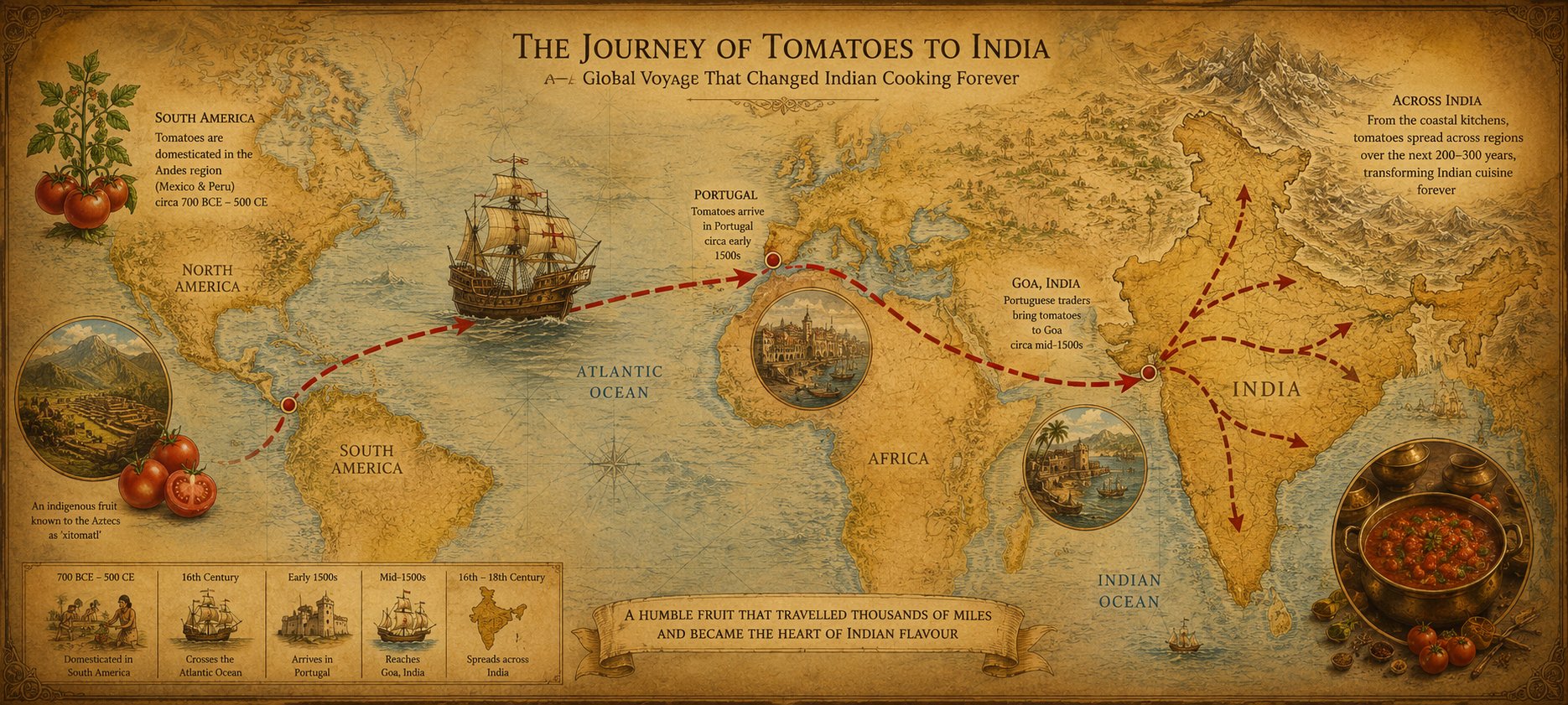
The tomato's journey: from the Americas to Portugal to Goa — and the uneven pattern of adoption that left South India largely tamarind-faithful while the north became tomato-dominant. Click to enlarge.
Debate & Myths
Was the Tomato Initially Rejected as Poisonous?
There is evidence that tomatoes were regarded with suspicion in some Indian communities for an extended period after their introduction. This is not surprising — the tomato belongs to the Solanaceae family, which includes several toxic plants, and in European contexts tomatoes were also initially treated with caution.
In India, Ayurvedic classification of new ingredients was important to their acceptance. Tomatoes did not fit easily into existing Ayurvedic food categories, and their acidic, heating nature made them potentially problematic in some dietary frameworks. The slow adoption — arriving in the sixteenth century but not reaching mainstream cooking until the eighteenth and nineteenth — likely reflects this cultural hesitation rather than simple ignorance of the ingredient.
Is Tamarind Really Better Than Tomato?
This is a question that deserves an honest answer: for some applications, yes. For others, no. Tamarind produces a depth and complexity in slow-cooked preparations that tomatoes cannot replicate — the specific tartaric acid profile interacts with spices differently, creating layers of flavour that develop over time. South Indian cooks who make sambar with tamarind produce a different — not simply older — dish than those who use tomatoes.
But the tomato's umami content, its dual souring-and-body function, and its year-round freshness make it genuinely superior for other applications — particularly in quickly cooked preparations where tamarind's characteristic depth never has time to develop. The more accurate statement is: they are different acids, suited to different applications, and the replacement of one with the other is always a flavour decision whether or not the cook recognises it as such.
What If Tomatoes Never Came to India?
Without the tomato, the extraordinary regional diversity of Indian souring traditions would have continued developing rather than partially converging. The tamarind coast of the south, the amchur north, the kokum west — these distinct regional flavour identities would be sharper and more differentiated than they are today.
Restaurant Indian food, particularly the North Indian curry house tradition that spread globally, would look entirely different. The onion-tomato-chilli base that defines it globally could not exist. Gravies would be built on tamarind or amchur or yoghurt — more complex, more varied, more regionally specific, and harder to standardise for mass production. Whether that would have been better or worse is a matter of preference. It would certainly have been more diverse.
What Survived
The Pre-Tomato Souring Agents That Remain
Modern Legacy
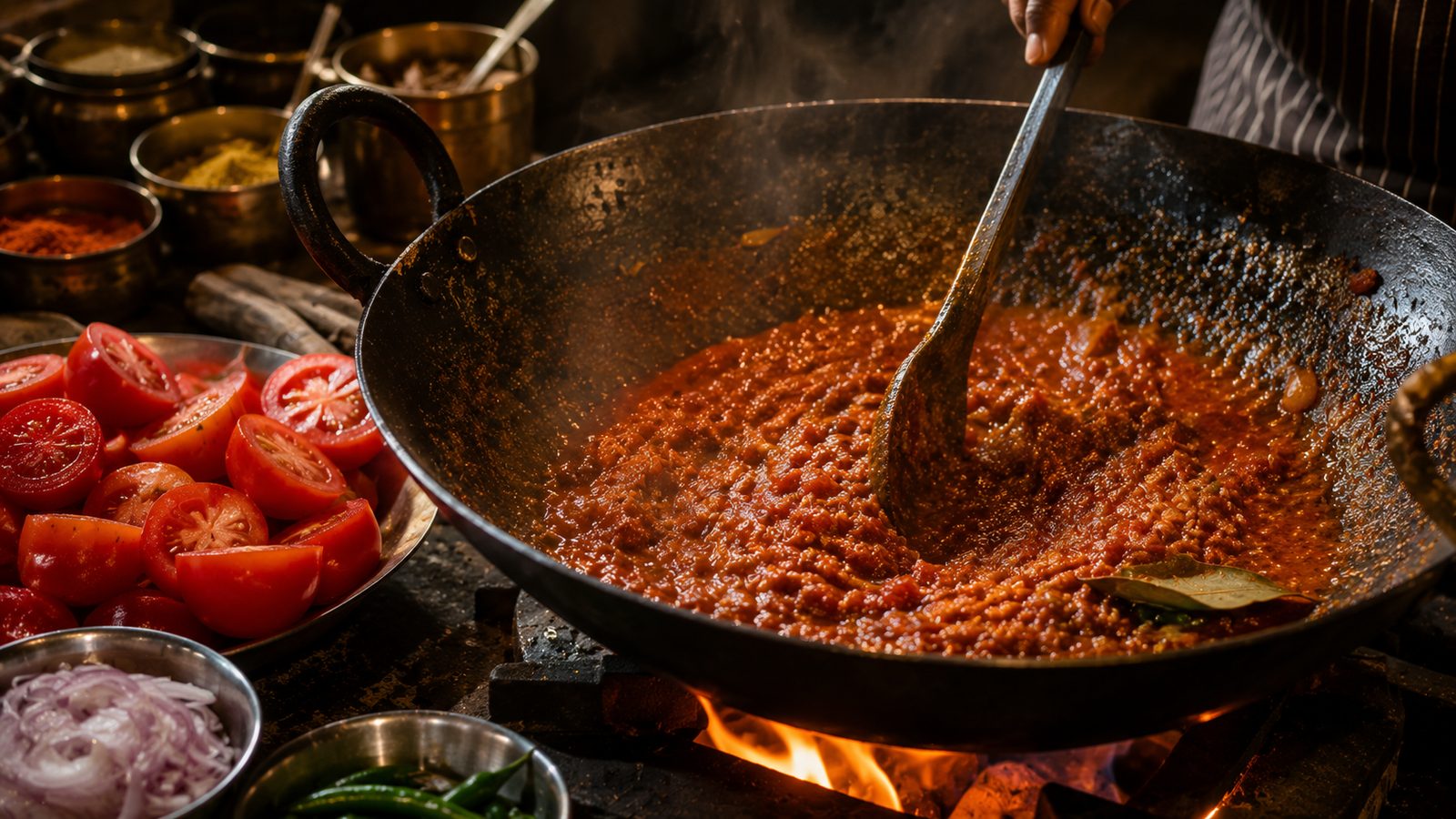
The onion-tomato-chilli base — the foundation of modern North Indian restaurant cooking — could not exist without a New World fruit that arrived less than five centuries ago.
The tomato today is so central to North Indian restaurant cooking that the cuisine would be unrecognisable without it. The rich, red gravies of butter chicken, palak paneer, and rogan josh all depend on a souring agent that arrived after the Mughal Empire was already in decline. The ingredient and the empire it is associated with never actually coexisted in the way popular imagination assumes.
Yet the pre-tomato souring tradition survives more completely than almost any other pre-Columbian Indian food tradition. South India eats tamarind. The Konkan coast eats kokum. North Indian street food uses amchur. These are not preserved specimens of an extinct tradition — they are living, daily practices that have refused to be displaced, carrying the complexity of three thousand years of Indian sourness into the modern kitchen.
Food History Scorecard
| Impact Area | Change | Still Visible? |
|---|---|---|
| North Indian Cooking | Extreme | Onion-tomato base is now standard; ancient souring agents marginalised in restaurant context |
| South Indian Cooking | Moderate | Tamarind remains dominant; tomato used alongside but has not displaced the ancient tradition |
| Konkan/Kerala Coast | Low | Kokum tradition survives strongly; tomato has made limited inroads in traditional coastal cooking |
| Street Food | High | Tomato chutney widespread; though tamarind chutney also survives in chaat |
| Restaurant Cuisine Globally | Extreme | The global image of Indian food is inseparable from tomato-based gravies |
| Regional Diversity | High | Tomato has partially standardised flavour profiles that were once more regionally varied |
Confidence Scale
| Claim | Confidence | Basis |
|---|---|---|
| Tomatoes originated in the Americas | Very High | Botanical and genetic evidence conclusive. |
| Tamarind, amchur, and kokum predate the tomato in Indian cooking | Very High | Extensively documented in Sanskrit texts, Ayurvedic literature, and medieval culinary records. |
| Tomatoes arrived via Portuguese trade | High | Consistent with Portuguese Goa presence and timing of other Columbian Exchange introductions. |
| Widespread tomato adoption was delayed until 18th–19th century | High | Supported by absence from pre-18th century culinary manuscripts and travellers' accounts. |
| Different acids taste genuinely different on the palate | Very High | Well-established food chemistry. Tartaric, citric, lactic, and malic acids are chemically distinct with different sensory profiles. |
Further Reading
- K.T. Achaya — Indian Food: A Historical Companion
- Colleen Taylor Sen — Feasts and Fasts
- Alfred Crosby — The Columbian Exchange
- Charaka Samhita (Ayurvedic text — references to souring agents)
- Lizzie Collingham — Curry: A Tale of Cooks and Conquerors