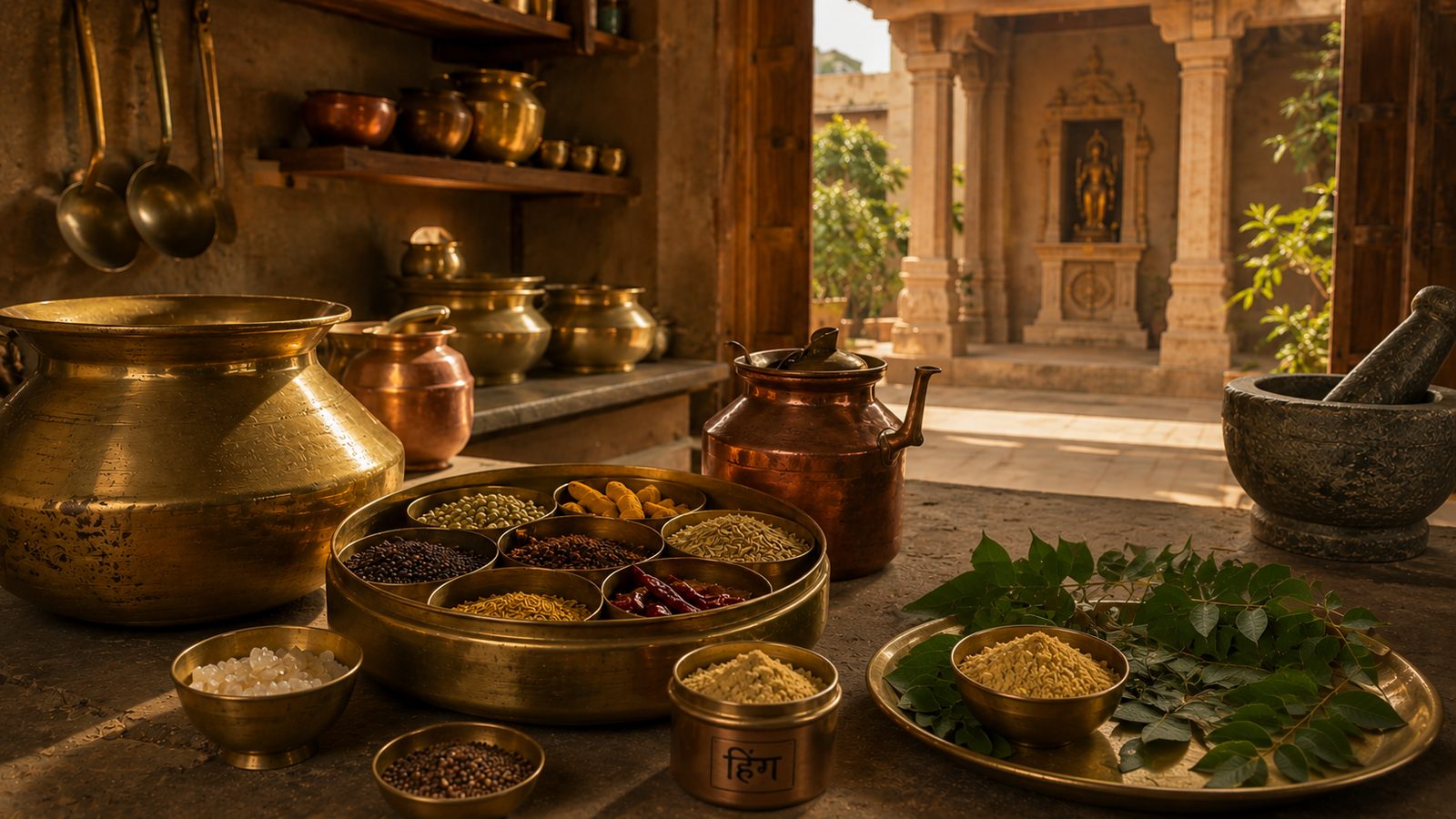
This chapter is different. Onions are not a foreign introduction — they have been in India for at least four thousand years. What makes Indian food history remarkable is that entire culinary traditions deliberately chose not to use them. Not because they couldn't. Because they decided not to. And the food they built without onions is extraordinary.
Onions Were Ancient in India
This is the first point to establish clearly: onions are not a colonial introduction. Archaeological evidence suggests onion cultivation in India from at least 2500 BCE, and onions appear in ancient Sanskrit texts, in Ayurvedic literature, and in the historical record across multiple periods. The Arthashastra references onions. Classical Sanskrit literature describes them. Ancient Indian cooks had access to onions for thousands of years.
The deliberate traditions of onion avoidance in Indian cooking are therefore not a response to absence. They are a philosophical choice — a reasoned decision, made by multiple communities across different periods, to exclude an ingredient they knew perfectly well and could easily have used. Understanding why they made this choice is the key to understanding one of Indian cooking's most distinctive and sophisticated traditions.
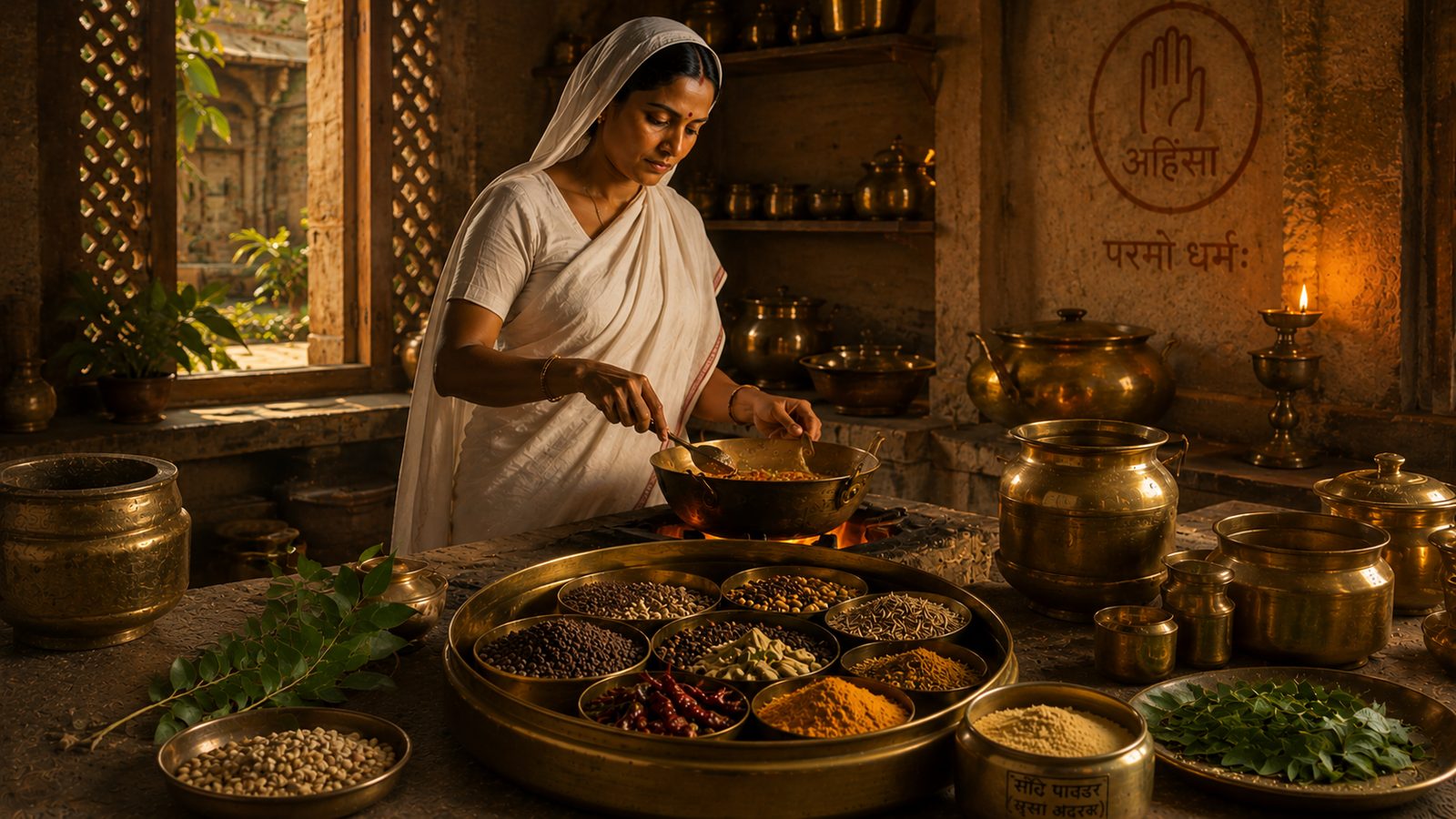
A Jain kitchen: no onions, no garlic, no root vegetables — and yet some of India's most sophisticated cooking. The absence is deliberate, the flavour is extraordinary.
What the Archaeology Tells Us
Archaeological Evidence at a Glance
Indus Valley (c. 2500 BCE): Archaeological evidence at Indus Valley sites indicates onion cultivation, making it one of the earliest documented crops in the subcontinent.
Vedic Period: Onions classified in early Ayurvedic and philosophical texts. The discussion of rajasic properties begins in this period.
c. 600 BCE: Jain dietary traditions develop under Mahavira. Root vegetable avoidance, including onions, codified as part of ahimsa practice.
Medieval India: Temple and Vaishnav onion-free traditions firmly established. Some of India's most elaborate festival cooking develops in this context.
Mughal Period: Onion-based gravies enter court cuisine. The caramelised onion base becomes a signature of Mughal-influenced cooking — the tradition that eventually produces the modern restaurant Indian style.
Timeline
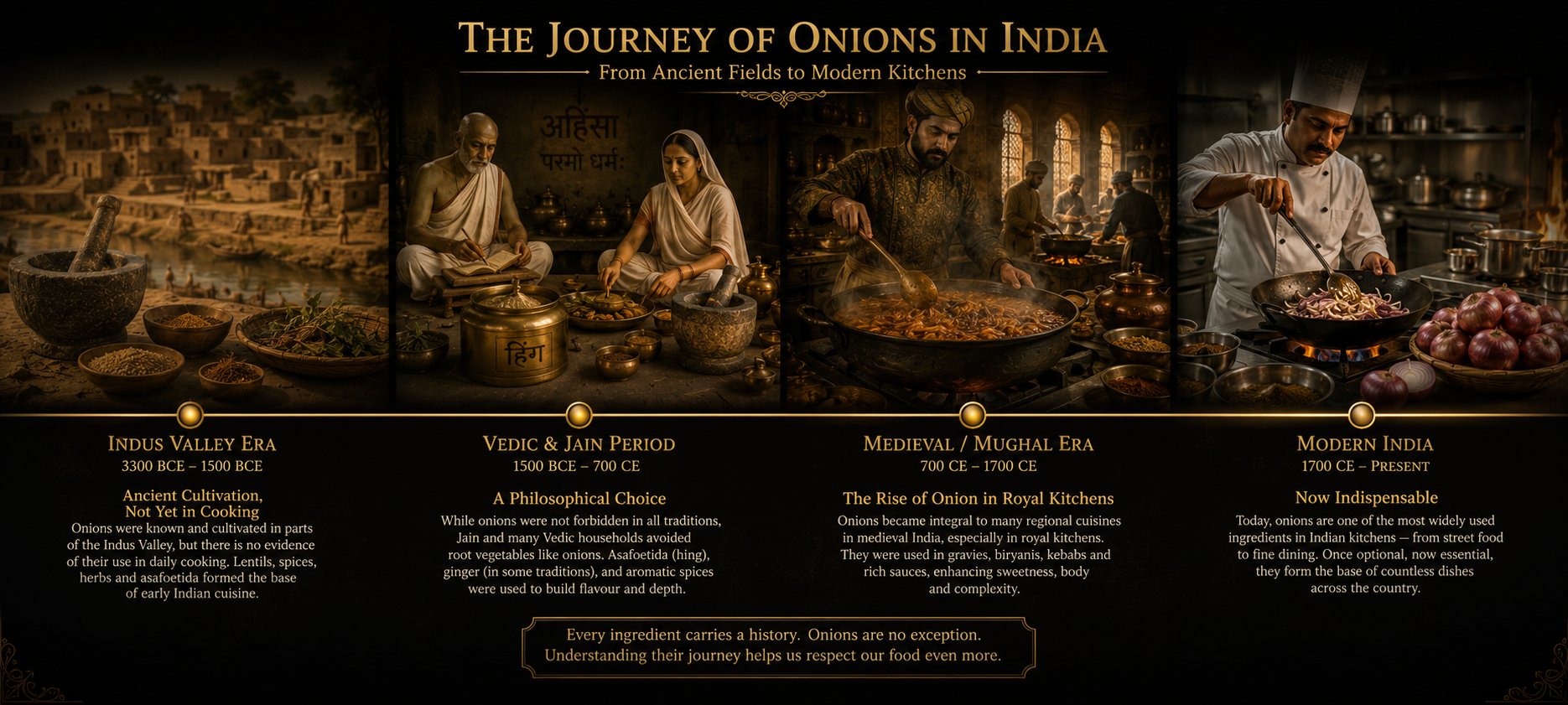
Four thousand years of onion history in India — from ancient cultivation to the philosophical split that created two parallel culinary worlds. Click to enlarge.
| Period | Development |
|---|---|
| c. 2500 BCE | Archaeological evidence of onion cultivation in the Indian subcontinent. |
| Vedic Period | Onions classified in Ayurvedic texts as rajasic; philosophical debate about their consumption begins. |
| c. 600 BCE | Jain dietary traditions develop under Mahavira; root vegetable avoidance including onions codified. |
| Medieval India | Temple and Vaishnav onion-free traditions firmly established across multiple regions. |
| Mughal Period | Onion-based gravies enter court cuisine; the caramelised onion base becomes a Mughal signature. |
| British Colonial Period | Restaurant tradition develops; onion-based cooking becomes the dominant public-facing style. |
| Modern India | Both onion-using and onion-free traditions coexist. Restaurant cooking is onion-dominant; Jain, temple, and sattvic traditions remain onion-free. |
The Philosophy Behind Avoiding Onions
In ancient India, food was never merely nutrition. It was a philosophical category. The Ayurvedic and yogic traditions classified every food according to its effect on the mind and body through the system of three gunas: sattva (purity, clarity, lightness), rajas (activity, stimulation, passion), and tamas (inertia, heaviness, dullness). Onions were classified as rajasic — heating, stimulating, and likely to disturb meditation, mental clarity, and spiritual practice. For communities whose daily life centred on religious discipline and contemplative practice, this was a meaningful and functional distinction, not an arbitrary rule.
The Jain position went further. Jain dietary philosophy avoids all root vegetables on the grounds that harvesting a root destroys the entire plant, potentially harms microorganisms in the soil, and represents an unnecessary taking of life. This is ahimsa applied with complete logical consistency — and it produced the most rigorous onion-free culinary tradition in the world.
"The onion-free tradition is not a lesser tradition. It is a different one — built on the conviction that great food requires not more ingredients but more skill. Two and a half thousand years of Jain cooking have proved the point completely."
Hing: The Great Replacement
Asafoetida — hing in Hindi, perungayam in Tamil — is the dried resin of Ferula plants native to Afghanistan and Iran, and it is the most important ingredient in the onion-free Indian culinary tradition. It contains the same organosulfur compounds responsible for the characteristic savouriness of onions and garlic, which is why a pinch dropped into hot oil produces an immediate, penetrating aroma that transforms any dish it enters.
The smell raw is notoriously pungent — sulphurous, almost overwhelming — but it mellows dramatically in hot fat, becoming the savoury, deeply aromatic base note that Jain and temple cooking depend on. Hing is not a mild substitute. It is an intensely potent flavouring agent that requires skill to use well — too much produces bitterness, too little disappears. Jain and temple cooks developed this skill over centuries because they had to, and the result demonstrates something important: extraordinary depth of flavour is achievable without onion, provided the cook understands alternative flavour-building tools.
The Science of Onion Flavour — Why It's So Hard to Replace
Onions derive their characteristic flavour from sulfur-containing compounds — particularly allicin and related molecules — that are released when the cell walls are broken. These compounds caramelise under heat, producing the sweet, deep, complex flavour that forms the base of most Indian restaurant gravies.
The Maillard reaction between onion sugars and proteins during browning creates hundreds of additional flavour compounds — this is why a properly caramelised onion base produces such extraordinary depth, and why replacing it requires a genuinely different approach rather than a simple substitution.
Hing works because it also contains organosulfur compounds — the same chemical family responsible for onion and garlic flavour. When dropped into hot oil, these compounds volatilise rapidly, creating an immediate savoury impact that the long caramelisation process achieves differently. The result is not the same but it is equally valid — a different flavour architecture producing equivalent savoury complexity.
Building Flavour Without Onions
| What Onion Provides | Traditional Onion-Free Alternative |
|---|---|
| Savoury depth | Hing in hot ghee or oil |
| Natural sweetness | Slow-cooked dairy; coconut; carefully managed spice sweetness |
| Body in gravy | Ground lentils; yoghurt; nut pastes; gram flour |
| Aromatic depth | Ginger; black pepper; long pepper; careful tadka management |
| Caramelised colour | Turmeric; dried red chilli; tomato where permitted |
The Great Onion-Free Traditions
Jain cuisine is the most rigorous onion-free tradition, avoiding not only onions but all root vegetables. It has produced some of India's most sophisticated cooking, particularly in Gujarat and Rajasthan, where Jain merchant communities developed elaborate festival foods, snacks, and sweets now enjoyed far beyond the Jain community. Temple cuisine across South India, Rajasthan, and Gujarat feeds thousands of devotees daily without onions or garlic — Tirupati temple's laddoos, Jagannath temple's mahaprasad, and the elaborate prasadam of South Indian Vaishnav temples are all onion-free. Sattvic cooking in yoga ashrams and traditional Brahmin households across the subcontinent maintains the rajasic classification of onions and cooks entirely without them.
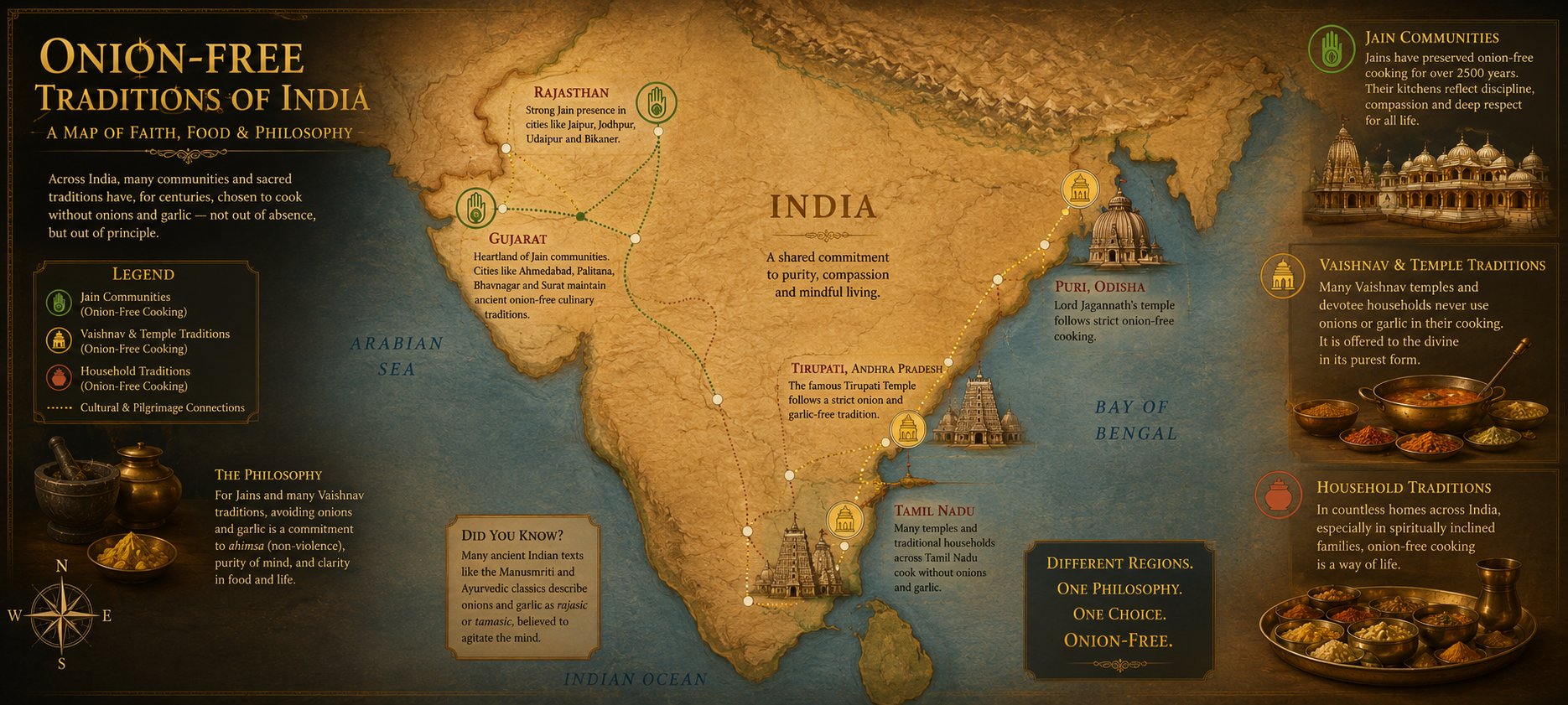
The geography of India's onion-free culinary traditions — Jain communities, temple kitchens, Vaishnav households — spread across the subcontinent. Click to enlarge.
Debate & Myths
Is Onion Avoidance Purely Religious or Also Health-Based?
Both. The rajasic classification of onions in Ayurvedic philosophy is not simply spiritual superstition — it reflects observed physiological effects. Onions contain compounds that have genuine stimulant and heating properties, and communities practising contemplative disciplines observed that their diet affected their mental states. Modern nutritional science confirms that allicin and related compounds have real physiological activity.
The Jain position — rooted in ahimsa rather than health — is philosophically distinct. Jain avoidance of root vegetables is not about what onions do to the body but about what harvesting them does to the plant and the soil microorganisms around it. These are different rationales leading to the same practice, which explains why they developed independently across communities with very different philosophical starting points.
Is Onion-Free Indian Food Actually Inferior?
This is a question worth asking directly — and the answer is no. The Jain and temple cooking traditions have produced food of extraordinary complexity and sophistication over two and a half thousand years. The assumption that onion is necessary for good Indian cooking reflects the dominance of restaurant cuisine, which adopted the onion-based Mughal gravy style because it is efficient to produce at scale. Efficiency and quality are not the same thing.
A skilled Jain cook using hing, ginger, slow dairy, and the full spice vocabulary of the ancient tradition produces food that is different from — not inferior to — food built on a caramelised onion base. The difference lies in the flavour architecture: quick, intense, and direct in the onion-based style; slower, more layered, and more dependent on spice management in the onion-free style.
What If Onions Had Always Been Avoided?
If the Jain and temple traditions had become dominant rather than the Mughal-influenced restaurant style, Indian food globally would look very different. The thick, onion-based gravies that define Indian cuisine for most of the world — butter chicken, rogan josh, saag paneer — could not exist in their current form. Indian cuisine would be more spice-forward, more regionally varied, and less accessible to mass production.
It would also be more dependent on skill. Hing-based cooking requires more precise technique than onion-based cooking — the margin for error is smaller, the window in which hing must be used in hot fat is seconds wide. The democratisation of Indian cooking through the restaurant tradition depended partly on the onion's forgiveness as an ingredient. An Indian cuisine without onions would have remained more firmly in the hands of specialist cooks.
What Survived
The Onion-Free Ingredients and Traditions That Remain
Modern Legacy
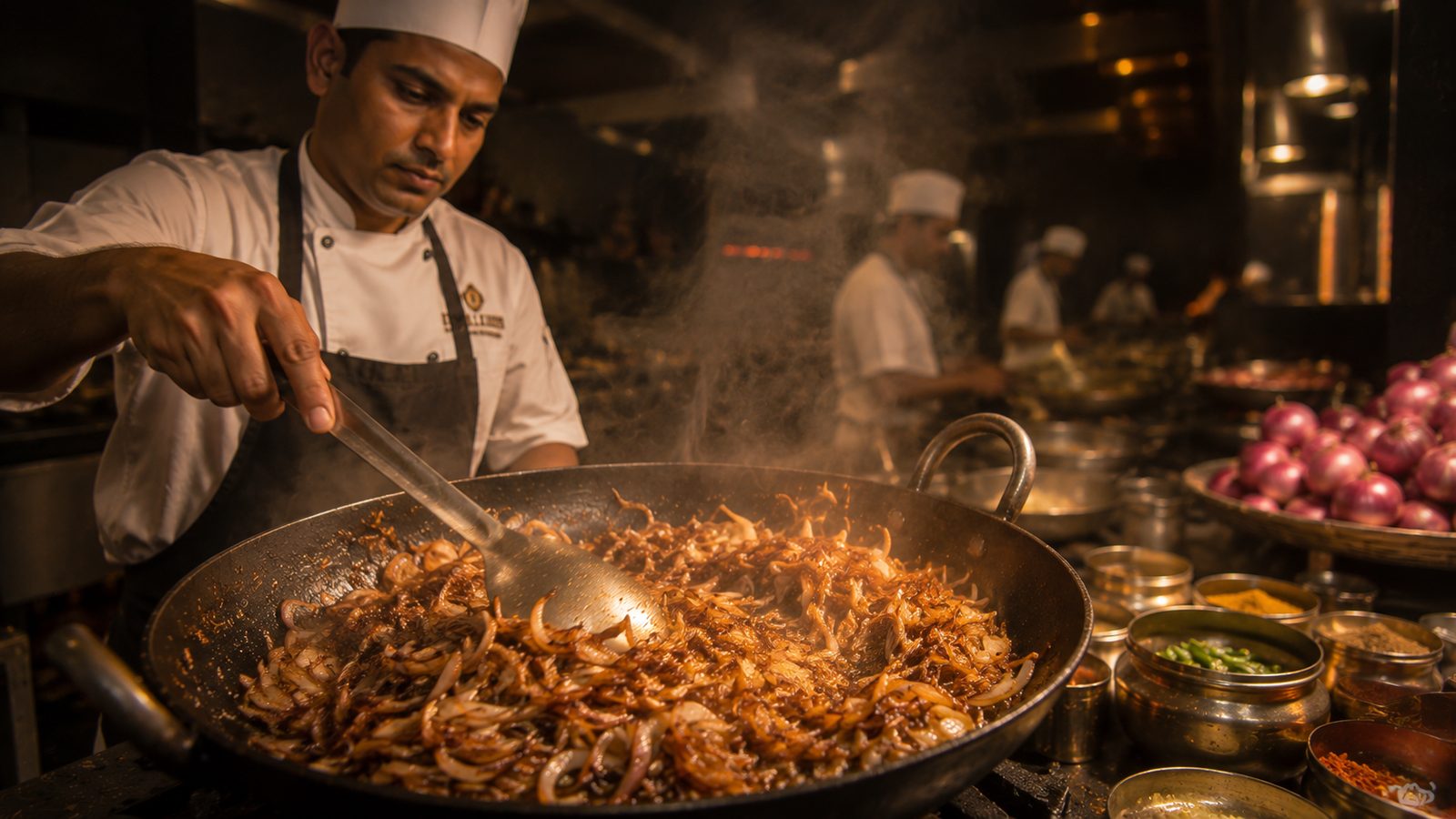
The caramelised onion base — the foundation of modern restaurant Indian cooking — is now so universal that its relatively recent dominance is almost invisible.
Onions today are so fundamental to restaurant Indian cooking that they function as invisible infrastructure — assumed, unnoticed, present in every dish. The Mughal-influenced caramelised onion base that became the restaurant standard created a style of cooking so efficient and so consistently satisfying that it spread globally as the face of Indian cuisine.
Yet the tradition that predates it — the hing-based, spice-forward, philosophically considered cooking of Jain, temple, and sattvic traditions — survives completely and continues to produce extraordinary food. It is a living reminder that Indian culinary genius does not depend on any single ingredient, and that the most sophisticated approaches to flavour sometimes arrive at their results through deliberate restraint rather than addition.
Food History Scorecard
| Impact Area | Change | Still Visible? |
|---|---|---|
| Restaurant Cuisine | Extreme | Onion-based gravy is now the global standard for Indian food |
| Temple Cooking | None | Completely unchanged — onion-free tradition continues unbroken |
| Jain Cuisine | None | Onion-free tradition maintained for 2,500 years; still practiced |
| Home Cooking | High | Onion dominant in most homes; onion-free households a significant minority |
| Global Perception | Extreme | Onion-based cooking is what the world thinks of as Indian food |
| Agricultural Significance | Extreme | India is among the world's largest onion producers; the crop is economically critical |
Confidence Scale
| Claim | Confidence | Basis |
|---|---|---|
| Onions have been cultivated in India since at least 2500 BCE | High | Archaeological evidence at Indus Valley sites. Some dating continues to be refined. |
| Jain avoidance of root vegetables is 2,500 years old | Very High | Well-documented in Jain canonical literature from the time of Mahavira. |
| Hing provides equivalent flavour to onion through organosulfur compounds | Very High | Well-established food chemistry; both contain sulfur compounds of the same molecular family. |
| Mughal court cuisine made the caramelised onion base dominant | High | Documented in Mughal culinary records and the Ain-i-Akbari. |
| Temple cooking traditions are continuously unbroken | High | Living traditions with documented continuity in major temple kitchens across India. |
Further Reading
- K.T. Achaya — Indian Food: A Historical Companion
- Colleen Taylor Sen — Feasts and Fasts
- Padmanabh Jaini — The Jaina Path of Purification
- Charaka Samhita (Ayurvedic text — food classifications)
- K.M. Munshi — The Glory That Was Gurjara-Desa