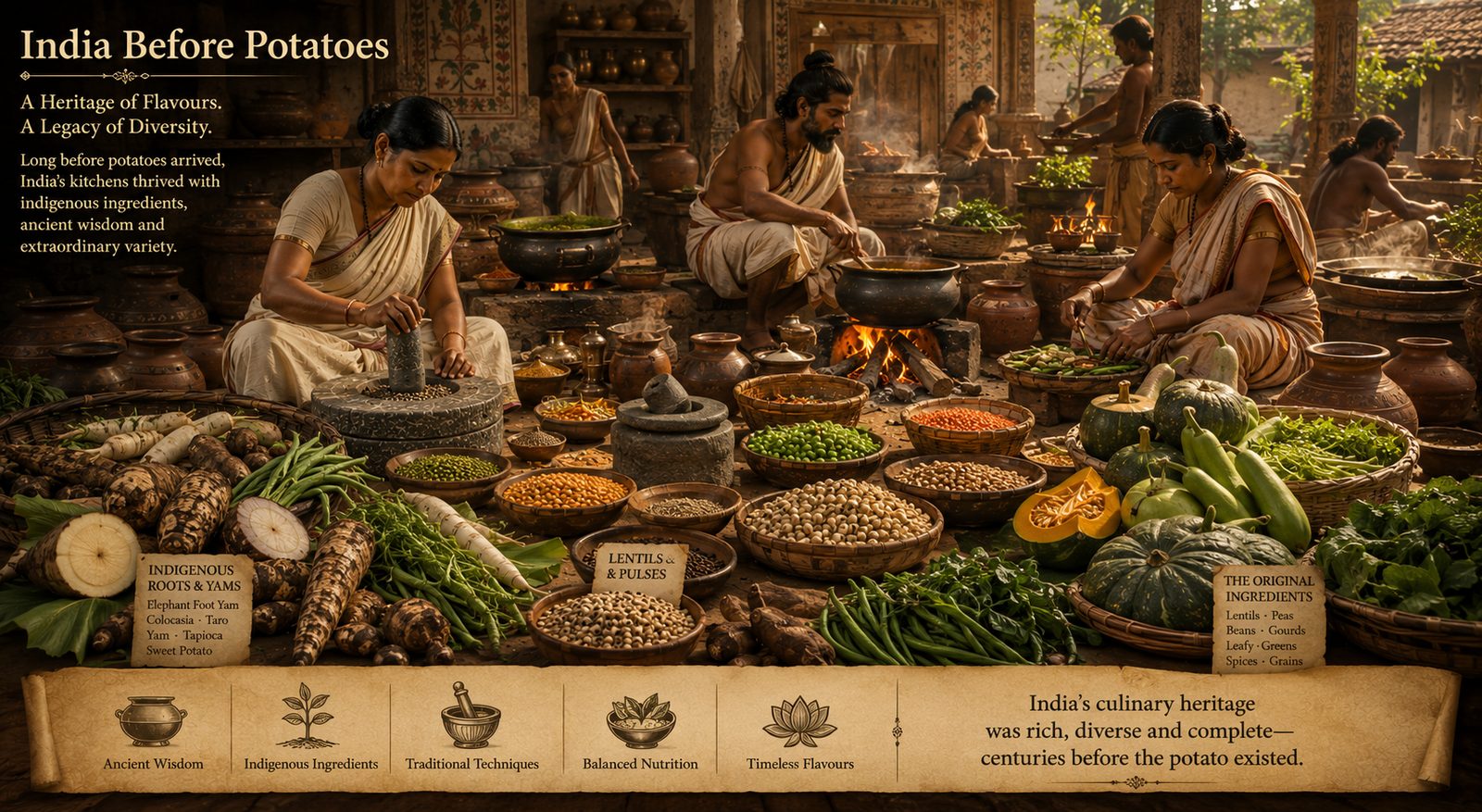
The samosa had a different filling. The curry had different bulk. The street food of Indian cities looked nothing like it does today. Potatoes are so embedded in modern Indian cooking that removing them feels like dismantling the cuisine — yet for the vast majority of Indian culinary history, the potato did not exist on the subcontinent at all.
The World Before Potatoes
Today potatoes are among the world's most important food crops — the fourth largest by production volume, after wheat, rice, and maize. Yet for most of human history they existed only in the Andes Mountains of South America, where Andean civilisations domesticated them approximately eight thousand years ago. The civilisations of India, China, Persia, Egypt, Greece, Rome, and the Islamic world all developed their cuisines without them.
When the potato arrived in India, it entered a culinary system that had already evolved over thousands of years and had thoroughly solved the problem of bulk, starch, and satisfying vegetable substance without any help from the Andes. The potato did not fill a gap. It displaced a tradition.
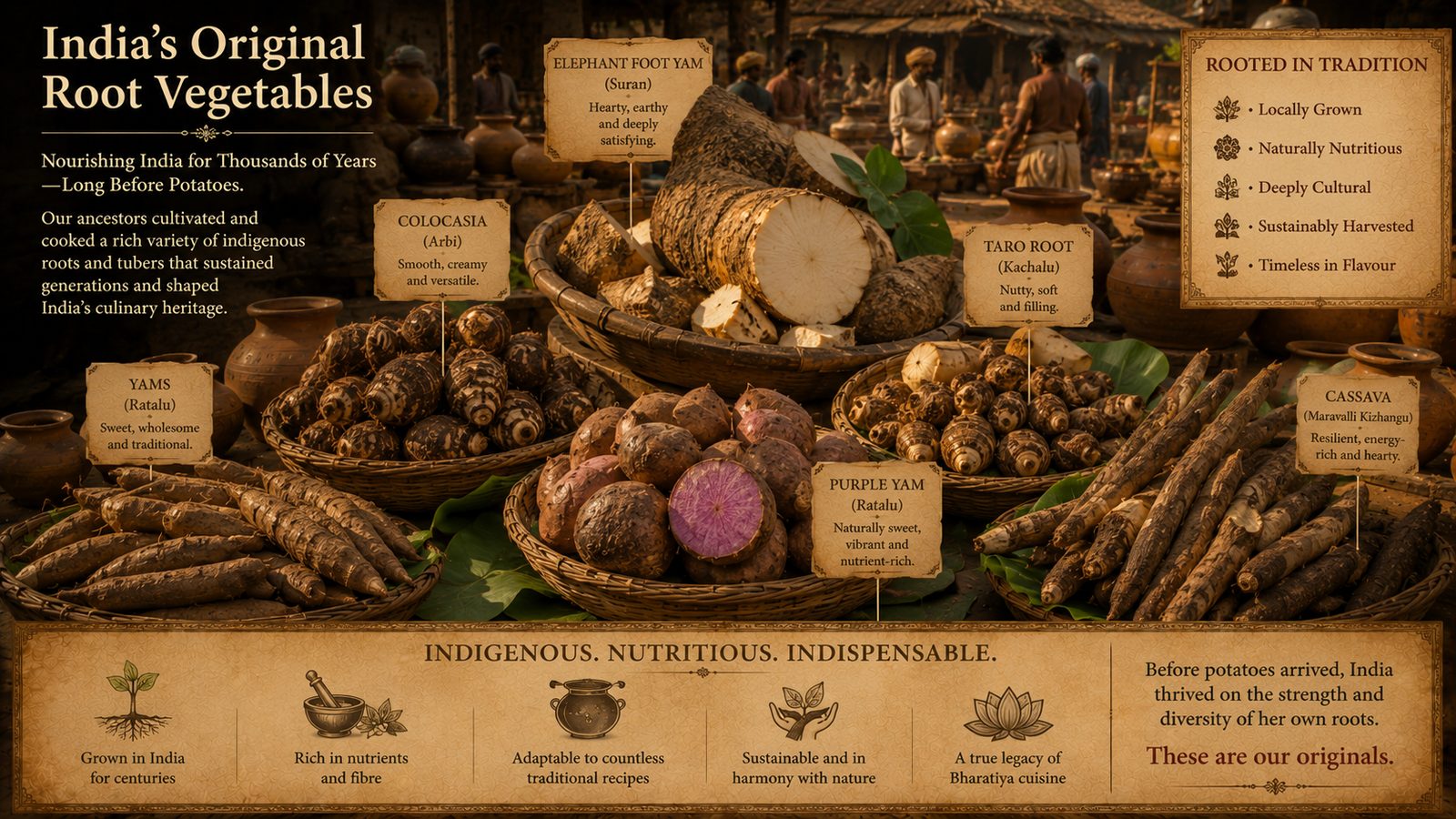
The ancient Indian starchy vegetable basket: raw banana, yam, arbi, lotus root, jackfruit. For thousands of years, these were the bulk vegetables of Indian cooking — before the Andes arrived.
What the Archaeology Tells Us
The absence of potatoes from ancient Indian texts and archaeological records is itself significant evidence. The Arthashastra, compiled in the fourth century BCE, lists vegetables cultivated and traded in India — raw banana, yam, lotus root, and colocasia appear; the potato does not. The Charaka Samhita's extensive listings of food plants reference none of the Andean crops. Sanskrit culinary literature from the medieval period documents the vegetable traditions of royal kitchens without a single mention of the potato.
Archaeological Evidence at a Glance
Indus Valley (c. 3000–1500 BCE): Botanical remains at sites including Harappa and Mohenjo-daro include barley, wheat, lentils, sesame, and various gourds. No Andean crops of any kind.
Vedic Period (c. 1500–500 BCE): Sanskrit texts reference a wide range of vegetables including raw banana, various gourds, lotus, and leafy greens. Potato absent.
Mauryan Period (322–185 BCE): Arthashastra lists regulated agricultural products. Yam and colocasia documented as important food crops. Potato absent.
Medieval period: Extensive culinary manuscripts document court and temple food traditions across multiple regions. No potato in any source before the seventeenth century.
Timeline of the Potato in India
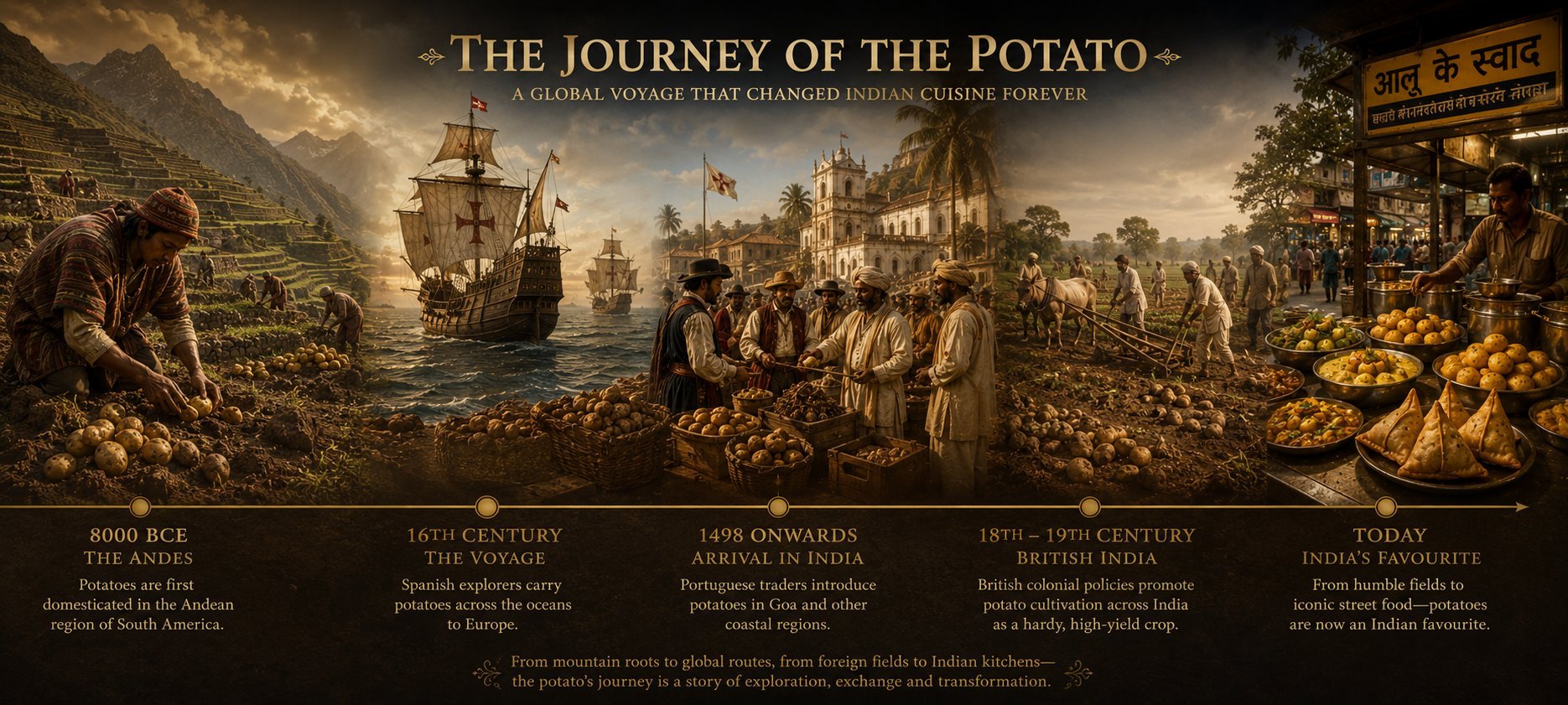
Eight thousand years in the Andes, then a four-century journey to become India's most consumed vegetable. Click to enlarge.
| Date | Event |
|---|---|
| c. 8000 BCE | Potatoes domesticated in the Andes by indigenous South American civilisations. |
| 1492 | Columbus reaches the Americas. Columbian Exchange begins. |
| 1500s | Spanish conquistadors encounter the potato in Peru; it enters the Spanish colonial system. |
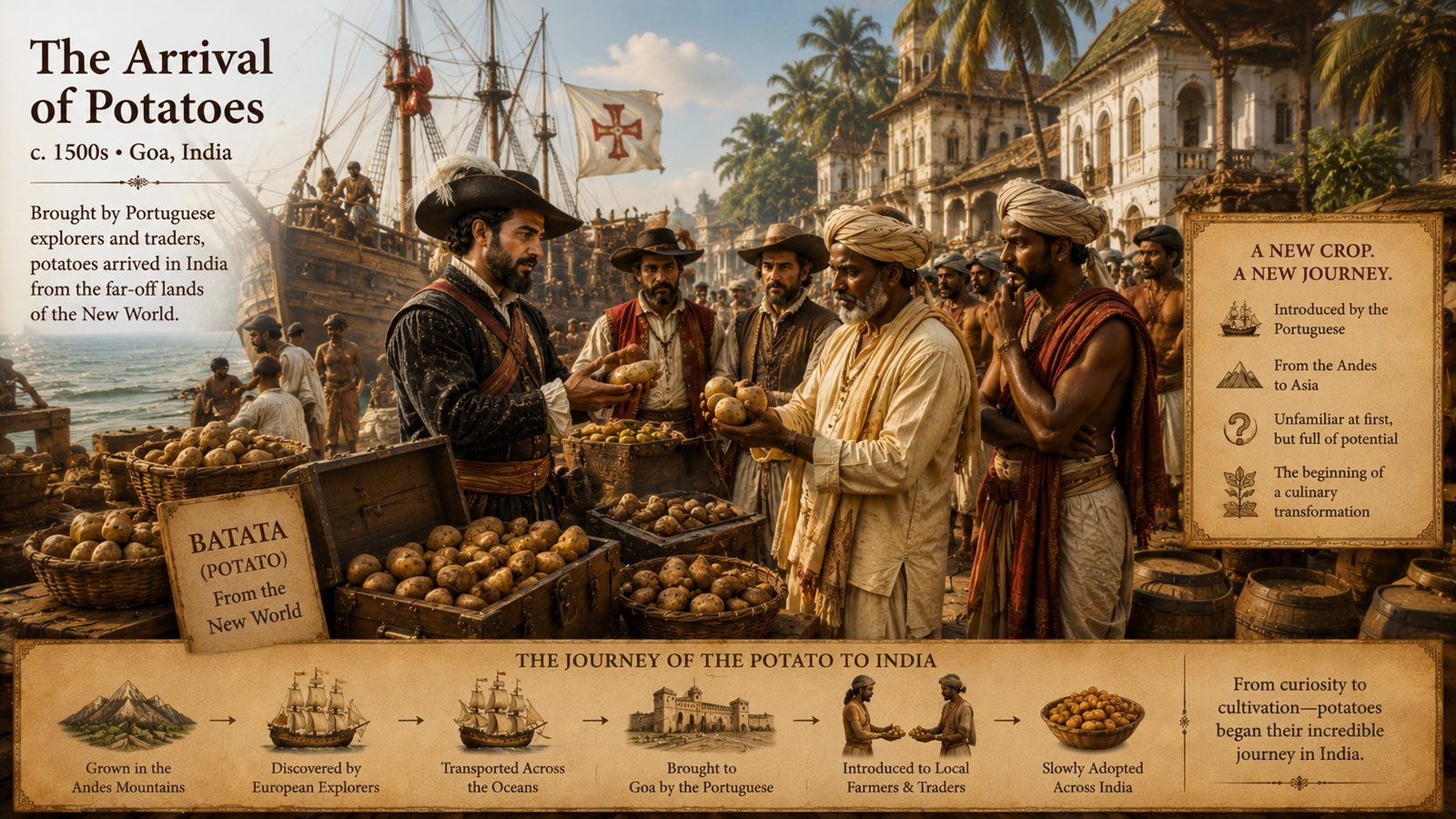
| 1600s | Potatoes reach India through Portuguese and Dutch trade networks. |
| 1700s | Limited cultivation; primarily grown for European community consumption. |
| 1800s | Widespread adoption; British colonial promotion and railway distribution accelerate spread. |
| Present | India is the world's second largest potato producer. The crop is fully embedded in Indian agriculture and cuisine. |
The Ancient Indian Vegetable Basket
Before the potato, Indian cooking had a rich vocabulary of starchy vegetables that filled equivalent culinary roles. Understanding this vocabulary is the key to understanding what pre-potato Indian food actually tasted like — and why Indian cuisine was already complete before the Andes arrived.
| Ingredient | Region | Historical Role |
|---|---|---|
| Raw Banana (Kela) | South India, Bengal | Neutral bulk, absorbed spices like potato; used in sabzi, kofta, and chips |
| Yam (Suran) | South India, Maharashtra | Dense, earthy staple; appears in Ayurvedic texts as a therapeutic food |
| Colocasia / Taro (Arbi) | North India, coastal regions | Creamy texture; one of India's oldest cultivated vegetables |
| Lotus Root (Kamal Kakdi) | Kashmir, North India | Seasonal delicacy; crunchy and visually distinctive |
| Jackfruit (Kathal) | East India, South India | Unripe jackfruit as a meat substitute in dry curries |
| Breadfruit | Coastal regions | Starchy coastal vegetable; still used in Goan and Kerala cooking |
Raw banana deserves particular attention because it most closely replicated what the potato would eventually do. It has a neutral flavour when cooked, absorbs spices beautifully, provides satisfying bulk in a curry, and can be prepared in virtually every way that potatoes now are. Kela ki sabzi, banana kofta, and raw banana chips all predate the potato and survive to this day in South Indian and Bengali cooking.
"The samosa existed as sambusak in Persia and the Arab world long before it reached India — filled with meat, nuts, and dried fruit. When the potato arrived centuries later, it completed one of the most unlikely culinary transformations in history."
The Samosa Before Potatoes
The samosa's potato filling is one of the most successful culinary fictions in history — so universal that most people assume it is ancient. It is not. The samosa in India is genuinely old, but its origins are not Indian, and its potato filling is at most two or three centuries old.
The samosa's ancestors — sambusak, sambusa, sanbusaj — appear in Persian and Arabic texts before 1000 CE, typically filled with minced meat, nuts, dried fruits, and spices. No potatoes. No chillies. The dish entered India through Persian and Central Asian influence during the Delhi Sultanate period (1200–1500 CE), when Persianate courtly culture reshaped North Indian food. The poet Amir Khusrau, writing in the early fourteenth century, describes courtly pastries closely resembling what would become the samosa — meat, nuts, spices. India adopted and adapted the dish; the potato filling that now defines it would not arrive for another few centuries.
As the samosa moved through Indian culinary culture, it adapted. In vegetarian communities, the meat filling was replaced with spiced vegetables and legumes. The specific transition to potato filling happened after the potato's arrival and gradual adoption, probably during the eighteenth and nineteenth centuries. The modern samosa is a Mughal-era Central Asian pastry with an Andean filling — two continents and several centuries of culinary history in a single fried triangle.
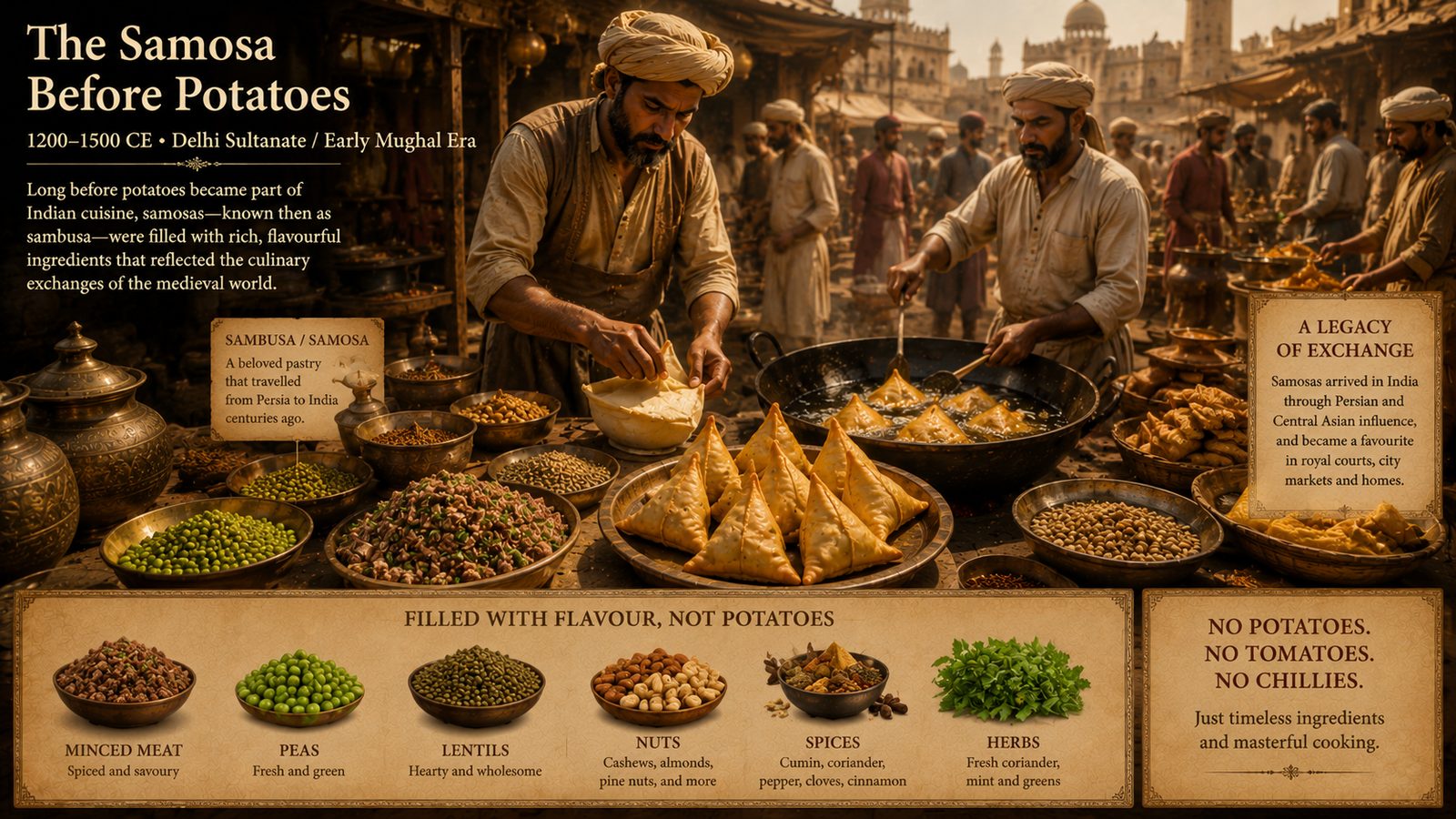
The samosa before potatoes: minced meat, nuts, and dried fruits — a Persian and Arab tradition (sambusak, sanbusaj) that entered India through the Delhi Sultanate court, centuries before any potato arrived.
Before vs After: What Actually Changed
Why Potatoes Won
Why Potatoes Succeeded So Completely
High yield per unit of land. Potatoes produce more calories per hectare than most alternatives, making them attractive to subsistence farmers and commercial growers alike.
Easy storage. Potatoes store at room temperature for months without spoiling — a significant advantage in a country without widespread refrigeration.
Climate adaptability. Potatoes grow across India's diverse climatic zones, from Punjab to Maharashtra to Kerala, with relatively consistent results.
Cheap calories. More energy per rupee than most alternatives — historically important for poor households feeding large families.
Neutral flavour. Absorbs spices without competing with them — the same property that made raw banana useful but delivered more reliably across cooking conditions.
Versatile technique. Performs excellently boiled, fried, mashed, and roasted — covering three of Indian cooking's most important preparation methods in a single ingredient.
How Regional India Adopted the Potato
The potato did not enter Indian cooking uniformly. Each region absorbed it into its existing culinary tradition in a distinct way, producing the regional potato dishes that now feel indigenous.
The potato's journey: from the Andes to Spain, to Portugal, to Goa, then northward through India under British colonial promotion. Click to enlarge.
Debate & Myths
Was the Potato Introduced by the Portuguese or the British?
Both played a role, but at different stages. The Portuguese introduced the potato to India in the seventeenth century through their Goa connection — the same route through which chillies and cashews arrived. However, Portuguese-introduced potatoes remained confined largely to the European community in Goa and nearby coastal areas for an extended period.
The British East India Company later actively promoted potato cultivation across India as a cheap, high-yield food crop for the agricultural population. British-promoted cultivation in Bengal and North India in the eighteenth and nineteenth centuries, combined with railway distribution, was what drove the potato's transformation from European curiosity to subcontinental staple. Both introductions were real; the British promotional campaign was what made adoption widespread.
Did Indian Cooking Really Need the Potato?
The honest answer is no — and that is precisely what makes the potato's adoption story interesting. Indian cuisine had already solved every culinary problem the potato addresses: bulk through raw banana, richness through yam, creaminess through arbi. The potato won not because it was necessary but because it was cheaper, more productive, and more versatile than its predecessors.
This reveals something important about culinary adoption: ingredients do not triumph because they fill gaps. They triumph because they offer economic and practical advantages over what came before. The potato is a better economic proposition than raw banana for most contexts — not a better ingredient in any absolute culinary sense.
What If Potatoes Never Came to India?
Without the potato, Indian street food culture would look fundamentally different. Vada pav would not exist in its current form. The aloo paratha would be a different bread entirely — or not exist at all. Dum aloo would be dum arbi or dum banana. Chaat culture, built extensively around aloo tikki and batata vada, would have different anchors.
But Indian cooking would not have suffered. Raw banana, yam, and arbi would have continued developing as bulk vegetables in their respective regions. The samosa would still exist — filled with its original meat and nut mixture, or with the spiced legumes that vegetarian communities had developed. The ancient vegetable basket was complete. The potato made it different; it did not make it better.
What Survived
The Pre-Potato Vegetables That Remain
Modern Legacy
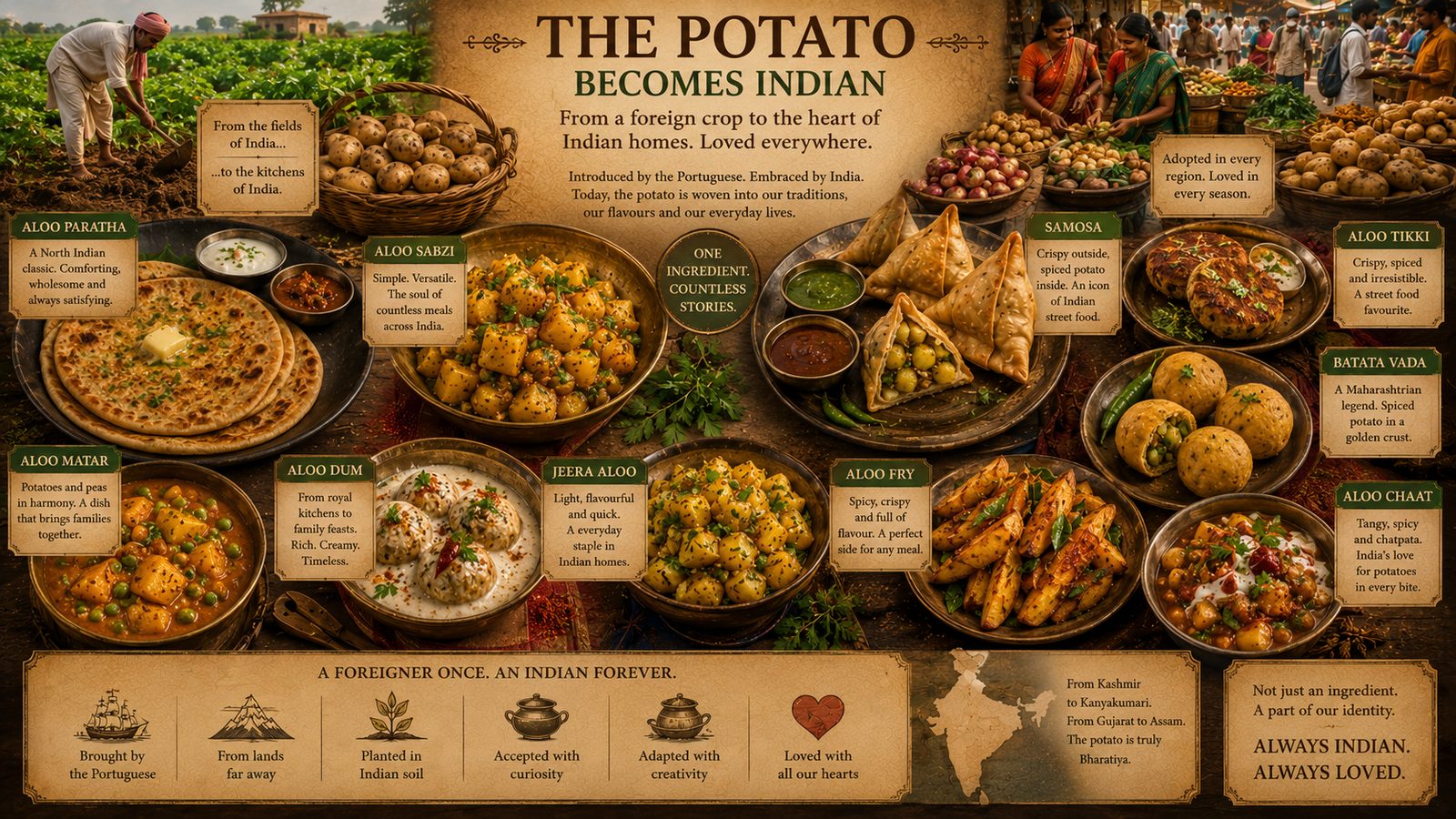
Modern India is the world's second largest potato producer — a transformation that took roughly three centuries from first introduction to total integration.
India today produces over 50 million tonnes of potatoes annually. The ingredient that arrived as a colonial curiosity has become so central to Indian identity that dishes built on it — aloo paratha, vada pav, dum aloo — are now considered quintessentially Indian. The Andean origin is entirely invisible.
Yet the pre-potato tradition survives in fragments. South Indian banana cooking, Bengali poppy-seed dishes with arbi, Kashmiri lotus root preparations — these are living evidence of what Indian vegetable cooking looked like before an eight-thousand-year-old Andean crop arrived and made itself at home. Indian cuisine's genius lies not in any specific ingredient but in its capacity to absorb whatever it encounters and make it entirely its own.
Food History Scorecard
| Impact Area | Change | Still Visible? |
|---|---|---|
| Street Food | Extreme | Vada pav, aloo tikki, samosa filling — potato defines Indian street food |
| Home Cooking | Extreme | Aloo gobi, aloo matar — potato in virtually every Indian household daily |
| Bread Tradition | High | Aloo paratha; potato stuffed breads entirely new category |
| Festival Food | Moderate | Many festival dishes still use yam, arbi, lotus root in preference to potato |
| Ancient Vegetable Tradition | High | Raw banana, yam, arbi survive in South Indian and Bengali cooking |
| Agriculture | Extreme | India now second-largest global producer; potato a major cash crop |
Confidence Scale
| Claim | Confidence | Basis |
|---|---|---|
| Potato originated in the Andes | Very High | Botanical, genetic, and archaeological evidence is conclusive. |
| Potato arrived in India via Portuguese trade | High | Consistent with Portuguese presence in Goa and the timing of other Columbian Exchange introductions. |
| British colonial promotion drove widespread adoption | High | Documented in East India Company records and agricultural surveys. |
| The samosa in India predates potatoes and had a meat, nut, and dried fruit filling | Very High | Medieval Persian and Arabic texts document sambusak/sanbusaj before 1000 CE. Amir Khusrau's 14th-century writings reference the dish in the Delhi Sultanate court. Potato filling is not documented before the 18th century at earliest. |
| Raw banana, yam, and arbi were the primary starchy vegetables before potatoes | Very High | Extensively documented in classical Sanskrit literature and Ayurvedic texts. |
Further Reading
- K.T. Achaya — Indian Food: A Historical Companion
- Colleen Taylor Sen — Feasts and Fasts
- Alfred Crosby — The Columbian Exchange
- Lizzie Collingham — Curry: A Tale of Cooks and Conquerors
- Sanjay Subrahmanyam — The Portuguese Empire in Asia