Series 1 · The Chronological Story · Chapter 2 of 17
Vedic Food
Food, Ritual and Daily Life
in Early India — 1500 to 500 BCE
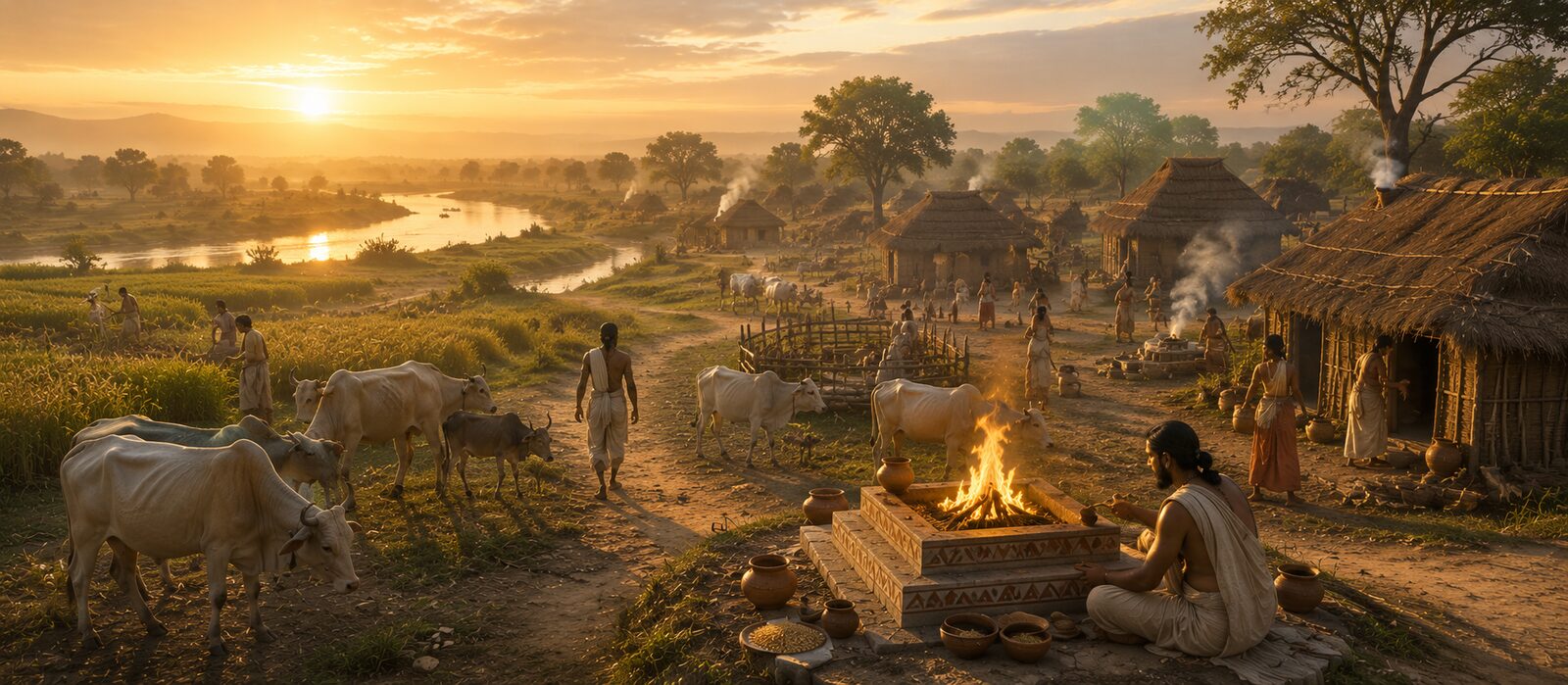
Artist's reconstruction based on archaeological and textual evidence
Food, Ritual and Daily Life
in Early India — 1500 to 500 BCE
Artist's reconstruction based on archaeological and textual evidence
Imagine sitting beside a sacred fire more than three thousand years ago. Milk simmers in clay pots. Barley cakes cook on heated stones. Priests chant hymns whose words have survived to the present day. Offerings are being prepared — ghee, grain, honey. Food is no longer just survival. Food has become culture, religion, and identity. This is the moment Indian food acquires its soul.
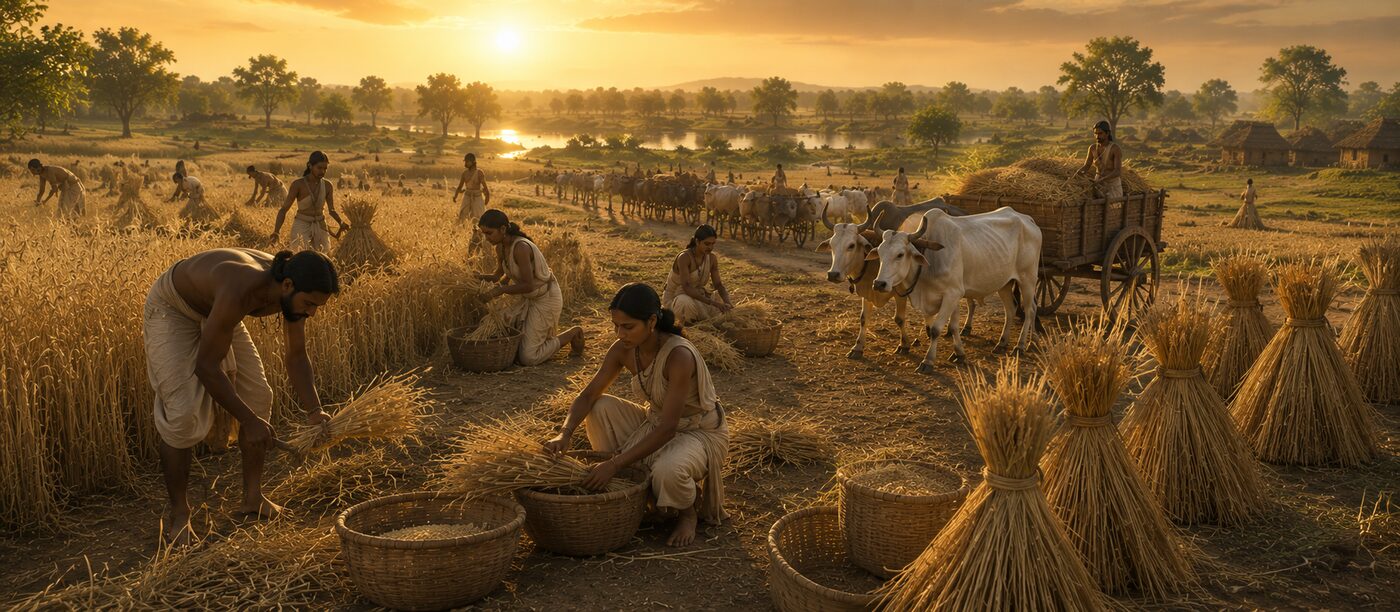
In the Vedic period, barley (yava) was not simply a food crop — it was a sacred substance woven into the fabric of ritual life. The Rigveda and later Vedic texts mention barley more frequently than any other grain. It was the grain of sacrifice, the grain of offerings to the gods, the grain ground into the ritual porridge (odana) that accompanied major ceremonies. When the Vedic texts speak of agricultural abundance, they are almost always speaking of barley.
Rice (vrihi) appears in Vedic literature but occupies a secondary position. It was cultivated in wetter eastern regions but was not yet the pan-Indian staple it would become in later centuries. The assumption that rice was always central to Indian food — common among modern readers — is a projection of present conditions onto a very different past. In Vedic India, a wealthy household's granary held barley first, wheat second, and rice as a regional or seasonal luxury.
The Vedic economy was built on cattle. The Sanskrit word for war (gavishti) literally means "a search for cows" — a measure of how central cattle were to Vedic wealth and conflict. But cattle were not primarily eaten. They were the living engine of the agricultural economy: ploughing fields, producing milk, generating the ghee that was the most ritually and nutritionally significant fat in the Vedic world.
Dairy was the prestige food of Vedic India in a way that has no modern equivalent. Fresh milk (payasa), curds (dadhi), butter (navanita), and above all clarified butter (ghrita — what we now call ghee) appear throughout the Vedic texts as markers of prosperity, ritual purity, and divine favour. The sacred fire at every Vedic ritual was fed with ghee. The gods were described as drinking soma mixed with milk. The household that could offer ghee at its fire altar was declaring not just piety but prosperity. Understanding this dairy-centred food culture is essential to understanding why ghee occupies its uniquely sacred position in Indian cooking to this day.
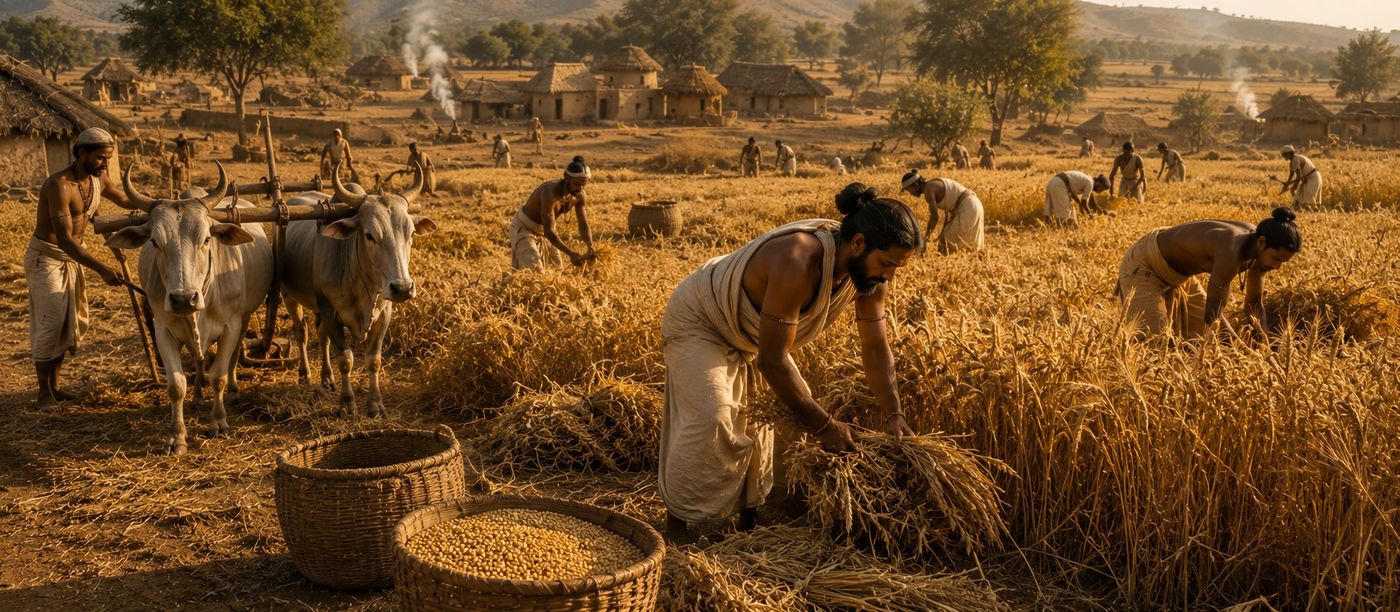
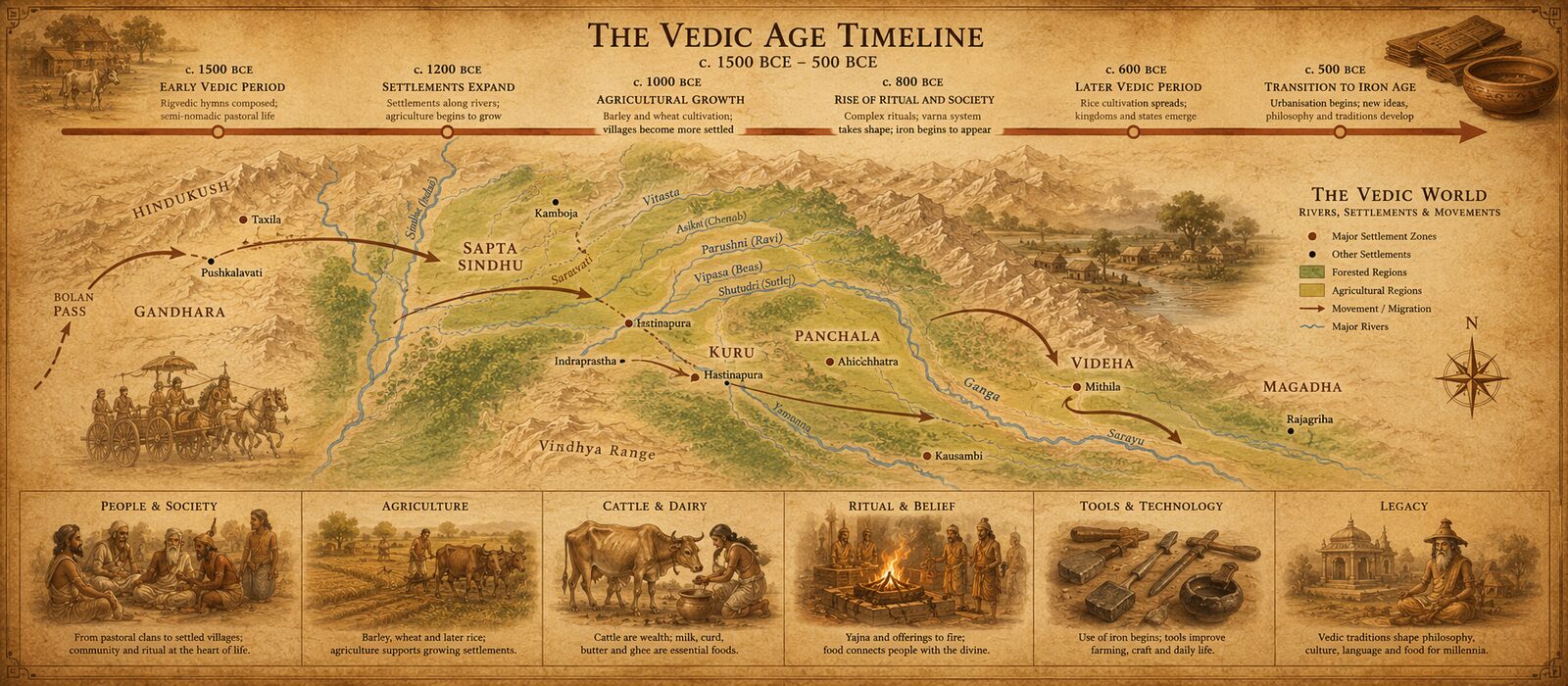
The Vedic period in Indian food history represents one of the most important transitions the cuisine has ever undergone. In Chapter 1, we saw a fully urban food system — the Indus Valley Civilisation with its cities, granaries, standardised weights, and long-distance spice trade. The Vedic period that followed was, in its early phase, markedly different: mobile, semi-pastoral, organised around cattle herding rather than city building, and documented not in archaeology but in some of the oldest surviving literature in any human language.
The four Vedas — the Rigveda, Yajurveda, Samaveda, and Atharvaveda — are not cookbooks. They are religious texts, ritual manuals, and philosophical reflections. But embedded throughout them is a detailed, specific, and remarkably consistent picture of what people ate, how they prepared it, and what food meant to them. Reading them as food history requires care, but the food information they contain is among the most detailed we have for any ancient culture in this period.
"Annam Brahma — food is the divine. He who knows food as Brahma, from whom all beings are born, by whom they live, toward whom they move and into whom they merge — he knows Brahma."
Taittiriya Upanishad, c. 600 BCE — the oldest statement of food philosophy in human historyIf the Indus Valley was wheat and barley in roughly equal partnership, the early Vedic period belongs decisively to barley. The Rigveda mentions yava — barley — in ritual, agricultural, and culinary contexts more than any other grain. Barley cakes called purodasha were prepared for ritual offerings. Barley was fermented into sura, an early intoxicating drink. Barley flour mixed with ghee and curds formed the basis of the everyday Vedic meal.
Why barley rather than wheat? Barley is more drought-tolerant and matures faster — advantages for a semi-pastoral people who moved seasonally and could not always guarantee long growing seasons. Barley also has a slightly lower gluten content than wheat, making it easier to process without sophisticated milling equipment. For a culture in transition from pastoral to agricultural life, barley was the practical choice — and it acquired religious significance precisely because it was so central to daily survival.
As Vedic culture moved eastward into the Gangetic plain over several centuries, a dietary revolution was underway. Rice — already cultivated in eastern India long before the Vedic period began — became increasingly important. The later Vedic texts reference vrihi (rice) with growing frequency, reflecting a genuine dietary transition: the eastern Gangetic plain, flooded seasonally and intensely fertile, was ideal rice country, and the communities settling it adapted accordingly.
This eastward movement is one of the most important events in the history of Indian food. The Gangetic plain that rice cultivation came to dominate is the most densely populated agricultural region in the world. The rice-based food cultures of Bengal, Bihar, eastern Uttar Pradesh, and Odisha — which feed hundreds of millions of people today — have their roots in this expansion. The Vedic period is when India's fundamental north-south, wheat-rice dietary geography begins to take shape.
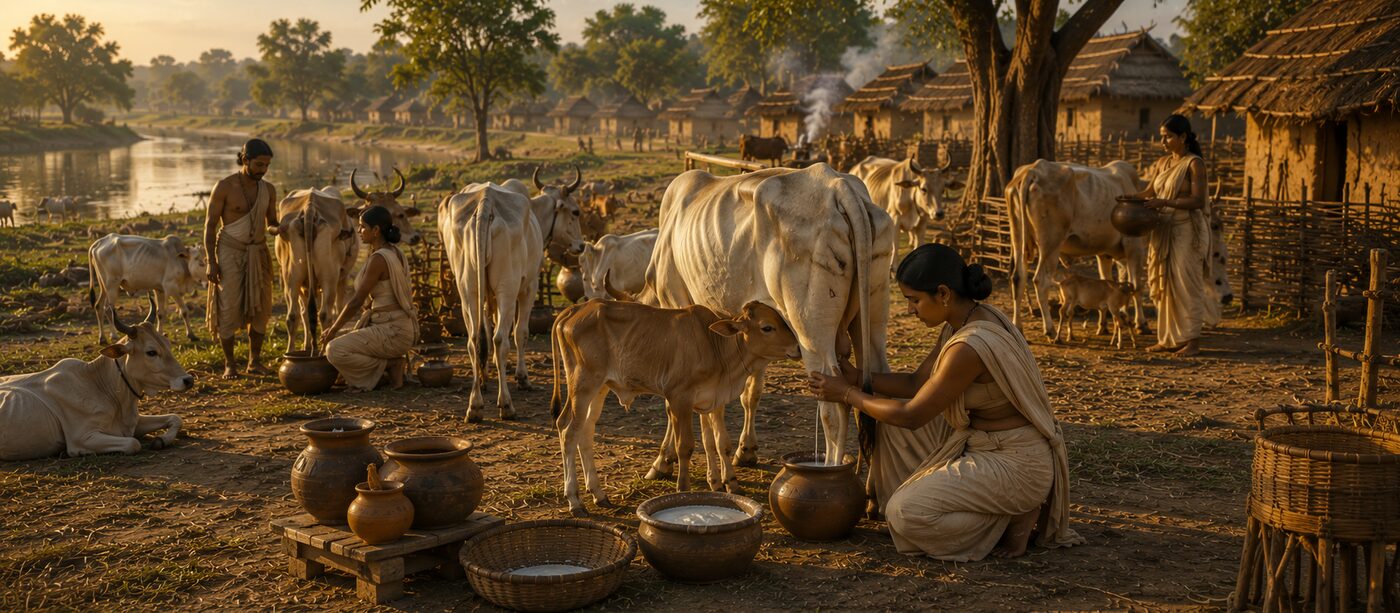
No single food better captures what makes Vedic food culture distinctive than ghee. In the Indus Valley, sesame oil was the dominant fat. In Vedic India, everything changed. Ghee — clarified butter made from cow's milk — became simultaneously the most sacred ritual offering, the most important medicine in early Ayurvedic thought, and the highest-status cooking fat in the kitchen. No other food in human history has occupied all three of these roles at once, for this long, in a continuous living tradition.
The Vedas are unambiguous about ghee's elevated status. The Rigveda calls it "the first and most excellent of foods" and describes it as the essence of the cow, which was itself considered sacred. The yajna — the central ritual of Vedic religious life — could not be performed without ghee. Every offering to the sacred fire, every ceremony marking birth, marriage, death, and harvest, required ghee to be poured into the flames. The flame that consumed ghee was believed to carry the offering directly to the gods.
In the kitchen, ghee's properties made it genuinely superior to the available alternatives. Unlike butter, it does not burn at cooking temperatures. Unlike sesame or mustard oil, it has a neutral flavour that does not compete with the food being cooked. Its antimicrobial properties — now understood through the chemistry of butyric acid — meant it stayed stable in hot climate conditions where fresh butter would spoil within hours. And its flavour — rich, nutty, deep — made everything it touched taste more complex.
The ghee that appears in Vedic texts three thousand years ago is the same ghee used in Indian kitchens today. The preparation method — simmering butter to evaporate water and separate milk solids, then filtering the pure golden fat — is unchanged. Ghee is used in the same ritual contexts, prescribed in the same medicinal frameworks, and prized for the same culinary qualities. Very few human foods have this kind of unbroken three-thousand-year continuous history.
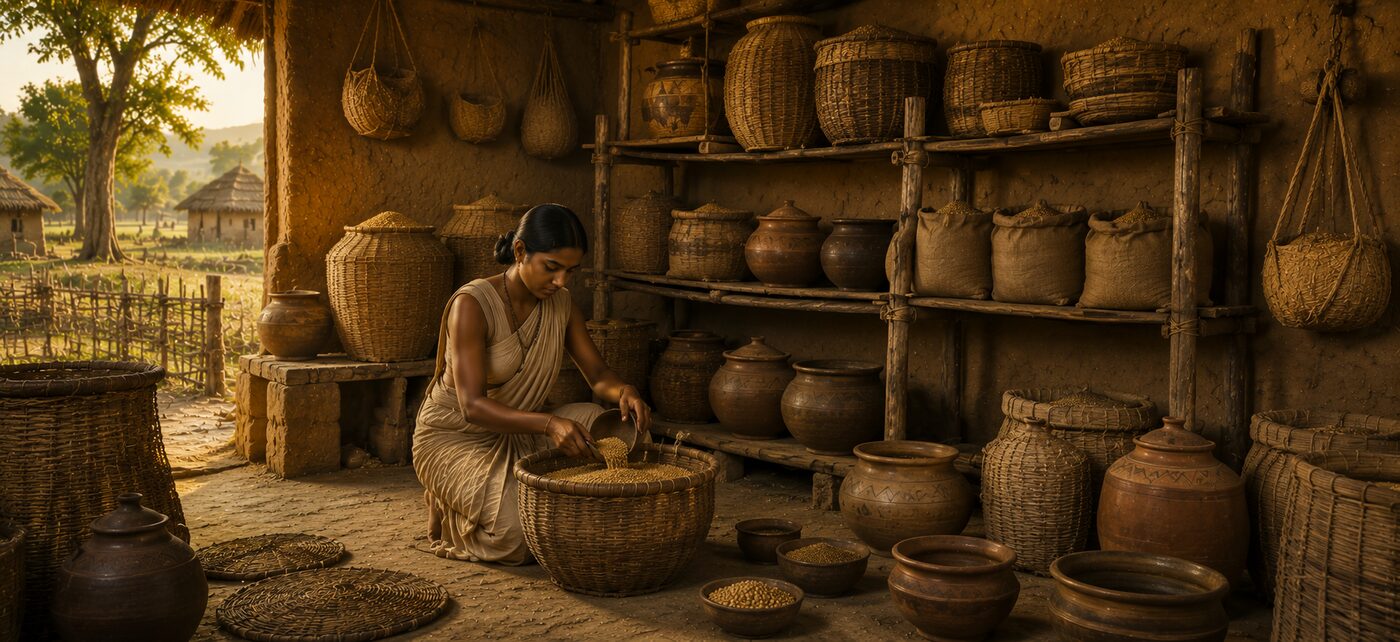
The yajna — the Vedic fire ritual — is one of the most important institutions in the history of Indian food culture, and it is almost completely invisible in mainstream food writing. Understanding it transforms the way you see the role of ghee, grain, and dairy in Indian food today.
The yajna was not a peripheral religious ceremony. In Vedic culture, it was the central act of religious life — performed at births, deaths, marriages, harvests, and coronations, conducted by trained priests who memorised thousands of verses describing the precise sequence of actions, offerings, and chants required. The fire itself was considered sacred — Agni, the fire god, was the messenger who carried offerings from the human world to the divine. Food placed in the fire was food delivered to the gods.
What was offered in the yajna? The texts are specific: ghee, grain (particularly barley), milk, curds, honey, and soma — an intoxicating ritual drink of disputed botanical identity. The best foods, the purest foods, the most laboriously prepared foods went into the fire. This is not waste: in Vedic thought, feeding the gods was an act of reciprocity that would return as rain, harvest, health, and prosperity. Food and cosmology were the same system.
The legacy of the yajna extends far beyond the Vedic period. Every Hindu religious ceremony involving fire — the wedding agni, the ancestral shraddha ritual, the daily Brahmin fire offering — descends from this tradition. The specific foods offered, the specific prayers chanted, and the specific sequence of actions all have roots reaching back three thousand years to the Vedic period described in this chapter.
Understanding Vedic food culture requires understanding cattle — and understanding cattle in the Vedic context requires considerable care, because this is one of the most politically charged topics in Indian cultural history. The purpose here is not to adjudicate modern debates but to report what the Vedic texts actually document.
The Vedic texts document cattle as the primary measure of wealth. The Sanskrit word gavishti — often translated as "war" or "conflict" — literally means "search for cows." Raids to acquire cattle were a documented feature of Vedic inter-community conflict. A man's wealth was counted in cows. The word "fee" in English and "pecuniary" (from Latin pecus, cattle) share the same underlying economic concept: cattle as currency.
What did this mean for food? Primarily, it meant dairy was central to the Vedic diet in a way that was qualitatively different from the Indus Valley period. Milk was drunk fresh, fermented into curds, churned into butter, and clarified into ghee. Buttermilk (takra) — the liquid remaining after churning — was consumed as a cooling drink. The churning of butter was a daily domestic activity, described in the Vedas both literally and as a cosmic metaphor for the creation of the universe from the primordial ocean.
| Food | Sanskrit Name | Evidence Level | Role in Vedic Life |
|---|---|---|---|
| Barley | Yava | Strong | Primary grain; ritual cakes; daily porridge; fermented preparations |
| Ghee | Ghrita | Strong | Ritual offering; highest-status cooking fat; early medicine |
| Milk | Dugdha / Payas | Strong | Daily consumption; ritual offering; basis for all dairy products |
| Curds | Dadhi | Strong | Daily food; ritual use; ancestor of modern dahi |
| Sesame | Tila | Strong | Continued from Indus period; ritual and culinary use |
| Honey | Madhu | Strong | Primary sweetener; ritual offering; medicine |
| Lentils | Masura | Strong | Daily protein; continued from Indus period; dal tradition |
| Rice | Vrihi / Shali | Moderate | Expanding in later period as culture moves eastward |
| Wheat | Godhuma | Moderate | Growing in importance through the period |
| Buttermilk | Takra | Moderate | By-product of churning; cooling drink; digestive use |
| Sugarcane | Ikshu | Moderate | Referenced in later Vedic texts; juice consumed; not yet crystallised |
| Turmeric | Haridra | Limited | Less documented than in Indus period; likely continued use |
| Cattle Meat | — | Limited | Ritually documented at specific ceremonies; everyday use disputed |
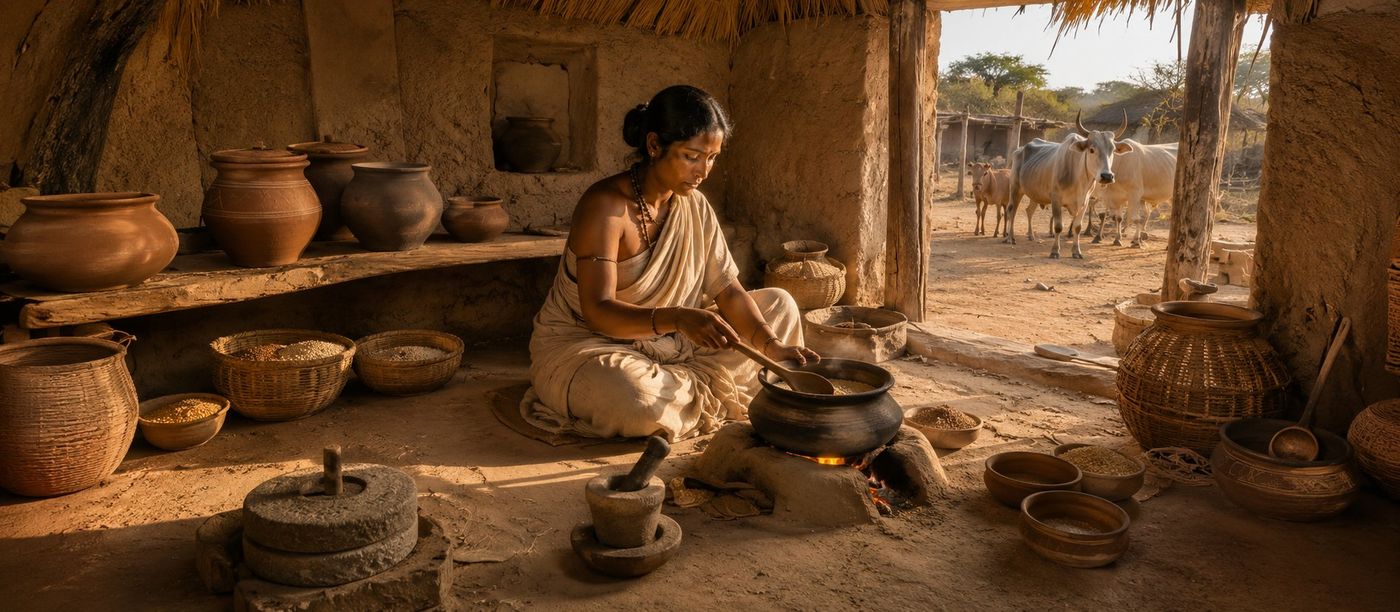
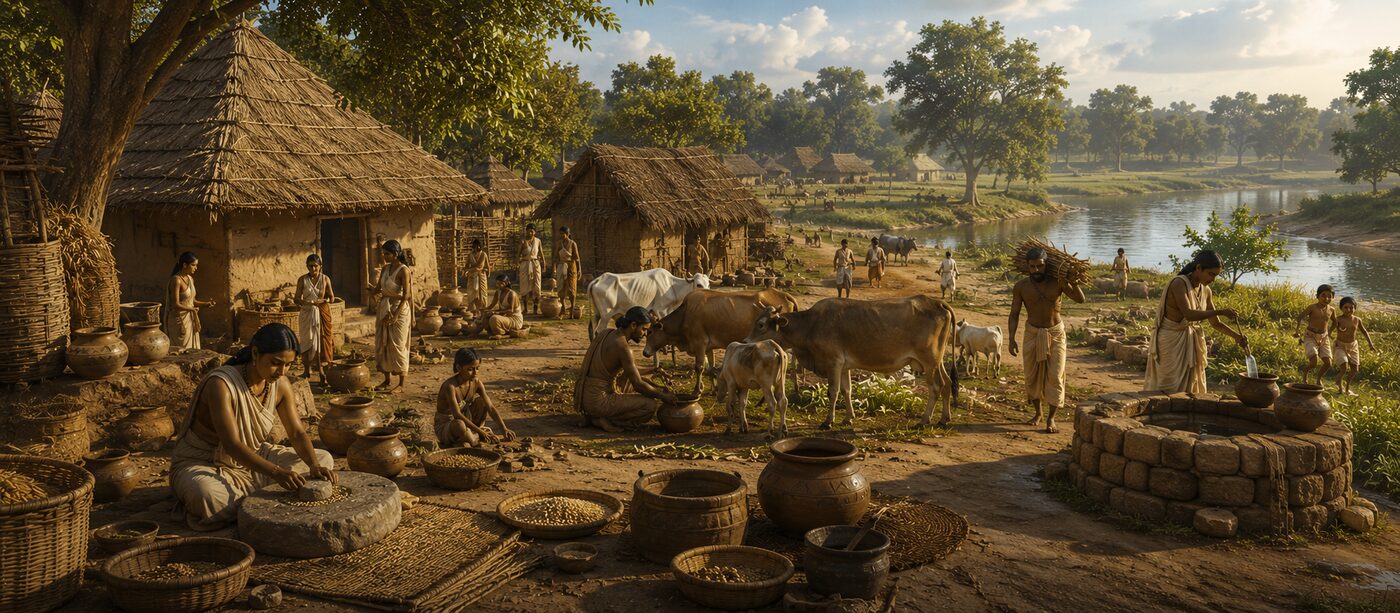
The household is a thatched structure at the edge of a growing village in the central Gangetic plain. The family has been here for two generations — settled enough to maintain a kitchen garden and a small herd of cattle, mobile enough to remember when their grandparents moved with the seasons. The boundary between pastoral and agricultural life is still visible in the household's habits.
The first sound of the morning is the churning. The clay churning pot — tall, slightly conical, with a rope-wound wooden dasher — has been set up by the senior woman of the household before full light. Yesterday's milk has been allowed to set overnight, the cream rising to the surface. The churning motion is rhythmic, meditative, and loud — the wooden dasher striking the sides of the pot as the rope is pulled back and forth. Butter will form within an hour. What remains — the slightly sour liquid — is takra: buttermilk, to be drunk through the day as a cooling, digestive food.
The butter is placed in a clay pot over the cooking fire — the sacred domestic fire that is never allowed to go out. The fire itself is considered a form of Agni, the fire god. As the butter heats, water evaporates in a foam of bubbles. The milk solids fall to the bottom and begin to turn golden. The room fills with a nutty, caramelised smell — the smell of ghee being made. When the bubbling slows and the liquid runs clear and golden, the ghee is ready. It is filtered through a woven cloth into a sealed clay vessel that will keep it stable for months.
Alongside the churning, barley grain is being ground on the sil-batta — the same grinding stone technology as the Indus Valley, unchanged for two thousand years. The barley flour will be mixed with ghee and water, shaped into small cakes called purodasha, and cooked on a flat clay surface over the fire. Some will be eaten at breakfast with curds and honey. Some will be set aside for the evening's small ritual offering — the daily fire ceremony that connects this household to the cosmic order the Vedas describe.
Breakfast: barley cakes with curds. Barley porridge with honey. A cup of buttermilk, slightly sour, cooling. Ghee poured over everything. This is prosperity by Vedic standards — dairy-rich, grain-sufficient, sweet with honey. The same meal, transformed into wheat roti with dahi and ghee, is still eaten across northern India every morning.
Three meals that the Vedic texts and archaeological context allow us to reconstruct with varying degrees of confidence. Each reflects a different dimension of Vedic food culture — the everyday, the seasonal, and the ritual.
This is the most confidently reconstructed meal of the Vedic period. The Vedas document barley porridge (yavagu), curds (dadhi), honey (madhu), and ghee (ghrita) extensively — all four appear together in multiple contexts. The combination of grain, dairy ferment, and sweet provides complete nutrition in the Vedic food framework. Ghee poured over the meal adds fat, flavour, and the blessing of the sacred. This meal — in its structural essentials, with wheat replacing barley — is dal-roti-dahi-ghee, still the everyday breakfast of millions across northern India.
The Vedic main meal is reconstructed from the combination of documented ingredients and comparison with contemporary food cultures at similar technological levels. Barley cakes (purodasha) were documented primarily in ritual contexts but were almost certainly also everyday food. Pulse stew — lentils or mung beans cooked with water and possibly ghee — provided the protein alongside grain. The specific combination here is informed reconstruction: each ingredient is documented, but their specific combination in one meal is inferred rather than directly stated.
This is one of the best-documented meals in ancient Indian history — not because the texts describe what was eaten, but because they describe in exceptional detail what was offered. After the offerings of ghee, grain, and milk to the sacred fire, the community shared a feast using the same foods. The Vedic texts describe specific ceremonial preparations: prishata (a dish of curds and barley), charu (a boiled grain preparation), and apupa (fried barley cakes). This ritual meal is one of the most directly documented food events of the ancient Indian world.
Ghee's extraordinary shelf stability — months without refrigeration in tropical heat — is not mysterious. It is a direct consequence of what clarification removes from butter, and what it leaves behind.
Butter is approximately 80% fat, 16-17% water, and 3-4% milk solids (proteins and sugars). The water and milk solids are the problem. Water provides a medium for bacterial growth. Milk proteins denature and oxidise, causing rancidity and off-flavours. The milk sugar (lactose) can ferment. In hot climates, these degradation processes happen rapidly — fresh butter in 35°C heat can turn rancid within hours.
What clarification does: Simmering butter to make ghee evaporates essentially all the water and causes the milk solids to separate and settle (or float as foam, which is skimmed off). What remains is almost pure butterfat — over 99% fat with negligible water and milk solids. Without water, bacteria cannot grow. Without milk proteins, oxidative rancidity is dramatically slowed. Without lactose, there is nothing to ferment.
The smoke point of a cooking fat is the temperature at which it begins to visibly smoke and break down — producing acrolein and other compounds that create bitter flavours and, at high levels, potentially harmful byproducts. Butter smokes at around 150°C — well below the temperatures needed for proper tempering of spices, searing of bread, or frying. This is why cooking with butter at high heat produces burned flavours.
Ghee smokes at approximately 250°C — above the temperature needed for virtually any cooking technique in the Vedic or modern Indian kitchen. The milk solids, which are the components that burn first in butter, have been removed. What remains is stable fat that can be heated to very high temperatures without degradation. This is not a minor advantage. In a kitchen where the primary cooking technique is flatbread on a high-heat clay griddle, having a fat that can withstand that heat without burning is genuinely transformative.
The dadhi of the Vedas — curds, the ancestor of modern dahi — is produced by the same process as modern yogurt: lactic acid bacteria converting milk sugar (lactose) into lactic acid, which denatures milk proteins and causes them to form a gel. The result is a food with dramatically extended shelf life compared to fresh milk, greater digestibility (the lactose is partially pre-digested by bacterial enzymes), and a distinctive sour flavour from the accumulated lactic acid.
Vedic curds were almost certainly more varied in bacterial culture than modern commercial yogurt — the unsterilised clay vessels in which they were prepared would have harboured a complex community of bacteria, yeasts, and wild cultures that would vary by season, location, and household. This microbial diversity would produce curds with more complex flavour than modern standardised product — richer, more sour, more varied. Traditional Indian regional dahistill made in unsterilised clay pots in this way — captures something of that ancestral complexity.
Because ghee is still in your kitchen. Because dahi is still on your table. Because the morning meal of barley porridge with curds and honey has become wheat roti with dahi and ghee — the same nutritional logic, the same combination of grain, dairy ferment, and fat, the same role in the daily rhythm of life. The container has changed. The content has not.
The Vedic period matters for a second reason: it is where Indian food acquires its philosophical dimension. The Taittiriya Upanishad's declaration that "food is the divine" — annam Brahma — is not a metaphor. It is a statement about the fundamental nature of food in Indian thought: that what you eat becomes you, that what you offer feeds the cosmos, that the quality of your food affects the quality of your consciousness. This idea underlies Ayurvedic nutrition, temple kitchen traditions, and the concept of sattvic food that persists in Indian vegetarian cooking today.
When a cook adds ghee to dal before serving it — not for flavour alone, but because ghee "completes" the dish, makes it "right," brings it to its proper state — they are participating in a tradition of thought about food that is three thousand years old. The action is practical. The meaning behind it is ancient beyond measure.
In addition to the ingredients absent from the Indus Valley, Vedic India was still missing many foods now central to Indian cooking. Some were not yet developed; others simply had not reached India yet.
| Vedic India, c. 1000 BCE | Modern India |
|---|---|
| Barley as primary bread grain | Wheat dominant for flatbread in North India; barley survives in specific regional and ritual contexts |
| Ghee as sacred and everyday fat | Ghee still the highest-status cooking fat; used in daily cooking, temple offerings, and Ayurvedic medicine — unchanged in three thousand years |
| Curds (dadhi) as daily fermented food | Dahi on virtually every Indian table; the word, the food, and the fermentation process are direct descendants of the Vedic original |
| Honey as primary sweetener | Sugar dominant since medieval period; honey retained in Ayurvedic medicine and specific ritual contexts |
| Barley cakes (purodasha) as ritual food | Roti, puri, and other flatbreads as ritual food — the form changes, the function is identical |
| Yajna fire ritual with food offerings | Hindu ceremonies still use ghee, grain, and fire as central ritual elements — continuous three-thousand-year tradition |
| Grain + pulse + dairy as dietary foundation | Dal-roti-dahi — the same nutritional logic, the same combination, the same daily meal for hundreds of millions |
| Food = spiritual practice | Sattvic diet, temple kitchen traditions, prasad — the philosophical identification of food with the sacred continues unbroken |
The Vedic period ended approximately 2,500 years ago. Its food legacy is not historical curiosity — it is living practice, daily reality, and active philosophy.