How a climbing vine on the Kerala coast sent Columbus west, da Gama around Africa, and wrote the map of the modern world — and why chilli peppers are called peppers at all
18 minute read
2000 BCE – 1600 CE
Kerala · Rome · Venice · Lisbon · The Atlantic
Scroll ↓
The extraordinary claim
India's spices did not just feed people. They wrote history.
In 1408 CE, a Visigoth king named Alaric besieged Rome. The greatest city in the world was brought to its knees. When negotiations opened for lifting the siege, the ransom demanded included five thousand pounds of gold, thirty thousand pounds of silver, four thousand silk garments — and three thousand pounds of black pepper. On that list, alongside precious metals and luxury cloth, sat the dried fruit of a climbing vine that grew on the hills of Kerala. The Romans paid every item on the list without hesitation.
This is not a footnote to history. It is the central story. Indian spices — pepper above all, but also cardamom, cinnamon, ginger, and turmeric — were among the most valuable commodities in the ancient and medieval world. They drove trade networks that connected Kerala to Rome, Arabia, China, and eventually the Americas. The desperate European desire to access Indian spices directly, without paying the astronomical markups of Arab and Venetian middlemen, sent explorers west and south into unknown oceans — and in doing so, accidentally discovered two continents and created the first truly global economy.
The story of the Indian spice trade is the story of the modern world. And it begins on a narrow strip of coast in present-day Kerala.
"There was no year in which India did not drain the Roman Empire of a hundred million sesterces."
Pliny the Elder · Naturalis Historia · 1st Century CE
⚓
Muziris · The first global trading port
The port that connected India to the world
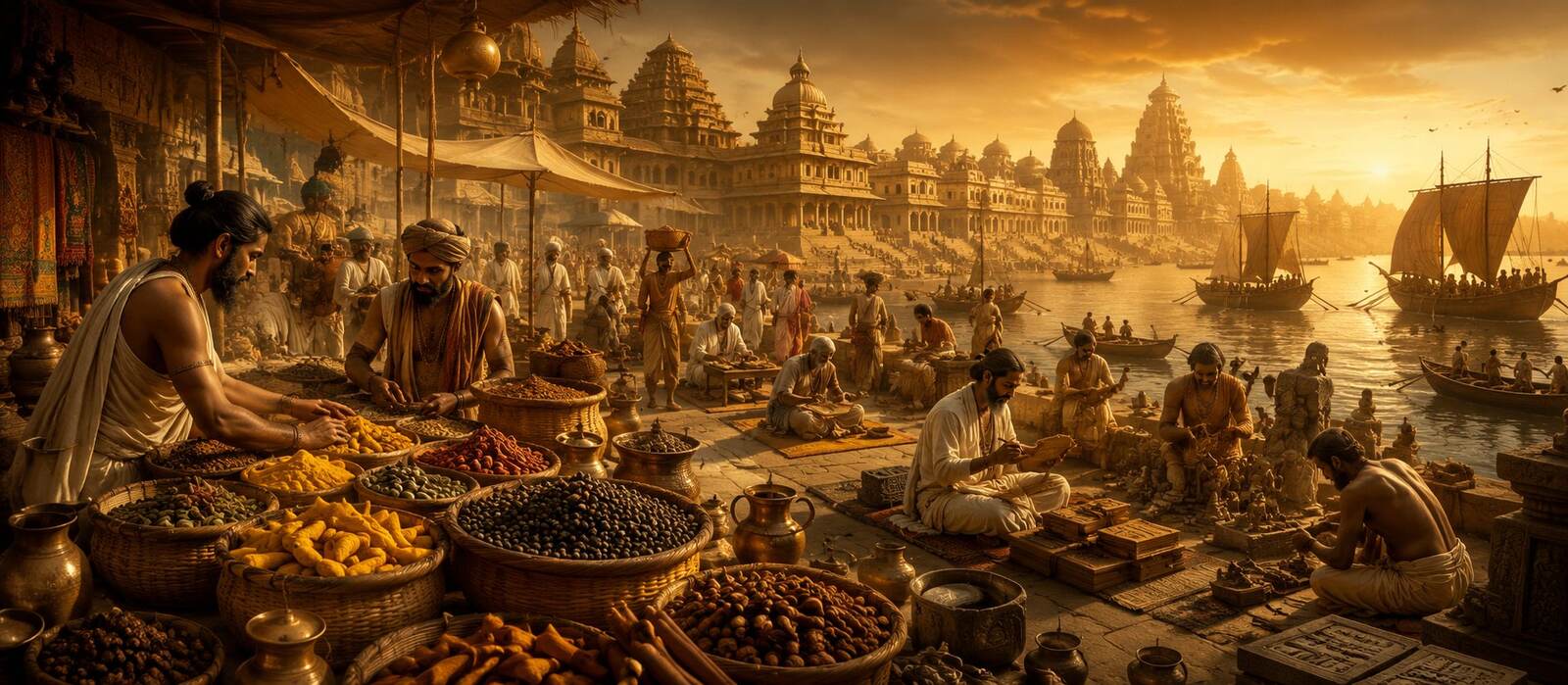
On the Kerala coast, near present-day Kodungallur, there existed a port city called Muziris. For over a thousand years — from roughly 300 BCE to 1341 CE when it was destroyed by floods — Muziris was one of the most important trading hubs in the ancient world. Pliny the Elder, writing in the first century CE, called it "the first trading post of India." Ships from Rome, Egypt, Arabia, and Mesopotamia converged there, loaded with gold to exchange for pepper.
Archaeological excavations at the Pattanam site near Muziris have uncovered Roman amphora fragments, Mediterranean glassware, Roman red-gloss pottery, and plant residues including pepper, cardamom, and frankincense — physical proof of the extraordinary volume of trade passing through this single port. Roman coins bearing the faces of emperors Nero and Tiberius have been found in the soil of Kerala for centuries, so common that local antique dealers kept them in stock.
The ancient spice trade routes from Kerala to Rome — the world's first truly global supply chain, operating for over a thousand years before European exploration
The Muziris Papyrus
A second-century CE papyrus discovered in Egypt — known as the Muziris Papyrus — documents a single cargo of Indian pepper shipped from Muziris to Alexandria. The papyrus records a loan agreement to finance the commercial voyage and details the Roman customs duties payable on arrival. It is physical evidence of a sophisticated financial and legal system built entirely around the Indian pepper trade — including well-organised merchant guilds, insurance-like loan instruments, and structured tax collection. This was not primitive barter. This was international finance, 1,800 years ago, built on Indian spice.
🌿
The price of spice · What made it so valuable
Why pepper was worth its weight in gold
To understand why Indian spices reshaped world history, you first need to understand what they were actually worth — not in vague terms but in specific, documented figures that make the modern mind pause.
The Price of Indian Spices in Medieval Europe
Documented values at European markets · 1100–1400 CE
Black Pepper
Currency
Used to pay taxes, settle dowries, and pay rents. "Peppercorn rent" survives in English law as a term for a nominal payment — because a single peppercorn was once a real unit of value.
Nutmeg
Gold weight
A pound of nutmeg in 14th century Europe was worth more than a pound of gold. The Banda Islands — the world's only source — became the most contested piece of land on earth. Wars were fought for it.
Saffron
20× pepper
The most expensive spice by weight, then and now. Adulterating saffron was punishable by burning at the stake in 15th century Germany — the "Safranschou" laws.
Cinnamon
Wartime ransom
When the Visigoths sacked Rome in 408 CE, 3,000 pounds of pepper formed part of the ransom. Nero reportedly burned an entire year's supply of cinnamon at his wife's funeral as a display of wealth.
Cardamom
Queen of spices
Native to the hills of Kerala. Already being cultivated in the gardens of Babylon by 800 BCE. Used as medicine, flavouring, and currency across the ancient Middle East.
Cloves
Manhattan Island
In 1667 the Dutch traded Manhattan Island to the British in exchange for the tiny nutmeg-producing island of Run in Indonesia. They considered it a good deal.
The reason for these extraordinary values was a combination of genuine scarcity, long supply chains, and aggressive monopoly control. Spices grew only in specific tropical conditions — pepper on the hills of Kerala, nutmeg only on a tiny cluster of islands in eastern Indonesia, cinnamon primarily in Sri Lanka. Every step of the journey from source to European table added cost: Arab dhow captains, Indian Ocean crossing risks, Red Sea transit fees, Egyptian customs, Venetian markups. By the time pepper reached London or Paris, it had passed through ten sets of hands and cost a hundred times what it was worth at the Kerala source.
🏛
Venice and the monopoly · 700 years of control
How Venice grew rich on Indian pepper
From roughly the 8th century to the 15th century, the spice trade from India to Europe was controlled by a chain of intermediaries: Indian producers, Arab dhow captains crossing the Indian Ocean, Egyptian merchants at Alexandria, and finally Venetian traders who distributed the goods throughout Europe. Each link in this chain took a margin. The final price in European markets was often fifty to one hundred times the price at source.
Venice, positioned at the northern end of the Adriatic with access to both the Mediterranean and the overland European routes, became the wealthiest city in the medieval world almost entirely because of its control of the European end of the spice trade. The domes of St Mark's Basilica, the palaces along the Grand Canal, the entire glittering infrastructure of Venetian civilisation — built on Indian pepper and cardamom.
The Ottoman Blockade · 1453 CE
In 1453, the Ottoman Empire captured Constantinople — the capital of the Byzantine Empire and the critical junction point for overland trade routes from Asia to Europe. The Ottomans imposed heavy tariffs on all goods passing through. The Mamluks placed an additional 33% tariff on the spice trade. The overland route to Indian spices was effectively blocked for European merchants. This single political event — the fall of Constantinople — is arguably the most important catalyst for the Age of Exploration. European powers suddenly had no affordable route to Indian spices. They desperately needed a new one. Portugal went south. Spain went west. The world was about to change.
🧭
The three explorers · India sent them all
The men who sailed into the unknown for Indian spice
Every major voyage of the Age of Exploration was motivated, directly or indirectly, by the desire to access Indian spices without paying Venetian and Arab markups. The three most consequential explorers in this story each changed the world — and the trigger for every voyage was the same: Indian pepper, cardamom, and cinnamon.
🧭
Vasco da Gama
Portugal · 1498
Sailed around the Cape of Good Hope in 1498 and arrived on the Kerala coast — the first European to reach India by sea. Found what he was looking for: a coast overflowing with the spices Europe desperately wanted. His voyage broke the Arab and Venetian monopoly permanently and shifted the centre of global trade from the Mediterranean to the Atlantic.
⛵
Christopher Columbus
Spain · 1492
Sailed west looking for a direct sea route to India and its spices. Found the Americas instead. When he landed in the Caribbean and encountered local capsicum peppers, he was so desperate to have found pepper that he called them "peppers" — a name that persists to this day. Chilli peppers are called peppers because of Columbus's mistake.
🌍
Ferdinand Magellan
Portugal/Spain · 1519
Led the first circumnavigation of the globe — motivated by finding a westward route to the Spice Islands of Indonesia. His expedition proved the Earth was round not as an abstract scientific exercise but as a commercial strategy to reach Asian spices. The world was literally mapped because of Indian and Indonesian spice.
Vasco da Gama arrives in Kerala
May 20, 1498 · Calicut (Kozhikode), Kerala
⚓
What he was looking for
A direct sea route to India's spices, bypassing Arab and Ottoman controlled overland routes
What he found
The Zamorin of Calicut — a ruler so wealthy and so surrounded by spices that da Gama's gifts were laughably inadequate by comparison
What he brought back
A cargo of pepper and cinnamon worth sixty times the cost of the entire expedition
What it ended
Seven hundred years of Arab and Venetian monopoly on the spice trade between India and Europe
Historical impact
Da Gama's arrival transformed Kerala from the source of the most valuable commodity in the world into a contested colonial prize. Within twenty years, Portugal had established a string of fortified trading posts along the Indian coast and was using naval power to control all Indian Ocean trade. Venice, which had grown rich as the European end of the spice trade, began its long economic decline. The centre of world trade moved from the Mediterranean to the Atlantic permanently — and it moved because of Indian pepper.
🌶
The greatest mistake in food history
Why chilli peppers are called peppers
The Columbus Naming Error · 1492
The mistake that named half the world's food
When Columbus landed in the Caribbean in 1492 and encountered the local capsicum plants — small, intensely hot fruits completely unrelated to black pepper — he called them "peppers." He was looking for pepper. He had been sent to find pepper. He was not going to report back to the Spanish crown that he had found nothing of interest. Capsicum and black pepper share no botanical relationship whatsoever. They are different plant families, different continents, different chemical compounds producing heat through completely different mechanisms. But the name stuck. Today, six hundred years later, every chilli pepper, every bell pepper, every paprika on earth carries a name given by a man who was looking for Indian black pepper and found something else entirely. The reach of the Indian spice trade is so deep that even its famous mistake has lasted half a millennium.
The irony runs even deeper. Columbus's "mistake" — the introduction of chilli peppers to the Old World through Portuguese trade — eventually transformed Indian cooking more profoundly than any other single event in its five-thousand-year history. The ingredient discovered because Europeans were desperately searching for black pepper became so completely Indian within two centuries that ninety percent of Indians today believe chilli is a native plant.
🌊
The monsoon secret · How trade actually worked
The wind that made the spice trade possible
One detail about the ancient spice trade is almost never mentioned in popular history: the entire Indian Ocean trade system was powered by the monsoon winds, and Indian and Arab sailors had understood and exploited this system for over two thousand years before Europeans arrived.
The Southwest Monsoon blows reliably from India towards Arabia from June to September. The Northeast Monsoon blows back from Arabia towards India from December to March. A sailor who understood this pattern could leave Kerala in June, reach Arabia or Egypt in September, conduct trade, and return to Kerala on the December wind — a round trip of approximately six months, timed perfectly by nature. Pliny the Elder noted that Muziris could be reached from Red Sea ports in forty days during the right monsoon season.
This knowledge — the precise timing and direction of monsoon winds across the Indian Ocean — was the secret intellectual property of Indian and Arab sailors for millennia. When Vasco da Gama reached the East African coast on his voyage to India, he was completely lost. He hired a Gujarati navigator named Kanhoji — some accounts say it was the legendary Ahmad ibn Majid — who knew the monsoon system and guided the Portuguese fleet across the Indian Ocean to Kerala. The European Age of Exploration reached India on the back of Indian and Arab navigational knowledge that was already ancient.
The Monsoon Navigator
The man who guided Vasco da Gama's fleet from East Africa to India in 1498 was likely a Gujarati or Arab navigator already familiar with the monsoon winds of the Indian Ocean. Some historians identify him as Ahmad ibn Majid, the Arab navigator who wrote detailed sailing manuals about Indian Ocean winds and currents. The Portuguese "discovery" of the sea route to India was made possible by a navigator from the civilization whose trade they were trying to access. The world's first global supply chain was guided to Europeans by the people who had been running it for two thousand years.
⏳
The full timeline · 2,000 BCE to 1600 CE
How the spice trade evolved over three millennia
2000 BCE
Kerala · India
The first recorded spice trade
Archaeological evidence confirms black pepper being traded from Kerala's Malabar Coast. The oldest known spice trade in human history. Indian and Arab dhow captains are already exploiting the monsoon winds to cross the Indian Ocean.
🌿 Malabar pepper trade begins
800 BCE
Babylon · Mesopotamia
Indian spices reach Babylon
Cardamom and turmeric are being cultivated in the royal gardens of Babylon — evidence of active overland spice trade between India and the Middle East over 2,800 years ago. Indian black pepper is being traded in Greek markets.
🏛 Spices reach the ancient Mediterranean world
300 BCE
Muziris · Kerala
Muziris becomes the world's greatest spice port
The port of Muziris at its height. Roman, Egyptian, Arab, and Greek ships converge. The Sangam Tamil literature of this period describes Roman ships arriving laden with gold. India is becoming the richest nation on earth from spice exports.
⚓ India called "sink of precious metals" by Rome
1 CE
Rome · Mediterranean
Rome spends 100 million sesterces annually on India
Pliny the Elder documents the extraordinary drain on Roman finances caused by the appetite for Indian spices. Roman amphora fragments, coins, and glassware are being excavated at Kerala sites 2,000 years later — physical proof of this trade at massive scale.
💰 Indian spice becomes Rome's most expensive import
408 CE
Rome · Italy
Pepper ransoms Rome
Visigoth king Alaric besieges Rome. The ransom includes 3,000 pounds of black pepper — placed alongside gold and silver as a negotiating commodity. Rome pays. The value of Indian spice in the ancient world reaches its most dramatic documented moment.
⚔️ Pepper listed alongside gold as ransom for Rome
700–1400 CE
Venice · Mediterranean
Venice builds an empire on Indian pepper
Arab traders dominate the Indian Ocean routes. Venetian merchants control the European end. Between them they extract enormous margins. Venice becomes the wealthiest city in the medieval world — its palaces, art, and infrastructure funded by Indian spice. Every gram of pepper that reaches Paris or London passes through Venetian hands.
🏛 Venice rises to become medieval Europe's richest city
1453 CE
Constantinople · Ottoman Empire
The Ottomans block the overland route
The Ottoman Empire captures Constantinople. The overland trade route from Asia to Europe is blocked or made prohibitively expensive. European powers — denied affordable access to Indian spices — begin funding voyages to find alternative sea routes. The Age of Exploration begins, triggered by the desire for Indian pepper.
🗺 Age of Exploration begins — all because of Indian spice
1492 CE
Caribbean · The Americas
Columbus finds America looking for India
Columbus sails west looking for India and its spices. Finds the Americas. Calls the local capsicum fruits "peppers" — a mistaken name that persists to this day. His failure to find black pepper accidentally introduces chilli peppers to the world — which eventually transform Indian cooking more than any other single ingredient.
🌶 Chilli "peppers" named after Indian black pepper by mistake
1498 CE
Calicut · Kerala
Da Gama reaches India — the world changes
Vasco da Gama arrives in Kerala. The Arab and Venetian monopoly on the spice trade is broken. Portugal immediately begins establishing a military presence along the Indian coast. Within fifty years the Portuguese will introduce chilli, potato, tomato, cashew, and pav bread to India — transforming Indian cooking forever as a direct consequence of the spice trade that brought them there.
🌍 The modern world begins at a Kerala spice port
💡
What this means in your kitchen today
The spice trade's living legacy
The spice trade is not ancient history. It is living in your kitchen right now. Every time you bloom black pepper in hot oil, you are using an ingredient so valuable that it once ransomed empires. Every time you add cardamom to chai, you are using a spice that was growing in the royal gardens of Babylon 2,800 years ago. Every time you reach for chilli — the defining ingredient of Indian cooking — you are using an ingredient named after Indian black pepper by an explorer who was looking for India when he found America.
The reason Indian food tastes the way it does — the complexity, the layering, the specific combination of indigenous spices and New World ingredients — is a direct product of this history. The spice trade brought the world to India's door. What India did with those visitors and their ingredients is the story of the next thirteen chapters.
"The world was literally mapped because of Indian spice. Every continent discovered, every sea route charted, every empire built in the Age of Exploration traces back to the hills of Kerala and the pepper vine that grew there."
indiancookingguide.com · The History of Indian Food
The Food Science Connection
Black pepper's heat comes from piperine — a completely different alkaloid compound from capsaicin, which provides chilli heat. Piperine produces a slower, more diffuse warmth without the sharp front-of-mouth burn of capsaicin. Ancient Indian cooks who used black pepper as their primary heat source were working with a fundamentally different flavour and heat profile than modern Indian cooks who use chilli. Modern Indian cooking is chemically different from ancient Indian cooking — not just in ingredients but in the fundamental mechanism of how heat is experienced on the palate. Piperine blooms differently in fat, dissipates differently with dairy, and behaves differently in fermented foods. The spice trade did not just change what Indians ate. It changed how Indian food feels in the mouth.
Long before the Mughals arrived, Persian traders and scholars were transforming North Indian cooking. Saffron, dum cooking, rich nut-based gravies, and the pilaf that became biryani — this is the chapter that explains where the royal kitchen of North India really came from.