★★★★★ Restaurant cooking
★★★★★ Kashmiri cuisine
What Does Kashmiri Chilli Taste Like?
Kashmiri Chilli in Every Indian Language
| Language | Name | Pronunciation |
|---|---|---|
| English | Kashmiri Chilli / Deghi Mirch | kash-MEER-ee CHIL-ee |
| Hindi | कश्मीरी मिर्च — Kashmiri Mirch | kash-MEER-ee MIRCH |
| Bengali | কাশ্মীরি মরিচ — Kashmiri Morich | kash-MEER-ee MOH-rich |
| Tamil | காஷ்மீரி மிளகாய் — Kashmiri Milagai | kash-MEER-ee MIH-lah-gye |
| Telugu | కాశ్మీర్ మిరపకాయ — Kashmir Mirapakaya | kash-MEER mee-RAH-pah-kye |
| Malayalam | കശ്മീർ മുളക് — Kashmir Mulakku | kash-MEER moo-LAK-koo |
| Kannada | ಕಾಶ್ಮೀರ್ ಮೆಣಸಿನಕಾಯಿ — Kashmir Menasina Kayi | kash-MEER MEH-nah-see-nah |
| Gujarati | કાશ્મીરી મરચું — Kashmiri Marchu | kash-MEER-ee MAR-choo |
| Marathi | काश्मीरी मिरची — Kashmiri Mirchi | kash-MEER-ee MEER-chee |
| Punjabi | ਕਸ਼ਮੀਰੀ ਮਿਰਚ — Kashmiri Mirch | kash-MEER-ee MIRCH |
| Urdu | کشمیری مرچ — Kashmiri Mirch | kash-MEER-ee MIRCH |
| Sanskrit | — | — |
What Is Kashmiri Chilli?
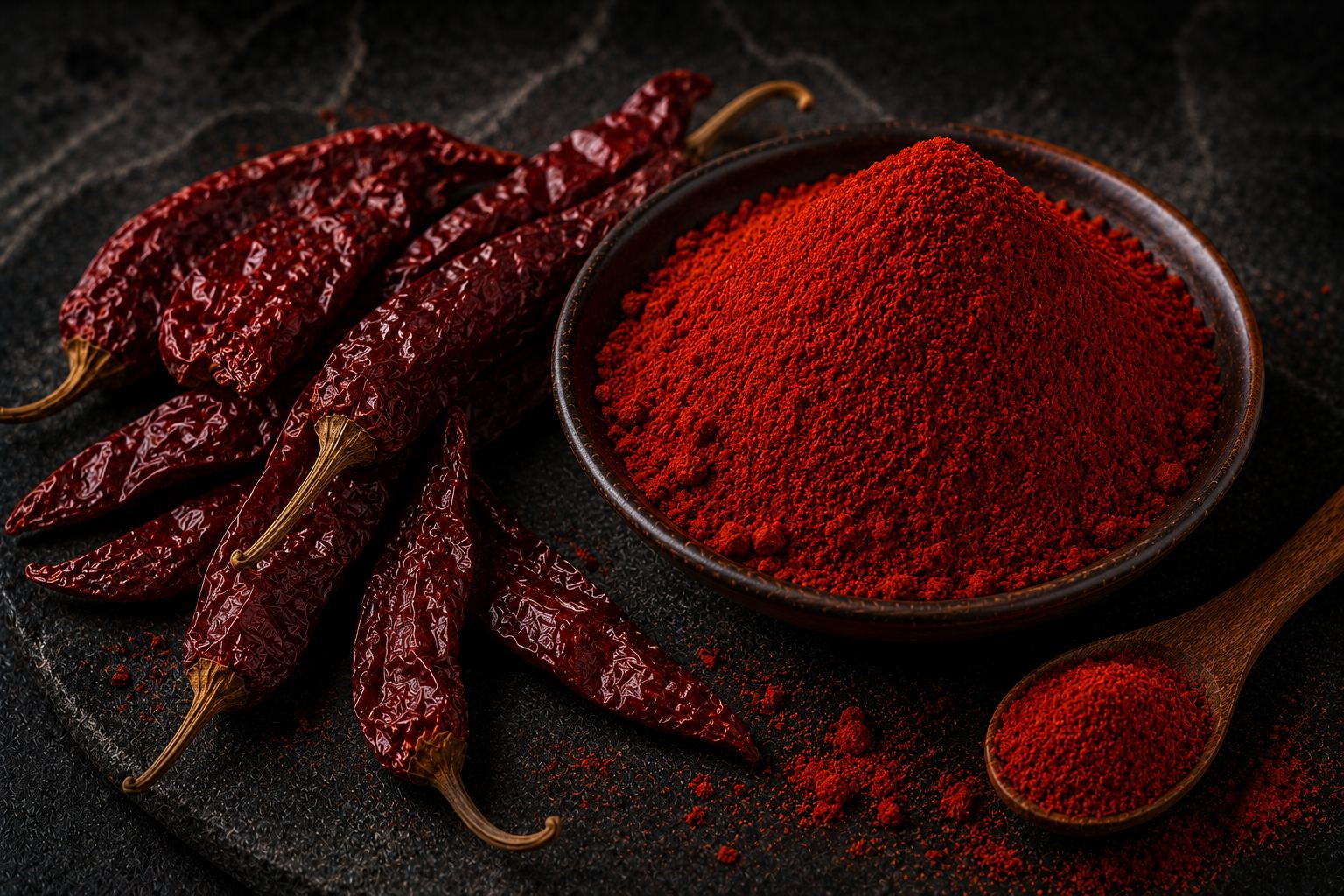
Kashmiri chilli — Deghi Mirch — is a specific variety of Capsicum annuum grown primarily in the Kashmir Valley. It is distinguished from other red chillies by one defining characteristic: it provides an intensely deep, vivid red colour with very low heat (1,000–2,000 Scoville Units, compared to 50,000+ for hot varieties). This combination makes it the professional kitchen's secret weapon for colour — tandoori chicken, chicken tikka, rogan josh, and butter chicken all derive their characteristic deep red colour from Kashmiri chilli, not from regular red chilli powder.
Deghi mirch is slightly different from standard Kashmiri mirch — traditionally referring to a blend or preparation used in Delhi's restaurant cooking, sometimes incorporating other mild red chillies with similar properties. In practice, the terms are used interchangeably for the mild, colour-forward Kashmiri variety.
- Tandoori chicken's iconic red-orange colour comes entirely from Kashmiri chilli in the marinade — without it, the chicken would be pale-yellow from turmeric
- Rogan josh — Kashmir's defining lamb preparation — derives its deep red colour from Kashmiri chilli (the traditional recipe uses Ratanjot, a plant dye, but Kashmiri mirch is the modern standard)
- Restaurant curries use Kashmiri chilli generously for colour with minimal heat impact — allowing chefs to control heat and colour independently
- Butter chicken's vivid orange-red colour in restaurant versions uses 2–3 tablespoons of Kashmiri mirch where a home cook might use only one of regular chilli
- The ability to add colour independently from heat is a fundamental professional cooking technique that Kashmiri chilli enables
Kashmiri Chilli Through History
The Kashmir Valley's cool climate, high altitude, and specific soil conditions produce a chilli variety with unusually high capsanthin (the red pigment compound) and low capsaicin content. This variety has been cultivated in Kashmir for several hundred years — long enough for it to become a defining agricultural product of the region.
The restaurant cooking tradition of North India, particularly in Delhi, developed the technique of using Kashmiri mirch as a colour agent separately from hot chilli as a heat agent — allowing precise control of both. This technique, once confined to professional kitchens, has become widely understood in home cooking.
The Science of Kashmiri Chilli
How to Store Kashmiri Chilli
How to Buy Good Kashmiri Chilli
How to Use Kashmiri Chilli Correctly
- Use generously for colour — 1–3 tbsp per dish for restaurant-style colour
- For tandoori marinade: 2 tbsp Kashmiri mirch in the yogurt base
- Combine with a small amount of hot chilli: Kashmiri for colour, hot chilli for heat
- Add to hot oil — the colour blooms immediately into the oil
- For rogan josh: use 2 tbsp per kilo of lamb for the characteristic deep red colour
- Tastes mild, use as much as needed for colour without worrying about heat
What Kashmiri Chilli Pairs Well With
Dishes That Use Kashmiri Chilli
Where Kashmiri Chilli Matters Most
| North Indian Cuisine | Essential |
| Kashmiri Cuisine | Essential |
| Mughlai Cuisine | Essential |
| Restaurant Indian Cooking | Essential |
| South Indian Cuisine | Common |
| Jain Cooking | Common |
| Sattvic Cooking | Occasional |
Kashmiri Chilli vs Regular Red Chilli vs Paprika
| Feature | Kashmiri Chilli | Regular Red Chilli | Paprika (Hungarian) |
|---|---|---|---|
| Heat level | Very mild (1,000–2,000 SHU) | Medium-high (30,000–100,000 SHU) | Mild-medium (0–1,000 SHU) |
| Colour | Deep vivid red | Orange-red | Orange-red |
| Colour compound | Capsanthin | Less capsanthin | Capsanthin |
| Flavour | Mildly fruity | Sharp, hot | Sweet, paprika-specific |
| Indian use | Essential for colour | Essential for heat | Acceptable substitute |
| Substitute for? | Paprika (approximately) | Cannot be replaced | Kashmiri chilli (approximately) |