★★★★★ South India
★★★★★ North India
What Does Coriander Seeds Taste Like?
Coriander Seeds in Every Indian Language
| Language | Name | Pronunciation |
|---|---|---|
| English | Coriander Seeds | CO-ree-an-der |
| Hindi | धनिया — Dhania | DHAH-nee-ah |
| Bengali | ধনে — Dhone | DHOH-neh |
| Tamil | மல்லி — Malli / தனியா — Dhania | MAH-lee |
| Telugu | ధనియాలు — Dhaniyalu | DHAH-nee-yah-loo |
| Malayalam | മല്ലി — Malli | MAH-lee |
| Kannada | ಕೊತ್ತಂಬರಿ — Kottambari | Kot-tam-bah-ree |
| Gujarati | ધાણા — Dhana | DHAH-nah |
| Marathi | धणे — Dhane | DHAH-neh |
| Punjabi | ਧਨੀਆ — Dhania | DHAH-nee-ah |
| Urdu | دھنیا — Dhania | DHAH-nee-ah |
| Sanskrit | धन्यक — Dhanyaka | DHAH-nyah-kah |
What Is Coriander Seeds?
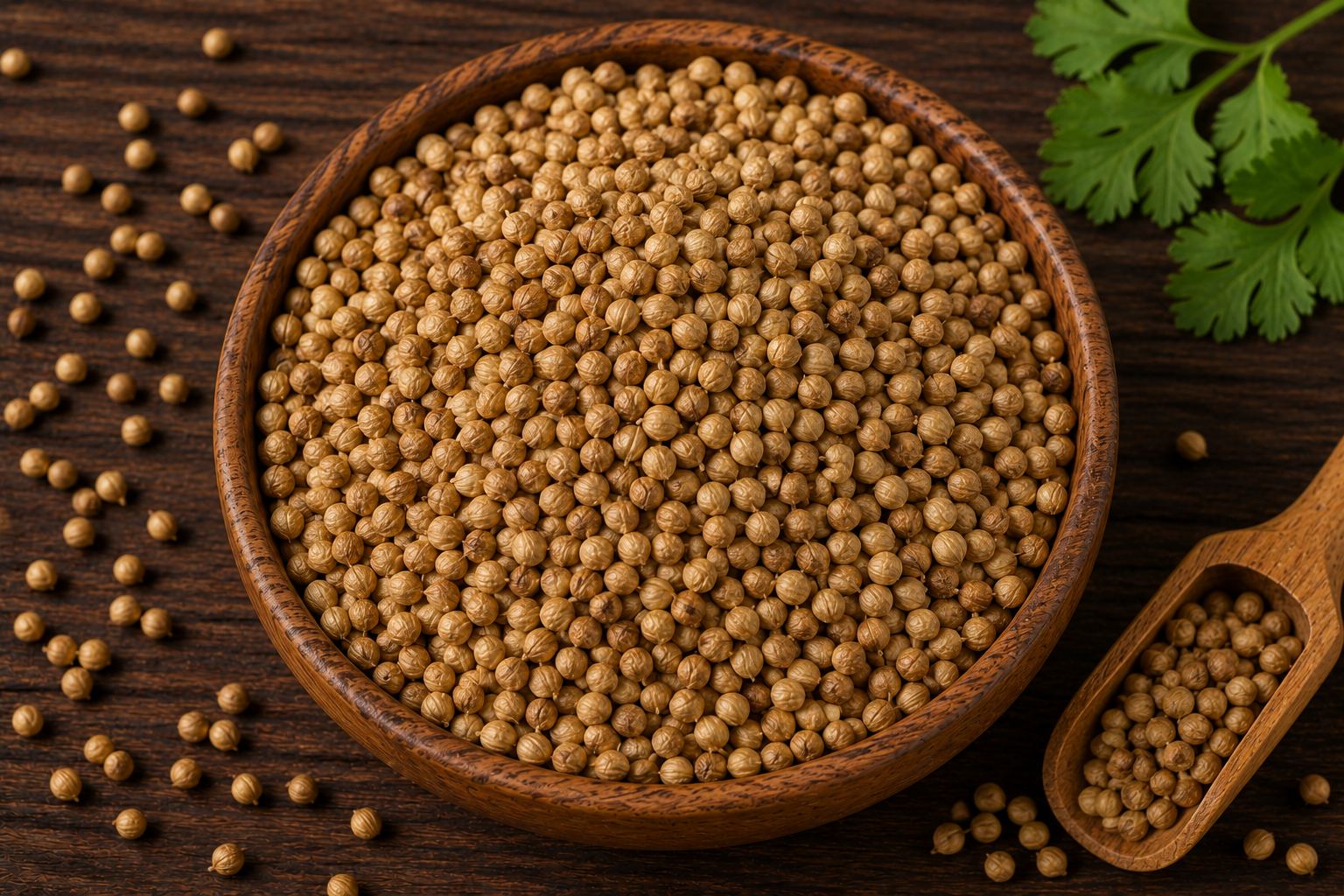
Coriander seeds are the dried fruits of Coriandrum sativum — the same plant that produces the fresh coriander leaves (cilantro) used as a garnish across Indian cooking. The seeds and leaves have distinctly different flavour profiles: the seeds are warm, citrusy, and gently floral, while the leaves are bright, grassy, and pungent. Using one as a substitute for the other is a fundamental error.
Coriander seeds are among the most ancient cultivated spices, used across Indian cooking for at least 5,000 years. In Indian cooking they appear in two forms: whole seeds in some regional tadkas and spice blends, and ground coriander powder (dhania powder) which is one of the foundational four spices of almost every North Indian curry base alongside cumin, turmeric, and red chilli.
- Ground coriander is the primary bulk spice in North Indian curry bases — curries made without it taste thin and unbalanced
- Sambar powder, rasam powder, and South Indian spice blends are structurally built on coriander as the base spice
- The gentle, citrusy character of coriander counterbalances the earthiness of cumin — the two are paired in virtually every Indian masala
- Chutney — both coconut chutney in the South and green chutney in the North — uses coriander as a structural flavour element
- Without coriander, most Indian spice blends would be too pungent and one-dimensional
Coriander Seeds Through History
Coriander seeds have been found in Egyptian tombs dating to 1000 BCE and are referenced in Sanskrit texts as dhanyaka. Archaeological evidence suggests cultivation in the Indian subcontinent for at least 5,000 years. It is one of the few spices that spans virtually every ancient food culture — appearing in Greek, Roman, Egyptian, Arab, and Indian historical records simultaneously.
The Arab spice trade brought coriander into contact with European cuisine via Alexandria, and it became one of the defining spices of medieval European cooking — now largely replaced by black pepper. In India, it never fell out of fashion and remains today the most versatile workhorse spice in the entire Indian kitchen.
The British colonial spice trade categorised coriander as a secondary spice — it was too mild and common to attract the premium prices commanded by pepper and cardamom. This commercial undervaluation obscures its fundamental importance to Indian cooking.
The Science of Coriander Seeds
How to Store Coriander Seeds
How to Buy Good Coriander Seeds
How to Use Coriander Seeds Correctly
- Ground: add with turmeric and other powder spices during the masala stage — after onions are cooked, before tomatoes
- Whole: dry-roast in a hot pan 2 minutes until slightly darker and fragrant, then cool and grind
- Quantity: 1–2 tsp ground per curry for 4 people — the largest quantity of any single ground spice
- For chutneys: add roasted whole seeds to coconut or herb chutneys for a nutty citrus note
- For tempering: not traditional but whole seeds can be used in South Indian tadka
What Coriander Seeds Pairs Well With
Dishes That Use Coriander Seeds
Where Coriander Seeds Matters Most
| North Indian Cuisine | Essential |
| South Indian Cuisine | Essential |
| Bengali Cuisine | Common |
| Gujarati Cuisine | Essential |
| Keralan Cuisine | Essential |
| Mughlai Cuisine | Essential |
| Jain Cooking | Essential |
| Sattvic Cooking | Essential |
Coriander Seeds vs Coriander Leaves vs Cumin
| Feature | Coriander Seeds | Coriander Leaves | Cumin Seeds |
|---|---|---|---|
| Plant part | Seed (dried fruit) | Fresh leaf | Seed |
| Flavour | Citrus, warm, floral | Grassy, bright, pungent | Earthy, warm, nutty |
| Used ground? | Yes — essential | No | Yes — essential |
| Indian cooking role | Masala base | Garnish | Tadka + masala |
| Interchangeable? | No | No | No — different role |
| Heat tolerance | Medium | Not cooked | High |