★★★★☆ Bengal
★★★☆☆ South India
What Does Bay Leaf Taste Like?
Bay Leaf in Every Indian Language
| Language | Name | Pronunciation |
|---|---|---|
| English | Bay Leaf / Indian Bay Leaf | BAY LEEF |
| Hindi | तेज पत्ता — Tej Patta | TEJ PAH-tah |
| Bengali | তেজপাতা — Tejpata | TEJ-pah-tah |
| Tamil | தாளிசபத்திரி — Talishapathiri | tah-LEE-sha-pah-THEE-ree |
| Telugu | బిర్యాని అకు — Biryani Akku | beer-YAH-nee AK-koo |
| Malayalam | തലിശ — Talisha | TAH-lee-sha |
| Kannada | ಬಿರ್ಯಾನಿ ಎಲೆ — Biryani Ele | beer-YAH-nee EH-leh |
| Gujarati | તમાલ પત્ર — Tamal Patra | TAH-mul PAH-trah |
| Marathi | तमालपत्र — Tamalpatra | tah-MAL-PAH-trah |
| Punjabi | ਤੇਜ ਪੱਤਾ — Tej Patta | TEJ PAH-tah |
| Urdu | تیز پتہ — Tej Patta | TEJ PAH-tah |
| Sanskrit | तमालपत्र — Tamalpatra | tah-MAL-pah-trah |
What Is Bay Leaf?
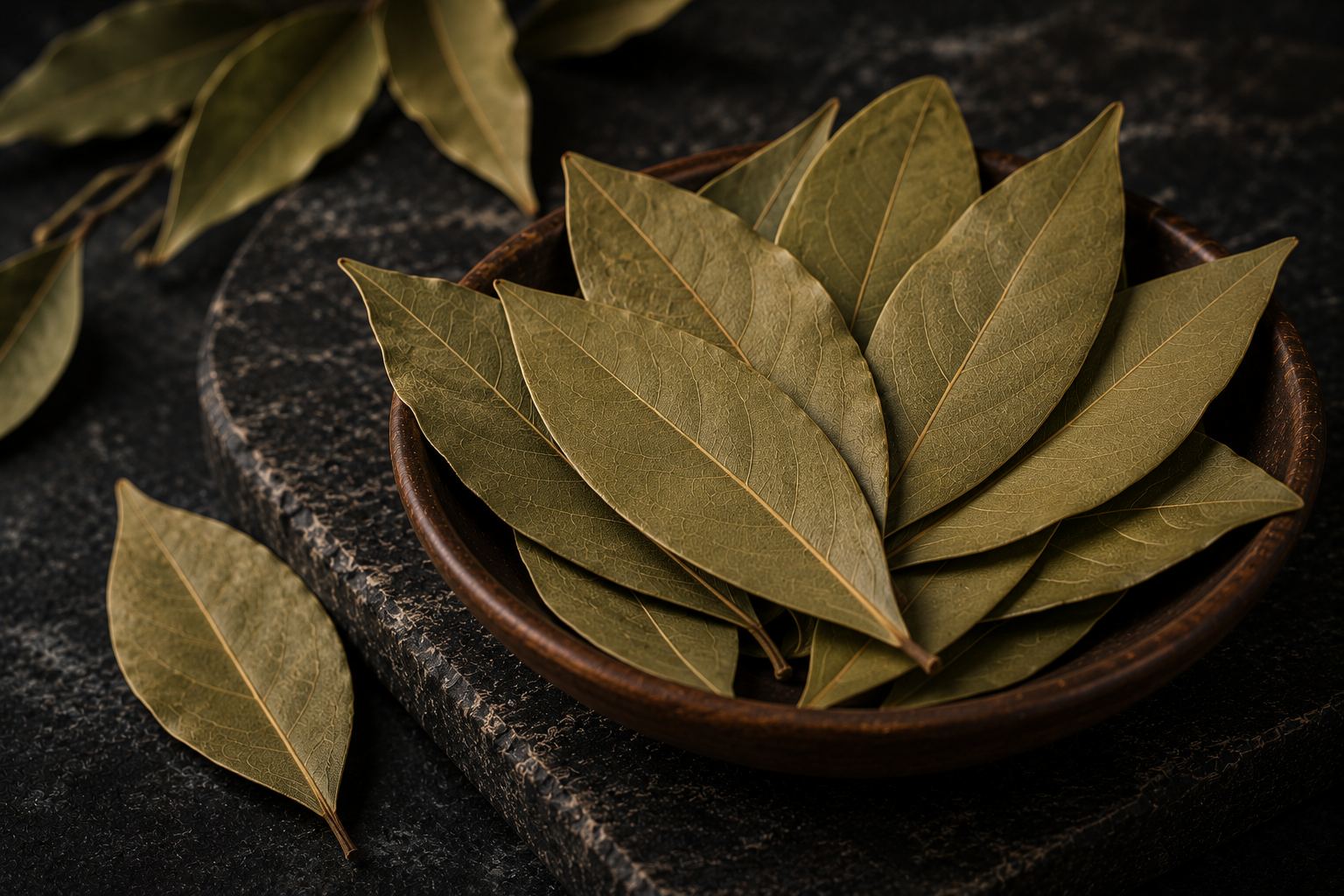
There is an important and widely misunderstood distinction in bay leaves: Indian tej patta (Cinnamomum tamala) and Mediterranean bay leaf (Laurus nobilis) are completely different plants with different flavour profiles. Indian tej patta has three prominent veins running the length of the leaf and tastes of cinnamon-clove — because it is from the lauraceae (laurel) family, like cinnamon. Mediterranean bay leaf has one central vein and tastes herbal-eucalyptus.
In Indian cooking, it is tej patta — the Indian variety — that is traditionally used and that is sold in Indian spice shops as 'tej patta' or 'bay leaf.' However, the Mediterranean bay leaf can be used as a substitute and is increasingly common in Indian households due to wider availability.
- Biryani's aromatic base in the ghee stage uses tej patta alongside cinnamon, cardamom, and cloves — it provides a gentle background note
- Pulao and rice pilafs in North Indian cooking traditionally include a tej patta leaf in the cooking water
- Dal makhani and slow-cooked lentils benefit from a tej patta infused during the long cooking process
- The cinnamon-adjacent character of Indian tej patta complements the cinnamon sticks already present in biryani spice mixes
- Without tej patta, North Indian rice dishes and biryanis lose a subtle but detectable aromatic layer
Bay Leaf Through History
Tej patta (Cinnamomum tamala) grows wild in the Himalayan foothills and across South Asia. It appears in Sanskrit texts as tamalpatra and in Ayurvedic formularies for digestive properties. The three-veined leaf is mentioned in the Charaka Samhita and other ancient texts.
The confusion between Indian tej patta and Mediterranean bay leaf arose during British colonialism, when European bay leaf (Laurus nobilis) began to be called 'bay leaf' in English and the two plants were conflated in Indian-English cooking references. Many recipe books written in English for Indian cooking specify 'bay leaf' and intend Mediterranean bay, but Indian cooking tradition uses tej patta with its distinctly different cinnamon-clove character.
The Science of Bay Leaf
How to Store Bay Leaf
How to Buy Good Bay Leaf
How to Use Bay Leaf Correctly
- Add 1–2 whole leaves to hot ghee at the start of biryani or pulao preparation
- For dal: add 1 leaf to the pressure cooker or pot during cooking — remove before serving
- For slow-cooked meat: add whole at the start — remove before serving
- Never eat whole — the leaf is always removed before serving
- Quantity: 1–2 leaves per dish for 4 people
- Crumble slightly before adding to release more aroma
What Bay Leaf Pairs Well With
Dishes That Use Bay Leaf
Where Bay Leaf Matters Most
| North Indian Cuisine | Essential |
| Mughlai Cuisine | Essential |
| Kashmiri Cuisine | Essential |
| Bengali Cuisine | Common |
| South Indian Cuisine | Occasional |
| Jain Cooking | Common |
| Sattvic Cooking | Common |
Indian Tej Patta vs Mediterranean Bay Leaf
| Feature | Indian Tej Patta | Mediterranean Bay Leaf |
|---|---|---|
| Botanical name | Cinnamomum tamala | Laurus nobilis |
| Veins | 3 prominent parallel | 1 central vein |
| Key compounds | Eugenol, Cinnamaldehyde | 1,8-Cineole, Linalool |
| Flavour | Cinnamon-clove adjacent | Herbal, eucalyptus-adjacent |
| Traditional Indian use | Yes — tej patta | No — Western influence |
| In biryani? | Traditional | Acceptable substitute |
| Interchangeable? | Partially | Partially |
| Availability | Indian grocery shops | Supermarkets worldwide |