🍛 Curry · Level 1
Kadai Paneer
Paneer and capsicum in a freshly ground kadai masala — the dish defined by the wok, the char and the crunch. Not a smooth curry. A textured, semi-dry preparation with bite.
Paneer and capsicum in a freshly ground kadai masala — the dish defined by the wok, the char and the crunch. Not a smooth curry. A textured, semi-dry preparation with bite.
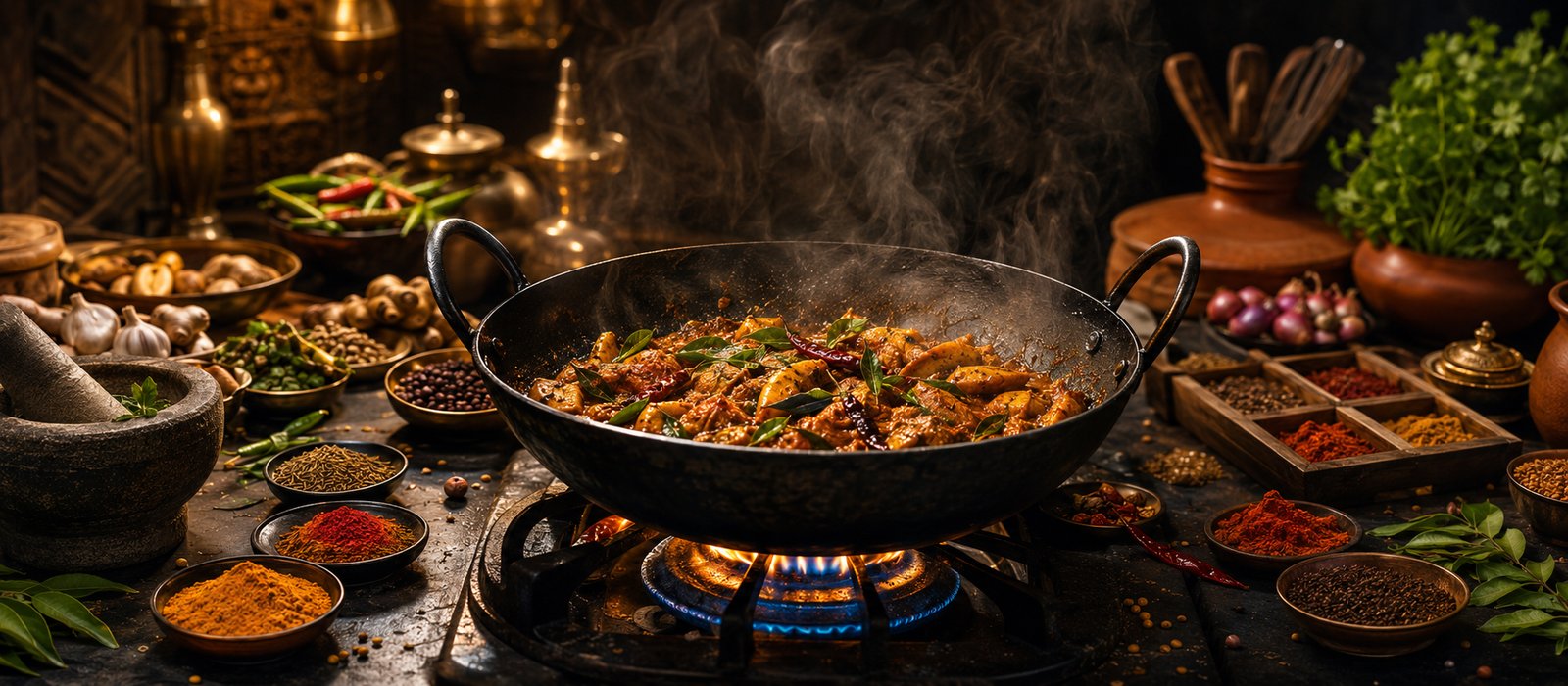
Kadai paneer gets its name from the kadai — the Indian wok — and the technique of cooking over high heat. The defining characteristics are: freshly ground kadai masala (not pre-made powder), crunchy capsicum that retains its texture, and a semi-dry consistency rather than a saucy gravy. Most restaurant versions produce a soft, saucy dish. The authentic version has texture at every level — the char on the paneer, the crunch in the capsicum, the coarseness of the freshly ground masala.
In a dry pan over medium heat, roast coriander seeds and dried red chillies until coriander seeds turn a shade darker and smell intensely aromatic — about 2 minutes. Do not burn. Cool, then coarsely grind — not a fine powder. Keep some texture.
Dry roasting triggers pyrolysis of the coriander seeds' cell walls, releasing trapped volatile terpenes — primarily linalool and geraniol — and creating new pyrazine and furan compounds through Maillard reactions between the seed's amino acids and reducing sugars. Fresh-ground masala contains these volatile compounds at full concentration — pre-made powder has lost 60–80% of these aromatics through oxidation during storage. The coarse grind preserves cell structure in some particles, releasing additional aromatics at different points during cooking as the particles break down.
Heat a kadai or wok over maximum heat. Add oil — it should shimmer immediately. Add paneer and fry without moving for 2 minutes until charred on one side. Flip and char the other side. Remove and set aside.
The kadai's curved shape and thin walls allow rapid temperature recovery — when cold paneer hits the hot surface, the pan temperature drops momentarily. A kadai recovers faster than a flat pan. The 2-minute undisturbed contact allows the Maillard reaction to reach completion on each surface — interrupted by moving the paneer, the surface temperature drops and browning stops. The char produces the same heterocyclic aromatic compounds as tandoor cooking, providing depth that cold-added paneer cannot contribute.
In the same pan, add more oil if needed. Add onion petals — cook 2 minutes on high heat, keeping some crunch. Add ginger-garlic paste, cook 1 minute. Add tomatoes, turmeric, Kashmiri chilli. Cook on high heat until tomatoes soften and oil begins to separate — about 8 minutes.
Onion cut into squares and cooked briefly on high heat retains its cell structure — the rapid surface browning seals the outer layers while the interior remains crunchy. This is fundamentally different from finely chopped onion cooked slowly. The textural contrast between the softened tomato base and the crunchy onion petals is structural to the dish. Cooking over high heat throughout prevents the onion from steaming in its own moisture, which would eliminate the crunch.
Add kadai masala to the tomato base and cook 1 minute. Add capsicum — toss on high heat for 3 minutes only. Add paneer, kasuri methi, salt. Toss everything together for 2 minutes. Garnish with coriander and ginger julienne.
Capsicum's cell walls are primarily pectin — a polysaccharide that breaks down above 70°C with prolonged heat exposure, causing the capsicum to become soft and watery. 3 minutes on high heat heats the capsicum surface above 70°C for a brief period, producing slight Maillard browning while leaving the interior crisp-tender — the cell walls soften only at their surfaces. The ginger julienne added as garnish provides a fresh, raw aromatic top note from uncooked gingerol — a sharp counterpoint to the cooked, deep masala base.