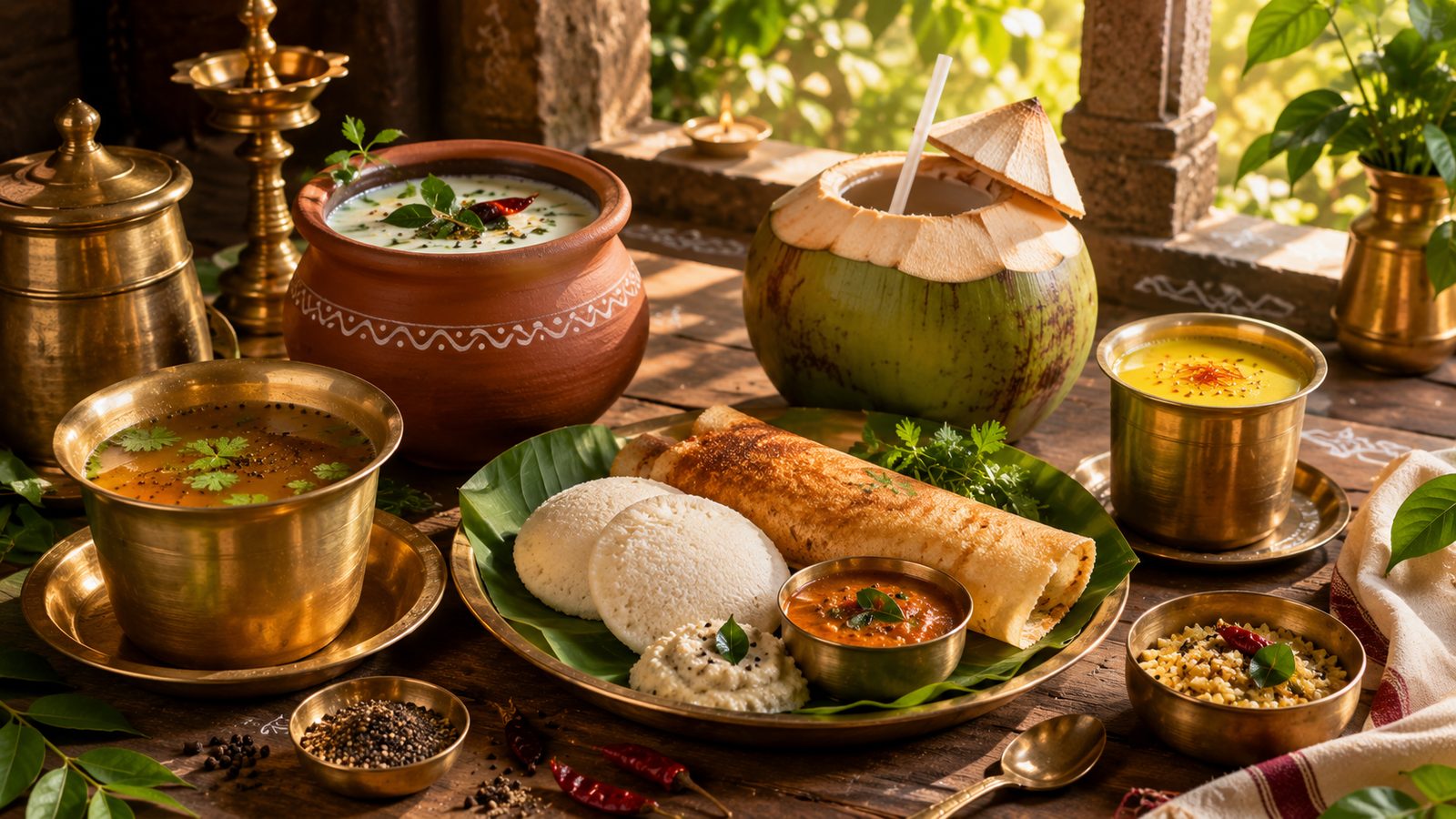
Before filter coffee, South India drank rasam. The thin, peppery, tamarind broth — warming, stimulating, restorative — occupied the emotional and physiological role that the morning cup of coffee now fills. Then seven seeds arrived from Arabia, found the perfect climate in the Western Ghats, and created a coffee culture so distinctly South Indian that it has almost nothing in common with the drink it technically came from.
The World Before Coffee in India
Coffee's story begins in the highlands of Ethiopia, where Coffea arabica grows wild and where indigenous communities consumed coffee in various forms for centuries. From Ethiopia, coffee cultivation spread to Yemen — probably in the fifteenth century — and it was the Arab world that first developed the practice of roasting and brewing coffee beans as a hot drink. By the sixteenth century, coffee houses — qahveh khaneh — had become important social institutions in Istanbul, Cairo, and Mecca. Coffee was a stimulant, a luxury, and increasingly a social ritual. But it was entirely Arab and Ottoman in its cultural context. India was outside this world entirely.
In South India, the beverage landscape was built around dairy, fresh juice, and herbal preparations — all of them aligned with Ayurvedic principles rather than the stimulant culture of Arabian coffee houses. Rasam, chaas, coconut water, herbal infusions of tulsi and ginger — these were the daily drinks of a region that had not encountered the coffee plant. They were not substitutes for coffee. They were the complete, appropriate, climate-adapted beverage tradition of a region that simply had not met coffee yet.
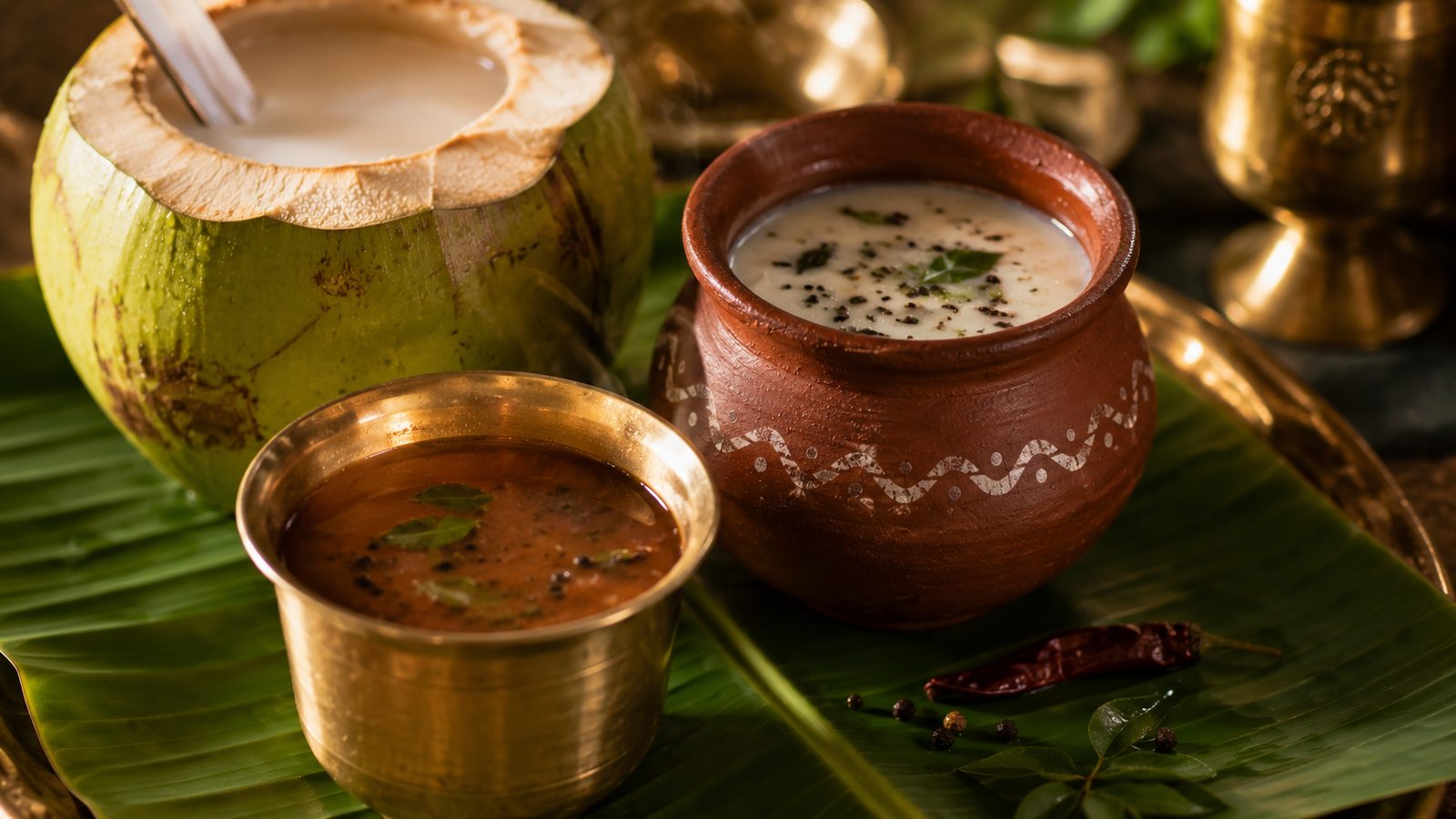
South India before coffee: rasam in a small tumbler, chaas, herbal infusions, fresh coconut water. A complete beverage tradition — warming, cooling, digestive, restorative — that existed for thousands of years before coffee arrived.
What the Texts Tell Us
Historical Evidence at a Glance
Ancient Tamil literature: Rasam — under various names — documented as a warming, restorative broth. Black pepper and dried ginger used as stimulant spices in broth preparations that functioned as medicinal and everyday drinks.
Charaka Samhita: Warm spiced water and herbal decoctions recommended as daily health practices. The Ayurvedic tradition of warming morning drinks predates coffee by thousands of years.
Coffee origins: The Sufi tradition in Yemen and Arabia developed coffee drinking in the 15th century as an aid to nocturnal prayer. The Arab monopoly on coffee cultivation was maintained by preventing fertile seeds from leaving Yemen.
Baba Budan tradition: A Sufi mystic from the Chikmagalur region of Karnataka is said to have returned from the Haj pilgrimage in the early 17th century with seven live coffee seeds concealed against his body, planting them in the hills now called Baba Budan Giri.
British colonial expansion: Large-scale commercial coffee estates in Coorg, Chikmagalur, and the Nilgiris developed in the 19th century under British promotion.
Timeline
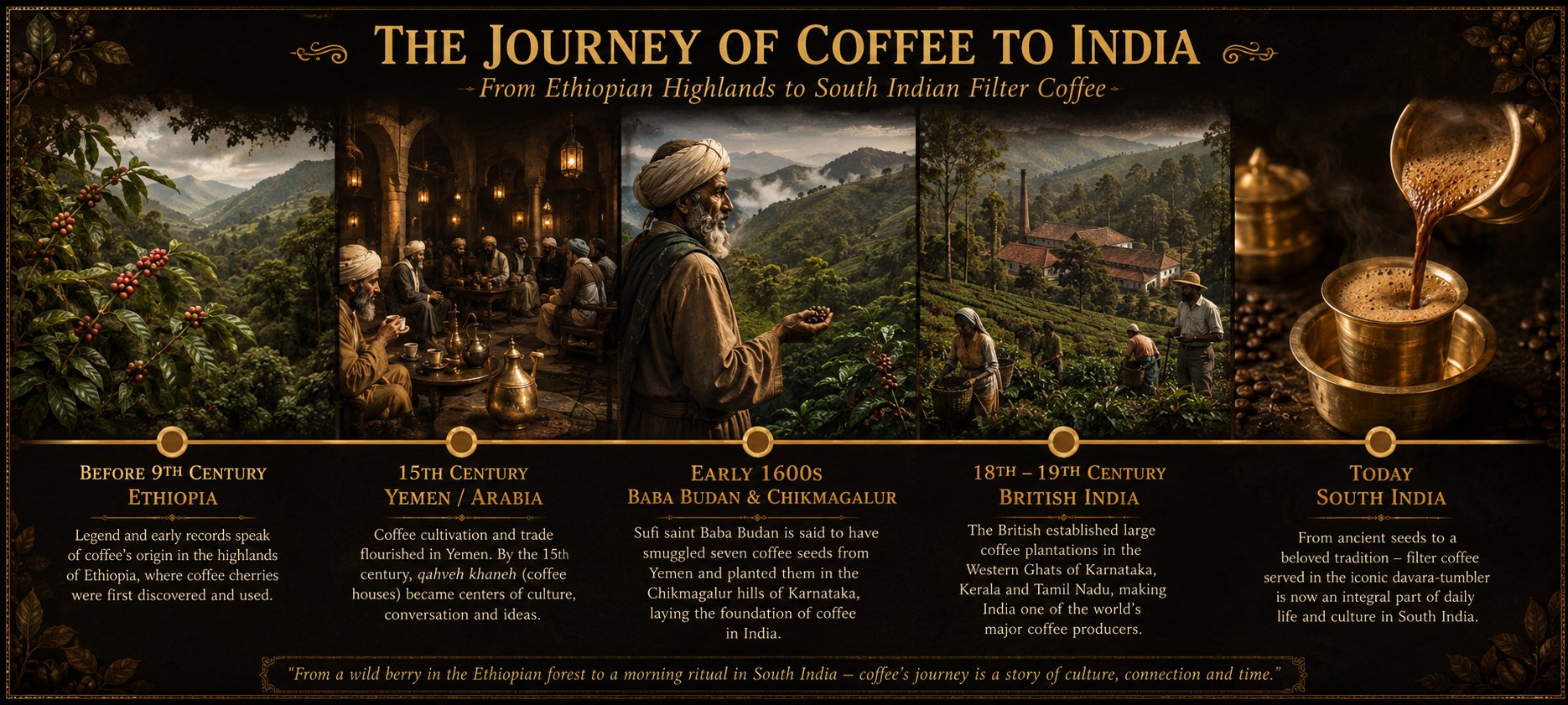
From Ethiopian highlands to Arabian coffee houses to the Western Ghats to the South Indian davara-tumbler — coffee's four-century Indian journey. Click to enlarge.
| Date | Event |
|---|---|
| Ancient Ethiopia | Coffee plants grow wild; indigenous communities use coffee in various forms. |
| 1400s | Coffee cultivation and the practice of brewing roasted beans develop in Yemen and Arabia. |
| 1500s | Ottoman coffee houses spread across the Middle East. Arab monopoly on coffee maintained by preventing fertile seeds from leaving Yemen. |
| Early 1600s | Baba Budan tradition: seven coffee seeds arrive in Chikmagalur, Karnataka. Cultivation begins in the Western Ghats. |
| 1700s | Coffee cultivation expands in the Western Ghats. Local consumption develops. |
| 1800s | British colonial expansion of coffee estates in Coorg, Chikmagalur, and the Nilgiris. India becomes a significant coffee producer. |
| 1900s | South Indian filter coffee culture emerges and consolidates. The davara-tumbler becomes iconic. Indian Coffee House established 1940s. |
| Present | India is among the world's significant coffee producers. Filter coffee is a core element of South Indian cultural identity. |
Rasam — What Coffee Replaced
Rasam is one of the oldest preparations in South Indian cooking — a thin, peppery, tamarind-based broth seasoned with dried ginger, black pepper, and a tadka of mustard seeds, curry leaves, and dried chilli. It contains black pepper and dried ginger, both of which have documented mild stimulant and digestive-activating properties, and it was consumed at the start of meals and throughout the day as a digestive and restorative. In some traditional South Indian households, rasam served the function of coffee — warming, slightly stimulating, deeply restorative — and its association with physical recovery is so strong that it remains the go-to food when anyone is unwell.
The comparison between rasam and coffee is not merely poetic. Both are hot, aromatic, mildly stimulating morning drinks with deeply restorative properties. Both are consumed daily as ritual rather than simply as nutrition. Both are associated with home comfort and recovery from illness. The emotional role they occupy is remarkably similar — which is why filter coffee could replace rasam as South India's morning ritual without requiring a wholesale change in the psychology of how South Indians relate to their morning drink.
"Rasam was South India's coffee before coffee arrived — warm, stimulating, restorative, and deeply connected to a sense of home. When filter coffee took root, it did not displace rasam. It took the morning ritual role and made it its own."
What South Indians Drank Before Coffee — A Full Picture
Rasam: Thin peppery tamarind broth — the primary warm, stimulating, restorative drink. Consumed at meals and medicinally. The closest functional equivalent to coffee in the pre-coffee South Indian beverage tradition.
Chaas / Majjige: Spiced buttermilk — the everyday cooling drink, particularly in the heat of South Indian summers. Digestive and settling.
Herbal infusions: Tulsi (holy basil) decoctions, ginger water, pepper-and-honey preparations. Ayurvedic warming and health-supporting drinks used daily in traditional households.
Coconut water: The default refreshing drink in coastal regions from Kerala to Tamil Nadu. Available year-round, naturally sweet, and culturally embedded.
Sugarcane juice: Seasonal, sweet, energising. Available wherever sugarcane was grown, which was widely across South India.
Panakam: A traditional cooling drink made with jaggery, dry ginger, cardamom, and pepper — offered as prasadam in South Indian temples and consumed domestically during festivals.
The Arab Monopoly and the Seven Seeds
Coffee cultivation was a jealously guarded Arab commercial monopoly. The primary cultivation region was Yemen, and Arab traders had a strong interest in maintaining their dominance over the supply of this increasingly valuable commodity. One mechanism of control was preventing fertile coffee seeds from leaving Yemen — green unroasted beans can germinate, but processed beans cannot. This context makes the Baba Budan story significant whether or not it is literally accurate.
According to tradition, a Sufi mystic named Baba Budan made the Haj pilgrimage to Mecca and returned to India with seven live coffee seeds concealed against his body, planting them in the Chandra Drona hills of Chikmagalur in Karnataka — now called Baba Budan Giri in his honour. The story captures something real about the period: Arab trade networks were the mechanism through which coffee knowledge could reach India, and the only way to break the monopoly was through a form of smuggling. Whether the specific details are accurate is uncertain. That the general pattern reflects the historical reality of how coffee arrived is not seriously disputed.
The Western Ghats — A Perfect Environment
When coffee seeds reached the Western Ghats hills of Karnataka, they found one of the world's best natural coffee-growing environments. The combination of elevation (900–1500 metres), rainfall (1500–2500mm annually), moderate temperatures, and natural shade from the forest canopy created conditions remarkably similar to the Ethiopian highlands where coffee originated. The Western Ghats also have rich volcanic soil and biodiversity that produces complex flavour profiles in the beans — low acidity, full body, and subtle spice notes that reflect the surrounding vegetation in which the coffee is shade-grown.
Indian coffee — particularly from Coorg, Chikmagalur, and the Nilgiris — is valued internationally for this distinctive character. The specific terroir of the Western Ghats produces coffee that tastes of the land that grows it: a quality that connects the modern cup of filter coffee to the ancient ecology of the same hills where Baba Budan is said to have planted his seven seeds.
Before vs After: South India's Morning
How South India Made Coffee Its Own
When South Indians adopted coffee, they built a coffee culture unlike anything that exists elsewhere. The davara-tumbler set — a wide stainless steel cup and a cylindrical vessel — the practice of pouring from height to aerate and foam the drink, the specific blend of dark-roasted Arabica with chicory, the mixing with hot milk and sugar before the pour — all of these are South Indian innovations. The result bears no resemblance to the qahwa of the Arab world that originally produced the seeds, nor to the espresso of Italy, nor to the filter coffee of North America. It is a South Indian creation, built on a foreign plant using entirely local ingenuity.
The Science of South Indian Filter Coffee
The apparatus: A two-stage stainless steel filter. Finely ground coffee in the upper chamber; hot water poured over it drips slowly through into the lower chamber over 15–30 minutes, producing a concentrated decoction.
Why it works: Slow drip extraction at near-boiling temperature extracts fewer bitter compounds than espresso's high-pressure extraction — producing a concentrate with lower bitterness and higher sweetness than most Western coffee methods.
The chicory blend: South Indian filter coffee typically contains 15–30% chicory alongside the coffee. Chicory adds bitterness, body, and a distinctive slightly earthy-sweet note that cannot be replicated without it. It also makes the coffee more affordable — an important practical consideration in its historical adoption.
The pour: Mixing hot decoction with hot milk and pouring between davara and tumbler from height aerates the drink and creates the characteristic foam. The height also cools the drink from scalding to drinking temperature in a single motion.
The result: A drink so specific and so distinct from every other coffee tradition that South Indian filter coffee occupies its own category in world coffee culture.
Regional Impact
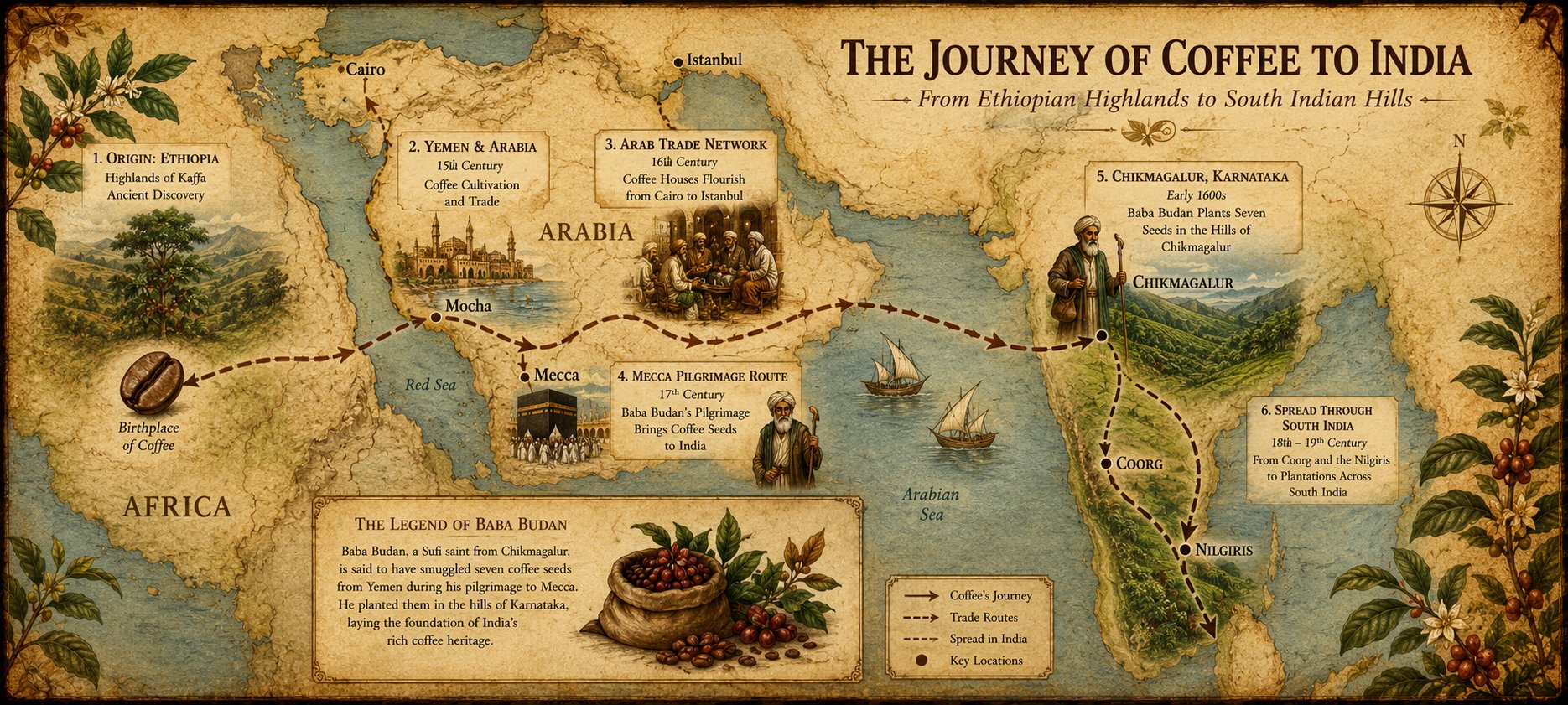
Ethiopia to Arabia to Chikmagalur to every South Indian kitchen — coffee's journey to becoming a defining element of South Indian identity. Click to enlarge.
Debate & Myths
Is the Baba Budan Story True?
Historians broadly agree that the general pattern — coffee seeds arriving in India through Arab trade networks in the early seventeenth century — is historically plausible and likely accurate. The specific details of the Baba Budan story (the exact identity of the pilgrim, the precise number of seven seeds, the specific date) are not independently documented and may be legendary accretions to a real historical event.
What the story accurately captures is the mechanism: Arab trade connections as the route of introduction, the monopoly-breaking nature of the transfer, and the Sufi spiritual context in which coffee was culturally embedded in both its Arabian origin and its South Indian adoption. The shrine to Baba Budan in the Chikmagalur hills — which is notably a site of both Hindu and Muslim veneration — suggests the story has cultural depth beyond simple invention. The historical consensus is that the legend is plausible; the specific details cannot be confirmed.
Why Did Coffee Take Root in South India But Not the North?
The answer is primarily geographic and climatic. The Western Ghats hills provide the elevation, rainfall, and temperature conditions that coffee requires — conditions that do not exist in the same way in the plains of North India. Coffee cultivation that started in Chikmagalur naturally spread through the ecologically similar hill regions of Karnataka, Kerala, and Tamil Nadu, while remaining marginal in the North Indian plains where the climate was unsuitable.
The parallel success of tea — which was cultivated in Assam and Darjeeling, not in South India — reinforced this geographic division. North India got its caffeine culture from tea, introduced and commercially developed by the British. South India developed its own from coffee, introduced through Arabian trade networks a century and a half earlier. The result is one of the most interesting cultural divides in Indian beverage history: two different plants, two different trade networks, two different colonial relationships, producing two parallel caffeinated cultures that coexist in the same country without ever quite converging.
What If Coffee Never Came to India?
Without coffee, South India's morning ritual would still centre on rasam and chaas. The intellectual café culture that developed around the Indian Coffee House — the tradition of writers, activists, and students meeting over coffee in Bengaluru, Chennai, and Thiruvananthapuram — would not exist in the same form. The Western Ghats coffee economy, which employs hundreds of thousands of people in cultivation and processing, would not have developed.
South India's beverage culture would have remained dairy-dominant, and the specific identity of filter coffee — one of the most distinctive regional food identities in India — would not exist. Tea might have spread more completely into the South, or the dairy traditions might have remained dominant. The Indian Coffee House as a specific institution of South Indian intellectual life — with its particular combination of affordable coffee and serious conversation — would simply not have happened.
What Survived
The Pre-Coffee South Indian Beverage Tradition That Remains
Modern Legacy
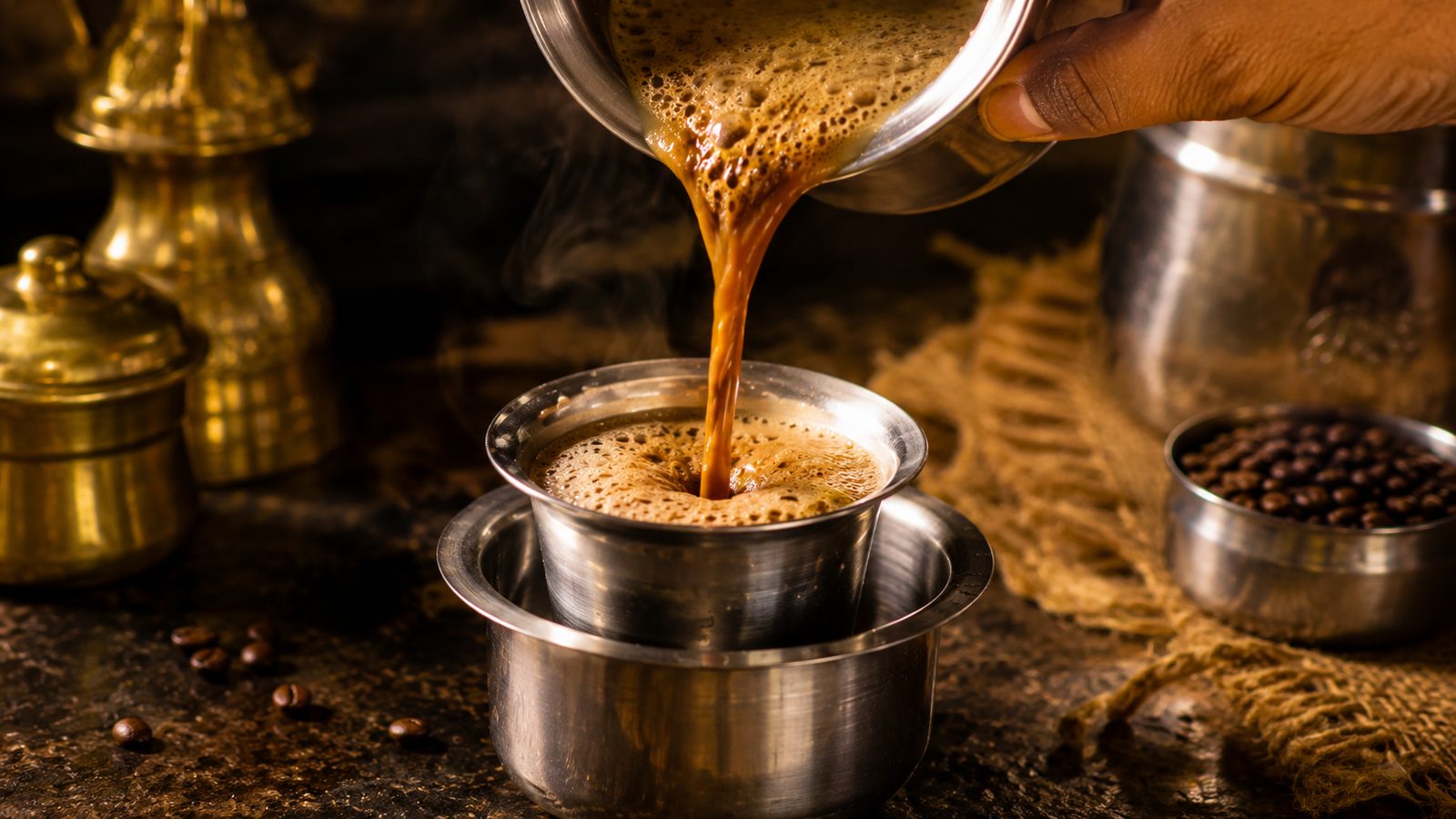
The davara-tumbler: South India's entirely original contribution to world coffee culture. No other coffee tradition pours from height, mixes with hot milk before serving, or uses this specific vessel combination. A foreign plant, completely reimagined.
Filter coffee today is one of South India's most powerful cultural identifiers. The sight of a steel davara-tumbler, the specific aroma of a dark-roasted Arabica-chicory blend, the ritual of the morning pour — these are as deeply embedded in South Indian identity as any ancient practice. The Indian Coffee House that became the intellectual gathering place of Tamil and Kannada writers, the Bengaluru cafe culture that defined a generation of tech workers, the Chennai mess that serves degree coffee with idli-sambar at 7am — all of these are built on a plant that arrived through an act of smuggling from an Arabian monopoly sometime in the early seventeenth century.
Before filter coffee: rasam. Still there, still drunk every day, still the first thing a South Indian household reaches for when someone is unwell. Coffee took the morning ritual. Rasam kept everything else. A foreign plant, making itself completely at home alongside the ancient tradition it partially — but never entirely — displaced.
Food History Scorecard
| Impact Area | Change | Still Visible? |
|---|---|---|
| South Indian Morning Culture | Extreme | Filter coffee is now the defining morning ritual of South Indian life |
| Intellectual and Social Life | High | Indian Coffee House tradition — writers, activists, students around coffee — active and alive |
| Pre-Coffee Beverage Tradition | Low | Rasam, chaas, coconut water all survive strongly alongside coffee |
| North Indian Culture | Low | Coffee is present but tea dominates; the geographic divide persists |
| Agricultural Economy | Extreme | Western Ghats coffee cultivation employs hundreds of thousands; India is a significant global producer |
| World Coffee Culture | High | South Indian filter coffee is recognised internationally as a distinct and original coffee tradition |
Confidence Scale
| Claim | Confidence | Basis |
|---|---|---|
| Coffee originated in Ethiopia; developed as a drink in Yemen and Arabia | Very High | Botanical, genetic, and historical evidence consistent. |
| Coffee arrived in India via Arab trade networks in the early 17th century | High | Consistent with historical trade patterns; specific Baba Budan details uncertain but general mechanism well-supported. |
| Rasam occupied the functional role of coffee before coffee's arrival | High | Historical evidence of rasam as a daily restorative drink; parallel functional properties (warming, stimulating, restorative) clear. |
| South Indian filter coffee is a distinctly Indian invention | Very High | Davara-tumbler method, chicory blend, and milk preparation are not found in any other coffee tradition globally. |
| The Western Ghats provide an ideal coffee-growing environment | Very High | Agroclimatic data confirms elevation, rainfall, and temperature conditions suitable for Arabica. International quality recognition of Indian Western Ghats coffee confirms this. |
Further Reading
- K.T. Achaya — Indian Food: A Historical Companion
- Colleen Taylor Sen — Feasts and Fasts
- William Ukers — All About Coffee
- Mark Pendergrast — Uncommon Grounds: The History of Coffee
- Alan Wares — writings on Indian coffee history