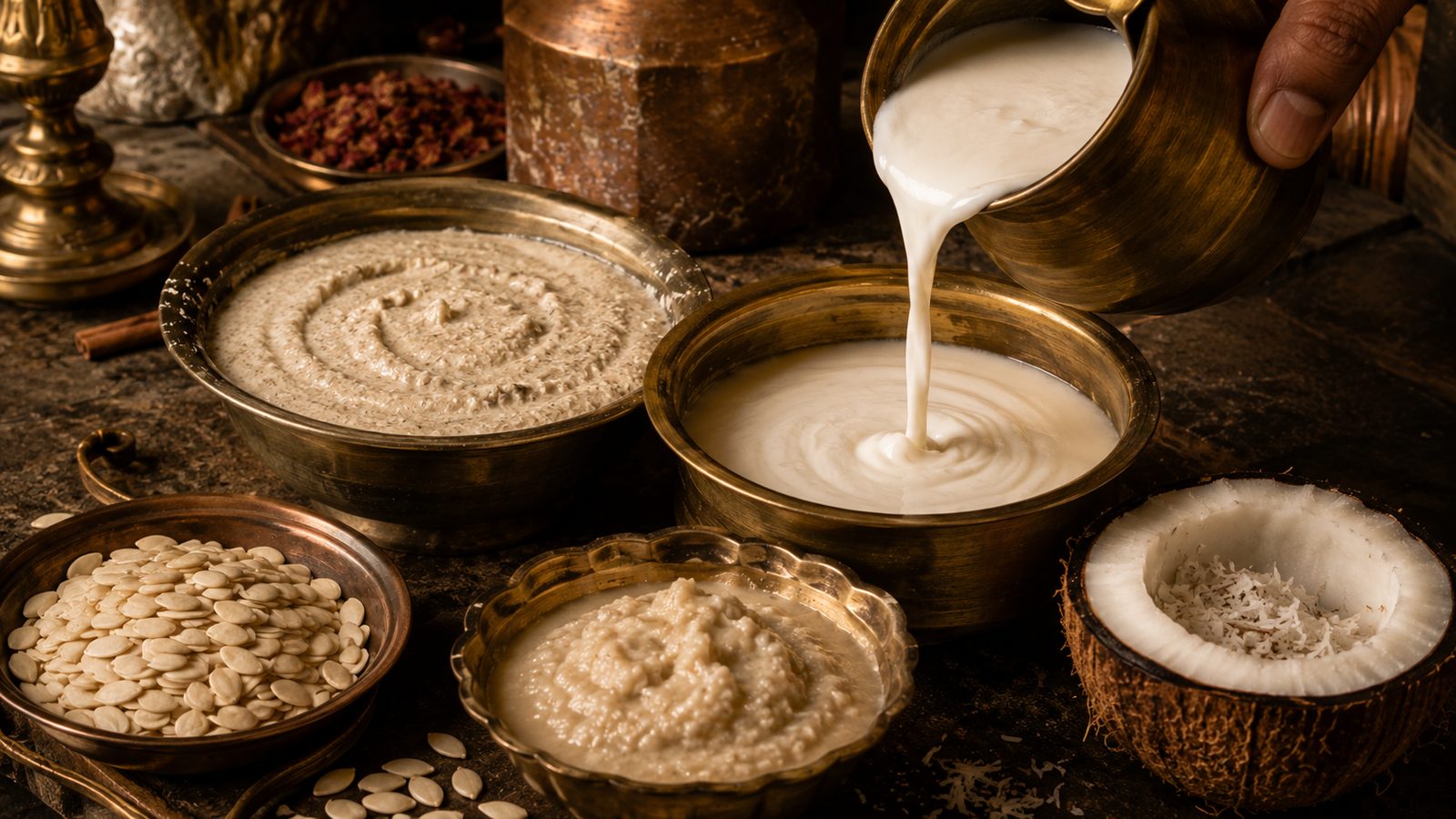
Kaju katli — India's most gifted Diwali sweet — is made from a Brazilian nut. The cashew arrived as an afterthought to a Portuguese alcohol industry, took root on the Konkan coast, and then did something extraordinary: it replaced the richness system that Mughal court cooking had developed over centuries. A nut the subcontinent had never seen became one of its most defining ingredients.
A World Before Cashews
Today cashews are so embedded in Indian cooking that it is difficult to imagine the cuisine without them. Korma, shahi paneer, kaju katli, cashew rice — the nut appears across both savoury and sweet traditions as if it had always been there. Yet the civilisations of India, Persia, Arabia, China, Greece, and Rome all developed sophisticated cuisines without cashews. The nut existed only in South America until the sixteenth century, when Portuguese traders encountered it in Brazil.
When the Portuguese brought cashew plants to their colony at Goa in 1510, they were not thinking about korma. They were thinking about the cashew apple — the swollen false fruit — which could be fermented and distilled into feni, a potent spirit. The culinary use of the cashew nut developed later, as processing knowledge spread and the nut's extraordinary culinary properties became apparent. The most famous Indian cashew product emerged as an afterthought to an alcohol production industry.
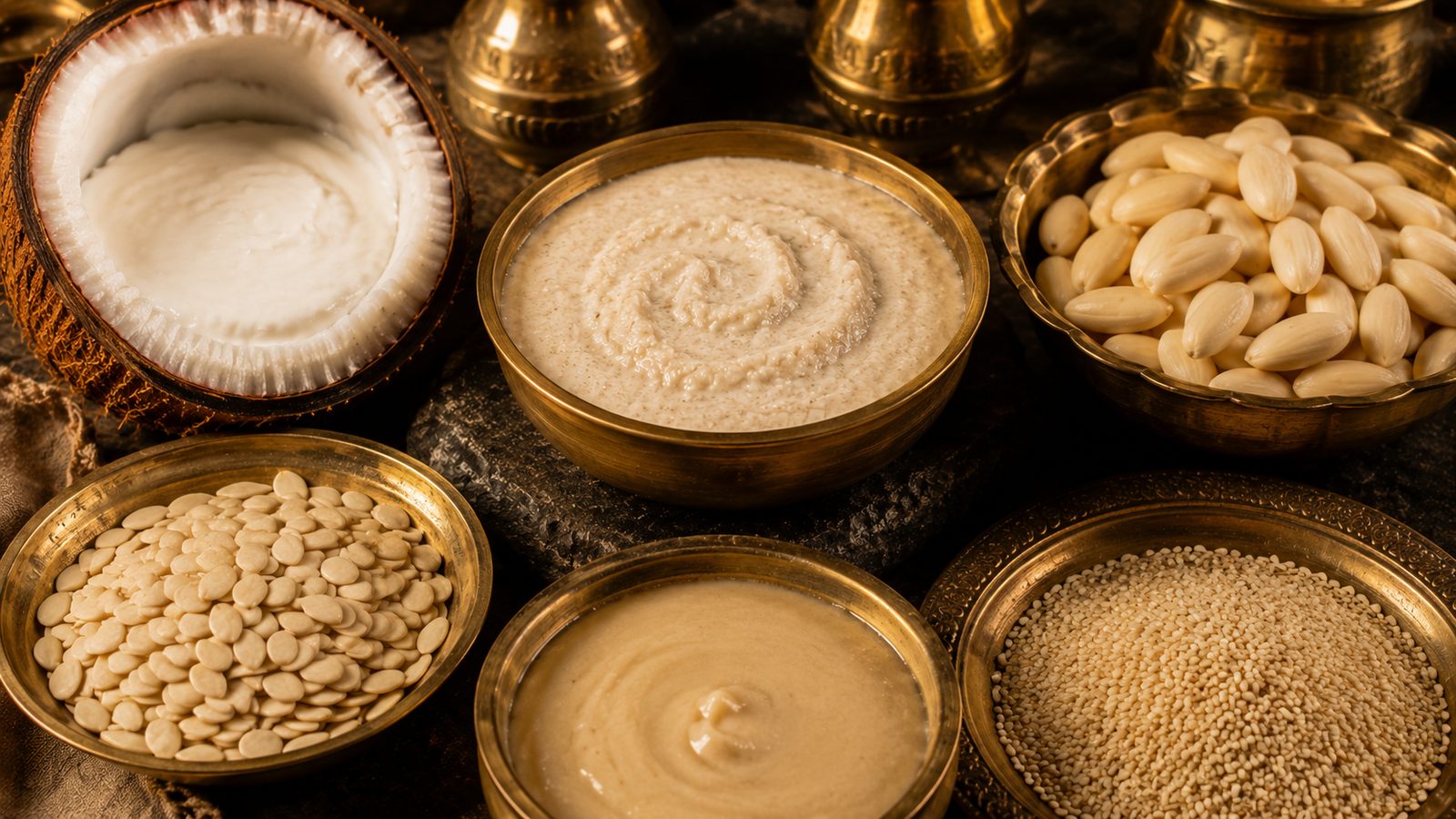
Richness before cashews: coconut cream, melon seeds (magaz), white poppy seeds (khus khus), and almonds — the ingredients that provided body and creaminess in Indian gravies for thousands of years before a Brazilian nut arrived.
What the Archaeology Tells Us
Historical Evidence at a Glance
Pre-1500: Cashews confined to South America. Completely absent from any Indian text, recipe, or archaeological record before Portuguese contact.
Ancient Indian texts: Coconut, melon seeds, and poppy seeds documented as richening agents in Sanskrit culinary literature. Almonds referenced as luxury thickeners in royal cooking contexts.
1510: Portuguese establish Goa. Cashew trees introduced for cashew apple production. Goan feni production begins as primary application.
1600s–1700s: Cashew cultivation expands along India's western coast. Culinary use develops gradually as processing knowledge spreads beyond Goa.
1800s: Cashew enters Mughal-influenced North Indian cooking. The nut-cream gravy tradition begins shifting from melon seeds and poppy seeds to cashews.
Timeline
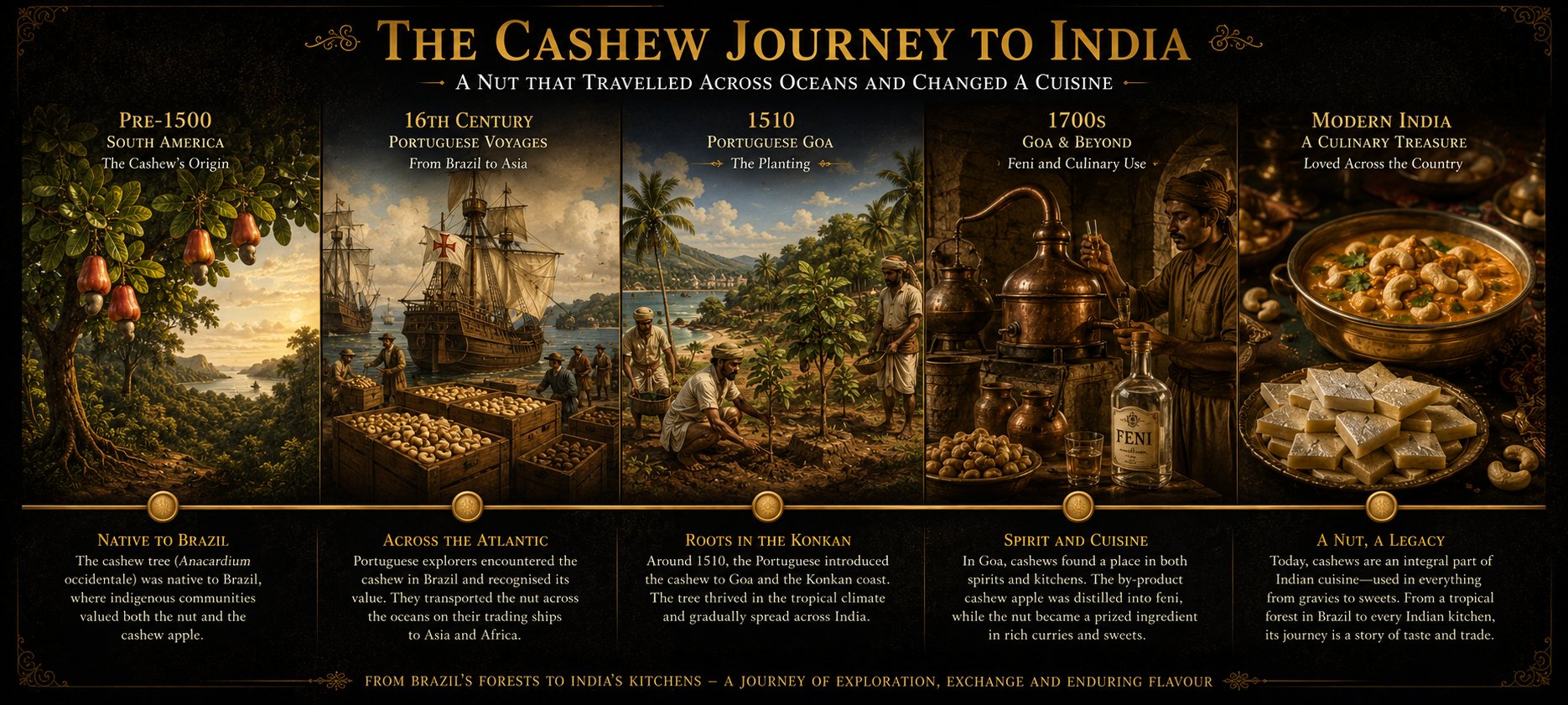
From Brazil to Goa to the Indian kitchen — the cashew's four-century journey to becoming a defining Indian ingredient. Click to enlarge.
| Date | Event |
|---|---|
| Pre-1500 | Cashews confined to South America. Unknown elsewhere. |
| 1500s | Portuguese encounter cashews in Brazil. Recognise potential of the cashew apple for fermentation. |
| 1510 | Portuguese establish Goa. Cashew trees introduced to India. Primary purpose: feni production from cashew apple. |
| 1600s | Cashew cultivation expands along India's western coast. Culinary use of the nut begins developing. |
| 1700s | Cashew feni production well-established in Goa. Nut culinary use increasing. |
| 1800s | Widespread cultivation. Cashew enters Mughal-influenced North Indian cooking as a luxury thickener. |
| 1900s | Karnataka and Kerala develop large-scale cashew processing industries. Kaju katli becomes a national Diwali sweet. |
| Present | India is among the world's largest cashew producers and exporters. The nut is fully embedded in Indian sweet and savoury traditions. |
The Strange Biology of the Cashew
The cashew is botanically unusual in ways that explain why it required Portuguese industrial knowledge to make it usable as a food. What we call the cashew nut is not botanically a nut at all — it is a seed attached to the outside of the cashew apple, the swollen false fruit of the cashew tree. The seed sits in a double shell containing cardol and anacardic acid, both caustic oils that cause severe skin burns and must be completely destroyed by heat before the cashew is safe to eat.
This is why raw cashews are never sold commercially — all cashews on the market have been processed to remove the toxic shell oil. The Portuguese, with their experience of processing tropical products from Brazil and West Africa, understood how to manage this process. It is part of what made the introduction to India feasible. Without the processing knowledge the Portuguese brought, the cashew would have remained a curiosity rather than a food.
"The Portuguese came to Goa for India's black pepper. They brought cashews as a by-product of their Brazilian colony. The nut they barely noticed transformed Indian cooking more completely than the spice they came to buy."
Before Cashews: The Great Thickening Traditions
The roles that cashews now fill in Indian cooking — richness in gravies, creaminess in sauces, texture in sweets, garnish on rice dishes — were performed by other ingredients for thousands of years. Understanding these pre-cashew thickening traditions reveals a more complex and regionally varied world of Indian sauce-making than the cashew-cream gravies that now dominate restaurant menus.
| Ingredient | Region | Role | Status Today |
|---|---|---|---|
| Coconut milk and cream | South India, coastal regions | Richness in curries | Still dominant in South India |
| Melon seeds (Magaz) | North India, Mughal cooking | Gravy thickener, creamy paste | Declining; largely replaced by cashews in restaurant cooking |
| White poppy seeds (Khus khus) | Bengal, North India | Creamy paste base, thickener | Declining; still used in traditional Bengali cooking |
| Almonds | Royal and festive cooking | Luxury thickener | Surviving in premium preparations |
| Gram flour (Besan) | Rajasthan, Gujarat | Gravy body without fat | Still widely used in kadhi and regional preparations |
| Sesame paste | Regional cooking | Richness and body | Surviving in specific regional preparations |
Coconut was the most important pre-cashew source of richness across coastal India. Coconut milk and cream provided the body and creaminess in South Indian curries that cashews now supply in Mughal-style North Indian dishes. A properly made Kerala fish curry or Chettinad chicken curry, built on freshly ground coconut with its natural fat content, achieves a richness and depth that cashew cream cannot replicate — and the tradition is still alive.
Melon seeds (magaz) and white poppy seeds (khus khus) were ground into pastes to thicken and enrich gravies in the cuisines that eventually became most associated with cashews — the Mughal-influenced cooking of North India. These pastes appear in historical recipes where cashews are now commonly substituted. A shahi korma made with poppy seed and melon seed paste has a distinctly different texture and flavour from the cashew version — more delicate, more subtly nutty.
The Science of Richness — Why Cashews Succeed
Fat content: Cashews contain approximately 44% fat — primarily monounsaturated — providing richness without the saturated fat dominance of coconut.
Protein emulsification: Cashew proteins create a stable emulsion when ground — preventing sauces from separating under heat. Coconut cream lacks this protein-based stability.
Neutral flavour: Unlike coconut (distinctly tropical) or poppy seeds (slightly floral), cashews provide richness without adding a pronounced flavour of their own — making them ideal for restaurant-style cooking where consistency matters.
Smooth texture: Soaked cashews grind to an exceptionally smooth paste — smoother than melon seeds or poppy seeds — producing the silky gravy texture that defines the North Indian restaurant style.
Restaurant reliability: Cashew cream behaves predictably under heat across different cooking conditions. Coconut cream and poppy seed paste require more careful handling and are more prone to splitting.
Before vs After: The Richness System
Regional Impact
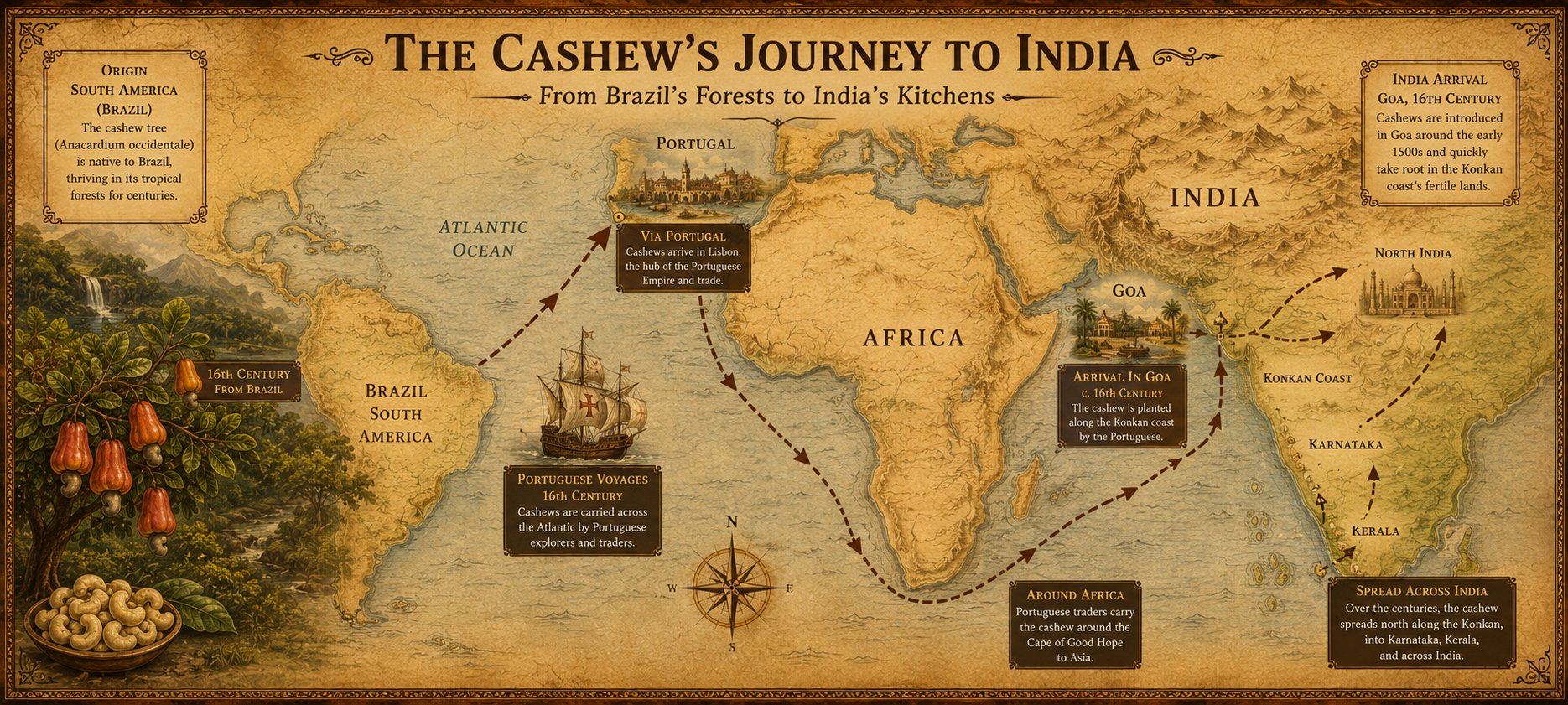
Brazil to Goa to every Indian kitchen — the cashew's journey from South American forest to national festival sweet. Click to enlarge.
Debate & Myths
Did the Portuguese Introduce Cashews for Food or for Feni?
The historical evidence suggests the primary motivation was the cashew apple rather than the nut. The Portuguese had encountered cashew apple fermentation in Brazil and recognised its commercial potential. Goan feni production — the distillation of fermented cashew apple juice — became an established industry relatively quickly after the Portuguese arrival.
The culinary use of the cashew nut developed more slowly and appears to have spread from Goa outward as processing knowledge (how to safely remove the toxic shell oil) became more widely known. The irony of this sequence — that one of India's most beloved ingredients arrived as a by-product of alcohol production — is genuinely interesting, and the historical record is fairly clear that feni, not food, was the original purpose.
Is Cashew Korma Authentic Mughal Cooking?
No — and this matters for understanding what the original Mughal culinary tradition actually was. Cashews arrived in India in 1510 and took several centuries to spread beyond Goa into North Indian cooking. The Mughal Empire's peak court cuisine — under Akbar, Jahangir, and Shah Jahan in the 16th and 17th centuries — predates the widespread use of cashews in North Indian cooking. The original Mughal nut-cream gravies were made with melon seeds and poppy seeds, possibly almonds for luxury preparations.
What is now called "Mughal cuisine" in restaurants — cashew-cream korma, shahi gravies — is a later synthesis that incorporated a Portuguese-introduced nut into a cooking tradition that predated the cashew's arrival. The flavour is different from the original. Whether it is better is a matter of preference.
What If Cashews Never Came to India?
Without cashews, melon seeds and poppy seeds would remain the primary gravy thickeners in North Indian cooking, and coconut would remain unchallenged in the south. The rich nut-cream korma that defines Indian restaurant cooking globally would taste different — more delicate, slightly more complex, with the specific flavour profiles of melon seed or poppy seed paste rather than the neutral creaminess of cashew.
Kaju katli would not exist, and Indian Diwali gifting culture would be built around a different sweet. The cashew processing industry of Karnataka and Kerala — which employs hundreds of thousands of people — would not have developed. The global trade in Indian cashews, which makes India one of the world's largest cashew exporters, would not exist.
What Survived
The Pre-Cashew Richness Tradition That Remains
Modern Legacy
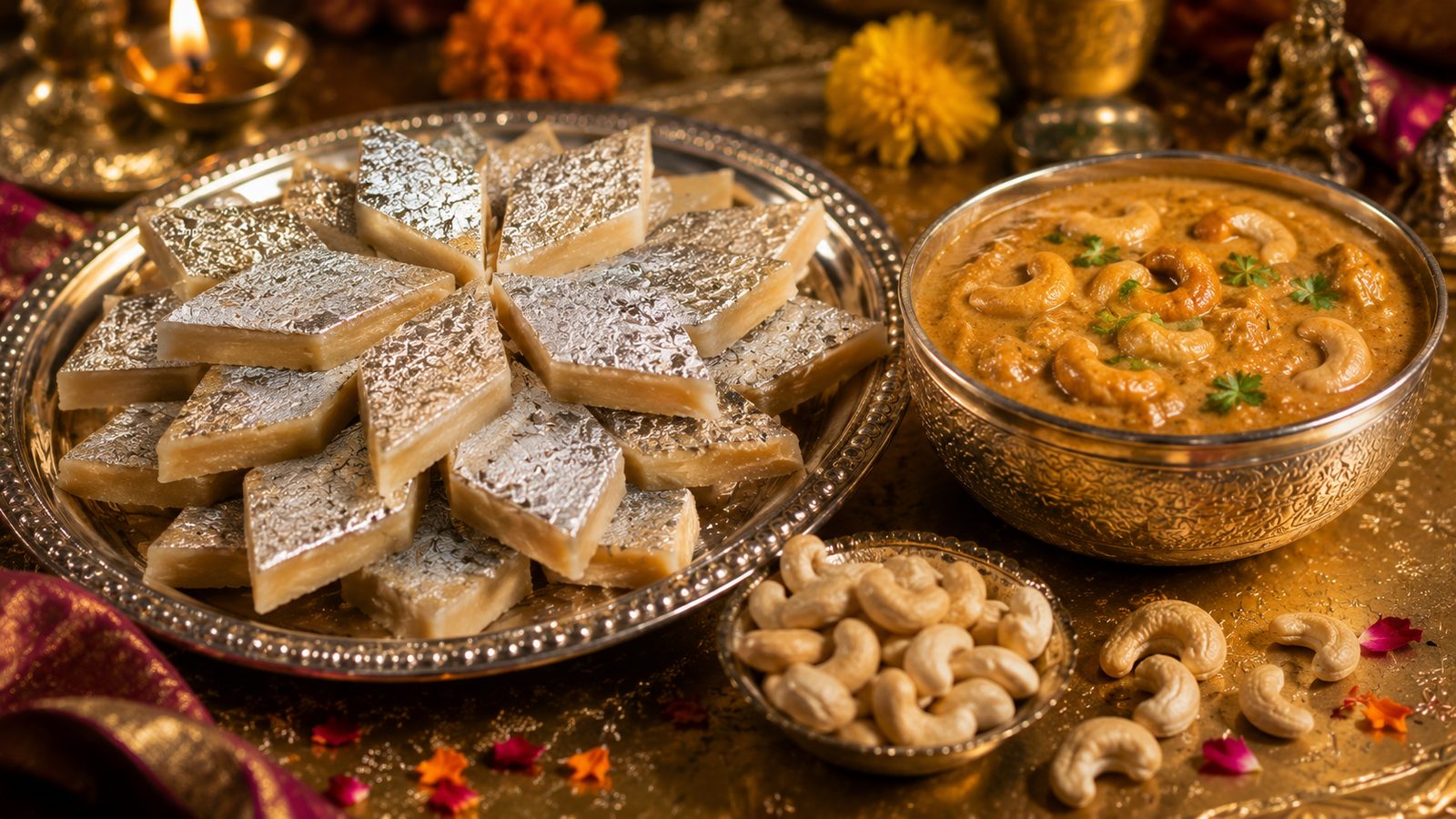
Modern India: kaju katli at Diwali, cashew korma in restaurants, cashew processing on the Karnataka coast — a Brazilian nut, five centuries after arrival, completely at home.
India today is one of the world's largest cashew producers and exporters. The nut that arrived as a Portuguese by-product now defines some of India's most beloved foods — kaju katli at Diwali, korma at restaurants, cashew rice at festivals. Its adoption was slower than the chilli and more geographically specific than the potato, but it was ultimately just as complete.
The coconut-rich gravies of Kerala and the poppy-seed traditions of Bengal survive as living evidence of what Indian richness tasted like before a Brazilian nut arrived on a Portuguese ship and made itself at home. They are not relics. They are parallel traditions — equally valid, differently flavoured — that remind us that cashew creaminess is an addition to Indian cooking rather than its foundation.
Food History Scorecard
| Impact Area | Change | Still Visible? |
|---|---|---|
| North Indian Restaurant Cooking | Extreme | Cashew-cream gravy is now the global standard for rich Indian curries |
| South Indian Cooking | Low | Coconut richness tradition largely unchanged; cashews used as garnish not as gravy base |
| Indian Confectionery | Extreme | Kaju katli is the most gifted Indian festival sweet nationally |
| Traditional Mughal Recipes | High | Melon seed and poppy seed traditions largely displaced by cashews in restaurant context |
| Goan Culture | High | Feni remains a protected GI product — the oldest surviving use of the cashew in India |
| Agricultural Economy | Extreme | Cashew is a major export crop; Karnataka and Kerala processing industries employ hundreds of thousands |
Confidence Scale
| Claim | Confidence | Basis |
|---|---|---|
| Cashews originated in Brazil and were introduced to India by Portuguese traders | Very High | Botanical and historical evidence conclusive. |
| Goa 1510 was the primary introduction point | Very High | Consistent with Portuguese colonial records and the botany of cashew cultivation in India. |
| Cashew feni production preceded culinary nut use | High | Historical records of Goan feni production predate widespread documentation of cashew nut culinary use. |
| Original Mughal korma used melon seeds and poppy seeds, not cashews | High | Cashews were not established in North Indian cooking during the height of Mughal court cuisine. Historical recipes support melon seed and poppy seed thickening. |
| Coconut remains the primary richness source in South Indian cooking | Very High | Living culinary tradition clearly documented and continuously practiced. |
Further Reading
- K.T. Achaya — Indian Food: A Historical Companion
- Colleen Taylor Sen — Feasts and Fasts
- Sanjay Subrahmanyam — The Portuguese Empire in Asia
- Alfred Crosby — The Columbian Exchange
- Lizzie Collingham — Curry: A Tale of Cooks and Conquerors