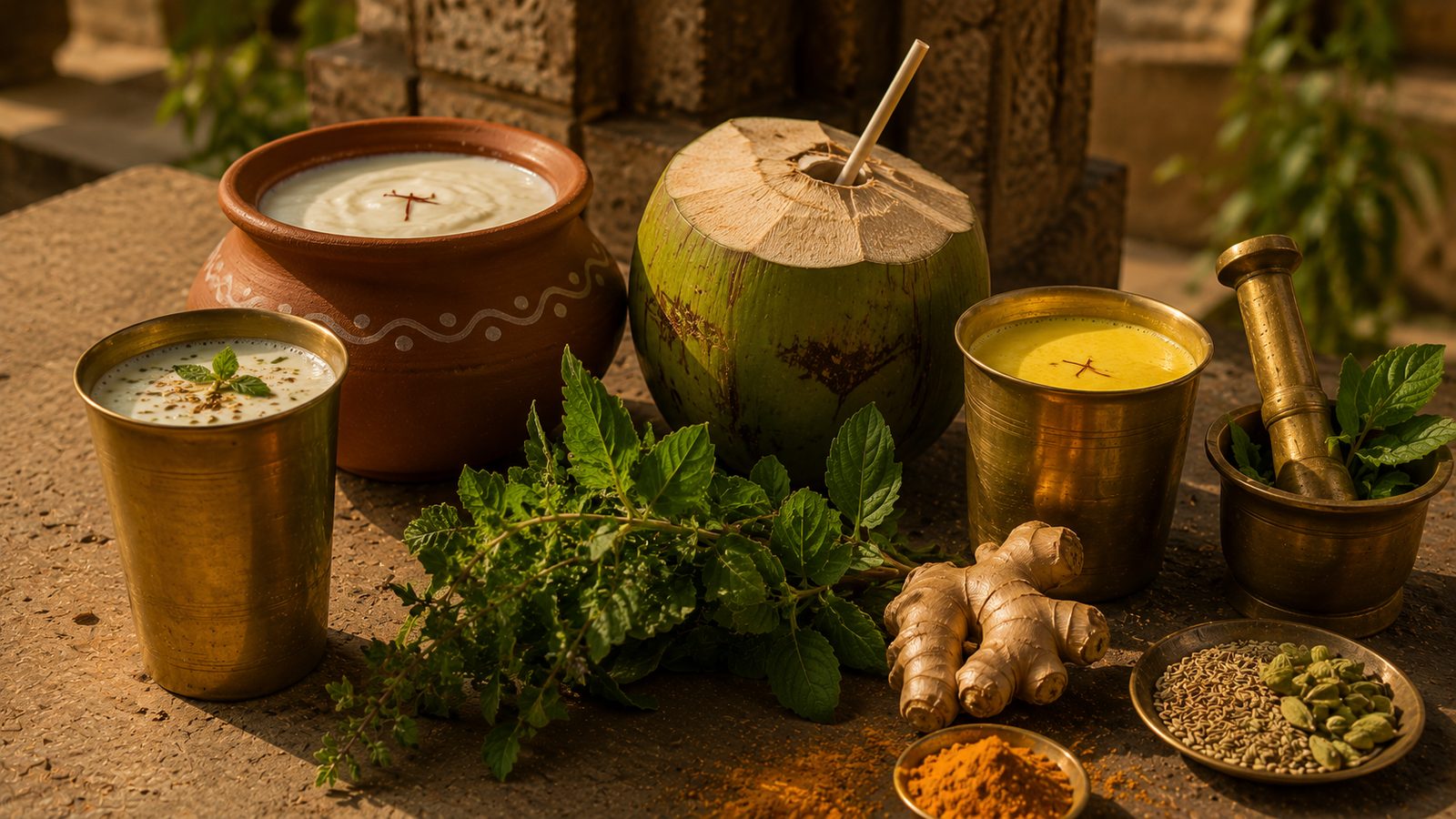
Before chai, India drank chaas. Spiced buttermilk — cooling, digestive, made from milk and culture rather than plantation and commerce — was the nation's everyday drink for thousands of years. The ingredient that feels most essentially Indian arrived through one of history's most deliberately manufactured cultural adoptions. The plant is foreign. The culture made it its own.
The World India Drank Before Tea
For most of Indian culinary history, the everyday beverage was dairy-based, locally produced, and connected to the agricultural rhythms of a community rather than to a global commodity market. Chaas — thin, spiced buttermilk — was the default cooling drink across most of the subcontinent. Lassi in Punjab. Tender coconut water on the coasts. Herbal infusions of tulsi, ginger, and pepper in households that understood their Ayurvedic properties. Sugarcane juice in the fields. These were not primitive precursors to tea — they were complete, appropriate, climate-adapted beverage traditions.
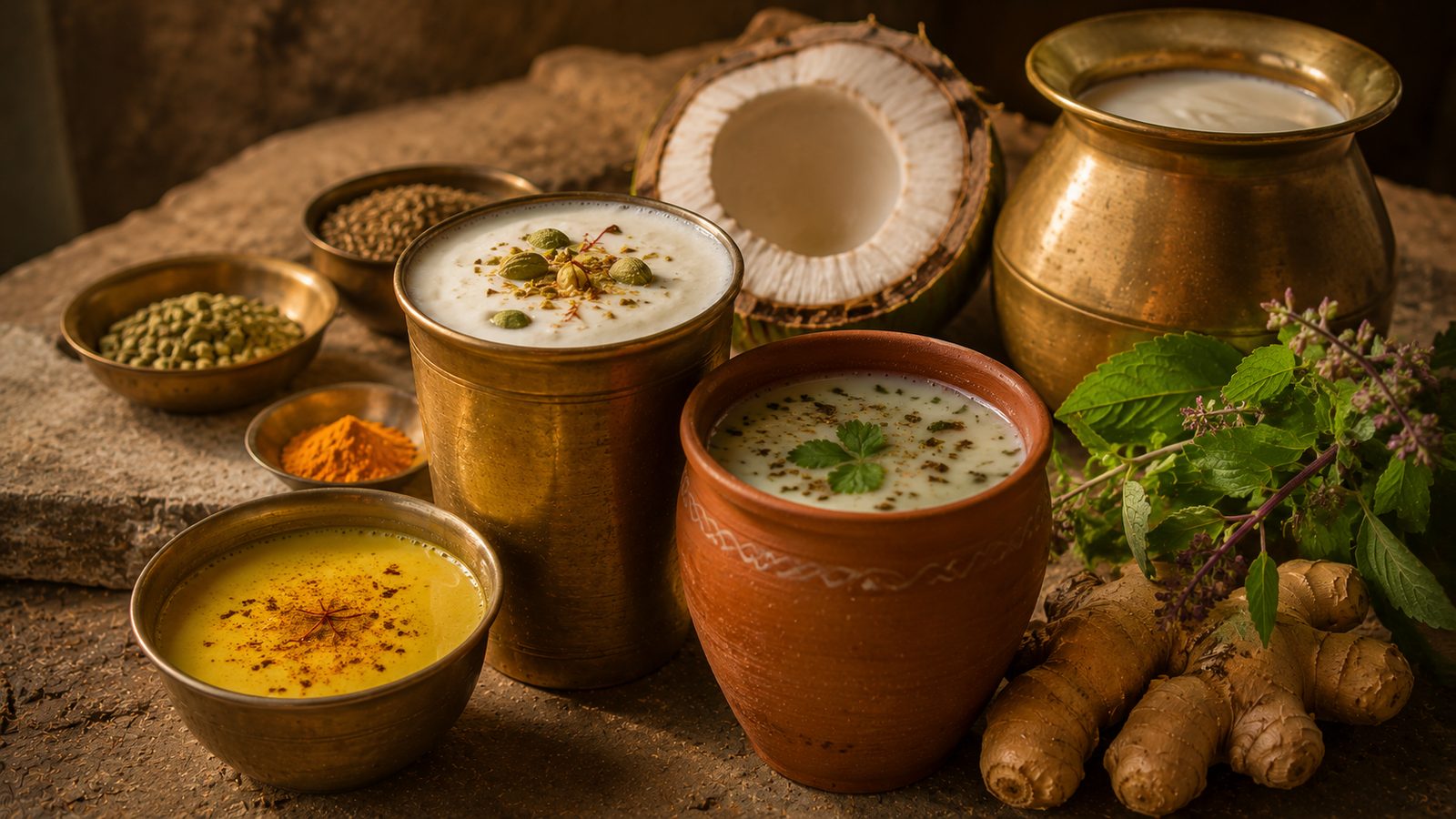
India before chai: chaas, lassi, herbal infusions of tulsi and ginger, haldi doodh, tender coconut water. A beverage tradition thousands of years old — diverse, regional, and rooted in dairy and local agriculture.
What the Archaeology and Texts Tell Us
Historical Evidence at a Glance
Vedic Period: Chaas referenced extensively in Sanskrit texts. Described in Ayurvedic literature as a digestive, restorative, and therapeutic drink. Recommended for specific health conditions.
Charaka Samhita: Detailed discussion of takra (chaas) as one of the most beneficial daily drinks. The text describes its preparation, therapeutic properties, and appropriate seasonal use.
Temple traditions: Chaas and buttermilk offered as prasadam across multiple regional temple traditions — indicating its cultural and ritual significance beyond mere refreshment.
Assam wild tea: The Singpho people of Assam had been consuming preparations made from wild Camellia sinensis var. assamica leaves for centuries before British commercial cultivation. But this was geographically limited and culturally specific — not a mass beverage tradition.
1820s–1830s: British botanists discover wild Assam tea commercially. Commercial cultivation begins shortly after. The Indian Tea Association marketing campaign begins in the early 20th century.
Timeline
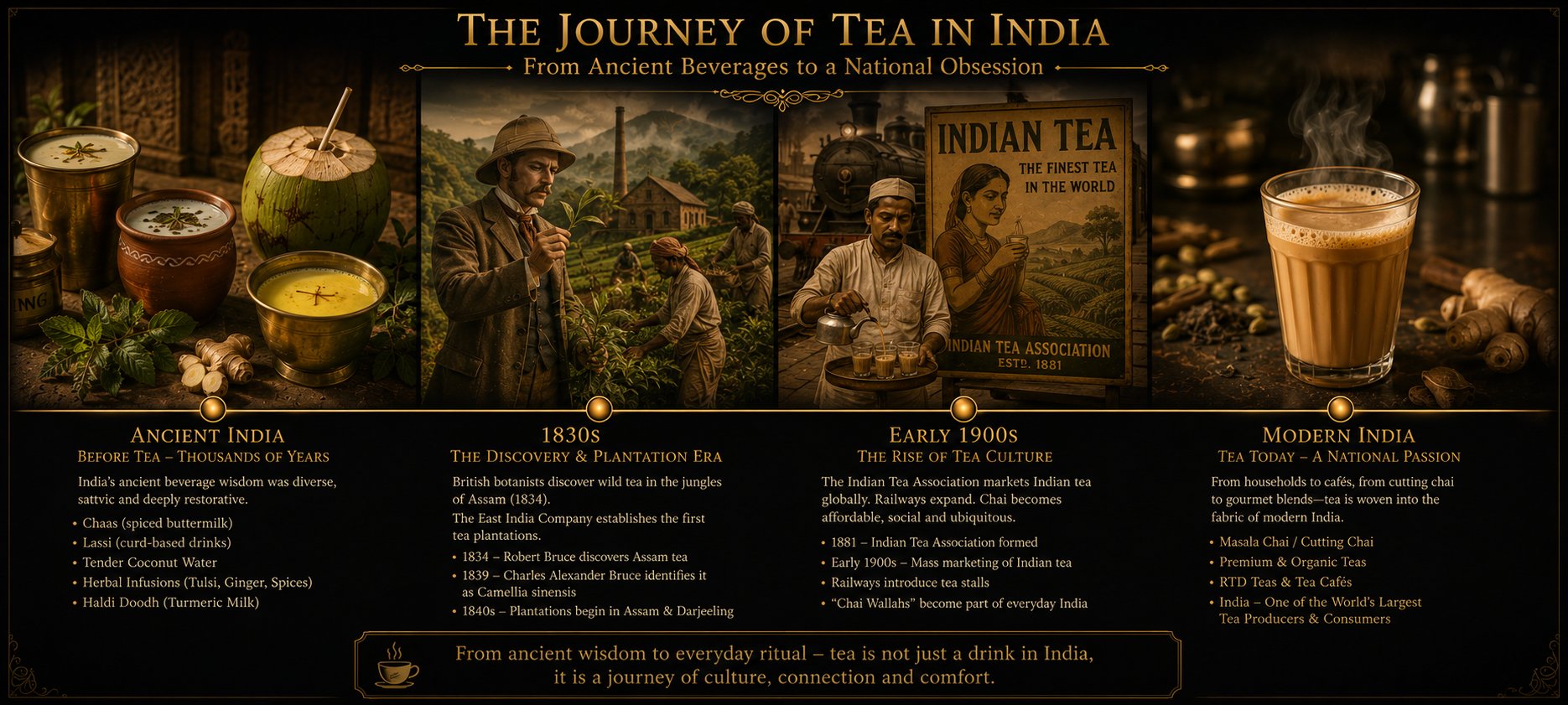
From ancient dairy beverages to colonial plantation to national obsession — the timeline of tea's transformation of India's drink culture. Click to enlarge.
| Date | Event |
|---|---|
| Ancient China | Tea drinking begins; develops over centuries into a sophisticated cultural practice. |
| Ancient India | Dairy beverages, herbal infusions, and chaas dominant across the subcontinent. |
| Pre-1830s | Wild tea known to Singpho communities in Assam. Not a mass beverage anywhere in India. |
| 1830s–1840s | British commercial cultivation begins in Assam. East India Company develops Indian tea industry to reduce dependence on China. |
| Late 1800s | Tea plantations across Assam, Darjeeling, and the Nilgiris. India becomes major producer but Indians barely drink it. |
| Early 1900s | Indian Tea Association runs domestic consumption campaigns. Chai wallahs at railway stations subsidised. Factory tea breaks promoted. |
| Mid 1900s | Chai becomes mainstream across the subcontinent. Masala chai — the Indian innovation — develops. |
| Present | India is among the world's largest tea producers and consumers. Chai is embedded in national identity. |
The Tea Marketing Campaign That Created a National Drink
The most remarkable fact about Indian chai culture is how deliberately it was created. In the early twentieth century, the Indian Tea Association — the industry body representing British plantation owners — faced a fundamental commercial problem: Indians were not drinking their own tea. The product was grown in India, processed in India, and exported to Britain. Domestic consumption was minimal. The solution was one of history's most successful food marketing campaigns.
The Indian Tea Association paid mills and factories to give workers tea breaks. They subsidised chai wallahs at railway stations across the country — creating the ubiquitous platform tea vendor that became a fixture of Indian travel. They promoted tea drinking as modern, healthful, and socially progressive. They distributed free tea to schools. They ran advertisements in newspapers and on billboards. This campaign, sustained over decades, created the domestic market that the industry needed — and in the process created the cultural practice that now feels as natural and ancient as any aspect of Indian life.
"Chai culture was not discovered — it was manufactured. That the result is genuinely Indian in character, and genuinely beloved, is one of the most interesting examples in culinary history of culture absorbing commercial imposition and making it entirely its own."
Why Chaas May Be India's Original National Drink
If any beverage has a legitimate claim to being India's oldest mass drink, it is chaas — spiced buttermilk. It appears in ancient texts, in Ayurvedic literature as both food and medicine, in temple offerings, in the poetry of multiple classical traditions. It requires only milk and a warm climate to produce — present wherever there were cows, which was almost everywhere. It is cooling in the heat that characterises most of India's geography for most of the year. It is digestive, settling, mild, and cheap.
The displacement of chaas by chai represents a significant shift: from a beverage produced locally, seasonally, and domestically, to one dependent on a plantation industry, a distribution network, and the global commodity market. Chai is not more Indian than chaas. It simply won the commercial competition — with considerable help from a deliberately engineered marketing campaign.
What India Drank Before Tea — A Regional Picture
Punjab: Lassi — thick, yoghurt-based, sweetened or salted. The quintessential North Indian dairy beverage. Still India's most internationally recognised non-tea drink.
Gujarat and Rajasthan: Chaas — thin, spiced buttermilk with jeera and coriander. An everyday digestive and cooling drink. Still widely consumed alongside tea.
Kerala and coastal regions: Tender coconut water — the default refreshing drink. Available year-round, naturally sweet, and culturally embedded in coastal life.
Bengal: Herbal infusions and sugarcane juice. Aam panna (raw mango water) in summer. Dairy-based drinks in winter.
Himalayan communities: Warming milk-based drinks suited to cold altitudes. In some communities, butter-tea preparations similar to Tibetan traditions.
Across the subcontinent: Haldi doodh (turmeric milk) — the Ayurvedic warming and restorative drink that has recently been rediscovered globally as "golden milk." Ancient, continuous, and not a tea competitor but a different category entirely.
How India Transformed Tea Into Chai
When Indians did adopt tea, they did not adopt it on British terms. The British drank tea with a small splash of cold milk added after brewing — a thin, tannin-forward drink served in a china cup. Indians did something fundamentally different: they boiled the tea leaves directly in a mixture of milk and water, added sugar, and layered in the spice vocabulary of their existing herbal infusion tradition — ginger, cardamom, cloves, black pepper, cinnamon, sometimes fennel.
The result — masala chai — has almost nothing in common with a British cup of tea except the plant it comes from. It is hotter, richer, sweeter, more aromatic, and more stimulating. It is simultaneously the product of colonial commercial introduction and an expression of Indian culinary creativity. The plant is foreign. The culture is not.
Before vs After: The Beverage Culture That Changed
Regional Impact
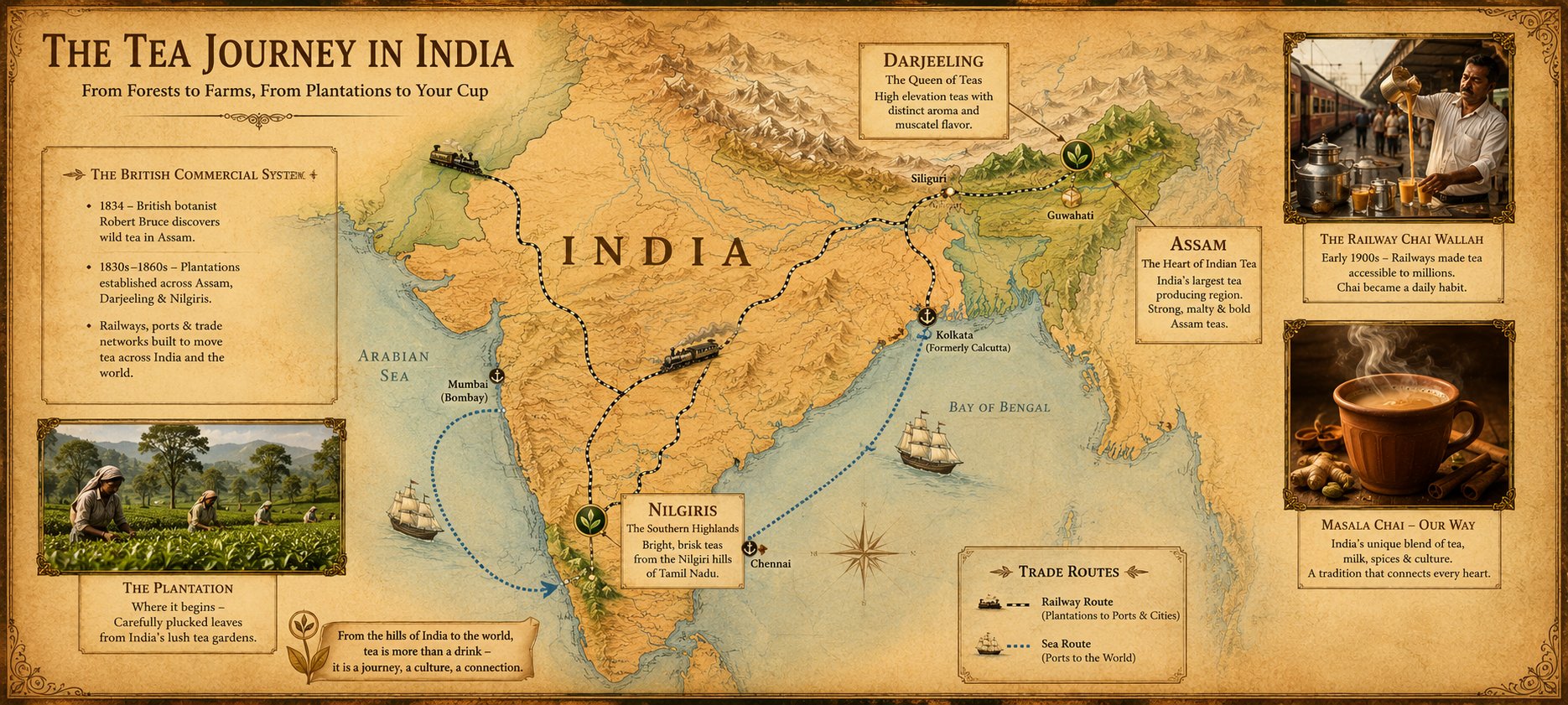
From plantation to cup — the geography of Indian tea cultivation and the spread of chai culture. Click to enlarge.
Debate & Myths
Was Tea Already Drunk in India Before the British?
In limited, specific contexts — yes. The Singpho people of Assam had preparations using wild Camellia sinensis leaves that predate British commercial cultivation. Some scholars also argue that trading contacts with China through the overland Silk Road may have introduced tea knowledge to parts of India before the British.
But these are different claims from mass consumption. The evidence clearly shows that tea drinking was not a widespread practice across the Indian subcontinent before the British commercial cultivation and marketing campaign. The Singpho tradition was localised and culturally specific. What the British created — a national mass market for a commercially grown product — was genuinely new.
Is Masala Chai Actually Indian?
Yes — completely. The plant is Chinese, the commercial introduction was British, and the drink is Indian. Masala chai involves boiling tea in milk, adding sugar, and incorporating the spice vocabulary of Indian herbal infusion traditions. None of these things were part of the British or Chinese tea tradition. The British drank tea in thin china cups with a splash of cold milk. Chinese tea was brewed and drunk unsweetened. Masala chai is a distinctly Indian creation that happens to use a foreign plant as its base material.
This is how culinary culture actually works: the ingredient travels, the cook transforms it, and the result belongs to the culture that does the transforming.
What If Tea Never Came to India?
Without the British commercial introduction of tea, chaas and lassi would remain India's primary daily beverages. The railway chai wallah would not exist. The structured tea break of Indian factory and office culture — itself a direct inheritance of the Indian Tea Association's campaign — would not have developed in the same way.
South India, which already had coffee established before tea's mass adoption, gives us a partial picture of what a tea-free Indian beverage culture might have continued to look like: coffee for those who wanted caffeine, dairy drinks for everyday refreshment, and a more regionally varied beverage landscape generally. The extraordinary uniformity of chai across India's enormously varied regions is itself evidence of how deliberate and effective the marketing campaign was.
What Survived
The Pre-Tea Beverages That Remain
Modern Legacy
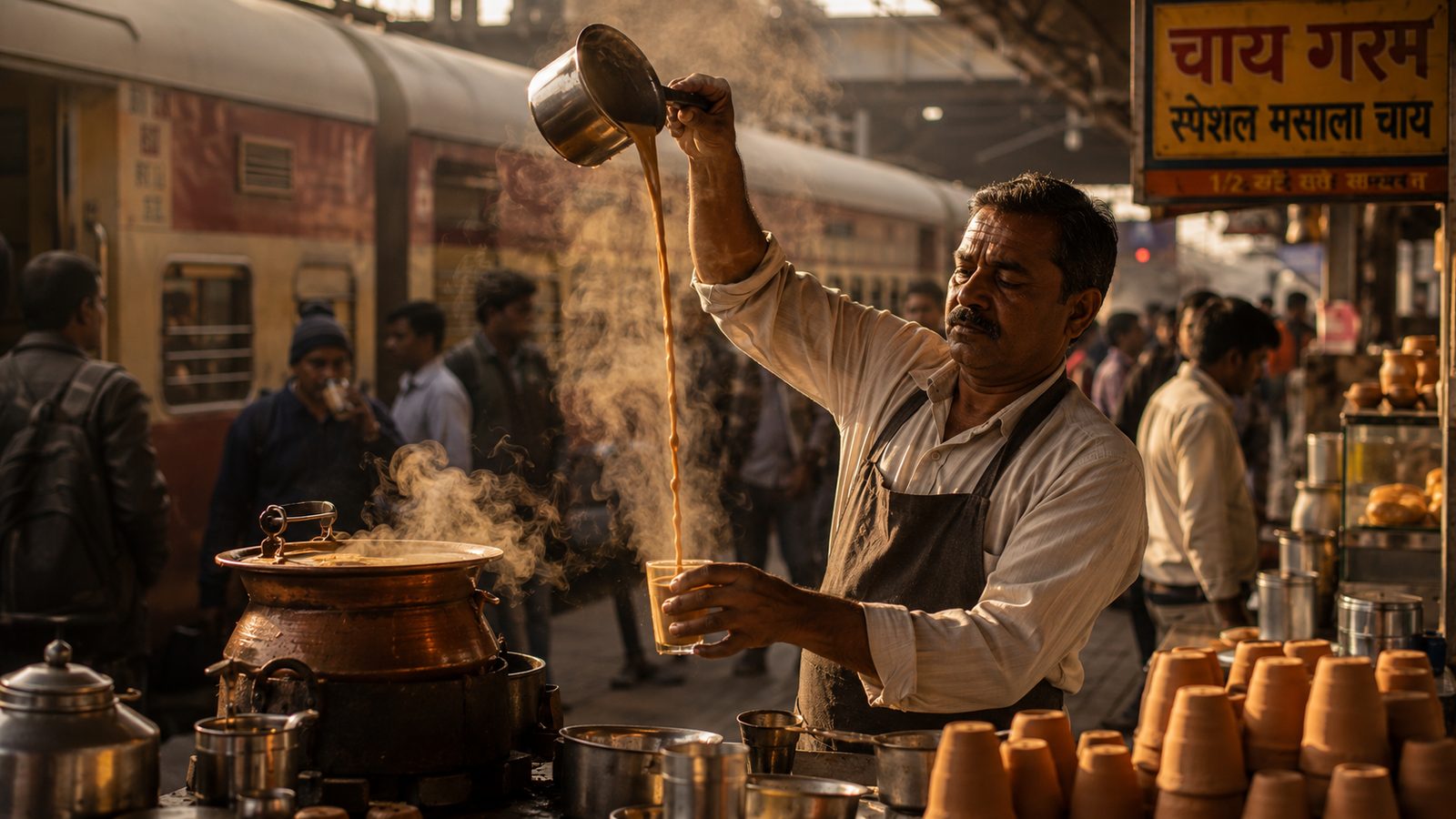
Modern India's chai culture: railway chai wallahs, street stalls, office tea breaks — a beverage tradition less than a century old that has embedded itself as deeply as any ancient practice.
Chai today is not just a beverage — it is a social ritual, an act of hospitality, a marker of pause in the Indian working day. The chai wallah at the railway platform is an institution of Indian public life as recognisable as any ancient tradition. The offer of chai to a visitor is as automatic and as culturally laden as any formal welcome.
All of this was manufactured, deliberately and commercially, within living memory. That it feels ancient is the measure of how completely India absorbed and transformed a foreign plant into something genuinely its own. Before chai, there was chaas — and chaas still survives, unchanged, as a direct link to the beverage tradition that chai displaced but never fully replaced.
Food History Scorecard
| Impact Area | Change | Still Visible? |
|---|---|---|
| National Beverage Identity | Extreme | Chai is now India's defining drink in national and international perception |
| Daily Beverage Culture | Extreme | Tea break is embedded in the working day; chai wallah is a national institution |
| Ancient Dairy Tradition | Moderate | Chaas, lassi, and haldi doodh all survive strongly alongside tea |
| South Indian Culture | Low | Coffee culture largely withstood the tea campaign in Tamil Nadu and Karnataka |
| Agriculture | Extreme | Tea is among India's most significant export crops; plantation industry shapes entire regional economies |
| Social Ritual | Extreme | Offering chai is now the primary act of Indian hospitality — displacing chaas in most contexts |
Confidence Scale
| Claim | Confidence | Basis |
|---|---|---|
| Mass tea drinking in India developed through commercial cultivation and marketing | Very High | Well-documented in Indian Tea Association records and colonial agricultural history. |
| Chaas and dairy beverages were India's primary everyday drinks before tea | Very High | Extensively documented in Sanskrit texts, Ayurvedic literature, and regional food histories. |
| Wild tea was known to Singpho communities in Assam before British cultivation | High | Documented in early British botanical and ethnographic records from Assam. |
| Masala chai is an Indian innovation, not a British or Chinese tradition | Very High | Neither British nor Chinese tea traditions involve boiling tea in milk with spices. |
| The Indian Tea Association ran systematic campaigns to create domestic consumption | Very High | Directly documented in historical records of the Indian Tea Association. |
Further Reading
- K.T. Achaya — Indian Food: A Historical Companion
- Colleen Taylor Sen — Feasts and Fasts
- Lizzie Collingham — Curry: A Tale of Cooks and Conquerors
- Jayanta Sengupta — writings on Indian food history
- Indian Tea Association historical records