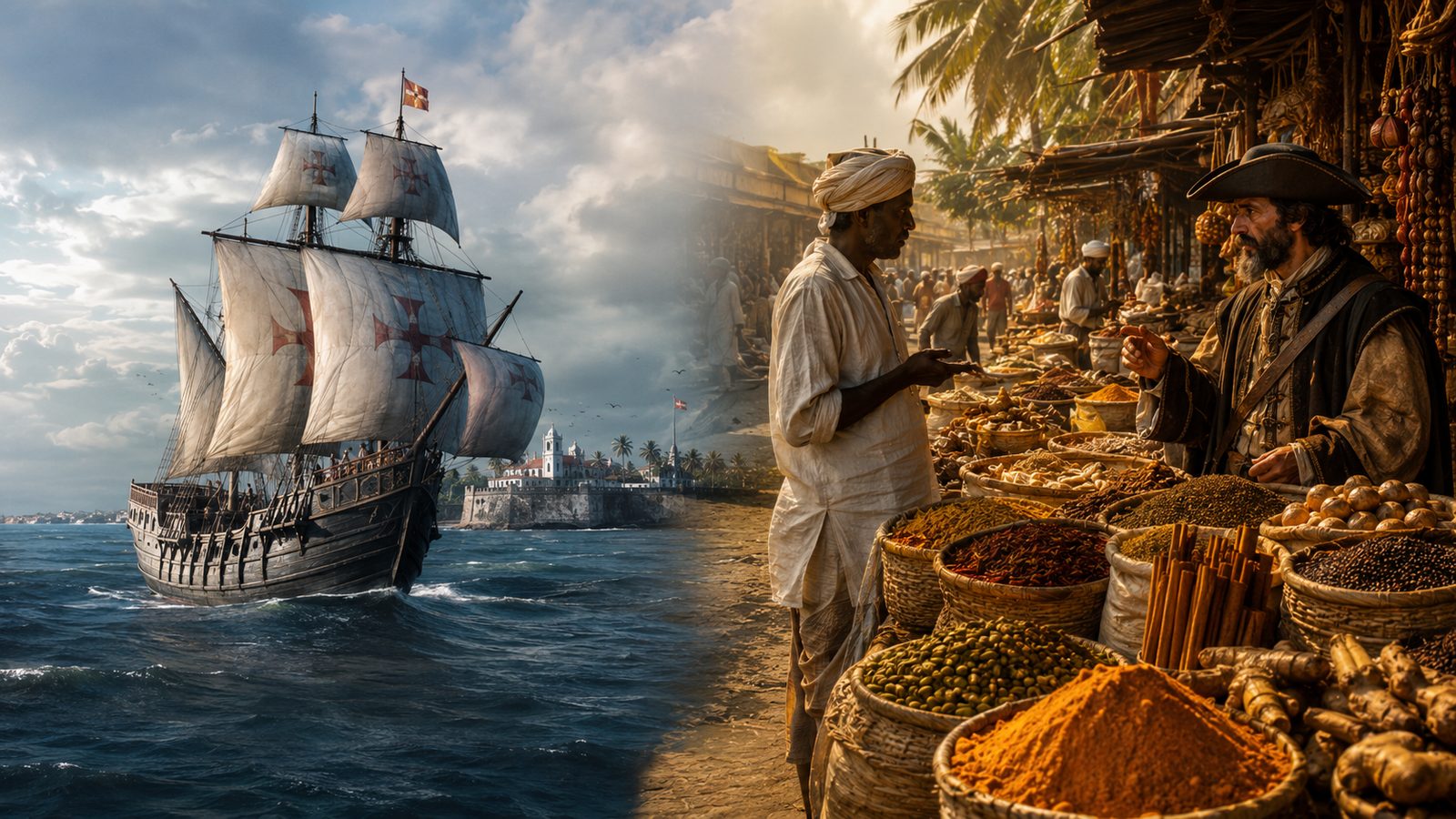
Stand in India in 1490. There is no chilli anywhere on the subcontinent. No tomato. No potato. No cashew. No pineapple, papaya, or guava. Indian cuisine is already one of the most advanced food systems in the world — a five-thousand-year tradition that was complete, sophisticated, and missing nothing. Then Portugal sent ships, and everything changed.
India in 1490 — Before the Portuguese
The pre-Portuguese Indian kitchen was not a cuisine in waiting. It was a complete culinary civilisation: sophisticated spice use documented across thousands of years, developed regional traditions from Bengal to Kerala to Kashmir, refined court cooking under the Delhi Sultanate and regional kingdoms, elaborate temple food traditions, and a vegetarian culinary achievement unmatched anywhere on earth. Black pepper, long pepper, cardamom, cinnamon, turmeric, ginger — these Indian spices had been shaping world trade for centuries before any Portuguese ship entered the Indian Ocean.
This matters enormously for understanding what followed. The Portuguese did not arrive to fill a gap. They arrived for spices — for pepper, cardamom, and cinnamon that Indian farmers had been growing for millennia. What they brought in return was not planned, not strategic, and not fully understood even by them. They brought seeds from their Brazilian colony as a by-product of their global maritime empire, and those seeds transformed Indian cooking more profoundly than any of the spices they came to buy.
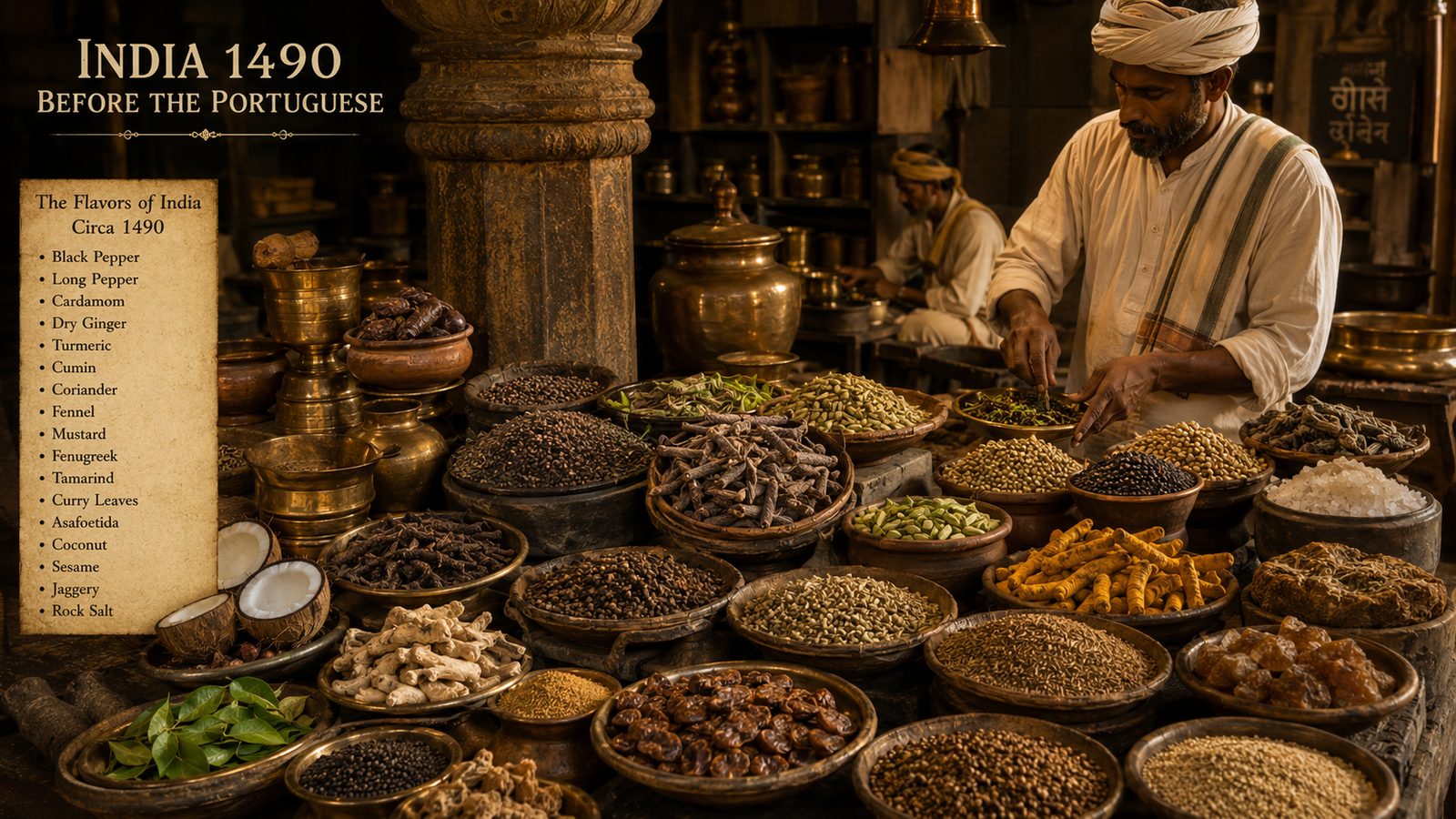
India in 1490: a complete culinary civilisation. Black pepper, cardamom, turmeric, ginger — spices the world came to buy. Nothing missing. Nothing waiting. The Portuguese arrived for what India had, not to give India what it lacked.
Why the World Changed in 1492
Before Columbus sailed west from Spain in 1492, the Americas and the Old World had been biologically separate for approximately fifteen thousand years. Each hemisphere had evolved its own plants, animals, and diseases in complete isolation. The Americas had developed maize, potatoes, tomatoes, chillies, cacao, vanilla, pineapple, papaya, guava, squash, and cassava — none of which existed in Asia, Europe, or Africa. The Old World had wheat, rice, cattle, horses, sugarcane, coffee, and black pepper — none of which grew in the Americas.
Columbus's voyage ended this separation permanently. What followed — the transfer of plants, animals, and diseases between the hemispheres — is now called the Columbian Exchange, and it was the most consequential ecological event since the last ice age. India received some of the most important crops of this exchange, and because Portugal controlled the sea routes connecting Europe, the Americas, Africa, and Asia during the critical period of initial transfer, Portuguese ships were the primary mechanism through which New World crops reached the Indian subcontinent.
Why Portugal Became the Bridge
Brazil: Portugal's colony in Brazil gave it direct access to South American crops — the source of chillies, potatoes, tomatoes, cashews, pineapples, papayas, and guavas.
Africa: Portuguese trading posts along the West African coast gave them experience moving crops between continents and further exposure to New World plants via Atlantic island colonies.
Goa: Portugal's Indian Ocean empire, centred on Goa from 1510, gave them the eastern terminus of the global network through which these crops could travel to India.
The unique combination: No other European power simultaneously held Brazil, African trading posts, and an Indian Ocean colony in the 16th century. Portugal's position was the accidental result of its specific sequence of colonial expansion — and it made Portuguese Goa the gateway through which American crops entered the Indian subcontinent.
Timeline
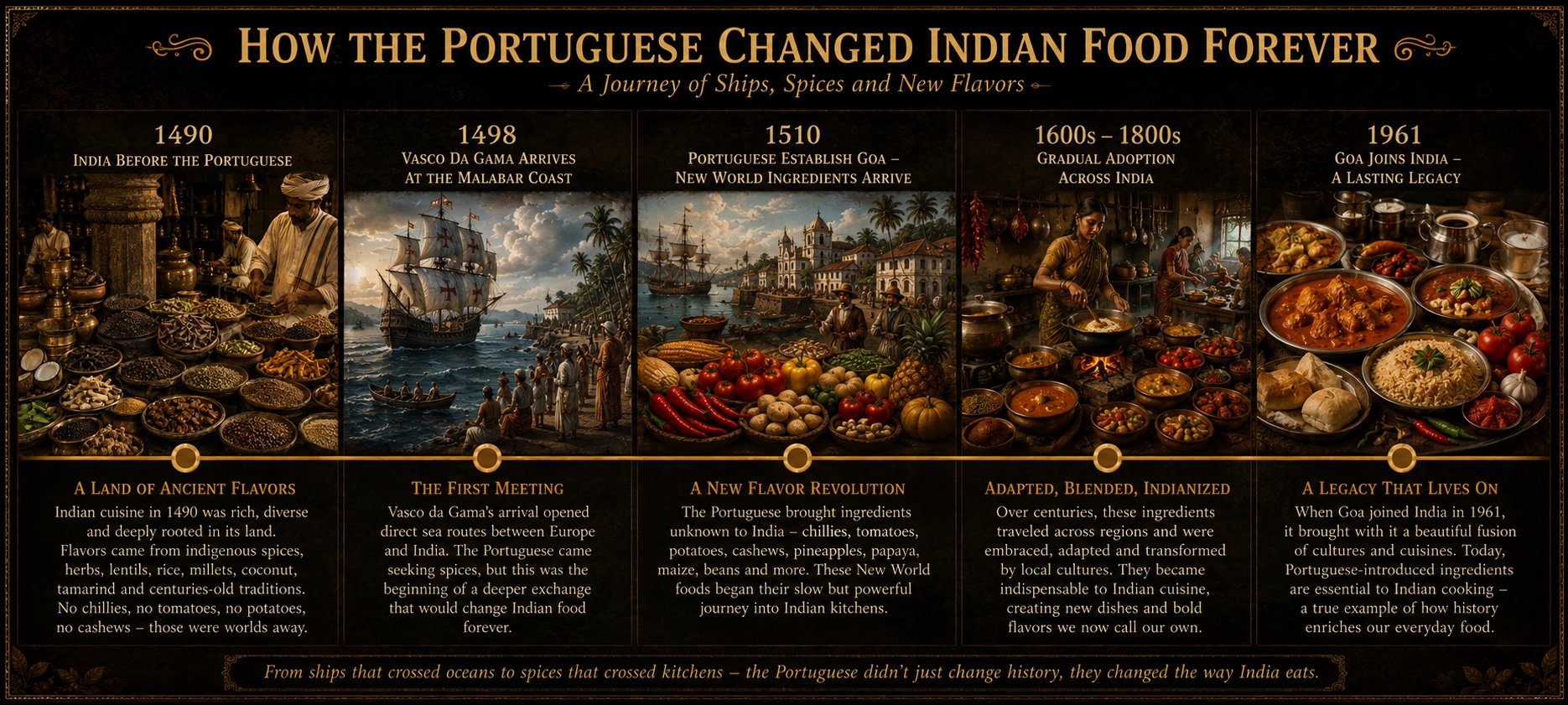
451 years — longer than the British Raj — and a transformation that still defines what the world calls Indian food. Click to enlarge.
| Date | Event |
|---|---|
| 1492 | Columbus reaches the Americas. The Columbian Exchange begins. The biological separation of hemispheres ends permanently. |
| 1498 | Vasco da Gama reaches India's Malabar Coast. The first direct European sea route to India is established. |
| 1510 | Portuguese capture Goa. 451 years of Portuguese presence begins — longer than the British Raj, longer than the Mughal Empire at its height. |
| 1500s | Chillies, tomatoes, and cashews arrive through Portuguese Goa. Begin spreading, initially slowly. |
| 1600s | Chillies widespread across South India and beginning to spread North. Potatoes arriving. Cashew cultivation expanding on west coast. |
| 1700s | Potato adoption accelerating. Tomatoes in limited but increasing use. All major New World ingredients establishing themselves. |
| 1800s | All major ingredients in mainstream Indian cooking. Chillies already dominant. The modern Indian flavour profile largely established. |
| 1961 | Indian military action ends Portuguese rule in Goa. The 451-year chapter closes. The culinary transformation it enabled is permanent and irreversible. |
The Ingredients, One by One
Chillies were the most consequential Portuguese introduction by an enormous margin. Originating in Central and South America, chillies provided heat more intensely, more cheaply, and more easily than anything in the existing Indian spice vocabulary. Black pepper required specific tropical growing conditions and years to establish. Long pepper was similar. Ginger was versatile but mild. Chillies grew in almost any Indian climate, produced abundantly in a single season, and could be dried and stored for years. Within two centuries of their arrival, they had spread across the entire subcontinent and permanently displaced black pepper as the primary source of heat. No other single ingredient change in Indian culinary history was as rapid, as total, or as transformative.
Tomatoes arrived alongside chillies but were adopted far more slowly — regarded with suspicion in many communities and probably classified as potentially toxic by some Ayurvedic practitioners. Their widespread culinary use in most regions probably did not occur until the eighteenth and nineteenth centuries. But when tomatoes did take hold, their impact was equally total: the onion-tomato-chilli base that now defines North Indian restaurant cuisine and represents "Indian food" to most of the world could not exist without them.
Potatoes followed a similar trajectory — introduced in the seventeenth century, spreading gradually, becoming mainstream in the eighteenth and nineteenth centuries with British colonial promotion. The potato transformed Indian street food, snack culture, and everyday cooking in ways the pre-potato ingredients could not match at scale. Cashews, introduced to Goa's western coast where they thrived, transformed Indian sweets and the rich nut-cream gravies of Mughal-influenced cooking. Pineapple, papaya, and guava completed the botanical transfer from Brazil, becoming so naturalised in Indian fruit culture that they now feel indigenous.
"The Portuguese supplied ingredients. Indian cooks created Indian dishes. The genius that made foreign ingredients Indian belongs entirely to the cooks who received them — and that genius is what matters."
Why Each Portuguese Introduction Succeeded — The Science
Chillies: Capsaicin provides cumulative, lingering heat that piperine (pepper) cannot match per unit of cost. More powerful heat agent, easier to grow, cheaper to produce — no competition.
Tomatoes: Citric acid for sourness, pectin for body, natural sugars for sweetness, glutamates for umami — no single ancient Indian souring agent provides all four simultaneously. The tomato is more versatile than tamarind.
Potatoes: Starch structure swells during cooking and creates an interior matrix that holds spice flavour compounds. Neutral taste absorbs surrounding spices perfectly. High yield per unit of land. Stores without refrigeration.
Cashews: Fat content and protein composition create an exceptionally smooth, stable emulsion when ground — more reliable than coconut cream in restaurant conditions. Neutral flavour that doesn't compete with spices.
Papaya: Contains papain — a protein-dissolving enzyme that works as a natural meat tenderiser. Properties that aligned perfectly with Indian meat marination traditions.
Goa: 451 Years of Culinary Laboratory
Portugal captured Goa in 1510 and held it until Indian military action ended Portuguese rule in 1961 — 451 years. This extraordinary duration created something genuinely unique: a place where Portuguese and Indian traditions merged over generations into a culture that neither could have produced alone.
The Goan Catholic community that emerged from this encounter developed a cuisine that is Indian in its spicing and technique, Portuguese in its structure and some of its ingredients, and American in the chillies and other New World crops that define it — a three-way synthesis with no parallel anywhere in world food. Vindaloo derives its name from the Portuguese vinha d'alhos — meat marinated in wine and garlic, a practical sea-voyage preservation technique. In Goa, wine became palm vinegar, Indian spices were layered in, and eventually chillies — themselves Portuguese-introduced — entered the dish. Sorpotel uses pork with vinegar and Indian spices. Bebinca is a layered egg-and-coconut dessert reflecting both the Portuguese love of egg confections and the Goan abundance of coconuts. Xacuti uses a spice paste that could only have been developed in a kitchen where both old Indian spice knowledge and New World chillies were simultaneously available.
The Portuguese Transformation — Before and After
Regional Impact
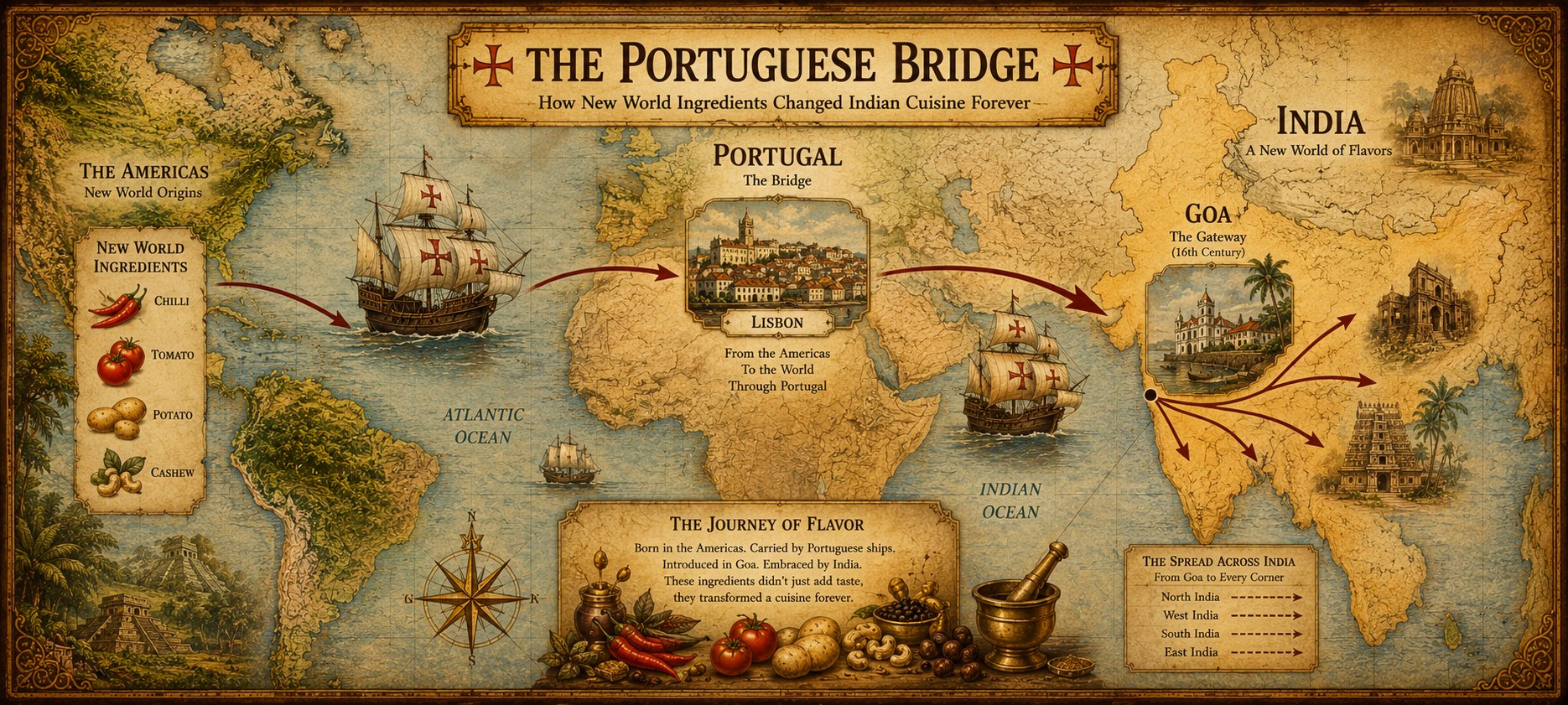
From Goa outward — how Portuguese-introduced ingredients spread across the subcontinent over four centuries, transforming every regional cuisine they reached. Click to enlarge.
Debate & Myths
Would Chillies Have Reached India Without the Portuguese?
Almost certainly — eventually. The Ottoman, Arab, and overland Silk Road trade networks that connected India to the rest of the world would likely have transmitted New World crops over time even without Portugal's specific intervention. Some historians argue that chillies may have had multiple entry routes into India, not just Goa.
But the timing matters enormously. Portuguese Goa accelerated the introduction of chillies and other New World crops by potentially centuries. The specific character of Indian cooking today — the particular heat profile of different regional traditions, the specific chilli varieties that became dominant in specific regions — was shaped by the Portuguese introduction route through Goa. A later arrival through different trade networks would likely have produced a different pattern of adoption and a somewhat different Indian cuisine.
Did the Portuguese Intentionally Transform Indian Food?
No — and this is an important point for understanding how culinary history actually works. The Portuguese did not arrive in Goa with a plan to change Indian cooking. They came for black pepper and other spices. They brought New World crops because they had them in Brazil and because crops were part of the agricultural activity of any colonial administration. The transformation of Indian cooking that resulted from their presence was a by-product of commercial activity, not a deliberate policy.
This is how most of the great culinary transformations in history happen: not through deliberate cultural exchange but through trade, migration, and accident. The Portuguese supplied the ingredients. The Indian cooks — through centuries of experimentation, regional adaptation, and creative integration — created the Indian dishes. The transformation belongs to India. Portugal was the delivery mechanism.
Why This Was Not Cultural Replacement
The Portuguese supplied ingredients. Indian cooks created Indian dishes. This distinction is not merely diplomatic — it is historically accurate and important. The Portuguese who introduced chillies to India were not attempting to change Indian cooking. What Indian cooks did with those ingredients — how they integrated chillies into every regional spice tradition, how they built tomato gravies that reflected Indian flavour philosophy, how they turned a Brazilian nut into kaju katli — was entirely Indian creativity applied to new materials.
This is how culinary history actually works. Ingredients travel. Cooks transform them. The results belong to the culture that does the transforming, not the culture that supplied the raw material. Modern Indian food is not Portuguese food with Indian spices. It is Indian food that happens to use Portuguese-introduced ingredients — ingredients so thoroughly absorbed that most people who eat them have no idea they ever came from anywhere else.
What If the Portuguese Never Came?
| Modern Indian Food | India Without the Portuguese |
|---|---|
| Chilli heat in virtually every dish | Black pepper, long pepper, ginger as primary heat sources — milder, more expensive, less ubiquitous |
| Tomato-onion gravy base | Tamarind, amchur, yoghurt, kokum for sourness and body — more regionally varied, more complex |
| Potato samosa, aloo gobi, vada pav | Raw banana, yam, colocasia, and meat-filled pastries |
| Cashew korma and kaju katli | Melon seed, coconut, and almond preparations for richness |
| Vindaloo, xacuti, sorpotel, bebinca | None of these dishes would exist |
| Chilli as a daily cooking staple for 1.4 billion people | Black pepper as the primary heat spice — India probably still the world's dominant pepper exporter |
What Survived — The Pre-Portuguese Tradition
What India Had Before the Portuguese — Still Alive Today
Modern Legacy
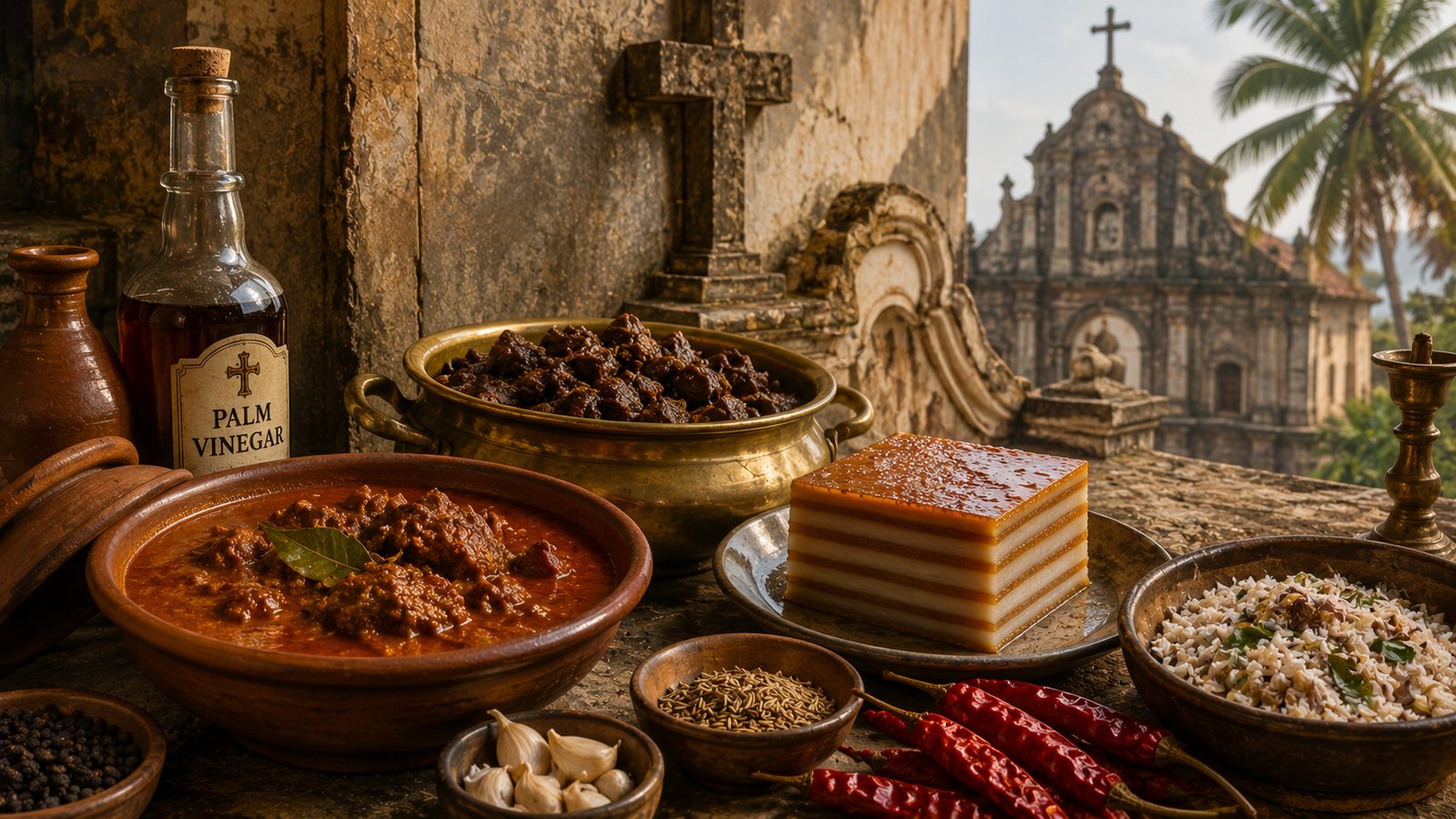
Goan cuisine: the most complete expression of what the Portuguese encounter produced — dishes that exist nowhere else, built from Indian technique, Portuguese structure, and American ingredients.
The Portuguese came to India for black pepper. They stayed for 451 years. In the process they served as the bridge through which the most consequential ingredients in food history — chillies, tomatoes, potatoes, cashews — reached the world's most sophisticated ancient cuisine and were transformed into something entirely new.
Modern Indian food — the butter chicken and dal makhani and aloo gobi that a billion people eat every day — could not exist without what the Portuguese carried. Yet it is not Portuguese food. It is Indian food, as thoroughly and unmistakably Indian as anything produced in the five thousand years before Vasco da Gama found his way to the Malabar Coast. The ingredients travelled. The genius stayed home.
Food History Scorecard
| Impact Area | Change | Still Visible? |
|---|---|---|
| Heat Source | Extreme | Chilli completely replaced black pepper as the primary heat agent in most Indian cooking |
| Souring System | Extreme | Tomato now dominant in North Indian cooking; ancient agents survive in South and coastal cooking |
| Starchy Vegetables | Extreme | Potato replaced raw banana and yam as the default bulk vegetable in most contexts |
| Richness and Thickening | High | Cashew largely replaced melon seeds and poppy seeds in restaurant North Indian cooking |
| Goan Cuisine | Extreme | A completely unique culinary tradition exists that would not exist without the Portuguese encounter |
| Global Indian Food Identity | Extreme | The image of Indian food globally is built almost entirely on Portuguese-introduced ingredients |
Confidence Scale
| Claim | Confidence | Basis |
|---|---|---|
| Portuguese Goa was the primary route for New World crops into India | High | Consistent with historical trade patterns, Portuguese colonial geography, and the timing of Indian adoption of New World crops. Some parallel entry routes possible. |
| Chillies transformed Indian cooking more rapidly and completely than any other single introduction | Very High | Historical record clearly documents chilli spread. The current universal presence of chillies in Indian cooking is the visible result. |
| Goan cuisine is a genuine three-way synthesis of Indian, Portuguese, and American influences | Very High | Directly documented in the cuisine's key dishes — vindaloo, xacuti, sorpotel, bebinca — each of which is analytically traceable to all three traditions. |
| The pre-Portuguese Indian kitchen was complete and not missing anything | Very High | Five thousand years of Indian culinary development documented before any Portuguese contact. The cuisine was not waiting to be completed. |
| Modern Indian food could not exist in its current form without Portuguese-introduced ingredients | Very High | Remove chillies, tomatoes, and potatoes from Indian cooking and the most globally familiar Indian dishes become unrecognisable. |
Further Reading
- K.T. Achaya — Indian Food: A Historical Companion
- Sanjay Subrahmanyam — The Portuguese Empire in Asia
- Alfred Crosby — The Columbian Exchange
- Colleen Taylor Sen — Feasts and Fasts
- Lizzie Collingham — Curry: A Tale of Cooks and Conquerors