★★★★★ All India
★★★★☆ South India
What Does Red Chilli Taste Like?
Red Chilli in Every Indian Language
| Language | Name | Pronunciation |
|---|---|---|
| English | Red Chilli / Dried Red Chilli | RED CHIL-ee |
| Hindi | लाल मिर्च — Lal Mirch | LAL MIRCH |
| Bengali | লাল মরিচ — Lal Morich | LAL MOH-rich |
| Tamil | மிளகாய் — Milagai | MIH-lah-gye |
| Telugu | మిరపకాయ — Mirapakaya | mee-RAH-pah-kye-yah |
| Malayalam | മുളക് — Mulakku | moo-LAK-koo |
| Kannada | ಮೆಣಸಿನಕಾಯಿ — Menasina Kayi | MEH-nah-see-nah KYE |
| Gujarati | લાલ મરચું — Lal Marchu | LAL MAR-choo |
| Marathi | लाल मिरची — Lal Mirchi | LAL MEER-chee |
| Punjabi | ਲਾਲ ਮਿਰਚ — Lal Mirch | LAL MIRCH |
| Urdu | لال مرچ — Lal Mirch | LAL MIRCH |
| Sanskrit | — | — |
What Is Red Chilli?
Red chilli arrived in India from the Americas with Portuguese traders around 1498–1510 — making it less than 600 years old in Indian cooking. Yet it has become so embedded in the Indian food vocabulary that it is now impossible to imagine Indian cooking without it. Before chilli arrived, black pepper (and long pepper) provided all heat in Indian cooking — a tradition still visible in South Indian pepper rasam and Chettinad cooking.
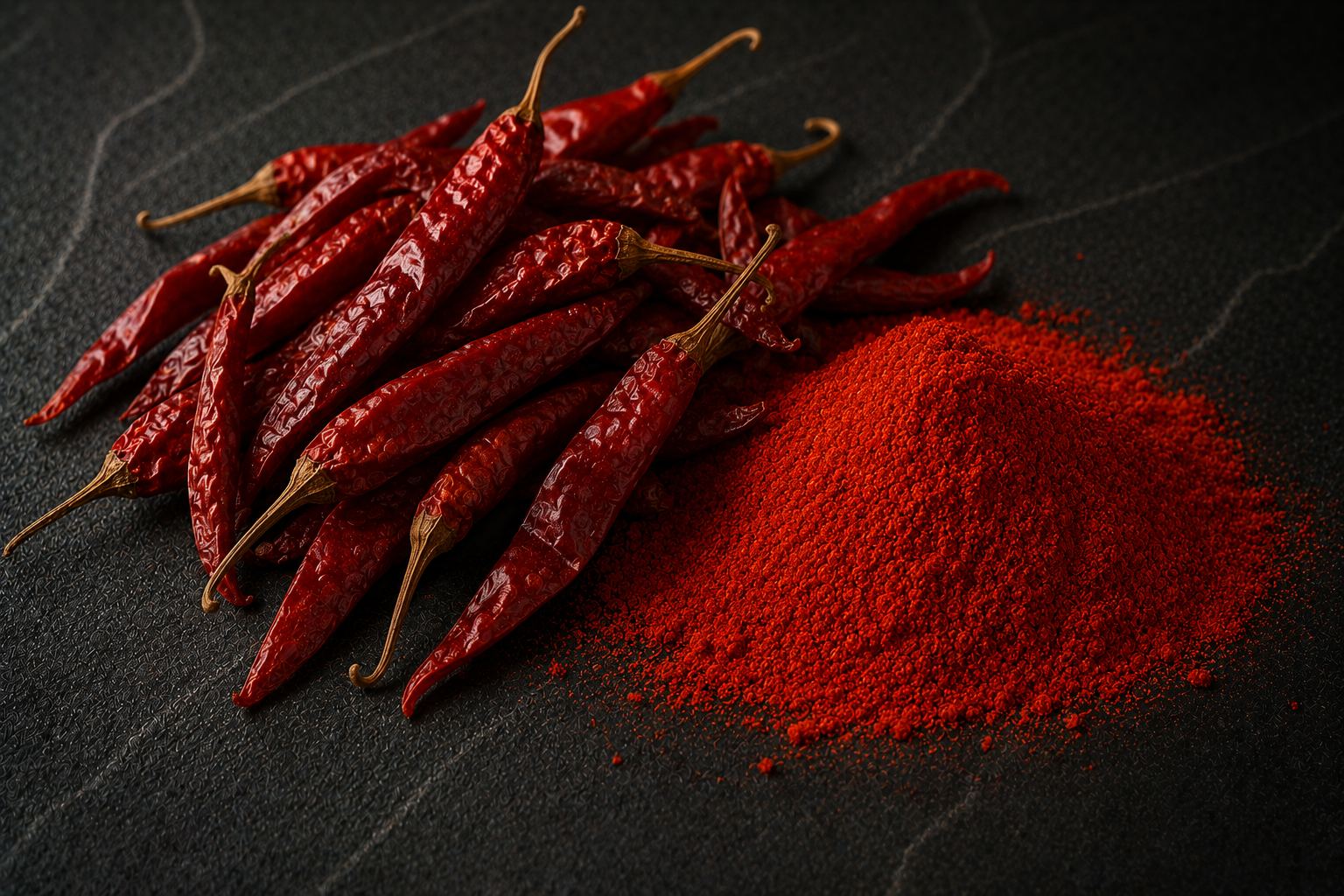
Dried red chillies in Indian cooking serve dual functions: heat and colour. Different varieties provide different balances of these two properties — Kashmiri chilli is prized almost entirely for its colour (deep red, very mild heat), Guntur and Sankeshwari chillies for intense heat, and Byadgi for both colour and moderate heat.
- Andhra Pradesh cooking — the hottest regional cuisine in India — is architecturally built on Guntur Sannam chilli
- South Indian tadka: dried whole red chilli is the third element after mustard seeds and curry leaves — without it the tadka is incomplete
- Red chilli powder forms one of the four base spices in North Indian curry masala alongside cumin, coriander, and turmeric
- The vivid red colour of many Indian preparations — from tandoori chicken to rajma — comes from red chilli or Kashmiri chilli, not from turmeric
- India is the world's largest producer and consumer of chillies — the spice has been fully indigenised despite its American origin
Red Chilli Through History
Red chilli is one of the most remarkable examples of agricultural adoption in world history. Within 100 years of arriving in India with Portuguese traders, it had replaced black pepper as the primary heat source in most regional cuisines. The speed of adoption is explained by economics: chillies grow prolifically in Indian soil and climate, are cheaper than black pepper, and provide more intense heat per gram.
Vasco da Gama's 1498 arrival in Calicut (Kerala) opened direct sea trade between India and Europe. Portuguese traders brought chilli seeds from Brazil in subsequent voyages, and local cultivation began almost immediately. By 1600, chillies were documented in agricultural texts across India. By 1700, they had transformed Indian cooking beyond recognition from its pre-chilli form.
Andhra Pradesh and Telangana became the heartland of Indian chilli production — the Guntur district in particular developed into the global centre of chilli trade, producing varieties of intense heat that are exported worldwide.
The Science of Red Chilli
How to Store Red Chilli
How to Buy Good Red Chilli
How to Use Red Chilli Correctly
- Tadka: add 1–2 whole dried chillies to hot oil — let them darken slightly (20–30 sec) before adding other ingredients
- Ground powder: add during masala stage with turmeric, cumin, and coriander
- For colour without heat: use Kashmiri red chilli powder (mild but vivid red)
- For heat without colour: use Guntur or bird's eye chilli
- Quantity: 1/2–1 tsp ground per curry for 4 people (adjust for heat preference)
- To reduce heat: remove seeds from dried chillies before using
What Red Chilli Pairs Well With
Dishes That Use Red Chilli
Where Red Chilli Matters Most
| North Indian Cuisine | Essential |
| South Indian Cuisine | Essential |
| Bengali Cuisine | Essential |
| Andhra Cuisine | Essential |
| Rajasthani Cuisine | Essential |
| Gujarati Cuisine | Essential |
| Jain Cooking | Essential |
| Sattvic Cooking | Rare |
Kashmiri Chilli vs Guntur Chilli vs Byadgi Chilli
| Feature | Kashmiri | Guntur Sannam | Byadgi |
|---|---|---|---|
| Heat level | Very mild (1,000–2,000 SHU) | Very hot (50,000–100,000 SHU) | Mild-medium (10,000–15,000 SHU) |
| Colour | Deep vivid red | Dark red-orange | Deep maroon-red |
| Primary use | Colour — tandoori, korma | Heat — Andhra cooking | Colour + mild heat — Karnataka |
| Flavour | Mild, slightly fruity | Sharp, intense | Rich, slightly sweet |
| Available as | Whole and powder | Whole and powder | Whole and powder |