★★★★★ All India
What Does Curry Leaves Taste Like?
Curry Leaves in Every Indian Language
| Language | Name | Pronunciation |
|---|---|---|
| English | Curry Leaves | KUH-ree LEEVZ |
| Hindi | करी पत्ता — Kadi Patta | KAH-dee PAH-tah |
| Bengali | কারি পাতা — Kari Pata | KAH-ree PAH-tah |
| Tamil | கறிவேப்பிலை — Karivepilai | KAH-ree-veh-pih-lye |
| Telugu | కరివేపాకు — Karivepaku | KAH-ree-veh-PAH-koo |
| Malayalam | കറിവേപ്പില — Kariveppila | KAH-ree-vep-pih-lah |
| Kannada | ಕರಿಬೇವು — Karibevu | KAH-ree-BEH-voo |
| Gujarati | કઢી પત્તા — Kadhi Patta | KAH-dhee PAH-tah |
| Marathi | कढीपत्ता — Kadipatta | KAH-dee-pah-tah |
| Punjabi | ਕੜੀ ਪੱਤਾ — Kari Patta | KAH-ree PAH-tah |
| Urdu | کڑی پتہ — Kari Patta | KAH-ree PAH-tah |
| Sanskrit | कृष्णनीम — Krishnaneem | KRISH-nah-NEEM |
What Is Curry Leaves?
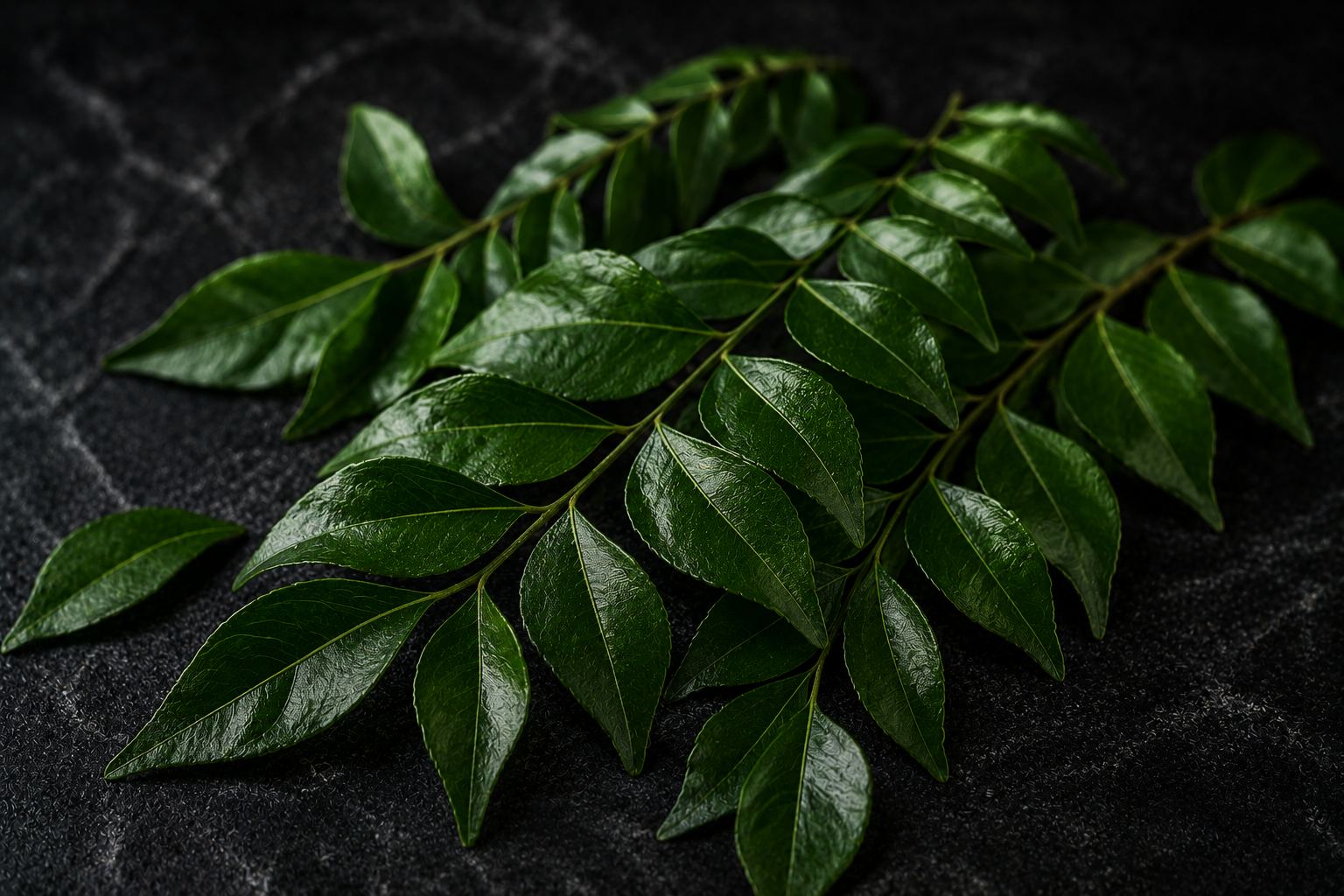
Curry leaves are the fresh leaves of Murraya koenigii — a small tree native to South India and Sri Lanka. They are not related to curry powder, not related to neem, and have nothing to do with the British concept of 'curry.' They have a completely distinctive flavour: a citrus-camphor-earthy aroma that is immediately recognisable and irreplaceable in South Indian cooking.
The leaves are used in hot oil (tadka/tempering) — added to oil or ghee that is very hot, they sizzle and release their aromatic compounds immediately. Fresh curry leaves are dramatically superior to dried. The plant is easily grown in a pot — many South Indian households in the diaspora maintain a curry leaf plant specifically because the fresh leaf is so superior to dried versions.
- South Indian tadka without curry leaves is incomplete — the combination of mustard seeds, curry leaves, and dried red chilli defines the foundational cooking technique of the region
- Sambhar and rasam derive their characteristic aroma significantly from curry leaves in the final tadka
- No other plant produces the specific citrus-camphor combination of curry leaves — dried, powdered, or other substitutes produce fundamentally different results
- The diaspora's consistent desire to grow curry leaf plants reflects how irreplaceable the fresh leaf is
- Without curry leaves, South Indian cooking loses its most distinctive aromatic signature
Curry Leaves Through History
Murraya koenigii is native to South India and Sri Lanka. The plant appears in ancient Tamil Sangam literature and in Ayurvedic texts — its medicinal use (digestion, hair care, blood sugar) predates its culinary adoption but both traditions are ancient. The name 'curry' in English comes from the Tamil word kari — and the leaves were likely named 'curry leaves' by British colonists who associated them with the local 'curry' preparations.
The Science of Curry Leaves
How to Store Curry Leaves
How to Buy Good Curry Leaves
How to Use Curry Leaves Correctly
- Add whole sprigs to very hot oil/ghee — they will sizzle and release aroma in 10–15 seconds
- Can tear leaves off the sprig before adding
- Add early in tadka — before mustard seeds pop or simultaneously
- For sambhar: add a sprig in the final tadka poured over the finished dal
- Quantity: 8–12 leaves per dish for 4 people
- Remove stem before eating (the individual leaves are eaten)
What Curry Leaves Pairs Well With
Dishes That Use Curry Leaves
Where Curry Leaves Matters Most
| South Indian Cuisine | Essential |
| North Indian Cuisine | Common |
| Keralan Cuisine | Essential |
| All Indian Cuisines | Common |
| Jain Cooking | Essential |
| Sattvic Cooking | Common |
Fresh Curry Leaves vs Dried vs Curry Powder
| Feature | Fresh Curry Leaves | Dried Curry Leaves | Curry Powder |
|---|---|---|---|
| Aroma | Full, citrus-camphor | Diminished — 30–40% of fresh | Completely different plant |
| Flavour | Complex, irreplaceable | Pale approximation | Unrelated |
| Substitutable? | No | Poor substitute | No — different substance |
| Shelf life | 1–2 weeks | 6–12 months | 1 year |
| Growing? | Yes — grow your own | N/A | N/A |