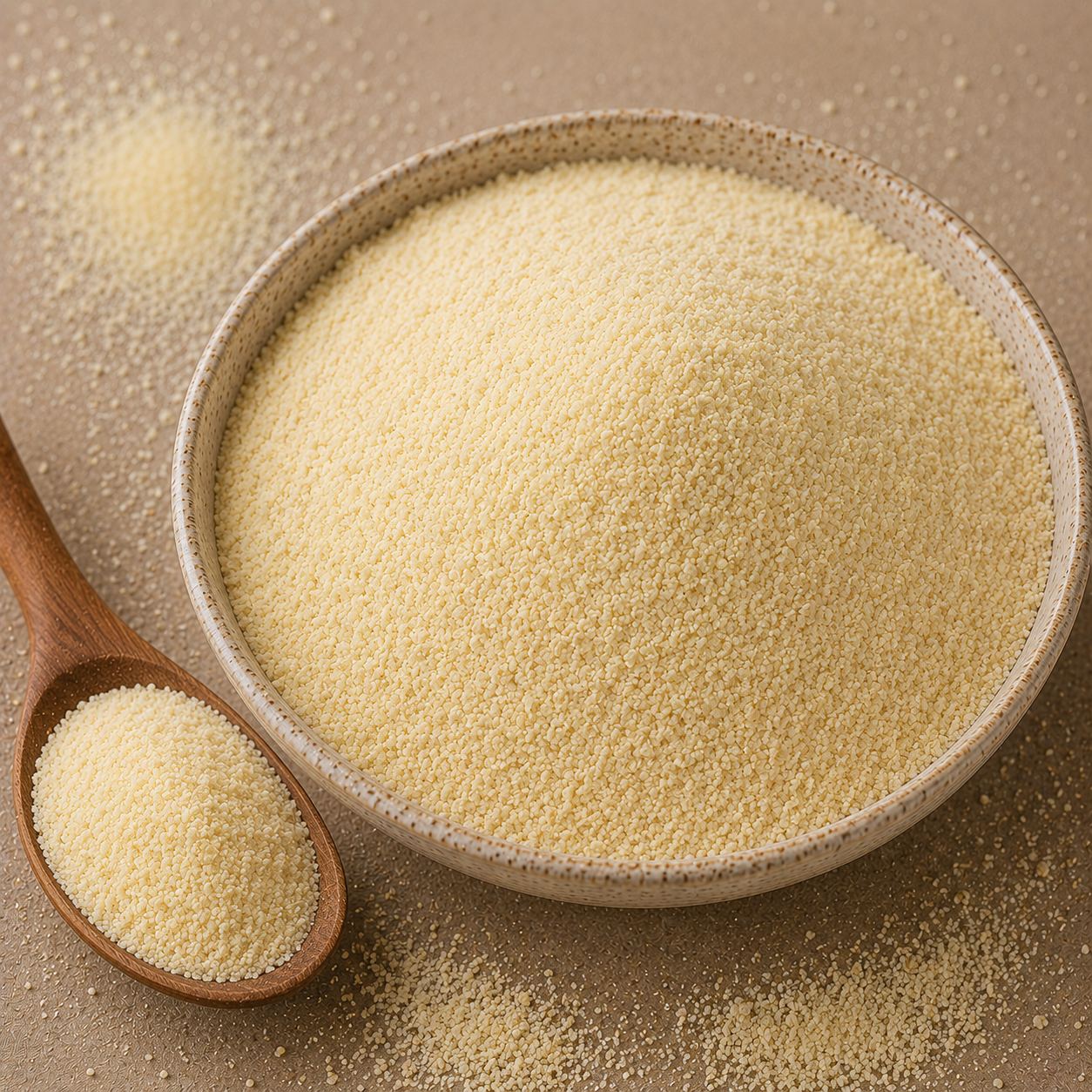
Ingredient identity
Ingredient DNA
Sooji / Rava — Semolina
Triticum durum (coarse ground) · Family: Poaceae / Fabaceae · Genus: Triticum
Origin
South Asia / Middle East
Form
Fine to coarse powder
Primary Use
Upma · Halwa · Kesari · Idli (Rava Idli) · Sooji Ladoo
Taste profile
What Does Sooji / Rava Taste Like?
Flavour Profile — Sooji / Rava
Botanical classification
Species
Triticum durum (coarse ground)
Names across India
Sooji / Rava in Every Indian Language
| Language | Name | Pronunciation |
|---|
| English | Semolina | |
| Hindi | Sooji / Rava | |
| Tamil | ரவை — Rava | |
| Telugu | రవ్వ — Rava | |
| Malayalam | റവ — Rava | |
| Kannada | ರವೆ — Rave | |
| Gujarati | Sooji / Rava | |
| Marathi | Sooji / Rava | |
| Punjabi | Sooji / Rava | |
Origin and identity
What Is Sooji / Rava?
Sooji (North India) / Rava (South India) is coarsely ground durum wheat — neither as fine as maida nor as whole as atta. The coarse grinding creates a specific granular texture that, when cooked in ghee, produces upma's characteristic slightly chewy, nutty quality that finely ground flour cannot replicate.
It appears in both savoury preparations (upma, rava dosa, rava idli) and sweet preparations (suji halwa, sooji ladoo, kesari bath). The granular texture is the point — when cooked properly in ghee, each grain remains slightly distinct while softening.
What Indian Cooking Loses Without Sooji / Rava
- Upma — South India's most widely eaten savoury breakfast — is built on rava's specific coarse texture
- Suji halwa's characteristic slightly chewy, distinct grain texture comes from semolina — smooth flour produces a completely different result
- Rava idli is a specific preparation that uses rava's granular quality for a different idli texture
- Kesari bath — South India's most beloved sweet — requires rava's specific behaviour in hot ghee and water
Historical significance
Sooji / Rava Through History
Historical Record
From Ancient Durum to Modern Breakfast
Durum wheat (Triticum durum) has been cultivated in India for thousands of years, and semolina grinding is an ancient process. The South Indian upma tradition dates to at least several hundred years — the preparation appears in regional literature from the medieval period.
Cooking science
The Science of Sooji / Rava
Granular Structure — Why Rava Behaves Differently
Rava's coarse grinding leaves starch granules partially intact — larger than in flour, smaller than in whole grain. When cooked in hot ghee, the surface of each granule undergoes Maillard reactions while the interior gelatinises slowly — creating the characteristic outer texture (slightly chewy) while the inside becomes tender. Fine flour would gelatinise uniformly, producing paste rather than textured upma.
Storage science
How to Store Sooji / Rava
Airtight container
Up to 1 year
Key note
Store away from moisture — flour absorbs humidity quickly
Buying guide
How to Buy Good Sooji / Rava
✓ Look For
- Fresh milling date where possible
- No rancid or musty smell
- Fine, uniform powder
- From reputable mills
✗ Avoid
- Old, rancid smell
- Lumpy or clumped flour
- No milling date
- Adulterated with other flour
Technique
How to Use Sooji / Rava Correctly
Technique, quantity, and what to avoid
- Store in airtight container
- Use within 3–6 months of milling
- Sieve before use for smoother dough
- Rest dough 15–30 minutes after mixing for better texture
Pairings
What Sooji / Rava Pairs Well With
Best Pairings — Sooji / Rava
Famous dishes
Dishes That Use Sooji / Rava
Regional use
Where Sooji / Rava Matters Most
Regional Importance
★★★★★
All India
Universal flour
★★★★★
North India
Primary wheat flour use
★★★★★
South India
Rice and millet flours
★★★★☆
Rural India
Traditional millet flours
| All Indian Cuisines | Essential |
| Jain Cooking | Essential |
| Sattvic Cooking | Essential |
Comparison
Sooji / Rava vs Other Indian Flours
| Feature | Sooji / Rava | Maida (Refined) | Besan (Chickpea) |
|---|
| Gluten | Yes (if wheat) | Yes | None |
| Fibre | High (whole wheat) | Low | High |
| Primary use | Upma · Halwa · Kesari · Idli (Rava Idli) · Sooji Ladoo | Baking, maida items | Pakoda, kadhi |
| Protein | 12–14g/100g | 10g/100g | 22g/100g |
Nutrition
Nutrition and Key Compounds
Sooji / Rava — Honest Nutritional Picture
Culinary quantities — aromatic and flavour contribution, not macro nutrition
Sooji/Rava (dry): ~11g protein, 73g carbohydrate, 4g fibre per 100g. GI ~66 — medium. Lower in fibre than whole atta. Higher GI than whole wheat.
Substitutions
Substitutes for Sooji / Rava
What Works and What Does Not
Other flours in 25% blend
Most Indian flours can be combined without dramatic effect on most preparations.
For traditional preparations
Each flour's specific properties are required for traditional dishes.
Chef's notes
Practical Insight
From the Kitchen
Roast rava in dry ghee until fragrant and slightly golden before adding water — this toasting step develops the Maillard flavours and prevents clumping. Cold water added too quickly to hot rava causes lumping; add gradually while stirring.