🫓 Bread · Level 1
Roti
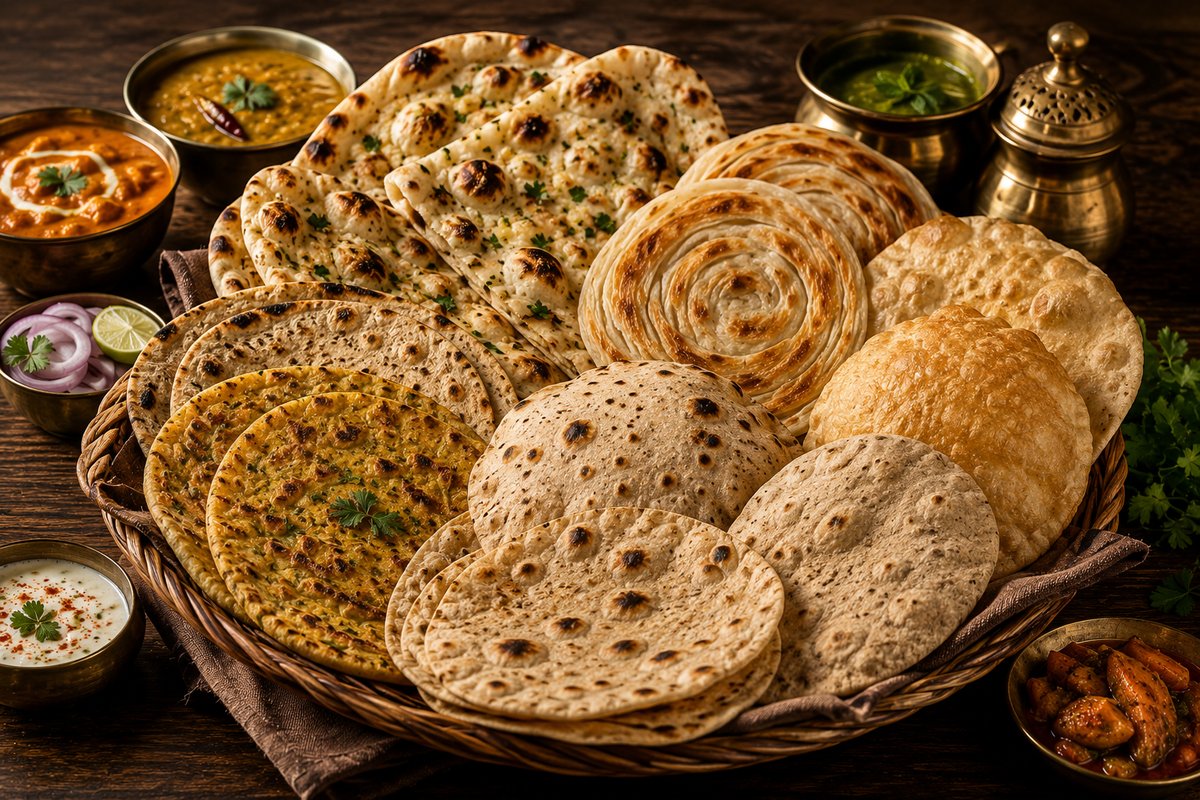
India's daily bread — whole wheat flatbread cooked on a tawa and finished on an open flame until it puffs. The most-eaten bread in the world. Mastered in a week.
India's daily bread — whole wheat flatbread cooked on a tawa and finished on an open flame until it puffs. The most-eaten bread in the world. Mastered in a week.
A roti that puffs into a balloon is not a display of skill — it is chemistry. The puffing occurs when the internal moisture converts to steam faster than it can escape through the partially cooked dough. The steam inflates the gluten network into a hollow sphere. This requires two conditions: the dough must have the correct hydration (enough water to generate steam), and the gluten network must be strong enough to hold the steam without tearing. Both depend on the dough.
Mix atta and salt. Add water gradually — add 150ml first, then adjust. Knead for 8–10 minutes until smooth, soft and elastic. The dough should be softer than bread dough — it should indent easily. Add oil, knead 1 more minute. Rest covered 20 minutes.
Atta contains both glutenin and gliadin proteins that form gluten when hydrated and kneaded. 8–10 minutes of kneading develops gluten into long, aligned networks capable of expanding under steam pressure without tearing. Under-kneaded dough has short, weak gluten chains that cannot expand uniformly — the steam escapes through weak spots rather than inflating the whole bread. The 20-minute rest allows the gluten to relax from the kneading stress, making rolling easier and preventing spring-back.
Divide into 8–10 balls. Roll each into a thin, even circle — 2mm thick. Dust with dry flour to prevent sticking. The edges should be no thicker than the centre.
Even thickness is essential for even cooking — thick edges remain doughy while the centre over-cooks. The dry flour dusting creates a moisture barrier between the rolling surface and the dough, preventing adhesion without adding moisture that would affect the gluten structure. The 2mm target allows the tawa to heat the dough through rapidly — in 3 seconds at 220°C, heat penetrates 2mm of dough to produce the steam needed for puffing.
Heat tawa on high until very hot. Place roti — cook 30 seconds until bubbles appear. Flip. Cook 30 seconds more. Use tongs to place directly on a medium gas flame — it will puff in 5–10 seconds. Flip on flame if needed. Remove and brush with ghee.
The two-stage cooking is deliberate. The tawa at 220°C cooks both sides 70% — the surface proteins denature and the starch partially gelatinises, forming a semi-rigid structure. When this semi-rigid roti goes onto the open flame (500°C+), the remaining moisture in the centre converts to steam almost instantaneously, generating enough pressure to inflate the semi-rigid structure. The structure holds because the tawa stage has already partially set it — raw dough would simply burn on the flame.