🫓 Bread · Level 1
Paratha
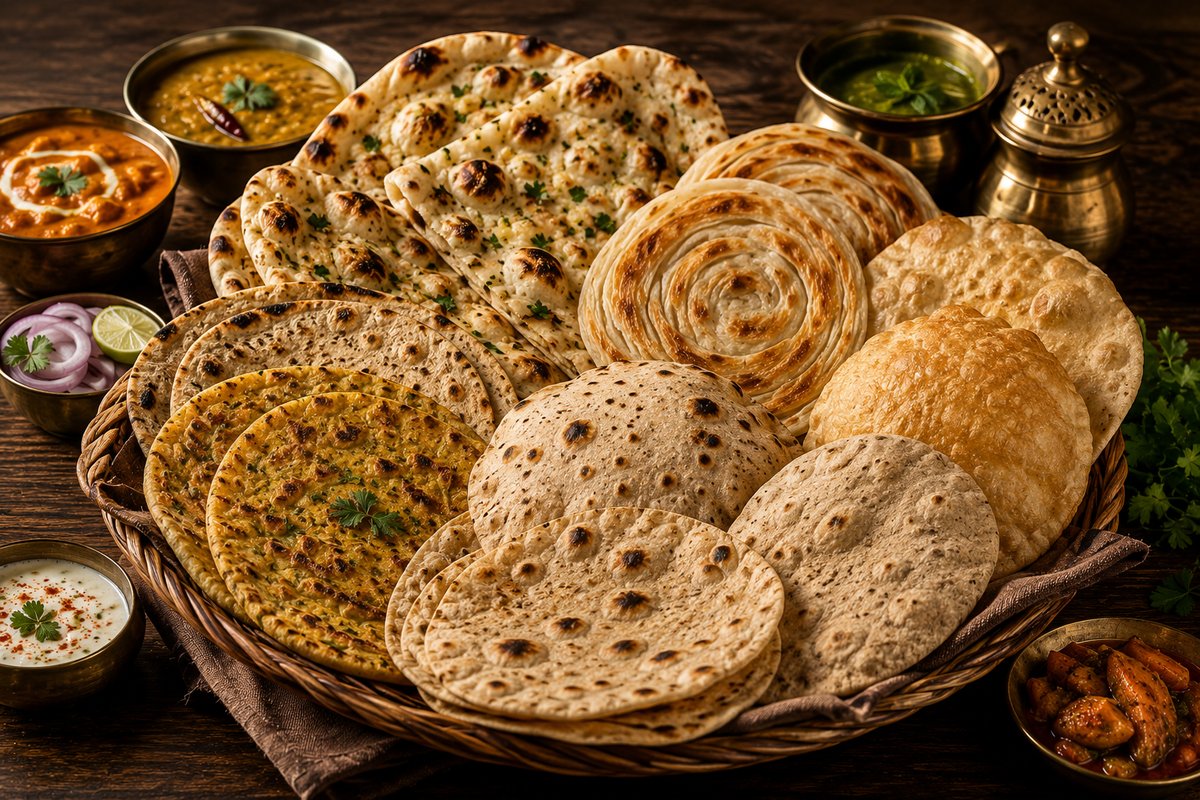
Roti's richer, flakier sibling — layered with ghee and cooked until golden. The folding creates the layers. The layers create the flakiness.
Roti's richer, flakier sibling — layered with ghee and cooked until golden. The folding creates the layers. The layers create the flakiness.
A paratha is a roti that has been folded with ghee between the folds before final rolling. The folding creates multiple layers of dough separated by thin films of fat — the same principle as croissant pastry but simpler. When the paratha cooks, the fat between the layers vaporises, separating the layers and producing the characteristic flaky, slightly crisp texture that distinguishes paratha from roti.
Make dough exactly as for roti (page r-bread-roti.html). Knead 8 minutes, rest 20 minutes.
The dough is identical to roti — the flakiness of paratha comes entirely from the folding and fat technique, not the dough composition.
Roll a dough ball into a thin circle. Brush generously with ghee. Fold in half. Brush top with ghee. Fold in half again — forming a triangle. Roll this triangle thin again. The layers are now inside.
Each fold creates a doubling of layers — one fold produces 2 layers, two folds produce 4 layers. The ghee between each layer creates a fat film that has two properties: it prevents the layers from re-bonding during the final roll, and it vaporises during cooking, inflating the spaces between layers. The triangle shape produces an even thickness throughout — a traditional approach to a shape that rolls consistently thin without the centre being disproportionately thick.
Heat tawa on medium-high. Cook paratha — 1 minute until bubbles appear. Flip. Add ½ tsp ghee around the edges — it will sizzle. Cook 1.5 minutes until golden patches appear. Flip again, add more ghee, cook 1 minute. The paratha should be golden-brown with some crisp spots.
Ghee added to the tawa after the first flip creates a shallow frying effect — the ghee heats to 200°C+ and produces Maillard browning on the paratha surface in the fat-contact zones. These golden patches are where the ghee has fried the surface proteins and starch, producing a crispness absent in the areas where the paratha cooked dry (the bubbled areas). The alternating crisp and soft zones are the textural characteristic of a well-made paratha.