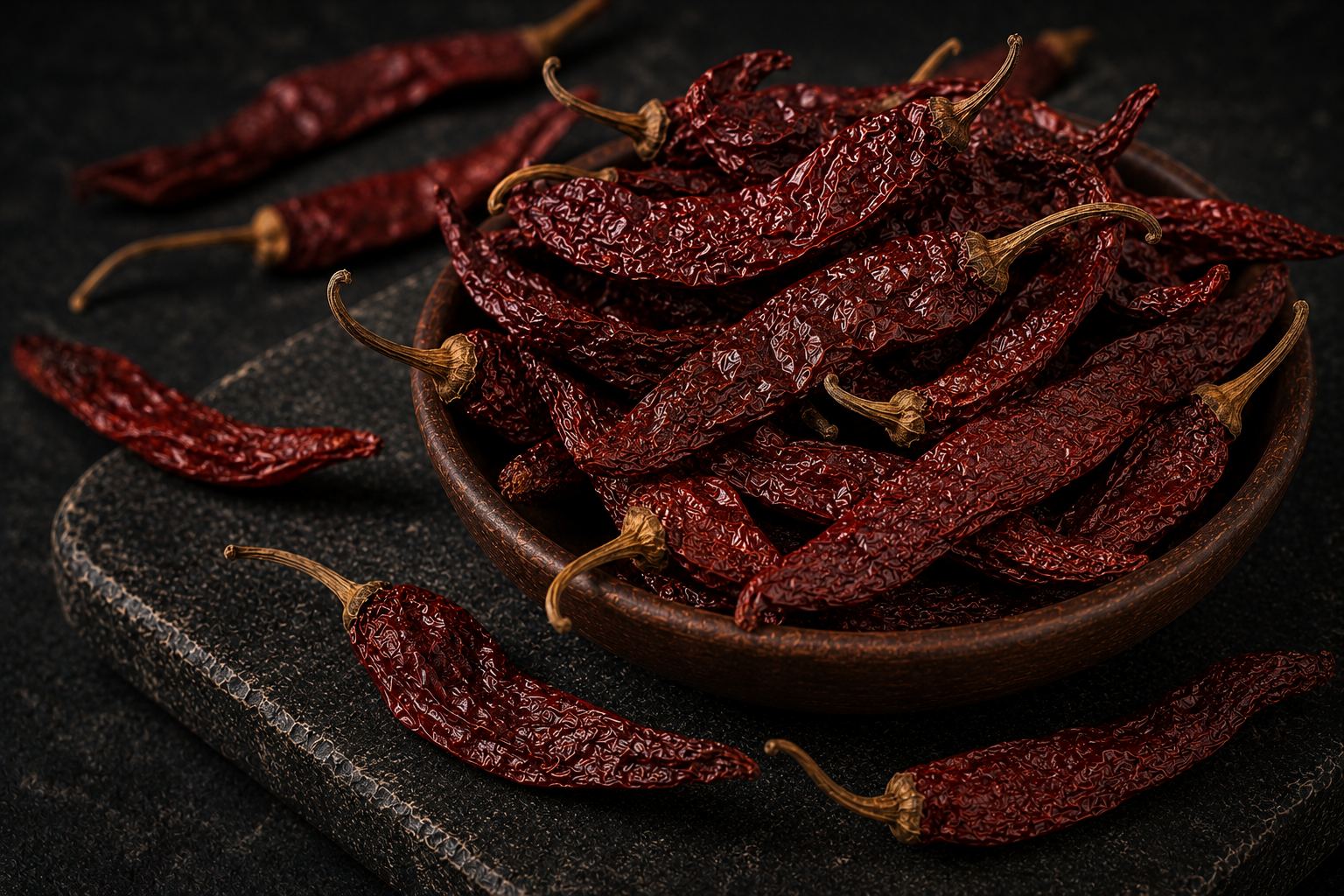
Ingredient identity
Ingredient DNA
Byadgi Chilli — Karnataka's Colour Spice
Capsicum annuum (Byadgi) · Family: Varies · Genus: Capsicum
Primary Use
Colour in Karnataka cooking · Sambar · Curries
Taste profile
What Does Byadgi Chilli Taste Like?
Flavour Profile — Byadgi Chilli
Botanical classification
Species
Capsicum annuum (Byadgi)
English Name
Byadgi Chilli
Names across India
Byadgi Chilli in Every Indian Language
| Language | Name | Pronunciation |
|---|
| English | Byadgi Chilli | |
| Hindi | Byadgi Mirch | |
| Tamil | ಬ್ಯಾಡಗಿ ಮೆಣಸಿನಕಾಯಿ — Byadgi Menasina | |
| Telugu | బ్యాడ్గి మిరపకాయ — Byadgi Mirapakaya | |
| Malayalam | ബ്യാഡ്ഗി മുളക് — Byadgi Mulaku | |
| Kannada | ಬ್ಯಾಡಗಿ ಮೆಣಸಿನಕಾಯಿ — Byadgi | |
Origin and identity
What Is Byadgi Chilli?
Byadgi chilli is a specific variety of Capsicum annuum grown in the Byadgi and Haveri regions of Karnataka. It is prized for its deep maroon-red colour and relatively mild heat — making it Karnataka's equivalent of Kashmiri chilli. The wrinkled, elongated pods produce a powder with intense colour and moderate heat. Two sub-varieties exist: Dabbi (stubby and round) and Kaddi (long and slender).
What Indian Cooking Loses Without Byadgi Chilli
- Karnataka's distinctive deep red dishes — coconut-based curries and sambar — derive their colour from Byadgi chilli
- The combination of Byadgi's colour with its moderate heat allows Karnataka cooks to use it generously
- Without Byadgi chilli, Karnataka cooking would lack its specific deep maroon-red signature
- Byadgi chilli is a major Karnataka agricultural product — exported nationally and internationally for its colour properties
Historical significance
Byadgi Chilli Through History
Historical Record
Karnataka's Regional Chilli
Byadgi chilli has been cultivated in the Haveri district of northern Karnataka for several hundred years. It developed as a distinct variety adapted to the local climate and has been grown as a commercial crop for the colour industry (paprika-type uses) as well as for cooking. Byadgi is one of India's most geographically specific chilli varieties with protected regional identity.
Cooking science
The Science of Byadgi Chilli
Capsanthin — High Colour, Moderate Capsaicin
Like Kashmiri chilli, Byadgi has unusually high capsanthin (colour pigment) relative to capsaicin (heat). Byadgi chilli has a slightly higher heat level than Kashmiri (approximately 2,000–3,000 SHU vs 1,000–2,000 SHU for Kashmiri) but both are in the mild range and both function primarily as colour spices.
Storage science
How to Store Byadgi Chilli
Note
Store in airtight container away from heat and light
Buying guide
How to Buy Good Byadgi Chilli
✓ Look For
- Fresh, strong aroma
- Correct colour
- No musty smell
Technique
How to Use Byadgi Chilli Correctly
Technique, quantity, and what to avoid
- Use as directed for each preparation
- Start small and adjust
Pairings
What Byadgi Chilli Pairs Well With
Best Pairings — Byadgi Chilli
Famous dishes
Dishes That Use Byadgi Chilli
Regional use
Where Byadgi Chilli Matters Most
Regional Importance
★★★★★
South India
Primary use region
★★★★☆
All India
Widely used
| South Indian Cuisine | Essential |
| All Indian Cuisines | Common |
| Jain Cooking | Common |
Comparison
Byadgi Chilli vs Related Spices
| Feature | Byadgi Chilli | Kashmiri Chilli | Regular Chilli |
|---|
| Heat | Varies | Very mild | Medium-hot |
| Colour | Varies | Deep red | Red-orange |
| Primary use | Colour in Karnataka cooking · Sambar · Curries | Colour | Heat |
Nutrition
Nutrition and Key Compounds
Byadgi Chilli — Honest Nutritional Picture
Culinary quantities — aromatic and flavour contribution, not macro nutrition
Byadgi Chilli at culinary quantities contributes negligible macro nutrition.
Substitutions
Substitutes for Byadgi Chilli
What Works and What Does Not
Similar spice
Adjust quantity to taste.
Chef's notes
Practical Insight
From the Kitchen
Byadgi chilli can substitute for Kashmiri chilli in most applications — both provide colour with mild heat. Use the same quantity. The colour is slightly more maroon and less vivid red than Kashmiri, with marginally more heat.