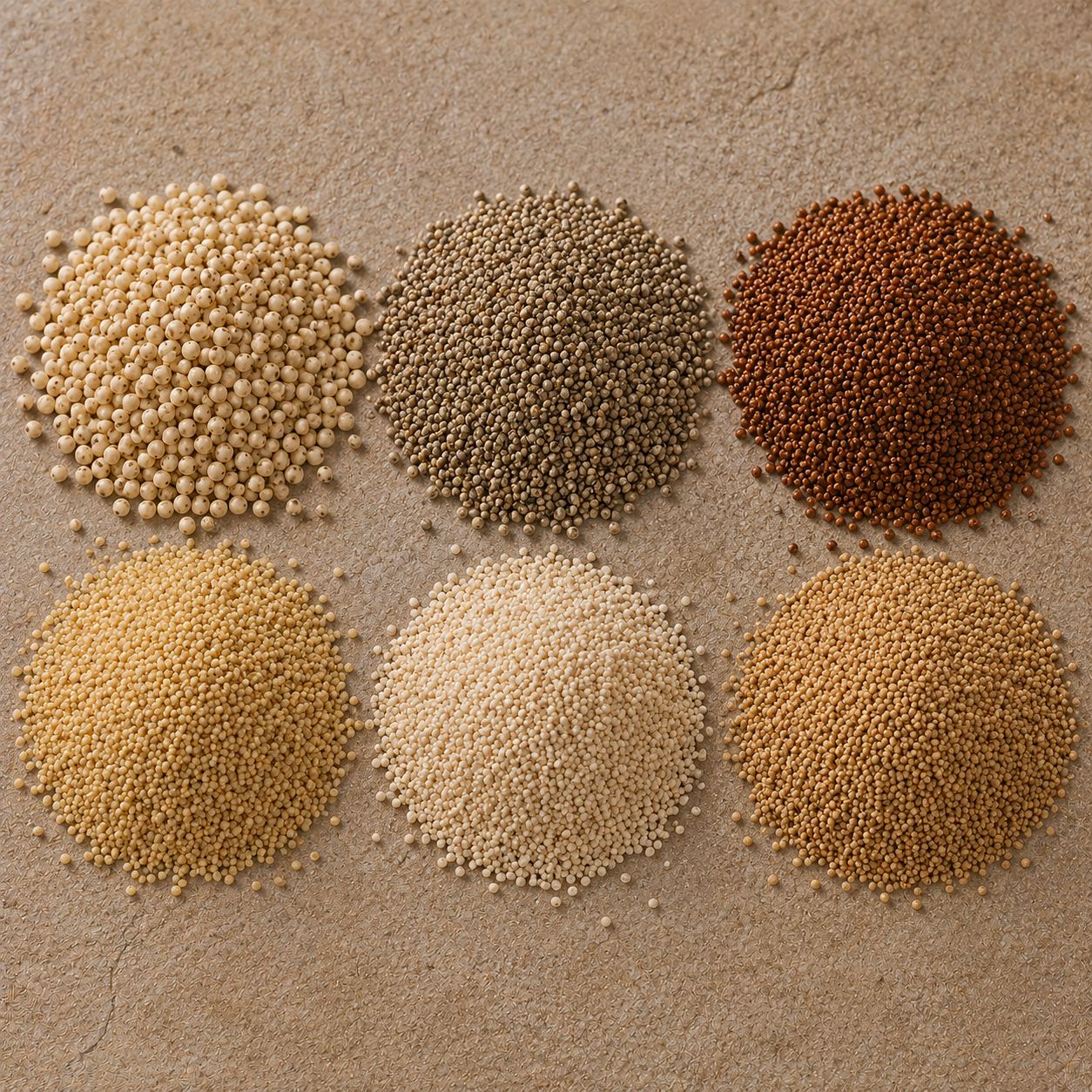
What Does Millets vs Rice and Wheat Taste Like?
Millets vs Rice and Wheat in Every Indian Language
| Language | Name | Pronunciation |
|---|---|---|
| Jowar | Sorghum bicolor | Cholam (Tamil), Jonna (Telugu) |
| Bajra | Pennisetum glaucum | Kambu (Tamil), Sajja (Telugu) |
| Ragi | Eleusine coracana | Kezhvaragu (Tamil), Ragulu (Telugu) |
| Foxtail | Setaria italica | Thinai (Tamil), Korralu (Telugu) |
| Little Millet | Panicum sumatrense | Samai (Tamil), Samalu (Telugu) |
| Kodo | Paspalum scrobiculatum | Varagu (Tamil), Kodo (Telugu) |
| Barnyard | Echinochloa frumentacea | Kuthiraivali (Tamil), Odalu (Telugu) |
| Proso | Panicum miliaceum | Panivaragu (Tamil), Variga (Telugu) |
| Amaranth | Amaranthus spp. | Rajgira (Hindi), complete protein |
What Is Millets vs Rice and Wheat?
This reference page provides an honest, evidence-based comparison of millets against rice and wheat, and between individual millets. Millets are a group of small-seeded grasses that have been cultivated in India for thousands of years. They were displaced from urban diets by rice and wheat during the Green Revolution (1960s–70s) but are now experiencing a significant revival driven by their nutritional advantages and climate resilience.
The Government of India designated 2023 as the International Year of Millets — a recognition that these ancient grains have a role to play in both nutrition and climate-resilient agriculture.
- Understanding millet nutrition helps Indian households make informed choices about grain alternatives
- The Green Revolution's focus on rice and wheat monoculture displaced more nutritious traditional grains — understanding this context helps reverse the trend
- Different millets serve different nutritional goals — knowing which to use when is practically important
- Millets require significantly less water than rice — important for water-scarce India
Millets vs Rice and Wheat Through History
India's Green Revolution (1960s–70s) successfully increased food production but did so primarily through rice and wheat, which were more amenable to high-yield variety development. Government support for these two grains — through procurement prices, distribution systems, and agricultural extension — systematically disadvantaged traditional millets. Over two to three generations, millets moved from staple to marginal crop.
The reversal began with growing awareness of their nutritional advantages and the recognition that climate change will reduce the viability of water-intensive rice cultivation in many Indian regions. Millets' drought tolerance and lower water requirements make them increasingly important as a climate-resilient alternative.
The Science of Millets vs Rice and Wheat
How to Store Millets vs Rice and Wheat
How to Buy Good Millets vs Rice and Wheat
How to Use Millets vs Rice and Wheat Correctly
- Transition gradually: replace 25% of rice with millet initially
- Toast whole grains in a dry pan before cooking for better flavour
- Millet flours: substitute up to 30% of wheat flour in most recipes
- For maximum nutrition: use unpolished whole millets
- Ferment for better mineral bioavailability (ragi especially benefits from fermentation)
What Millets vs Rice and Wheat Pairs Well With
Dishes That Use Millets vs Rice and Wheat
Where Millets vs Rice and Wheat Matters Most
| All Indian Cuisines | Common |
| Diabetic-Friendly Cooking | Essential |
| Gluten-Free Cooking | Essential |
| Fasting Food | Essential |
| Sattvic Cooking | Essential |
Millet Nutritional Comparison
| Grain | Protein (g/100g) | Fibre (g/100g) | Calcium (mg/100g) | Iron (mg/100g) | GI |
|---|---|---|---|---|---|
| White Rice | 7 | 0.4 | 10 | 0.8 | 73 |
| Whole Wheat | 13 | 12 | 30 | 4 | 68 |
| Jowar (Sorghum) | 11 | 6 | 25 | 4.1 | 55 |
| Bajra (Pearl) | 11 | 8 | 38 | 8 | 54 |
| Ragi (Finger) | 7 | 4 | 344 | 3.9 | 54 |
| Foxtail Millet | 11 | 8 | 31 | 2.8 | 50 |
| Barnyard Millet | 6 | 13 | 20 | 5 | 50 |
| Amaranth | 14 | 7 | 159 | 7.6 | — |