Level 3 — Mastery
Wild Fermentation — Advanced Dosa and Appam
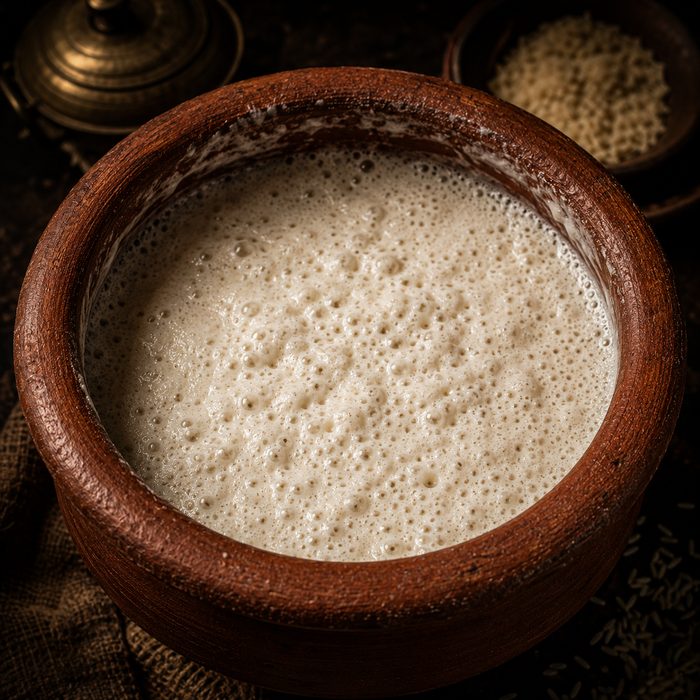
Standard dosa uses the reliable lactic acid bacteria naturally present on rice and urad dal. Wild fermentation goes further — using naturally occurring wild yeast (Saccharomyces cerevisiae relatives) in addition to lactic acid bacteria to produce batters with greater complexity, more pronounced sour character, and specific textures impossible with standard fermentation. Appam's distinctive lacy edge and dome-shaped soft centre depends on wild yeast producing CO2 more aggressively than lactic bacteria alone.
Wild fermentation involves capturing and cultivating the yeast and bacteria naturally present in the local environment — in flour, on grain surfaces, and in the air. This is the same principle as sourdough bread. The complexity of wild-fermented batter increases with starter maintenance over time — a mature wild culture produces more complex flavour than a newly started one.
1
Establish a wild starter
Mix cooked rice and urad dal 3:1, add a small amount of previously fermented batter (or leave open overnight to capture wild yeast). Feed daily with fresh rice-dal mixture.
🔬 Wild yeast strains produce ethanol and CO2 — the ethanol burns off during cooking leaving complex aromatic compounds. Lactic bacteria produce lactic acid — sourness. Together they create multi-layered flavour.
2
Maintain the starter
Replace half the starter daily with fresh ground rice-dal mixture. Within 3-7 days the starter should be reliably active — doubling in 4-6 hours after feeding at room temperature.
🔬 A mature starter with a diverse microbial community produces consistently better results than a fresh starter. The longer it is maintained, the more complex the microbial balance becomes.
3
Use starter to leaven appam
For appam: mix wild starter with fresh rice batter, add coconut milk, ferment 6-8 hours before use.
🔬 The wild yeast produces vigorous CO2 during cooking — creating appam's characteristic lacy edge (thin batter spreads and sets quickly) and domed centre (thicker batter traps steam and rises).
4
Cook appam in a curved pan
Appam is cooked in a round-bottomed wok-like pan (appachatti). The curved shape means batter settles at the centre, producing the thick soft dome, while the edges are paper-thin and crispy.
Dietary Variants
Works for every diet
🥬Vegetarian
Fully vegetarian
🥩Non-Veg
Batter is vegetarian — serve with non-veg stew (Kerala beef or fish curry)
🌱Vegan
Fully vegan — coconut milk in appam is vegan
🟡Jain
Fermented foods avoided by strict Jain practice
🔴Sattvic
Fermented foods controversial in sattvic practice
Recipes Using This Technique
What this unlocks