Level 1 — Foundations
How to Make a Tadka
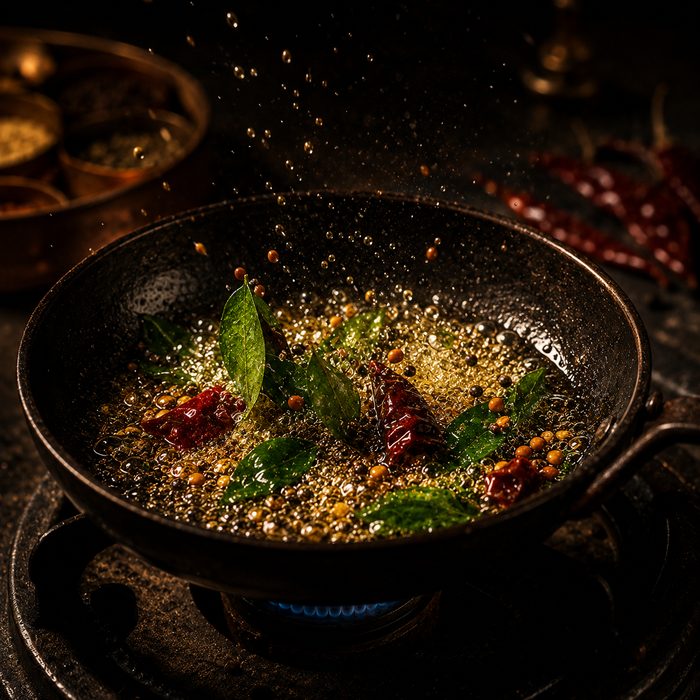
The tadka (also called tarka, chaunk, or phodni depending on region) is the technique of adding whole spices to hot fat and allowing them to sizzle briefly before adding other ingredients or pouring the infused fat over a finished dish. It is the single most important technique in Indian cooking — used at the start of a dish to build flavour into the oil, or at the end to add a fresh burst of aroma.
The science: spice flavour compounds are fat-soluble, not water-soluble. Blooming them in hot fat extracts and dissolves these compounds into the cooking medium, then distributes them throughout the entire dish via that fat. A water-based curry made without tadka will always taste flat — the same spices added directly to water produce a fraction of the flavour.
1
Heat fat in a small pan
Use ghee, oil, or butter. Heat on medium until a mustard seed sizzles immediately when dropped in — approximately 160-170°C.
🔬 Fat acts as the extraction solvent for fat-soluble aromatic compounds in spices. The higher the temperature (within limits), the faster and more complete the extraction.
⚠ Do not let fat smoke — above 200°C most fats begin breaking down and spices burn immediately.
2
Add whole spices first
Mustard seeds, cumin seeds, dried red chillies, curry leaves go in first. Wait for mustard to pop and cumin to turn golden — 20-30 seconds.
🔬 Popping mustard seeds means the water inside has turned to steam and expanded — the starch gelatinises and the cell walls rupture, releasing flavour compounds into the fat.
⚠ If spices turn black they are burnt — the bitter pyrazines that develop at high heat from over-roasting have formed. Start again.
3
Add aromatics
Onion, garlic, ginger — if using. Cook until the rawness disappears.
🔬 Allicin in garlic and quercetin in onion require heat to convert to sweeter, more complex compounds. Raw garlic and onion taste sharp; cooked alliums taste sweet and savoury.
4
Use immediately or pour over
Pour the tadka over dal or finished curry while still sizzling. The sound and aroma of sizzling tadka hitting the dish is the signal it's correct.
🔬 The sizzle means the temperature differential between the hot fat and the cooler curry is still high enough to continue extracting flavour compounds on contact.
Dietary Variants
Works for every diet
🥬Vegetarian
Use ghee or oil — no changes
🥩Non-Veg
Identical technique — fat choice is the cook's preference
🌱Vegan
Use neutral oil or coconut oil instead of ghee — technique identical
🟡Jain
Skip onion and garlic. Use hing (asafoetida) instead — add a pinch to the hot oil just before cumin. Same technique.
🔴Sattvic
Skip onion and garlic. Use hing instead. Sattvic tadka: cumin + hing + curry leaves. Same technique.
Recipes Using This Technique
What this technique unlocks