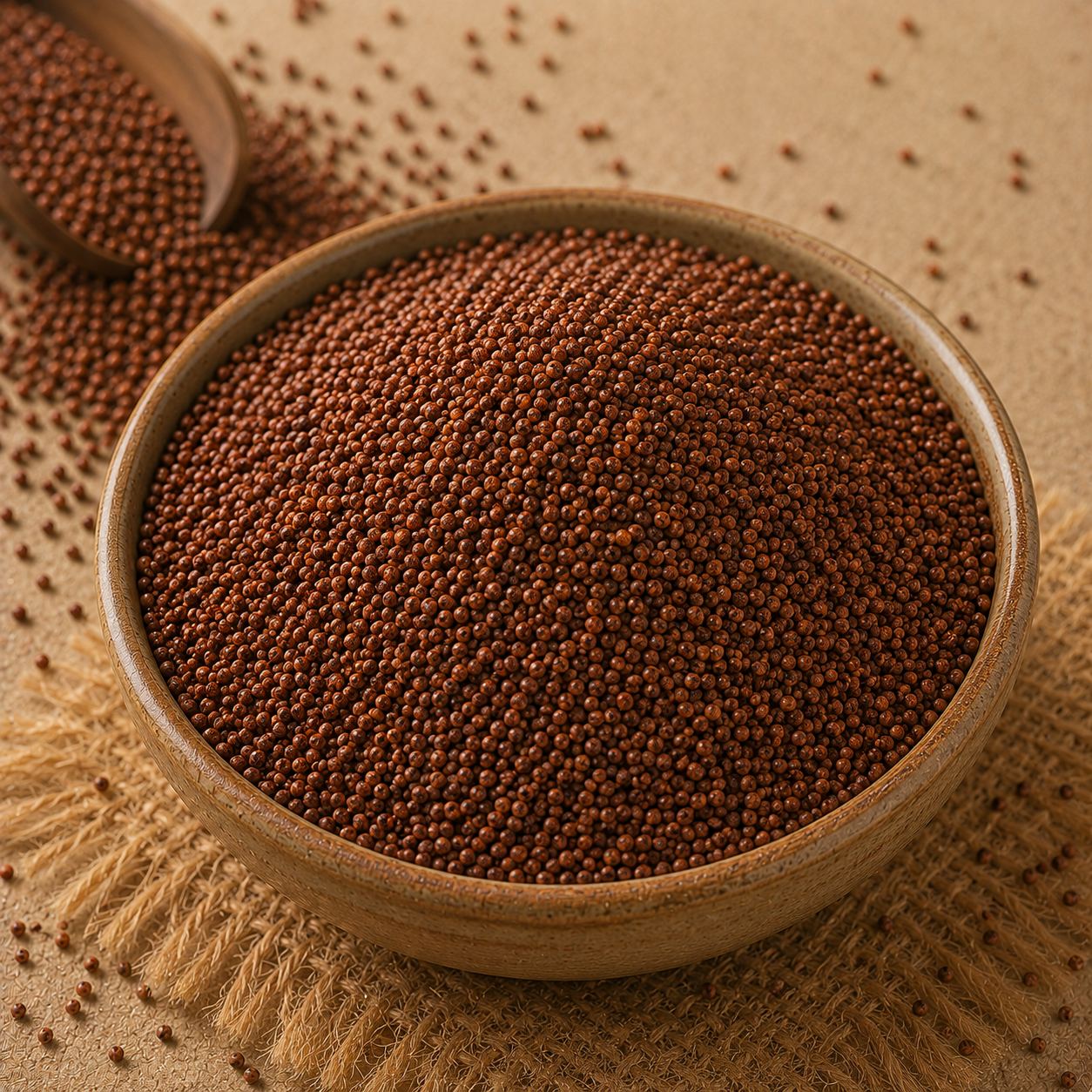
Ingredient identity
Ingredient DNA
Ragi — Finger Millet
Eleusine coracana · Family: Poaceae · Genus: Eleusine
Origin
Africa / South Asia — ancient cultivation
Category
Millet / Ancient Grain
Form
Small round or oval grains
Gluten-free
Yes
Protein
~11g per 100g dry
Fibre
High — higher than rice and wheat
Taste profile
What Does Ragi Taste Like?
Flavour Profile — Ragi
Earthiness★★★☆☆
Nuttiness★★★☆☆
Mildness★★★☆☆
Warmth★★☆☆☆
Complexity★★☆☆☆
Aroma Strength★★☆☆☆
Botanical classification
Kingdom
Plantae
Family
Poaceae
Genus
Eleusine
Species
Eleusine coracana
Hindi Name
Ragi / Nachni
Sanskrit Name
—
English Name
Ragi
Arabic Name
—
Names across India
Ragi in Every Indian Language
| Language | Name | Pronunciation |
|---|---|---|
| English | Finger Millet | |
| Hindi | Ragi / Nachni | |
| Tamil | கேழ்வரகு — Kezhvaragu | |
| Telugu | రాగులు — Ragulu | |
| Malayalam | റാഗി — Ragi | |
| Kannada | ರಾಗಿ — Ragi | |
| Gujarati | Ragi / Nachni | |
| Marathi | Ragi / Nachni | |
| Punjabi | Ragi / Nachni |
Origin and identity
What Is Ragi?
Ragi — finger millet — is nutritionally exceptional among grains: it contains more calcium per 100g than milk. This makes it one of the most important dietary calcium sources for South India's largely vegetarian, dairy-limited populations. The dark, tiny grains produce a brownish flour used for ragi mudde (the signature Karnataka preparation), ragi dosa, and ragi porridge.
What Indian Cooking Loses Without Ragi
- Ragi mudde — Karnataka's labour preparation food — provides more sustained energy than rice due to its high fibre and low glycemic index
- Ragi is the first solid food given to South Indian babies — ragi porridge (kanji) is nutritionally ideal for infants
- Karnataka's agricultural labourers and farm workers have eaten ragi mudde with sambar for generations — the combination provides complete nutrition
- The calcium content makes ragi particularly valuable for lactose-intolerant populations and post-menopausal women
Historical significance
Ragi Through History
Historical Record
Ancient Grain, Modern Comeback
Finger millet has been cultivated in India for at least 5,000 years and in East Africa for even longer. Archaeological evidence from Karnataka places ragi cultivation at 1800 BCE. It was the primary staple of Karnataka's agricultural communities for millennia before rice gained social prestige and displaced it from urban tables.
Cooking science
The Science of Ragi
Cooking Science
Calcium Without Dairy — Ragi's Exceptional Profile
Ragi contains approximately 344mg calcium per 100g dry weight — significantly higher than milk (~120mg/100ml). This calcium is in the form of calcium oxalate, which has somewhat lower bioavailability than dairy calcium, but in the quantities eaten daily as a staple grain, the contribution is significant. Ragi also contains tannins that can reduce iron absorption — soaking or fermenting ragi before cooking reduces tannin content and improves mineral bioavailability.
Storage science
How to Store Ragi
Storage Reference
Whole grain
12–18 months
Flour
3–4 months
Key note
Store in airtight container away from moisture
Buying guide
How to Buy Good Ragi
Technique
How to Use Ragi Correctly
Using Ragi in the Kitchen
Technique, quantity, and what to avoid
- Rinse before cooking
- Cook ratio: 1 cup millet to 2.5 cups water
- Bring to boil, reduce heat, cook 20–25 minutes
- Rest covered 5 minutes before serving
- Use as replacement for rice or in traditional preparations
- Toast dry in pan first for nuttier flavour
Pairings
What Ragi Pairs Well With
Best Pairings — Ragi
Famous dishes
Dishes That Use Ragi
Key Dishes Using Ragi
Ragi Mudde
Karnataka · Finger millet ball
Primary grain
Ragi Dosa
South India · Millet crepe
Primary flour
Ragi Kanji
South India · Porridge
Baby food and daily meal
Ragi Malt
All India · Health drink
Roasted flour beverage
Regional use
Where Ragi Matters Most
Regional Importance
★★★★★
Rajasthan / Gujarat / Maharashtra
Traditional staple
★★★★☆
South India
Growing adoption
★★★★★
Rural India
Centuries-old staple
★★★☆☆
Urban India
Health food trend
★★★★☆
Tribal communities
Foundational food
Where Ragi Fits in Indian Cooking
| Rajasthani Cuisine | Essential |
| Gujarati Cuisine | Common |
| South Indian Cuisine | Common |
| Jain Cooking | Common |
| Sattvic Cooking | Essential |
| Gluten-Free Cooking | Essential |
Comparison
Ragi vs Rice vs Wheat
Ragi vs Rice vs Wheat
| Feature | Ragi | White Rice | Wheat |
|---|---|---|---|
| Glycemic Index | Low (50–70) | High (73) | Medium (68) |
| Fibre | High | Low | Medium |
| Gluten | None | None | Yes |
| Protein | ~11g/100g | ~7g/100g | ~13g/100g |
| Micronutrients | Higher overall | Lower | Moderate |
Nutrition
Nutrition and Key Compounds
Ragi — Honest Nutritional Picture
Culinary quantities — aromatic and flavour contribution, not macro nutrition
Ragi (dry): ~7g protein, 72g carbohydrate, 4g fibre per 100g, 344mg calcium. Low glycemic index (~54). High in iron and B vitamins. The most micronutrient-dense of all millets.
Substitutions
Substitutes for Ragi
What Works and What Does Not
Good substitute
Other millets
Most millets can substitute each other with minor adjustments.
Good substitute
Quinoa (outside India)
Similar protein profile and cooking method.
People Also Search
Related Articles
Chef's notes
Practical Insight
From the Kitchen
Ragi is best introduced gradually — swap rice for millet in 25% of meals first, increasing over weeks. The nutty flavour and slightly different texture take adjustment. Toast the grain dry in a pan for 2–3 minutes before cooking for the most flavourful result.