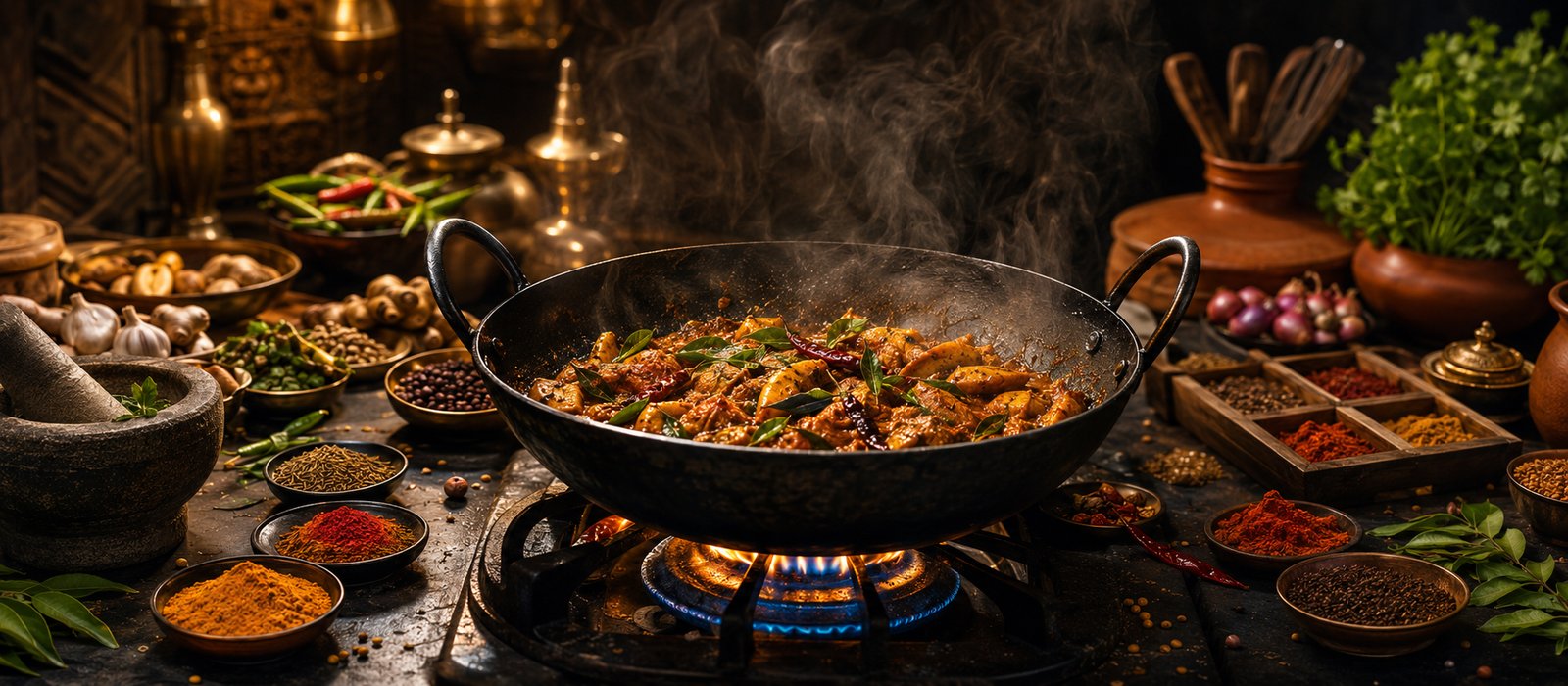
About ten to twelve years ago, I started cooking. Not out of passion — not initially, anyway. I started cooking because I needed somewhere to put my mind after long days at a demanding job — first in Auckland, New Zealand, where the cooking journey began. I needed something that required my complete attention. Something where the outside world simply could not follow me in.
What I discovered — and what I did not expect — is that cooking is one of the very few activities that engages all five senses simultaneously. The smell of whole spices hitting hot oil. The sound of mustard seeds beginning to pop. The colour change of an onion as it moves from raw to golden to caramelised. The resistance of dough under your hands. The first taste that tells you whether the balance is right. When every sense is occupied, a demanding mind has no spare capacity for anything else. It became, genuinely, a form of therapy.
The only problem was that I was terrible at it.
I was not failing because I lacked ability. I was failing because nobody was telling me why any of it worked.
— Rajesh VasaThe gap nobody was filling
Indian cooking has more online content than almost any other cuisine. There are thousands of recipe videos, hundreds of cooking channels, dozens of well-produced websites. The volume of material is not the problem. The problem is what that material actually teaches — or rather, what it does not.
Almost universally, Indian cooking content teaches you what to do. Add one tablespoon of this. Cook for ten minutes. Stir until the oil separates. But it rarely — almost never — tells you why. Why does the onion need twenty minutes and not ten? Why does the cream split if you add it too early? Why does the biryani need to be sealed? What does "the oil separating" actually mean, and why is it a signal to move to the next step?
Without the why, you are not learning to cook. You are learning to follow a script. And the moment anything deviates from the script — a different hob, a different pan, slightly different ingredients — you have no framework to recover. You repeat the same mistakes because you have no idea what caused them.
A ten-minute recipe video does not answer the why. It cannot — there is not enough time, and the format does not invite it. I found myself watching four or five different videos of the same recipe, looking for the clue that one presenter would let slip that explained what the others had skipped over. Slowly, across many videos and many failed attempts, I started to piece together the logic underneath the steps.
That process took years. It should not have to.
This is the gap. Not a shortage of recipes. A shortage of understanding.
The moment it changed
The shift for me came when I stopped trying to follow recipes and started trying to understand them. When I learned that an onion cooked for twenty minutes is not just "more cooked" than one cooked for ten — it has undergone a fundamentally different chemical process that produces entirely different flavour compounds. When I understood that cream splits in a curry because the protein structure of cream is destabilised by heat and acidity in a specific, predictable way — and therefore there is a specific, predictable solution.
Suddenly, cooking stopped being stressful. It became interesting. A dish that went wrong became a problem to understand rather than a failure to abandon. And the meals I produced began to actually taste like what I was aiming for — not by luck, but by design.
That shift — from following to understanding — is what this entire website is built around.
When you understand why each step exists, you stop being dependent on instructions. You start being able to think in the kitchen.
— Rajesh VasaOne more layer — cooking overseas
Living in Perth adds a dimension that anyone cooking Indian food outside India will immediately recognise. The ingredients are not quite the same. The tomatoes are less acidic. The chillies are different varieties with different heat profiles. The yogurt has a different fat content. The basmati available at the local supermarket is not the same as aged basmati from a specialist store. And nobody — in any video, in any recipe — tells you how to adapt.
This is something we intend to address directly. As the site grows, we will be building guidance on ingredient substitutions, overseas equivalents, and adaptations for cooking authentic Indian food with what is actually available where you live — whether that is Perth, London, Toronto or anywhere else.
What has been built so far
This site launched quietly and has been built steadily since. As of today, it contains:
What is coming
The commitment
This blog — The Kitchen Table — will publish at least twice a month. The posts will not be filler content. Every piece will earn its place — whether that is a deep dive into a technique, an honest account of a dish that went wrong, a look at a regional cuisine that deserves more attention, or an exploration of why Indian cooking overseas is its own distinct challenge.
The long-term aspiration behind all of this is personal. The author intends to open a restaurant one day. This site is partly the groundwork for that — understanding the science deeply enough, and communicating it clearly enough, that the food that comes out of that kitchen will be something people understand and remember. That goal is years away. But every page on this site moves toward it.
If any of this resonates — if you have stood in a kitchen frustrated by a curry that will not come together and wished someone would just explain it — this site was built for you. Work through it at your own pace. Read the same page twice if you need to. There is no video to rewind.
Two thoughtful articles every month.
No recipes copied from elsewhere.
The science, the history, the technique — and the honest story of what happens when you cook Indian food far from India. Free. Unsubscribe any time.
No spam. Published at least twice a month.
Rajesh Vasa — Perth, Australia
Started cooking in Auckland, New Zealand as a way to decompress after demanding work days — and discovered that when every sense is occupied, the mind finally goes quiet. Now living in Perth, Australia. Jain by background, which means this site will one day have a section built with more personal authority than almost any other. The restaurant is still a dream. The website is very much real.