Level 2 — Technique
Bhuno Masala — The Foundation of All Curries
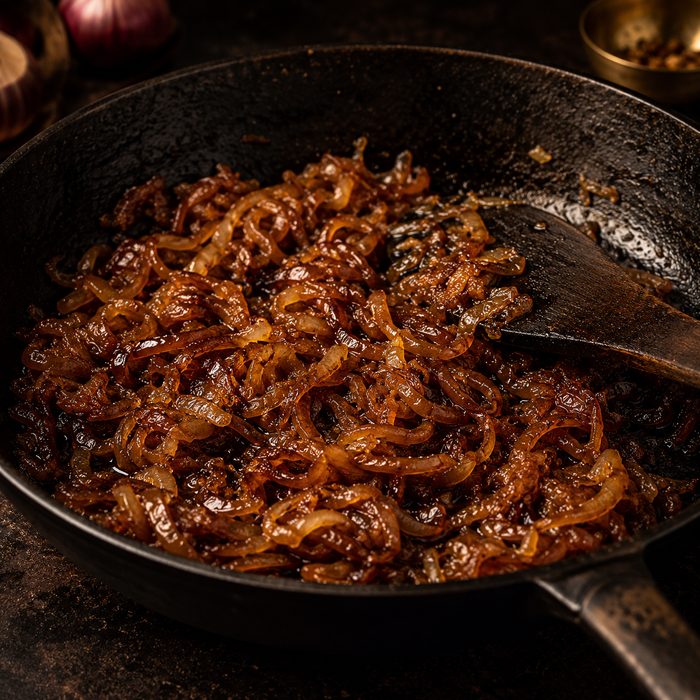
Bhuno means to roast thoroughly — cooking a masala over medium-high heat until water fully evaporates and solids begin browning in oil. This is what separates restaurant-quality curry from home cooking. The oil separation is not optional — it signals the Maillard reaction has occurred and complex flavour compounds have formed.
Without bhuno, a curry made with the same ingredients tastes flat and slightly raw. With proper bhuno, the same curry has depth and richness. The difference is chemistry: the Maillard reaction between amino acids and reducing sugars in onion and tomato, occurring above 150°C once water has evaporated, produces hundreds of new flavour compounds.
1
Cook onion to deep golden
On medium heat, cook chopped onion in generous oil 15-20 minutes, stirring every 2-3 minutes, until deep golden.
🔬 The Maillard reaction in onion begins at 150°C and requires water absence. Medium heat ensures even cooking throughout.
⚠ Do not rush with high heat — fast high heat browns outside while inside remains raw.
2
Add ginger-garlic and cook out rawness
Add ginger-garlic paste, cook 3-4 minutes until raw smell completely gone.
🔬 Allicin transforms to 30+ aromatic compounds with heat.
3
Add tomato, cook until oil separates
Add tomato. Cook on medium-high, stirring frequently, until oil appears at sides — 12-15 minutes.
🔬 Oil separation means water fully evaporated from tomato — Maillard reaction can now occur.
⚠ If masala burns before oil separates: heat too high or too little oil. Add a splash of water, reduce heat, continue.
4
Add spices, fry in dry masala 1-2 minutes
Add ground spices — coriander, cumin, turmeric, chilli. Fry in dry masala 1-2 minutes.
🔬 Spices frying in dry hot masala undergo their own Maillard browning.
5
Add main ingredient, coat thoroughly
Add meat or vegetables, stir to coat in masala, fry 3-5 minutes before adding liquid.
🔬 Coating the main ingredient in bhunoed masala before adding liquid maximises flavour absorption.
Dietary Variants
Works for every diet
🥬Vegetarian
Identical — use paneer, vegetables, chickpeas
🥩Non-Veg
Classic technique for all meat curries
🌱Vegan
Use oil not ghee. Skip cream — use coconut cream.
🟡Jain
Skip onion and garlic. Use extra tomato and ginger. Bhuno still applies.
🔴Sattvic
Skip onion and garlic — use hing and extra ginger and tomato.
Recipes Using This Technique
What this unlocks